Xcapit Labs
AiSec: Automated Security Analysis of OpenClaw — The World's Most Popular AI Agent Framework
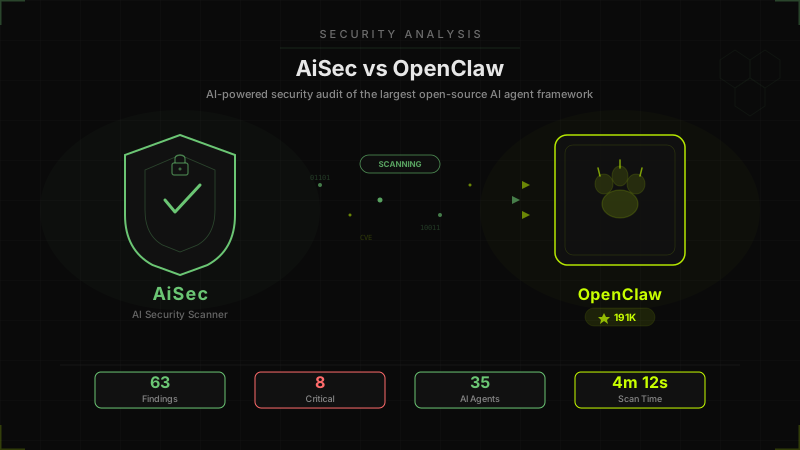
How Xcapit's AiSec framework deployed 35 specialized AI agents to analyze OpenClaw (191K GitHub stars) in 4 minutes and 12 seconds, uncovering 63 security findings including 8 critical vulnerabilities — mapped across 8 industry security frameworks.
Security findings
AI agents
Analysis time
Security frameworks
The Challenge
The adoption of AI agents in production environments has grown exponentially. Companies are deploying autonomous systems that can execute code, access databases, browse the internet, manage files, and interact with APIs — all with minimal human oversight. Yet the security practices surrounding these deployments remain alarmingly immature.
OpenClaw, with 191,000 GitHub stars, is the most widely used open-source AI agent framework in the world. It powers production deployments across finance, healthcare, government, and enterprise software. Despite its ubiquity, it had never been subjected to a comprehensive, publicly documented security analysis. The few security reviews that existed were manual, incomplete, and not mapped to standardized frameworks — making it impossible for organizations to assess their risk posture against established compliance benchmarks.
The fundamental challenge was twofold: first, AI agent frameworks introduce entirely new attack surfaces — prompt injection, sandbox escapes, excessive agency, insecure tool execution — that traditional application security tools are not designed to detect. Second, the scale and complexity of modern AI agent codebases make manual review impractical. A framework like OpenClaw contains hundreds of thousands of lines of code spanning agent orchestration, tool execution, memory management, and provider integrations.
Why OpenClaw?
The decision to analyze OpenClaw was deliberate. In security research, the highest-impact targets are those with the broadest deployment. A vulnerability found in a niche tool affects dozens of users; a vulnerability found in the most popular AI agent framework affects thousands of organizations and millions of end users.
- 191,000 GitHub stars — making it the most popular AI agent framework by a significant margin
- Used in production by thousands of companies across regulated and unregulated industries
- Serves as the foundation for numerous commercial products and internal tools
- Has an active community of contributors, but security-focused contributions represent a small fraction of total development
- No prior comprehensive public security audit existed, despite the framework's critical role in production infrastructure
By choosing OpenClaw as the first target for AiSec's public analysis, Xcapit aimed to demonstrate both the framework's capabilities and the urgent need for systematic AI agent security — starting with the project that affects the most people.
AiSec Framework: The Solution
AiSec is an open-source security analysis framework built specifically for evaluating AI agent systems. Unlike traditional static analysis tools that scan for known vulnerability patterns, AiSec deploys 35 specialized AI agents — each trained to detect a specific class of AI security risk — that work collaboratively to produce a comprehensive security assessment.
The framework is designed around three principles: automation (a complete analysis runs without human intervention), reproducibility (anyone can install AiSec and produce identical results), and standardization (all findings are mapped to established security frameworks, not proprietary taxonomies).
- 35 specialized AI agents, each focused on a specific security domain such as prompt injection, sandbox integrity, data leakage, or permission management
- 250+ detection rules covering vulnerabilities specific to AI agent architectures
- 8 security framework mappings: OWASP Top 10 for LLM Applications, NIST AI RMF, MITRE ATLAS, ISO 42001, OWASP ASVS, CWE, NIST CSF, and ISO 27001
- pip-installable and open source — designed for integration into CI/CD pipelines and security workflows
- Structured output in JSON, Markdown, and HTML formats for integration with existing security dashboards
Analysis Methodology
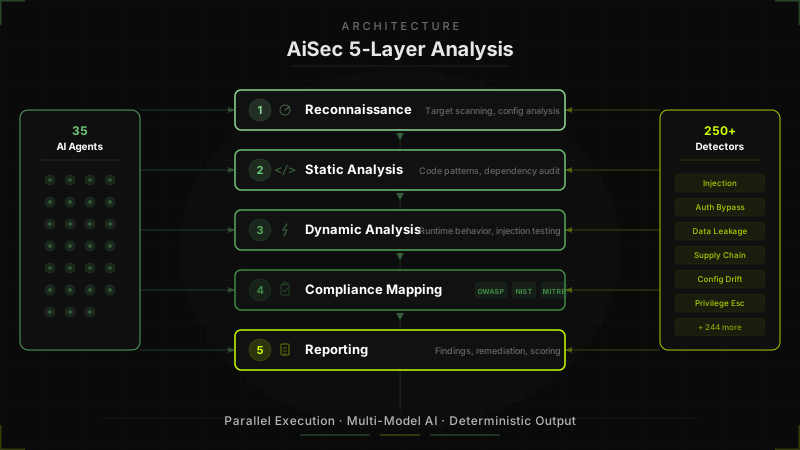
AiSec's analysis of OpenClaw followed a five-layer architecture that mirrors how security professionals approach a manual audit — but executes in minutes rather than weeks.
- Layer 1 — Codebase Mapping: automated discovery of all agent definitions, tool registrations, provider integrations, configuration files, and entry points. This creates a structural graph of the entire framework
- Layer 2 — Static Analysis: rule-based and AI-assisted scanning for known vulnerability patterns including hardcoded credentials, insecure deserialization, unvalidated inputs, and missing access controls
- Layer 3 — Semantic Analysis: AI agents analyze code semantics to detect higher-order risks that pattern matching cannot find — such as implicit trust assumptions, excessive agency granted to sub-agents, and data flows that cross security boundaries without sanitization
- Layer 4 — Cross-Reference Validation: findings from layers 2 and 3 are cross-referenced to eliminate false positives and identify compound vulnerabilities where multiple individually low-risk patterns combine into high-risk attack chains
- Layer 5 — Framework Mapping and Prioritization: validated findings are classified by severity (critical, high, medium, low), mapped to relevant security framework controls, and prioritized based on exploitability, blast radius, and remediation complexity
The entire five-layer pipeline executed against the OpenClaw codebase in 4 minutes and 12 seconds — processing the complete repository including all agent definitions, tools, configuration files, and integration code.
Results Overview
The analysis produced 63 security findings distributed across four severity levels:
- 8 Critical findings — issues that could allow complete compromise of the agent system, unauthorized data access, or arbitrary code execution on the host
- 15 High findings — vulnerabilities that could be exploited to escalate privileges, bypass security controls, or leak sensitive data under specific but realistic conditions
- 22 Medium findings — weaknesses that reduce the overall security posture and could be exploited as part of a multi-step attack chain
- 18 Low findings — informational issues and best-practice deviations that should be addressed as part of ongoing security hygiene
The severity distribution reveals a concerning pattern: the critical and high findings are concentrated in the areas most fundamental to AI agent security — execution sandboxing, prompt handling, and permission management. These are not edge cases; they affect the core execution paths that every OpenClaw deployment exercises.
Critical Findings
The 8 critical findings identified by AiSec represent the most severe security risks in the OpenClaw codebase. While full technical details were provided to the OpenClaw maintainers through responsible disclosure, the categories of findings can be summarized:
- Prompt Injection Vectors: multiple paths through which adversarial input could override system-level instructions, causing agents to execute unintended actions or reveal confidential context. The framework lacked systematic input sanitization at key agent-to-agent communication boundaries
- Sandbox Escape Pathways: the tool execution environment contained configuration defaults that allowed tools to access host filesystem resources, environment variables, and network endpoints beyond their intended scope. Under specific conditions, a malicious tool could break out of the execution sandbox entirely
- Data Leakage Channels: sensitive data — including API keys, user prompts, and model responses — could be exposed through logging mechanisms, error messages, and inter-agent communication channels that were not designed with confidentiality in mind
- Permission Escalation: the agent permission model did not enforce the principle of least privilege. Sub-agents could inherit permissions from parent agents without explicit authorization, allowing a compromised sub-agent to access resources intended only for higher-privilege contexts
Each critical finding was documented with proof-of-concept attack scenarios, affected code paths, and specific remediation recommendations.
Cross-Framework Mapping
One of AiSec's most valuable features is its ability to map findings to multiple security frameworks simultaneously. This allows organizations to assess how OpenClaw vulnerabilities affect their specific compliance posture, regardless of which framework they follow.
- OWASP Top 10 for LLM Applications: findings mapped to LLM01 (Prompt Injection), LLM02 (Insecure Output Handling), LLM04 (Model Denial of Service), LLM06 (Excessive Agency), and LLM08 (Excessive Autonomy)
- NIST AI RMF: findings aligned with GOVERN, MAP, MEASURE, and MANAGE functions — particularly in areas of AI system transparency and risk monitoring
- MITRE ATLAS: attack techniques mapped to reconnaissance, initial access, execution, and exfiltration tactics specific to machine learning systems
- ISO 42001: findings connected to AI management system controls for risk assessment, security controls, and continual improvement processes
- OWASP ASVS: traditional application security requirements that remain relevant when AI agents interact with web services and APIs
- CWE: common weakness enumeration entries for underlying software vulnerabilities that enable AI-specific attacks
- NIST CSF: cybersecurity framework functions (Identify, Protect, Detect, Respond, Recover) mapped to AI agent operational contexts
- ISO 27001: information security management system controls applicable to AI agent data handling and access management
This multi-framework mapping means that a CISO evaluating OpenClaw for deployment in a regulated environment can immediately see which compliance controls are affected by each finding — without needing to perform the mapping manually.
Remediation Priorities
AiSec does not just identify problems — it generates prioritized remediation recommendations based on three factors: exploitability (how easy it is to trigger the vulnerability), blast radius (how much damage a successful exploit could cause), and fix complexity (how much engineering effort is required to resolve the issue).
- Priority 1 — Immediate: implement systematic input sanitization at all agent-to-agent and user-to-agent communication boundaries to mitigate prompt injection. Estimated effort: 2 to 3 weeks
- Priority 2 — Urgent: harden the tool execution sandbox by enforcing strict filesystem, network, and memory isolation by default. Estimated effort: 3 to 4 weeks
- Priority 3 — High: redesign the agent permission model to enforce least privilege with explicit capability grants rather than inherited permissions. Estimated effort: 4 to 6 weeks
- Priority 4 — Important: audit and restrict all logging and error handling paths to prevent sensitive data exposure. Estimated effort: 1 to 2 weeks
- Priority 5 — Recommended: implement structured security boundaries between agent memory stores to prevent cross-context data leakage. Estimated effort: 2 to 3 weeks
Total estimated remediation effort for all 63 findings: approximately 16 to 22 weeks of focused engineering work, with the most critical items addressable within the first 6 weeks.
Impact & Disclosure
Xcapit followed a responsible disclosure process for all critical and high-severity findings. The OpenClaw maintainers were notified with full technical details, proof-of-concept demonstrations, and remediation guidance before any public disclosure. The response from the OpenClaw community was constructive — acknowledging the findings and initiating discussions around several of the recommended architectural changes.
The public release of the analysis serves multiple purposes: it provides the thousands of organizations using OpenClaw with actionable information about their risk exposure, it demonstrates that automated AI security analysis is now achievable at a fraction of the cost and time of manual audits, and it establishes a benchmark for the level of security scrutiny that AI agent frameworks should receive before production deployment.
What This Means for AI Agent Developers
The findings from the OpenClaw analysis are not unique to one framework. They represent systemic patterns that exist across the AI agent ecosystem:
- Prompt injection remains the most pervasive and least mitigated threat in AI agent architectures — most frameworks treat prompts as trusted input by default
- Tool execution sandboxing is rarely implemented with the rigor required for production environments — default configurations tend to be permissive rather than restrictive
- Permission models in AI agent frameworks are typically flat or overly broad, granting agents more access than they need to perform their intended functions
- Security logging and monitoring are afterthoughts in most AI agent frameworks, making incident detection and forensic analysis extremely difficult
- Cross-framework compliance mapping does not exist in most AI security tools, forcing organizations to perform manual assessments that are expensive and inconsistent
Any team deploying AI agents in production should consider whether their framework of choice has been subjected to this level of scrutiny — and if not, they should perform the analysis themselves.
Getting Started with AiSec
AiSec is open source and designed to be integrated into existing security workflows with minimal setup. Installation requires a single command:
- Install: pip install aisec
- Scan a repository: aisec scan /path/to/ai-agent-project
- Generate a report: aisec report --format html --frameworks owasp,nist,mitre
- Integrate into CI/CD: aisec scan --ci --fail-on critical,high
- Custom rules: aisec scan --rules /path/to/custom-rules.yaml
The framework supports Python, TypeScript, and Rust codebases, and can analyze any AI agent architecture regardless of the underlying LLM provider. Analysis time depends on codebase size, but most projects complete in under 10 minutes.
Want to know how secure your AI agent infrastructure really is? Whether you need a comprehensive security audit of your AI systems, want to integrate AiSec into your development pipeline, or need help remediating findings in your existing deployments — Xcapit has the tools and the expertise. Let's talk.
Let's build something great
AI, blockchain & custom software — tailored for your business.
Get in touchReady to leverage AI & Machine Learning?
From predictive models to MLOps — we make AI work for you.
More Case Studies
Xcapit Labs
Agentor: Building a Secure AI Agents Framework in Rust
How a security audit of an open-source AI agents framework exposed fundamental limitations in Python-based runtimes — and led Xcapit to build Agentor, a Rust-native framework optimized for code generation.
UNICEF Innovation Fund
UNICEF Digital Wallet: Financial Inclusion for 4M+ People
How Xcapit built a blockchain-based digital wallet that reached 4M+ people across 167+ countries as part of the UNICEF Innovation Fund — recognized as a Digital Public Good by the DPGA.