

Two years ago, most of my conversations with enterprise clients about AI started with use cases — what problem can AI solve, how do we integrate it, what's the build timeline. Today, those conversations increasingly begin with a different question: what are we legally allowed to do, and what will it cost us if we get it wrong? That shift represents one of the most consequential changes in the business technology landscape since GDPR. AI regulation has arrived, and it is substantially more complex than most organizations are prepared for.
As a lawyer and CEO who has spent the last decade at the intersection of technology and international business, I have tracked regulatory developments across jurisdictions closely. The picture that emerges is not a single global standard — it is a fragmented, fast-moving set of frameworks that differ significantly in scope, risk classification, enforcement approach, and timeline. That complexity is both the challenge and the opportunity. Companies that develop serious compliance programs now will have a durable competitive advantage over those scrambling when deadlines hit.
The EU AI Act: The World's First Comprehensive AI Law
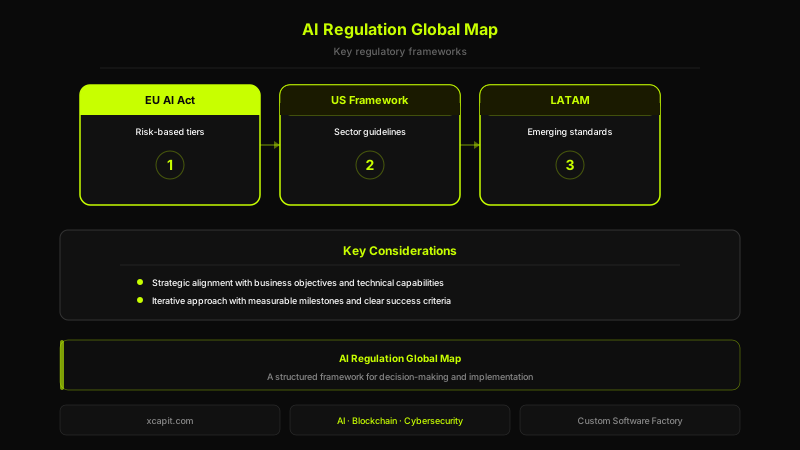
The European Union's AI Act, which entered into force in August 2024, is the most significant piece of AI legislation enacted anywhere in the world. It is a risk-based framework — different categories of AI systems face different obligations, and the severity of those obligations scales with the potential for harm. Understanding the risk tiers is essential for any company that develops, deploys, or uses AI systems with European exposure.
Prohibited AI practices — including social scoring systems, real-time biometric surveillance in public spaces, and AI systems that exploit psychological vulnerabilities — have been banned since February 2025. High-risk systems face the heaviest regulatory burden. This category includes AI used in critical infrastructure, educational assessment, employment decisions, credit scoring, law enforcement, border control, and administration of justice. If your AI system makes or significantly influences decisions in any of these areas affecting EU residents, you face substantial compliance obligations.
High-Risk System Requirements
- Risk management system: documented identification, analysis, and mitigation of risks throughout the system lifecycle
- Data governance: training, validation, and testing datasets must meet quality standards; relevant bias must be examined and addressed
- Technical documentation: comprehensive records of the system's purpose, design decisions, performance characteristics, and limitations
- Record-keeping: automatic logging of events throughout the system's operation to enable post-hoc review
- Transparency and human oversight: users must be informed they are interacting with AI; meaningful human review mechanisms must be in place for consequential decisions
- Accuracy and robustness: systems must achieve appropriate levels of accuracy and withstand known adversarial attacks
- Conformity assessment: before market placement, high-risk systems must pass a conformity assessment, either self-assessed or by a notified body
The compliance timeline for high-risk systems is August 2026 — and that deadline will arrive faster than organizations expect. Penalties for non-compliance reach up to 35 million euros or 7% of global annual turnover for prohibited practices, and up to 15 million euros or 3% of global turnover for high-risk system violations. The EU has made clear these are not aspirational figures.
General-purpose AI models — including large language models and foundation models — face their own tier of requirements under the Act, focusing on transparency, copyright compliance, and (for models deemed to pose systemic risk) additional safety evaluations. If you are building products on top of these models, which practically every enterprise AI initiative now is, you need to understand how GPAI model obligations interact with your own compliance responsibilities.
The United States: A Fragmented Landscape
The US approach to AI regulation is fundamentally different from Europe's, and that difference has important practical implications. Rather than a comprehensive federal law, the US landscape consists of executive orders, sector-specific agency guidance, and an increasingly active patchwork of state legislation. This creates a more flexible environment for AI development but a more complex compliance challenge.
The 2023 Executive Order on Safe, Secure, and Trustworthy AI directed federal agencies to develop sector-specific guidance across healthcare, financial services, transportation, and critical infrastructure. The subsequent executive orders in 2025 shifted emphasis toward AI competitiveness and reduced some of the previous administration's safety-focused requirements — but sector regulators at the FTC, SEC, EEOC, and FDA have continued developing their own AI governance frameworks independently of executive branch direction. This means that even if federal executive policy becomes more permissive, regulated industries face binding obligations from their sector regulators.
At the state level, Colorado, Illinois, Texas, and California have enacted or are advancing significant AI legislation, particularly focused on high-stakes decision-making in employment and consumer contexts. The EU AI Act's extraterritorial reach — applying to any system that affects EU residents regardless of where the developer is located — means US companies should not assume that avoiding the EU exempts them from substantive AI compliance obligations.
China: Strategic Sector-by-Sector Control
China has adopted a sector-by-sector regulatory approach, issuing specific regulations for algorithmic recommendations (2022), deep synthesis (2022), and generative AI (2023). The common thread across these regulations is a focus on content control and platform accountability rather than the risk-based harm prevention framework that animates EU regulation. Companies operating in China or serving Chinese users must navigate requirements around content filtering, mandatory disclosures, and security assessments that have no direct parallel in Western frameworks.
China is also advancing its own AI standards body, positioning itself to export its regulatory model to countries with Belt and Road trade relationships. For companies operating across the Asia-Pacific region, China's regulatory approach has influence well beyond its borders.
Latin America: Emerging Frameworks and Strategic Opportunity
Latin America is at an inflection point in AI governance. Brazil's AI regulatory framework — building on its strong LGPD data protection foundation — is the region's most advanced, with a draft AI Act that closely mirrors the EU's risk-based structure. Colombia has adopted a soft-law approach with an AI ethics framework, while Chile and Peru have produced white papers and consultations that are likely precursors to formal legislation. Argentina, while currently focused on economic stabilization, has a strong technical foundation and active regulatory debate.
The strategic implication for companies operating in the region: the window to shape regulatory frameworks through constructive engagement is open now but closing. Companies that participate in consultations, demonstrate responsible AI practices, and build relationships with regulators before legislation finalizes have far more influence over the outcome than those who engage only after laws are enacted. Our experience working with government entities across the region — including UNICEF Innovation Fund projects — has shown that regulators genuinely want to hear from responsible practitioners.
Risk Classification: What Category Is Your AI System In?
The most immediate practical task for any organization building or deploying AI is conducting an AI inventory and risk classification exercise. Most companies, even those with relatively modest AI deployments, are surprised by how many AI systems they are actually operating when they conduct a thorough audit — recommendation engines, automated decisioning in workflows, AI-assisted hiring tools, fraud detection systems, and more.
Using the EU AI Act's framework as a baseline (because it is the most comprehensive and because its extraterritorial reach makes it relevant to most global organizations), classify each system by: the nature of the decisions it supports or makes, the affected population and their vulnerability, the degree of human oversight in the process, and the reversibility of the system's outputs. This classification drives every subsequent compliance decision.
ISO 42001: The Universal Governance Framework
ISO 42001, published in 2023, is the international standard for AI management systems. It provides a framework for governing AI development and deployment across the full lifecycle — from design and training through deployment and monitoring. What makes ISO 42001 particularly valuable in a fragmented regulatory landscape is that it is jurisdiction-neutral and maps well to the requirements of both the EU AI Act and emerging frameworks in other regions.
Think of ISO 42001 as playing the same role for AI governance that ISO 27001 plays for information security — a structured management system that demonstrates governance commitment, creates documented processes, and provides a foundation for regulatory compliance regardless of which specific law applies. Companies that have already gone through ISO 27001 certification (as we have at Xcapit) will find that many of the management system disciplines — risk registers, internal audits, control documentation, incident management — transfer directly. The AI-specific elements build on that foundation rather than replacing it.
Practical Compliance Steps: Where to Start
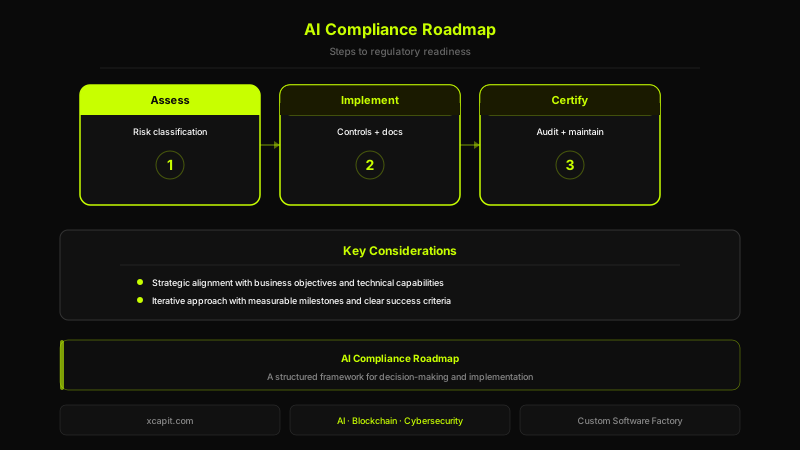
For most organizations, AI compliance feels overwhelming when viewed as a whole. The practical approach is to sequence it. The following is the framework we recommend to clients beginning their AI governance journey.
- Complete an AI inventory: identify every AI system in use across the organization, including systems purchased from vendors that contain AI components. Most organizations discover they have two to three times more AI systems than they initially estimated.
- Classify each system by risk tier: use the EU AI Act framework as a baseline. High-risk systems demand immediate attention; limited-risk systems require transparency measures; minimal-risk systems can proceed with basic monitoring.
- Assess gap against applicable frameworks: for each high-risk or limited-risk system, document the current state against the relevant compliance requirements. Gaps become your remediation roadmap.
- Establish an AI governance committee: AI compliance is not an IT project — it requires legal, product, operations, and executive involvement. Governance responsibility needs to be clearly assigned.
- Implement documentation and record-keeping: the single most common compliance gap is inadequate documentation. Start building the technical documentation, risk registers, and decision logs that regulations require.
- Engage with your AI vendors: many compliance obligations flow through to the vendors and platforms your AI systems are built on. Understand what your vendors can certify and where the responsibility is yours.
- Build toward ISO 42001 certification: this provides a structured path, external validation, and a certification that carries weight with enterprise clients and regulators alike.
The Impact on Enterprise AI Adoption
One of the most common concerns I hear from enterprise technology leaders is that regulation will slow AI adoption. The evidence so far suggests the opposite — at least for well-governed organizations. Enterprises with mature AI governance programs are deploying AI faster and in higher-stakes use cases precisely because they have the frameworks in place to manage risk responsibly. Regulation creates barriers for the unprepared, but for organizations that invest in governance, it becomes a competitive moat.
The financial services sector is the clearest example. Banks and insurance companies that invested early in AI governance — driven partly by existing regulatory scrutiny — are now deploying AI in credit decisions, fraud detection, and customer service with far more confidence than less-regulated industries that are only now grappling with governance questions. The discipline required by regulation turns out to be the same discipline that makes AI systems reliable and trustworthy.
For companies in Latin America specifically, there is a window to build governance capabilities now, before regulatory requirements become binding. The talent and infrastructure for responsible AI development exist in the region — we see it every day across our teams in Córdoba and Lima — and companies that build those capabilities during this preparatory period will be positioned to lead rather than scramble when regulation arrives in full force.
Navigating AI regulation requires both legal expertise and deep technical understanding of how AI systems actually work — which is why the compliance conversation and the development conversation need to happen together. At Xcapit, we build AI systems with governance built in from the design phase, not bolted on after the fact. If you are planning an AI initiative and want to ensure it is built for the regulatory environment ahead, our team can help you design and execute with compliance as a foundation. Explore our approach at /services/ai-development.

José Trajtenberg
CEO & Co-Founder
Lawyer and international business entrepreneur with over 15 years of experience. Distinguished speaker and strategic leader driving technology companies to global impact.
Ready to leverage AI & Machine Learning?
From predictive models to MLOps — we make AI work for you.
You Might Also Like
Shadow AI, ISO 42001, and the New Boardroom Risk in Oil & Gas
Why directors of oil & gas operators are starting to treat unmanaged AI use as a duty-of-care issue — and what to do in the next 90 days.
Why Vulnerability Scanners Don't Replace a Pentest — and How AI Changes the Equation
Scanners like Nuclei and ZAP detect known CVEs but miss the vulnerabilities that actually get companies breached: IDOR, privilege escalation, race conditions, and business logic flaws. This article explains why, shows benchmark data (47 findings vs 0), and introduces a third option: AI-driven pentesting that reasons like a human attacker at scanner speed and cost.
ISO 42001: The New Question Regulators and Auditors Will Ask Your Utility
Why the first internationally certifiable AI governance standard matters more than it seems for the Latin American energy sector.