

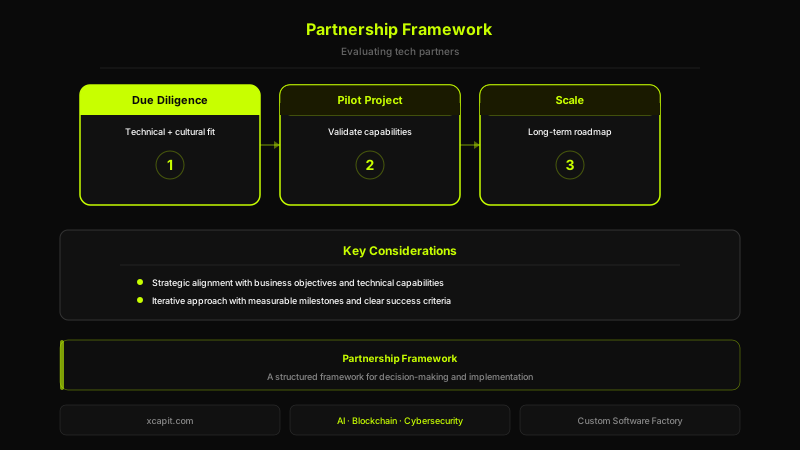
In fifteen years of building technology companies and advising enterprises on their technology strategy, I have witnessed the full spectrum of technology partnerships — from transformative multi-year relationships that became genuine competitive advantages to expensive disappointments that took years to unwind. The single most consistent pattern I have observed is that the partnerships that fail almost never fail because of technical shortcomings. They fail because of misaligned expectations, inadequate communication structures, underestimated cultural differences, and contracts that optimized for the wrong things.
This guide represents what I have learned from both sides of that equation — the hard-won lessons from building Xcapit from a startup in Córdoba to a company with presence in Miami and Lima, serving enterprise clients across regulated industries in multiple continents, as well as from the mistakes I have watched clients make when selecting and managing their technology partners. The goal is to give you a framework for building partnerships that compound in value over time rather than deteriorating into contractual obligations that both parties resent.
Why 85% of Technology Partnerships Fail
The 85% failure figure — drawn from research across enterprise technology engagements — is frequently cited but rarely unpacked. What does it mean for a technology partnership to 'fail'? It typically means that the partnership failed to deliver the business outcomes that justified the initial investment, not that the software did not work or that the services were not delivered. This distinction matters enormously because it points to where the intervention should happen.
When we analyze failed partnerships, five causes account for the vast majority of outcomes. First, misaligned scope expectations: the client believes they are buying a comprehensive solution; the vendor believes they are delivering a defined scope. The gap between those two mental models only becomes visible when something falls outside the scope definition, at which point the relationship becomes adversarial. Second, communication failures: irregular touchpoints, escalation paths that are unclear until a crisis, and the gradual accumulation of unaddressed concerns that surface explosively after months of polite suppression.
Third, cultural mismatches that were never acknowledged: the client expects proactive problem-reporting; the partner expects to be praised for solving problems quietly. The client expects documentation and process discipline; the partner operates with informal communication and tribal knowledge. Neither is wrong in the abstract, but the mismatch creates friction that compounds over time. Fourth, SLA designs that create perverse incentives: measuring inputs rather than outcomes, penalizing the wrong behaviors, and failing to reward the kind of proactive value creation that distinguishes a great partner from a compliant vendor. Fifth, IP and data ownership ambiguity that was manageable during the honeymoon period but becomes intractable when the relationship ends or a dispute arises.
Partnership vs. Vendor Relationship: A Meaningful Distinction
The language of 'partnership' is heavily overused in enterprise technology sales. Every vendor claims to be a strategic partner. Very few are. The distinction is not rhetorical — it has practical implications for how the relationship should be structured and managed.
A vendor relationship is fundamentally transactional: a defined scope is delivered for a defined price, and the relationship is governed entirely by the contract. The vendor's incentive is to deliver exactly what is specified at the lowest possible cost; the client's incentive is to extract maximum scope from the agreed price. Both parties are optimizing locally, and the overall outcome is compliance with the contract rather than achievement of the business objective.
A strategic partnership is different in kind, not just in degree. Both parties have invested in mutual understanding of each other's business context, constraints, and goals. The partner proactively identifies problems and opportunities outside the defined scope because they understand the client's objective well enough to recognize when it is at risk. The client shares information about their business strategy, competitive pressures, and future needs because they trust the partner to use that context constructively. Communication is candid because both parties have enough relationship capital to absorb uncomfortable conversations.
The difference is built through deliberate choices on both sides, starting from the evaluation process and reinforced through every interaction thereafter.
Evaluation Criteria Beyond Cost
Cost is the most legible dimension of technology partner evaluation, which is why it receives disproportionate weight in most selection processes. RFP processes often effectively select for the lowest-cost provider willing to accept the required terms — and then wonder why the winning partner fails to behave like a strategic ally. The organizations that build the best technology partnerships evaluate on a fundamentally different set of criteria.
- Domain depth vs. generalist capability: does the partner have genuine depth in the specific technical domain your initiative requires, or are they general practitioners proposing to learn your domain during the engagement? Deep domain expertise is worth a significant price premium — the cost of learning on your project is often far higher than the difference in rates.
- Reference quality over reference volume: any technology partner can provide three references from satisfied clients. The question is whether those references describe experiences similar to what you are planning, at comparable complexity and scale, and whether the referees will speak candidly about failures and recoveries as well as successes.
- Team stability and continuity: what is the partner's average tenure for senior engineers and project leads? High turnover means the institutional knowledge of your project walks out the door repeatedly, imposing ramp-up costs on you. Ask about the specific people proposed for your engagement and how they are likely to be allocated over the engagement's duration.
- Governance and process maturity: how does the partner manage quality, handle incidents, escalate risks, and document decisions? Certifications like ISO 27001 are useful signals because they demonstrate a commitment to documented process rather than heroic individuals. Ask to see actual examples of project governance artifacts, not just descriptions of their process.
- Cultural alignment indicators: how does the partner communicate when things go wrong? Do they surface problems early and with potential solutions, or do they minimize and defer? This is best assessed through behavioral questions in reference calls and by observing how they handle even minor difficulties during the sales and contracting process — the contracting process is a preview of the engagement.
- Financial stability: a partner that is financially fragile creates risks you cannot mitigate contractually. A partner that goes out of business or loses key staff due to financial pressure mid-engagement can be catastrophic. Assess financial stability as seriously as technical capability.
Communication Cadence: Designing the Relationship's Operating System
The most preventable cause of partnership failure is communication breakdown — and communication breakdown almost always happens because the communication structure was never intentionally designed. Assuming that informal communication will be sufficient, or that a single weekly status meeting covers everything that needs to be covered, is a failure mode we see repeatedly.
A well-designed communication cadence has distinct forums for distinct purposes. Operational updates — sprint reviews, task progress, immediate blockers — should happen at short intervals (daily standups, weekly status calls) and should be documented in writing so there is a record. Strategic alignment — are we building the right thing, are priorities shifting, what is happening in the client's business that affects the technology roadmap — should happen monthly or at key milestones, and should include stakeholders who can make decisions, not just project managers. Relationship health checks — how is the partnership functioning, what is working and what is not, what would each party do differently — should happen quarterly and should be candid conversations, not performance theater.
Escalation paths deserve special attention. Most partnerships have a formal escalation mechanism on paper but no one has ever used it. The question to ask at the outset is: when a problem is too big for the project teams to resolve, what happens? Who is the named executive on each side, what is their commitment to response time, and how have they handled escalations in previous engagements? Escalation mechanisms that are clear and credible in advance prevent the slow burn of unresolved tension that eventually breaks relationships.
IP and Data Ownership: Getting It Right Before It Matters
As a lawyer, I have reviewed more technology partnership agreements than I can count, and the single most common structural flaw is ambiguity in IP and data ownership provisions. Parties often agree in principle — 'you own what you paid for' — while leaving unresolved the harder questions that determine what that principle means in practice.
The questions that need clear answers before work begins include: who owns the code written during the engagement, and under what circumstances can the partner reuse elements of it in other client engagements? Who owns the AI models, training data, or model weights if the project involves machine learning? What happens to the IP if the relationship terminates early? If the partner uses open-source components or third-party libraries, how does that affect the client's ownership or licensing position? What data is the partner permitted to access, retain, or use for their own model training or benchmarking?
These questions feel abstract before the relationship begins and suddenly feel very concrete when a dispute arises or the relationship ends. The cost of ambiguity is almost always borne disproportionately by the client. Invest in clarity at the contracting stage — it is far cheaper than litigation or renegotiation.
SLA Design: Incentivizing the Right Behaviors
Service level agreements are the mechanism by which organizations attempt to make their expectations enforceable. Most SLAs fail at this objective because they measure the wrong things — inputs and activities rather than outcomes, and individual incidents rather than cumulative reliability. Good SLA design starts from the question: what behaviors do we want to incentivize, and what would tell us that those behaviors are actually occurring?
For output quality, the relevant metrics are typically defect rates, rework ratios, and user-reported issues in production — not just code coverage percentages or sprint velocity numbers. For responsiveness, measure time-to-resolution for different severity levels of incidents, not just whether the partner attended the scheduled meetings. For strategic value, the hardest dimension to measure but arguably the most important, consider tracking the number of proactive improvement recommendations, the ratio of partner-identified issues to client-identified issues, and stakeholder satisfaction scores that assess qualitative dimensions of the relationship.
Also consider what you are NOT measuring, because what gets measured gets managed and what does not gets ignored. If you measure hours billed but not value delivered, you will get compliant timesheets. If you measure feature velocity but not technical debt accumulation, you will get fast development that becomes expensive to maintain. Design your SLAs to reflect your actual success criteria, even when those criteria are harder to quantify.
Cultural Alignment: The Factor That Determines Everything Else
I consistently find that cultural alignment is both the most important factor in partnership success and the one that receives the least systematic attention during partner selection. Organizations evaluate technical skills extensively, check financial references carefully, and then form an impression of cultural fit based on a few meetings with the sales team — who are, by definition, not representative of the people who will actually do the work.
Cultural alignment does not mean finding a partner with identical values and working styles. It means finding a partner where the specific differences in working style are ones you can bridge effectively. A client with rigorous documentation requirements and a partner with an informal communication culture can work together successfully if both parties understand the gap and deliberately build bridges — regular written summaries, structured templates, dedicated process time. Those same organizations will fail if they assume the gap will close on its own.
In international partnerships — which increasingly defines enterprise technology work — cultural dimensions include communication directness, hierarchy and decision-making authority, attitudes toward schedule flexibility, and the meaning of 'yes' in different contexts. In Latin America, our teams in Córdoba and Lima bring a working culture that combines strong technical excellence with a high-context communication style — more relationship-oriented and less transactional than clients sometimes expect from a software firm. When we invest time upfront in establishing working norms and communication expectations, those partnerships consistently outperform. When we do not, the gaps surface at the worst possible moments.
Red Flags That Predict Partnership Failure
Pattern recognition matters in partner evaluation. These signals, observed during the selection and early engagement process, reliably predict partnership difficulties downstream.
- The partner agrees with everything during sales: a partner who never pushes back, never identifies risks, and never says 'that will be difficult because...' during the evaluation phase is either hiding their concerns or has not thought critically about your problem. Both are bad signs.
- References that are only positive: great partners have navigated real difficulties. If every reference story is a smooth success with no significant challenges, either the references are curated beyond usefulness or the partner lacks experience with complex engagements.
- Opaque pricing structure: when it is genuinely difficult to understand how costs are calculated, what drives overruns, and what is included versus excluded, that opacity is intentional and will be exploited.
- Senior talent in the pitch, junior talent in the delivery: one of the oldest patterns in professional services. Ask explicitly who will be on your account day-to-day and insist on meeting those people before signing.
- Slow or evasive communication during contracting: the contracting process is the partner at their most motivated to impress you. If communication is slow, questions are deflected, or commitments are vague during this period, the engagement will be worse.
- Resistance to milestone-based payment structures: partners confident in their delivery welcome payment structures tied to meaningful deliverables. Resistance to outcome-based payment is a signal worth examining.
- No clear governance artifacts: if the partner cannot show you examples of how they document decisions, manage risks, and handle incidents on real projects, they do not have the process discipline that enterprise engagements require.
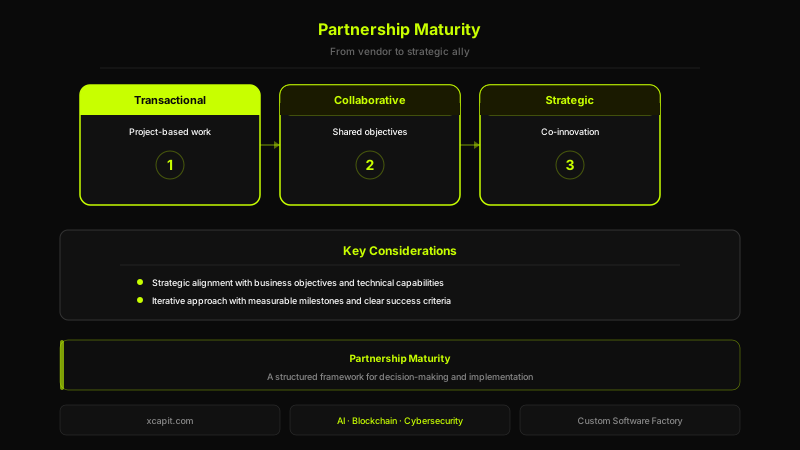
The Partnership Maturity Model
The most durable technology partnerships I have observed — and built — move through recognizable stages of maturity. Understanding those stages helps organizations set realistic expectations for each phase and invest deliberately in advancing to the next level.
Stage 1 is Transactional: defined scope, defined deliverables, limited mutual context, governance primarily through the contract. Most partnerships start here, and that is appropriate. The objective at this stage is demonstrating mutual reliability — the partner delivers what they commit to, the client makes timely decisions and payments, and both parties learn each other's working style.
Stage 2 is Integrated: the partner has accumulated enough context about the client's business to make independent judgments about priorities and approach. Communication has shifted from formal to fluid. The client has reduced oversight requirements because reliability has been demonstrated. At this stage, the partner begins contributing perspectives and recommendations that extend beyond the defined scope — this is the first real signal of strategic value creation.
Stage 3 is Strategic: the partner is embedded in the client's product and technology strategy. They participate in roadmap discussions, provide early-stage input on new initiatives, and the client proactively shares business context that helps the partner do better work. IP is jointly developed in some areas. The relationship has enough trust capital to survive significant difficulties — and at this stage, it will be tested by them.
Advancing through the maturity stages requires intentional investment from both parties. The most common mistake is expecting Stage 3 behavior from a Stage 1 relationship — or assuming that time alone advances the maturity stage without deliberate relationship investment. The milestones that mark advancement are earned, not assumed.
Building a technology partnership that creates lasting value is one of the highest-leverage decisions an enterprise technology leader makes. At Xcapit, we have built relationships with clients that now span years across multiple initiatives — not because we have perfect contracting, but because we invest in the communication, transparency, and shared context that turn vendors into partners. If you are exploring how to structure your next technology engagement for long-term success, our engagement models are designed with exactly this in mind. Learn more at /engagement-models.

José Trajtenberg
CEO & Co-Founder
Lawyer and international business entrepreneur with over 15 years of experience. Distinguished speaker and strategic leader driving technology companies to global impact.
You Might Also Like
Custom software or an existing solution? How to make the best decision for your company
Buy or build is one of the most important decisions in any digital transformation project. When each option makes sense, why the right question is not binary, and how to assess long-term impact.
Software Factory vs In-House Development: A Decision Framework for 2026
A balanced, data-driven guide for CTOs and engineering leaders comparing in-house development teams with software factory partnerships. Includes cost breakdowns, decision criteria, hybrid models, and a structured framework to make the right choice for your organization.
The Five Steps That Will Define the Future of Technology Providers
The future of technology providers is defined by five strategic moves: from being measured by results to betting on verticals and ecosystems.