
This is not a sales pitch. If anything, it might cost us a few deals -- and that is exactly the point. After fifteen years of building technology companies and hundreds of client engagements, I have learned that the most expensive projects are not the ones with the highest budgets. They are the ones that start with misaligned expectations. So I want to have the conversation we usually have three months into an engagement, except I want to have it before we sign anything.
Why I Am Writing This
I am a lawyer by training, not an engineer. I co-founded Xcapit because I believed that technology could solve problems at a scale traditional businesses could not reach -- and our track record building products used by over four million people in 167 countries tells me that belief was well-placed. But I also bring a perspective to this industry that pure technologists sometimes miss: the relationship between a client and a software factory is, at its core, a business partnership. And like any partnership, it works only when both sides understand what they are signing up for.
Too many engagements begin with enthusiasm and end with frustration -- not because the code was bad, but because the expectations were wrong from day one. The CTO expected the factory to also define product strategy. The factory expected the CTO to provide detailed specifications. Neither communicated their assumptions, and by month three, everyone was disappointed. I have seen this pattern enough times that I believe addressing it publicly is more valuable than another blog post about our technical capabilities.
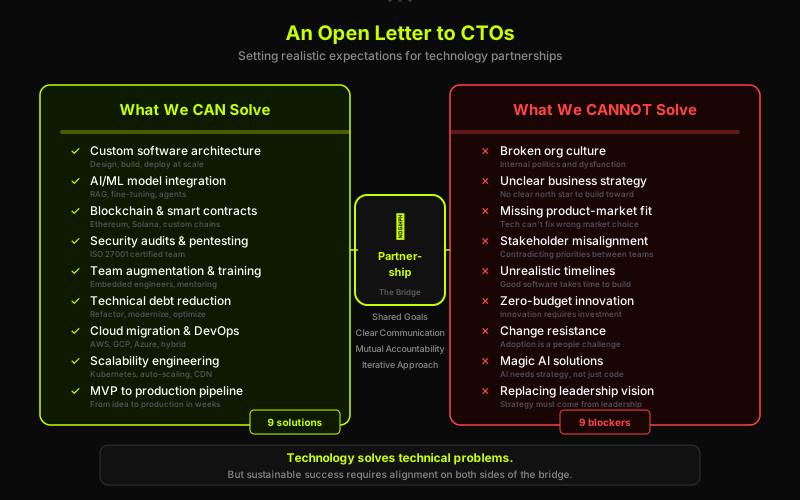
What a Specialized Software Factory Can Solve
Let me start with the good news. A strong software factory brings capabilities that are genuinely difficult -- sometimes impossible -- to build in-house. Understanding what these are helps you extract maximum value from the partnership.
Technical Execution at Scale
This is the core value proposition, and when done right, it is transformative. A mature software factory has refined its development processes across hundreds of projects. It has battle-tested CI/CD pipelines, code review standards, testing frameworks, and deployment procedures that a company building its first or second product simply does not have. You are not just hiring developers -- you are hiring a system of delivery that has been optimized over years. At Xcapit, our ISO 27001 certification is not a badge on the website. It represents a security-first development methodology that we apply to every line of code, every deployment, and every architecture decision. That level of process maturity takes years to develop internally.
Specialized Talent You Cannot Hire
The market for AI engineers, blockchain developers, and cybersecurity specialists is brutally competitive. A mid-sized company competing with Google, Meta, and well-funded startups for the same talent pool faces a structural disadvantage in hiring. A software factory solves this by aggregating specialized talent under one roof. When you need a Solidity auditor for three months, a machine learning engineer for six months, or a DevSecOps architect for a security overhaul, we have that expertise ready -- without the twelve-month recruiting process or the risk of hiring someone who leaves after their equity vests.
Faster Time to Market
Speed in software is not about working longer hours. It is about removing friction from the development process. A factory that has built similar systems before knows which architectural patterns work, which third-party services are reliable, and where the hidden pitfalls are. When we built blockchain solutions for UNICEF, we did not start from scratch -- we drew on years of accumulated knowledge about wallet architecture, key management, and regulatory constraints across jurisdictions. That institutional knowledge compresses timelines in ways that raw engineering talent alone cannot.
Deep Domain Expertise
The difference between a generic development shop and a specialized factory is domain knowledge. We do not just write code in blockchain, AI, and cybersecurity -- we think in those domains. Our engineers understand why ERC-4337 matters for enterprise wallet design, how to structure RAG pipelines for production reliability, and what OWASP standards mean in practice for a fintech application. That depth of understanding translates into better architectural decisions, fewer wrong turns, and software that actually solves the problem rather than merely implementing the specification.
Security-First Development
Security is not a feature you can add later. It is a mindset that must be embedded from the first line of code. A specialized factory with security credentials -- ISO 27001, regular penetration testing, secure SDLC practices -- builds security into the architecture, not on top of it. For any organization handling sensitive data, financial transactions, or regulated information, this alone can justify the engagement.
What a Software Factory Cannot Solve
This is the section most software companies would rather skip. But I believe being honest about our limitations builds more trust -- and leads to better outcomes -- than pretending we can fix everything.
Unclear Product Vision
If you do not know what problem your product solves, or who it solves it for, no amount of excellent engineering will save the project. A software factory can help you refine and validate a vision through a Discovery phase. We can challenge assumptions, propose alternative approaches, and bring market perspective from adjacent projects. But we cannot invent your product strategy from scratch. That has to come from you -- from your understanding of your market, your customers, and the value you intend to create. When a client comes to us and says 'we want to build something with AI,' our first question is always 'what business outcome are you trying to achieve?' If there is no clear answer, we recommend stepping back and defining that before writing any code.
Organizational Dysfunction
Software projects do not fail because of technology. They fail because of people. If your organization has competing priorities with no resolution mechanism, if departments are working against each other, or if leadership is not aligned on what success looks like -- those are problems that manifest as software project failures but have nothing to do with software. We have seen projects where the marketing team wanted one thing, the operations team wanted another, and the CTO was caught in between with no authority to make the call. The result was months of rework, scope changes, and ultimately a product that satisfied no one. A software factory cannot resolve internal politics, and we are honest about that upfront.
Lack of Stakeholder Alignment
Related but distinct from organizational dysfunction: stakeholder alignment means that the people who will approve, fund, use, and maintain the software agree on what it should do and why. When this alignment does not exist, every sprint review becomes a negotiation, every demo surfaces new requirements that contradict previous ones, and the project timeline stretches indefinitely. We can facilitate stakeholder workshops. We can present trade-offs clearly and help decision-makers understand the implications of their choices. But the actual alignment -- the decision to commit to a direction -- must come from within your organization.
Unrealistic Timelines
There is a physics to software development. Certain things take the time they take, regardless of budget. You cannot compress a six-month project into six weeks by tripling the team -- you will just get three times the coordination overhead and code that no one can maintain. When a prospective client tells us their board has already announced a launch date that is physically impossible to meet, we say so. We would rather lose the deal than take on a project destined to fail and damage both our reputations. This is not arrogance. It is respect for the client's investment and our team's wellbeing.
The Profile of an Ideal Client
After hundreds of engagements, a clear pattern has emerged. The clients who get the most value from working with us share three characteristics -- and none of them are about budget size.
They Have a Clear Business Problem
Not a technology problem -- a business problem. 'Our customers are abandoning the onboarding process because it takes two weeks.' 'We are losing $200K per quarter to manual data reconciliation errors.' 'Regulators are requiring transaction traceability we cannot currently provide.' These are problems a software factory can solve. 'We want to use blockchain' is a technology solution looking for a problem. The difference matters enormously, and the best CTOs we work with frame conversations in business terms first.
They Understand Their Domain
Nobody knows your industry better than you do. The best engagements happen when the client brings deep domain expertise and we bring deep technical expertise. A fintech CTO who understands settlement flows, regulatory requirements, and customer behavior patterns enables our team to make better architectural decisions, faster. We do not need you to write specifications in technical language. We need you to explain what the real-world constraints are, how your users actually behave, and what outcomes matter.
They Are Willing to Invest in Discovery
The clients who resist a Discovery phase -- who want to jump straight from a brief conversation to a fixed-price proposal -- almost always end up spending more in the long run. Discovery is not a delay. It is an investment that typically saves 20-40% of total project cost by identifying scope gaps, technical risks, and integration challenges before development begins. The most sophisticated CTOs we work with view Discovery as due diligence -- the same rigor they would apply to any significant business investment.
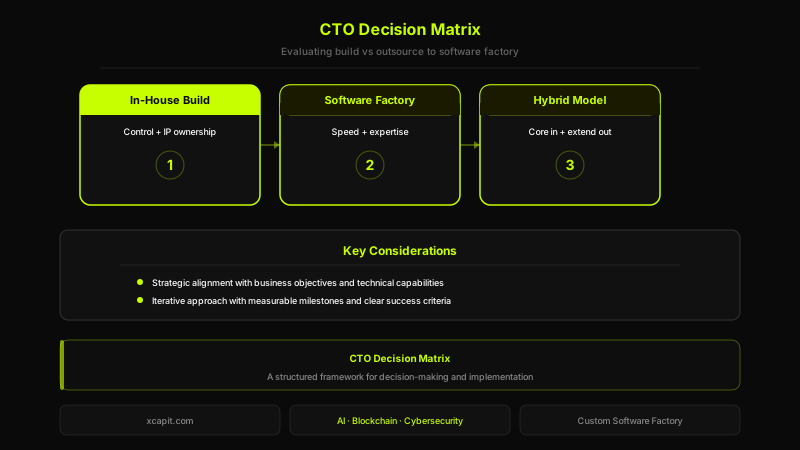
Engagement Models That Actually Work
There is no universal engagement model. The right structure depends on your project's maturity, your internal capabilities, and the nature of the work. Here is how we think about the three primary models.
Dedicated Team for Long-Term Product Development
When you are building a product that will evolve over months or years, a dedicated team becomes an extension of your organization. They learn your domain, your codebase, and your business context. The value compounds over time as the team accumulates institutional knowledge that accelerates every subsequent sprint. This model works best when you have a product roadmap with at least six months of visibility and an internal product owner who can prioritize and make decisions. The monthly cost is predictable, and you have full control over how the team's capacity is allocated.
Project-Based for Defined Scope
When the scope is well-defined and the timeline is bounded -- a security audit, a blockchain integration, a platform migration -- project-based engagement makes the most sense. You get a clear deliverable, a fixed or capped budget, and a defined completion date. This model requires a thorough Discovery phase to work well. The more precisely the scope is defined upfront, the more accurately we can estimate cost and timeline. It does not work well when requirements are likely to change significantly during development.
Staff Augmentation for Gap-Filling
When you have a strong internal team but need specific expertise for a defined period -- a Rust developer for a blockchain module, an ML engineer for a model training phase, a security architect for a compliance initiative -- staff augmentation puts the right specialist in your team without the overhead of permanent hiring. The key distinction from body shopping is quality. Our augmented engineers are not interchangeable resources. They are experienced professionals who bring not just individual skill but the accumulated knowledge of our organization's practices and standards. They integrate into your team, follow your processes, and transfer knowledge as part of the engagement.
Red Flags We See -- From Both Sides
Transparency works both ways. Here are warning signs we have learned to identify early -- some from the client side, some from the factory side -- that predict troubled engagements.
Red Flags in Client Organizations
- No internal product owner -- When no one on the client side has authority and accountability for product decisions, every question becomes a committee discussion. Velocity drops to near zero while everyone waits for consensus that never comes.
- No budget for QA -- A client who says 'we will handle testing ourselves' or 'we do not need a dedicated QA budget' is telling you they view quality as optional. The bugs will be found by end users instead, and the cost of fixing them in production is five to ten times higher than catching them in development.
- 'We need it yesterday' -- Urgency driven by a real market opportunity is one thing. Urgency driven by a deadline that was committed to before anyone understood the scope is something else entirely. The second kind almost always leads to shortcuts that create long-term technical debt.
- 'Just code what we tell you' -- This phrase signals that the client views the factory as a typing service rather than a thinking partner. The best outcomes come when we bring our technical judgment to bear on product decisions, not when we are treated as an order-taker.
- No budget allocated for post-launch maintenance -- Software does not end at deployment. A client who has not budgeted for ongoing maintenance, monitoring, and iteration is planning for the product to decay from day one.
Red Flags in Software Factories
- Promising unrealistic timelines to win the deal -- Any factory that says yes to every deadline without pushback is either lying or planning to cut corners. Be wary of proposals that are significantly more optimistic than competitors.
- No Discovery phase offered -- A factory that jumps straight to a proposal without deeply understanding your requirements is guessing at scope, timeline, and cost. Those guesses are almost always wrong, and you pay for the errors.
- Inability to show relevant case studies or references -- If a factory claims expertise in your domain but cannot introduce you to a past client or show a relevant project, the expertise may be aspirational rather than actual.
- Opaque team composition -- You should know exactly who will work on your project, their experience levels, and their relevant background. 'We will assign the appropriate team' is not an acceptable answer.
- No code ownership clause -- If the contract does not clearly state that you own the code upon payment, walk away. Your software should be yours.
How to Get the Most from the Partnership
Assuming you have found the right factory and the engagement is structured well, here are the practices that consistently separate high-value partnerships from mediocre ones.
- Assign a dedicated product owner with real authority -- This person does not need to be full-time on the project, but they must be empowered to make decisions, prioritize features, and resolve ambiguity without escalating every question to a committee.
- Participate in sprint reviews and provide timely feedback -- The faster you provide feedback, the less rework is needed. A two-week delay in reviewing a sprint's output can cascade into months of misalignment.
- Treat the factory team as partners, not vendors -- Share context about your business strategy, competitive landscape, and user feedback. The more your development team understands the 'why' behind what they are building, the better their technical decisions will be.
- Invest in the relationship, not just the contract -- Relationships built on trust outperform relationships governed purely by contract terms. When problems arise -- and they always do -- a team that trusts each other resolves them faster and with less friction.
- Plan for knowledge transfer from day one -- Document architecture decisions, maintain up-to-date technical documentation, and ensure that institutional knowledge does not live solely in the heads of external developers.
The Honest Conversation About Cost vs. Value
Every CTO faces budget pressure. Every procurement process wants to compare vendors on price. And every software factory knows that the cheapest option often wins the deal. So let me be direct about how we think about cost.
A specialized factory with domain expertise, security certifications, and a proven track record will cost more per hour than a generic development shop. That is a fact, and there is no point pretending otherwise. The question is not which hourly rate is lower. The question is which engagement delivers more value per dollar invested.
When we work on a blockchain project, our engineers do not spend three weeks researching consensus mechanisms -- they already know them. When we build an AI agent pipeline, our architects do not discover the latency challenges of real-time inference during production testing -- they design around them from day one. When we implement security controls, we do not treat OWASP as a checklist to complete at the end -- it is embedded in our development process from the first commit.
That accumulated expertise translates into fewer wrong turns, faster delivery, and higher quality. A project that costs 20% more per hour but delivers in 60% of the time at higher quality is not more expensive -- it is dramatically cheaper when you account for total cost of ownership, reduced rework, and faster time to revenue.
I am not asking you to take our word for it. I am asking you to evaluate total value delivered, not just the number on the invoice. Talk to our past clients. Review our case studies. Ask us the hard questions. That is the kind of scrutiny that leads to partnerships built on reality rather than optimism.
An Invitation, Not a Pitch
If you have read this far, you are the kind of CTO we want to work with -- someone who values honesty over hype and who thinks carefully about partnerships before entering them. I wrote this letter because I believe the software industry needs more transparency about what outsourced development can and cannot accomplish. Too many engagements start with inflated promises and end with mutual frustration. We can do better.
If your organization has a clear business problem, a willingness to invest in getting the foundation right, and an internal champion who can drive decisions -- we should talk. Not to sell you something, but to have the honest conversation about whether we are the right fit for each other. Sometimes the answer is no, and that is perfectly fine. A deal declined is better than a partnership that fails.
If this resonated, I welcome the conversation. Reach out through our contact page or connect with me directly. At Xcapit, we build technology partnerships the same way we build software: with transparency, rigor, and a commitment to outcomes that matter.

José Trajtenberg
CEO & Co-Founder
Lawyer and international business entrepreneur with over 15 years of experience. Distinguished speaker and strategic leader driving technology companies to global impact.
Need custom software that scales?
From MVPs to enterprise platforms — built right.
You Might Also Like
Custom software or an existing solution? How to make the best decision for your company
Buy or build is one of the most important decisions in any digital transformation project. When each option makes sense, why the right question is not binary, and how to assess long-term impact.
Software Factory vs In-House Development: A Decision Framework for 2026
A balanced, data-driven guide for CTOs and engineering leaders comparing in-house development teams with software factory partnerships. Includes cost breakdowns, decision criteria, hybrid models, and a structured framework to make the right choice for your organization.
Outsourcing Software Development to Argentina: A 2026 Guide for US & European Companies
Everything you need to know about outsourcing software development to Argentina -- from timezone advantages and talent pool to legal frameworks, costs, and how to choose the right partner.