

The Case for API-First: Why Code-First Fails at Scale
In the traditional code-first approach, teams build the implementation first and document the API afterward — or, more commonly, never. The result is APIs that reflect the internal structure of the service rather than the needs of the consumers, documentation that lags behind reality, and integration work that consistently blows delivery timelines. At the scale of a monolith, these problems are manageable. In a microservices architecture with dozens or hundreds of services, they compound into organizational dysfunction.
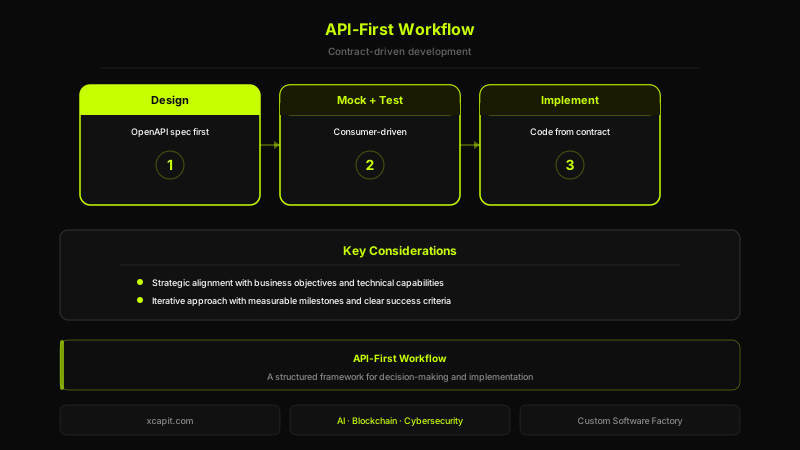
API-first inverts this sequence. The API contract — specifying every endpoint, request shape, response shape, error condition, and authentication mechanism — is written and reviewed before a single line of implementation code is produced. This sounds like overhead. In practice, it's the opposite: it eliminates a far more expensive form of overhead that occurs later, when integration failures and contract mismatches have to be debugged across service boundaries with multiple teams involved.
The core insight is that an API is a product, not an implementation detail. It has consumers (frontend teams, mobile teams, partner integrations, internal services), and those consumers have needs that should drive the design. When the API is designed in collaboration with its consumers before implementation begins, the resulting interface fits actual usage patterns rather than the convenience of the implementing team. This alignment saves rework on both sides.
We've experienced this directly across dozens of projects. When we designed the blockchain wallet API for our financial inclusion work — which eventually reached over 4 million users — the API-first approach allowed our mobile and web teams to build against mock servers while the blockchain integration layer was still being developed. The parallel development compressed the timeline by roughly 40% compared to a sequential approach, and the integration phase was relatively smooth because both sides had been building against the same contract throughout.
OpenAPI and Contract-Driven Development
OpenAPI (formerly Swagger) is the de facto standard for describing REST APIs. An OpenAPI specification is a YAML or JSON file that describes your API's endpoints, parameters, request bodies, response schemas, authentication methods, and error codes in a machine-readable format. The ecosystem around OpenAPI has matured to the point where a well-written spec generates significant value beyond documentation.
From a single OpenAPI spec, you can generate: interactive documentation (Swagger UI, Redoc) that clients can explore and test against; mock servers (Prism, WireMock) that return realistic responses based on the schema; client SDKs in multiple languages (TypeScript, Python, Go, Java); server stubs that teams implement rather than design from scratch; and validation middleware that rejects requests that don't conform to the contract.
Contract-driven development takes this further by using the OpenAPI spec as a testing artifact. Consumer-driven contract testing (Pact is the leading framework) allows API consumers to define the exact requests they'll send and the minimum response structure they require. These contracts are then verified against the provider's implementation in CI/CD. If a backend change breaks a consumer contract, the build fails before the change is deployed — catching integration failures at commit time rather than at runtime.
The practical discipline of maintaining an OpenAPI spec forces clarity in API design. When you write a spec before implementing it, ambiguities that would otherwise survive to integration testing become visible immediately. What are the error codes for each failure mode? What's the pagination strategy? Are null fields omitted or included as null? How does the API handle partial updates — PUT versus PATCH? These decisions, made deliberately during spec review, are far cheaper to resolve than when they surface as integration bugs.
Versioning Strategies: Decide Before You Need To
API versioning is the most consequential design decision you'll make, and it needs to be made before the first API is published. Once clients are consuming an API in production, making changes that break their integrations without a versioning strategy means either breaking clients or freezing the API forever — neither of which is acceptable.
There are four common versioning approaches, each with genuine tradeoffs. URL path versioning (/v1/users, /v2/users) is the most explicit and widely understood — the version is visible in every request, routing is simple, and documentation is easy to organize. The cost is that URL paths proliferate as versions accumulate, and clients must explicitly upgrade. This is the approach we recommend for most microservice contexts because its explicitness reduces operational surprises.
Header versioning (Accept: application/vnd.api+json;version=2) keeps URLs clean and is favored by API purists, but it's invisible in browser URL bars, complicates caching, and requires clients to understand content negotiation. Query parameter versioning (?version=2) has similar visibility problems and is generally considered poor practice for anything beyond internal debugging.
Semantic versioning applied to the entire API — publishing API v1.0.0, v1.1.0 for backward-compatible additions, v2.0.0 for breaking changes — is clean conceptually but requires a release management process and clear consumer communication that many teams underestimate. It works well when you control all consumers (internal services) and less well when you have external partners integrating against public APIs.
Regardless of which strategy you choose, the deprecation policy matters as much as the versioning scheme. Clients need advance notice — typically 6-12 months for external APIs, less for internal services — before a version is decommissioned. Deprecation headers (Deprecation: true, Sunset: Sat, 01 Jan 2027 00:00:00 GMT) allow clients to receive machine-readable notice and automate monitoring for deprecated endpoints. Define your deprecation policy before the first version and enforce it consistently.
API Gateway Patterns
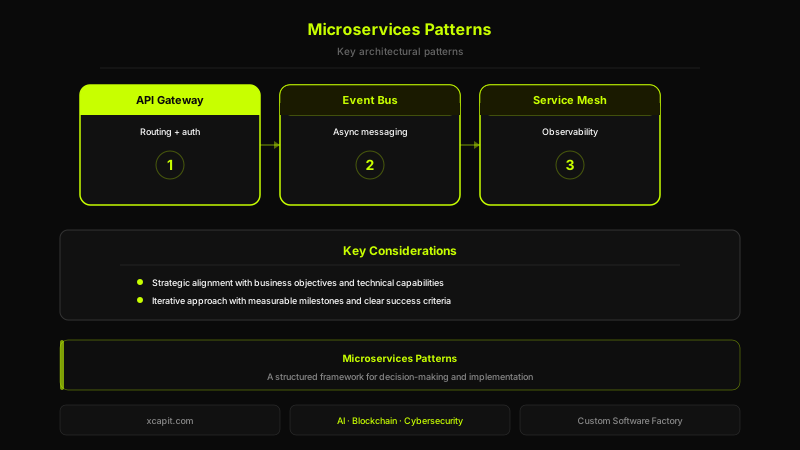
In a microservices architecture, an API gateway is the single entry point for external clients, handling concerns that would otherwise be duplicated across every service: authentication and authorization, rate limiting, request routing, response transformation, logging, and TLS termination. Getting the gateway design right early prevents significant refactoring as the service count grows.
The Backend for Frontend (BFF) pattern is one of the most useful architectural patterns for multi-client microservice deployments. Instead of a single generic gateway serving all clients, each major client type (web, mobile, third-party partner) gets a dedicated gateway layer that aggregates and transforms the underlying services for that client's specific needs. A mobile BFF might combine three service calls into one optimized response; a web BFF might provide different field sets tailored to the UI components in use.
BFFs solve the problem of over-fetching (getting more data than the client needs) and under-fetching (making multiple round trips to assemble what the client needs) without adding the complexity of GraphQL to the core service layer. They're particularly valuable when mobile clients have bandwidth and battery constraints that desktop web clients don't share. The cost is additional services to maintain — BFFs add operational surface area, so the team needs to own and monitor them like any other service.
For authentication, the gateway should validate JWT tokens and propagate identity information to downstream services via trusted internal headers — services should receive authenticated user context, not raw credentials. This centralizes authentication logic, simplifies service implementation, and creates a clear security perimeter. Services behind the gateway can assume requests are authenticated and focus on business logic rather than credential management.
REST vs. GraphQL vs. gRPC: A Genuine Architectural Decision
The choice between REST, GraphQL, and gRPC is not a matter of fashion — each protocol has specific strengths and weaknesses that make it more or less appropriate depending on the client relationship, performance requirements, and team capabilities involved.
REST remains the best default for public-facing APIs and third-party integrations. It's universally understood, has excellent tooling support, works naturally with HTTP caching infrastructure, and requires no client-side framework. REST's main limitation is its rigidity: if a client needs data assembled from multiple resources, it must make multiple requests, and if it needs only a subset of a resource's fields, it receives and discards the rest. For internal services where you control both sides, these inefficiencies are worth considering.
GraphQL excels in scenarios with highly variable data requirements across clients — a characteristic common in content-heavy products, e-commerce platforms, and any application with rich, query-driven UIs. Clients declare exactly what data they need, the graph resolves the optimal combination of service calls, and the response contains exactly and only the requested fields. This eliminates over-fetching and reduces the number of client-server round trips dramatically. The cost is GraphQL's complexity: caching requires custom solutions (persisted queries, response hashing), N+1 query problems require careful resolver design with DataLoader patterns, and schema evolution requires careful deprecation management.
gRPC is the right choice for high-performance synchronous communication between internal services, particularly where latency is a constraint. Its binary Protocol Buffers encoding is significantly more compact than JSON, and HTTP/2 multiplexing allows multiple concurrent requests over a single connection. gRPC also generates strongly-typed client and server code from proto definitions, which is a significant ergonomic advantage for polyglot service architectures. The limitations are real: browser support requires gRPC-Web with a proxy layer, debugging binary messages is harder than inspecting JSON, and the tooling ecosystem is less mature than REST's.
The pragmatic approach most mature microservice architectures use is a combination: REST or GraphQL at the external-facing gateway layer where client diversity and developer experience matter, and gRPC for the internal service mesh where performance is the priority. This hybrid is more complex to operate but captures the strengths of each protocol where they're most relevant.
Event-Driven Communication and Asynchronous Patterns
Synchronous API calls create coupling between services: if Service B is slow or unavailable, Service A's latency or availability degrades proportionally. In a large microservice deployment with long chains of synchronous calls, a single slow service can propagate latency upstream across the entire request path. Event-driven communication breaks this coupling by replacing synchronous calls with asynchronous message publication.
In an event-driven architecture, services publish events to a message broker (Kafka, RabbitMQ, Amazon SNS/SQS) describing what happened, and interested services subscribe to the events they care about. The publisher doesn't wait for consumers to process the event — it publishes and continues. Consumers process events on their own schedule. This architecture is more resilient (a slow consumer doesn't block the publisher), more scalable (consumers can be added or scaled independently), and more flexible (new consumers can subscribe to existing events without modifying the publisher).
The cost of event-driven communication is eventual consistency. When an order is placed and an event is published, the inventory service may not reflect the reservation for milliseconds to seconds. For many business processes, this is acceptable. For others — particularly those involving financial transactions or strong consistency requirements — it requires careful design around saga patterns, distributed transactions, or hybrid synchronous-for-write, asynchronous-for-read architectures.
Event schema evolution is a critical concern that's often underestimated. Unlike REST APIs where versioning is explicit, event schemas evolve over time as producers add new fields or change existing ones, and consumers may be consuming old events from a replay. Using a schema registry (Confluent Schema Registry is the most common) with Avro or Protobuf schemas enforces backward and forward compatibility at publication time. This is not optional for production systems — it's what prevents events from becoming a distributed monolith where every schema change requires coordinated deployments.
Testing Strategies for API-First Microservices
A comprehensive testing strategy for microservices requires tests at multiple levels, each addressing different failure modes. Unit tests verify individual service logic in isolation. Integration tests verify that a service behaves correctly with its dependencies (database, message broker, external APIs) using test containers or sandboxed environments. Contract tests (using Pact or similar) verify that the API implementation matches the published contract and that consumers' expectations are met. End-to-end tests verify that complete user journeys work across the deployed service graph.
The microservices testing pyramid inverts the traditional ratio in one important way: contract tests replace much of the need for end-to-end tests for internal service interactions. End-to-end tests are expensive to write, slow to run, and fragile to maintain. If you trust that each service is tested against its contract individually, you need far fewer end-to-end tests — only for the critical user journeys that represent your highest-risk paths. Investing in contract test infrastructure pays back significantly in reduced end-to-end test maintenance burden.
Performance testing for APIs is often deferred until late in a project and then skipped entirely under deadline pressure. This is a pattern we've observed repeatedly and consistently regret. API performance characteristics should be validated early — ideally before the architecture is locked — using load testing tools like k6, Locust, or Apache JMeter against realistic payload sizes and traffic patterns. A latency problem discovered at API design time costs an afternoon to fix; discovered in production under load, it can require architectural changes that take weeks.
Documentation as Code: Keeping Specs and Reality in Sync
The most common failure mode for API documentation is drift: the spec is written at project inception and updated infrequently as the implementation evolves. Within months, the documentation describes an API that no longer exists, and consumers — internal and external — learn to distrust it. Once documentation credibility is lost, teams revert to reading source code or pinging other engineers, which scales poorly.
Treating documentation as code — keeping the OpenAPI spec in version control alongside the implementation, including spec validation in CI/CD, and requiring spec updates as part of the definition of done for any API change — is the only sustainable approach. The CI/CD pipeline should run the spec through a validator (Spectral is the leading linter for OpenAPI) on every pull request and fail if the spec is invalid or violates defined API design standards.
Several frameworks (Fastify with fastify-swagger, FastAPI, Spring Boot with springdoc) generate OpenAPI specs directly from annotated code, which guarantees that the spec and implementation stay in sync at the cost of some flexibility in spec structure. For teams that struggle with the discipline of keeping specs updated manually, code-generated specs are a pragmatic compromise. The spec is less likely to have the exact structure a skilled API designer would produce, but it's guaranteed to be accurate — which is the more valuable property.
Designing APIs that stand the test of scale requires architectural thinking from day one — not as an afterthought after the first version is shipped. At Xcapit, we apply API-first principles across every microservice engagement, from blockchain infrastructure APIs to AI orchestration layers to fintech integrations requiring high reliability and strict contract governance. If you're building or rearchitecting a distributed system, explore our custom software development capabilities at /services/custom-software or reach out to discuss your architecture challenges.

Santiago Villarruel
Product Manager
Industrial engineer with over 10 years of experience excelling in digital product and Web3 development. Combines technical expertise with visionary leadership to deliver impactful software solutions.
Need custom software that scales?
From MVPs to enterprise platforms — built right.
You Might Also Like
Custom software or an existing solution? How to make the best decision for your company
Buy or build is one of the most important decisions in any digital transformation project. When each option makes sense, why the right question is not binary, and how to assess long-term impact.
What is technical debt and why can it slow down a company's innovation?
Technical debt does not appear on any balance sheet, but it makes every new feature more expensive and limits your ability to adopt AI or automation. What it is, how to spot it, and why modernizing does not mean starting from scratch.
Will Artificial Intelligence replace developers? Why software engineering matters more than ever
AI automates code generation, testing and documentation, but it does not replace engineering. Why, as writing code becomes easier, the value of those who design architectures and understand the business goes up.