
Why Traditional Estimation Consistently Fails
Every engineering leader has lived through this scenario: a project manager asks how long a feature will take, the engineering team gives a careful estimate, and three months later that estimate has proven wildly optimistic. The post-mortem assigns blame to scope creep, unclear requirements, or technical surprises — but the root cause is almost always the estimation method itself, not the people using it.
Traditional estimation treats software development like manufacturing. You break a feature into tasks, estimate each task in hours, sum them up, and you have a delivery date. The logic is appealing because it mirrors how we estimate physical work. But software is fundamentally different from manufacturing: it involves discovery, learning, and creative problem-solving whose duration is impossible to predict with precision. The act of building the software is itself the process of figuring out what the software needs to do.
Two cognitive biases compound this structural problem. The planning fallacy — first described by Daniel Kahneman and Amos Tversky — is our systematic tendency to underestimate task duration even when we have direct evidence from past experience that similar tasks took longer than expected. And anchoring bias means that once an estimate is stated, subsequent discussion gravitates toward it regardless of new information. The first number said in a room exerts gravitational pull on every estimate that follows.
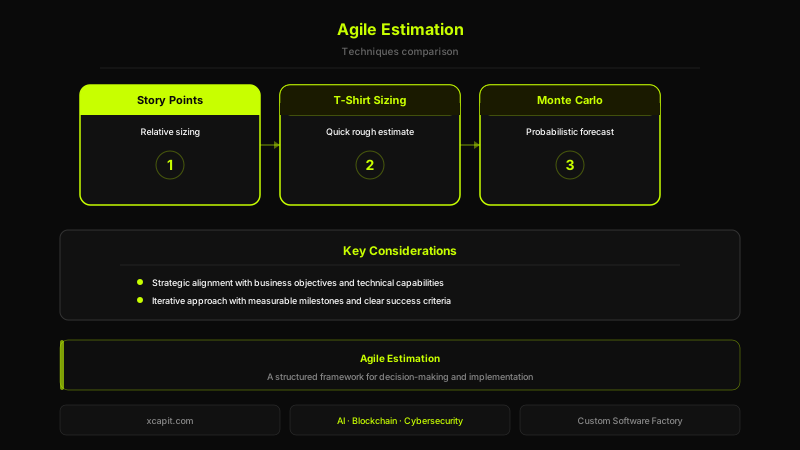
The software industry's response has been to develop estimation approaches that work with human psychology rather than against it. The most effective of these — story points, T-shirt sizing, Planning Poker, and Monte Carlo simulation — share a common insight: relative comparison is far more reliable than absolute measurement, and probabilistic ranges are more honest than point estimates.
Story Points: Relative Complexity, Not Time
Story points measure the effort, complexity, and uncertainty of a user story relative to other stories the team has already completed. The unit is intentionally abstract. A story worth 8 points is not expected to take 8 hours — it's expected to require roughly twice the effort of a 4-point story and half the effort of a 16-point story. This abstraction is the entire point.
When teams estimate in hours, they anchor on individual capacity — and individual capacity varies enormously based on familiarity with the codebase, interruptions, meetings, and energy levels. When teams estimate in story points, they're calibrating the work against their collective past experience. A senior engineer and a junior engineer might each take very different amounts of time to complete an 8-point story, but over a sprint, the team's total story point delivery — its velocity — becomes remarkably consistent.
The Fibonacci sequence (1, 2, 3, 5, 8, 13, 21) is the standard for story point scales, and its non-linearity is intentional. The increasing gaps between values reflect the exponential growth of uncertainty as complexity increases. You can estimate a 1-point story with high confidence. An 8-point story involves enough unknowns that precise hour-level estimation would be false precision. The Fibonacci gaps encode this epistemological reality — the larger the story, the wider the meaningful estimation band.
A common pitfall is conflating points with hours after the fact. Teams that track actual hours per story and compare them to point estimates are missing the point (so to speak). The question is not whether an 8-point story took 16 hours or 24 — it's whether the team's velocity is consistent enough to forecast sprint completion reliably. Velocity stability over 6-8 sprints is the signal that your team has internalized a shared sizing standard.
T-Shirt Sizing: Lightweight Estimation for Roadmapping
T-shirt sizing (XS, S, M, L, XL, XXL) trades precision for speed, making it ideal for early-stage roadmapping when you need rough relative sizing across dozens of epics or features. It's particularly useful in discovery sessions with clients who don't yet have refined requirements — you can sort items by rough magnitude without the cognitive overhead of Fibonacci numbers.
The practical use case is portfolio prioritization. When a product backlog has 40 potential features and a leadership team needs to decide what goes into Q3, T-shirt sizing allows the engineering team to communicate relative effort quickly and clearly. An XL item has fundamentally different planning implications than an S item, and stakeholders intuitively understand this without needing to understand story points or sprint velocity.
T-shirt sizing typically maps to a day-range equivalence for communication purposes: XS is under half a day of work, S is a day or two, M is a week, L is two to three weeks, and XL is a month or more. These mappings help non-technical stakeholders build intuition, but they should be communicated as rough guides rather than commitments. The value of the method is in the relative ordering, not the absolute durations.
Planning Poker: Eliminating Anchoring Through Simultaneous Reveal
Planning Poker is the most effective tool for calibrating a team's shared understanding of story complexity — and its value comes entirely from one rule: estimates are revealed simultaneously. Every team member holds up their card at the same moment, preventing any individual's number from anchoring the others.
The protocol is simple. The product owner reads a user story and answers clarifying questions. Team members privately select an estimate card from the Fibonacci sequence. On the count of three, all cards are revealed. If everyone agrees, the estimate is logged and the team moves on. If there's disagreement — which is the interesting case — the team discusses the divergence. The person with the lowest estimate and the person with the highest estimate each explain their reasoning.
These conversations surface assumptions and knowledge gaps that would otherwise remain hidden. The senior engineer who estimated 13 points might know about a third-party integration that makes the feature far more complex than it appears. The junior engineer who estimated 3 might not have considered error handling requirements or the performance implications of the database query. After the discussion, the team re-estimates — and the new estimates tend to converge toward a more accurate shared understanding.
In our experience building products across AI, blockchain, and custom software for clients ranging from startups to international organizations like UNICEF, Planning Poker sessions are most valuable not for the numbers they produce but for the conversations they generate. A 30-minute session that surfaces a critical integration constraint is worth days of downstream re-planning. We run Planning Poker at the beginning of every sprint and during quarterly roadmap sessions when we need to validate scope assumptions with clients.
The Cone of Uncertainty: Honesty About What You Don't Know
The Cone of Uncertainty is not an estimation technique but a communication framework that every product manager and engineering leader should internalize. It describes how estimation uncertainty changes over the lifecycle of a project: very high at the beginning, progressively narrowing as requirements are defined and work is completed.
At project inception, before requirements are defined, a delivery estimate could be off by a factor of 4x in either direction. After requirements are established but before design is complete, the range narrows to roughly 2x. After design but before implementation starts, 1.5x. After a significant portion of the code is written, the range approaches 1.1x. Only when the software is nearly complete can you estimate its completion date with confidence.
The business implication is that asking for a precise delivery date on the first day of a project is asking for a number that will be wrong. The right response is to communicate the cone — to say 'based on what we know today, our best estimate is Q3, with a range of Q2 to Q4 depending on what we learn during discovery and early sprints.' This is not hedging; it's accurate communication of the actual state of uncertainty. Stakeholders who understand the cone make better decisions than those who demand false precision.
Monte Carlo Simulation: Probabilistic Forecasting for Real Projects
Monte Carlo simulation is the most powerful estimation tool most software teams have never used. It replaces point estimates with probability distributions, producing forecasts like 'there is a 70% probability of completing this scope by Q3 and a 90% probability of completing it by Q4.' These probabilistic ranges are more honest, more defensible, and — counterintuitively — more useful to decision-makers than false precision.
The mechanics are straightforward. You take your team's historical velocity data — actual story points completed per sprint over the last 10-15 sprints — and use it to simulate thousands of possible futures. In each simulation, you randomly sample a velocity value from the historical distribution and subtract it from the remaining backlog. You repeat this until the backlog is empty, recording how many sprints it took. After running 10,000 simulations, you have a distribution of possible completion dates, from which you can read off percentile confidence intervals.
The key insight is that you're not predicting a specific future — you're describing the range of plausible futures given past performance. If the team's velocity has ranged from 20 to 40 points per sprint, the simulation captures that variability and propagates it forward. The resulting probability distribution reflects the actual uncertainty in the system rather than the optimism of any individual estimator.
Practical tools for Monte Carlo simulation include Focusedlabs' throughput forecaster, various Jira plugins, and simple spreadsheet implementations using random number generation. The minimum viable version requires only two inputs: historical velocity per sprint (at least 10 data points) and remaining backlog size in story points. With these, you can generate a credible probabilistic forecast in under an hour.
One important caveat: Monte Carlo simulation is only as good as the data behind it. If your team's velocity has been highly erratic due to team composition changes, parallel projects, or inconsistent estimation standards, the simulation will reflect that uncertainty — which is honest, but also wide. The best way to tighten your forecasts is to stabilize the inputs: consistent team size, consistent estimation standards, and a focused backlog. Forecasting tools amplify signal and noise equally.
The #NoEstimates Movement: Valid Critique, Impractical Conclusion
The #NoEstimates movement, popularized by Vasco Duarte and others in the Agile community, argues that the cost of estimation exceeds its value and that teams should instead focus on delivering small, frequently deployed increments whose value is self-evident. The critique of traditional estimation is largely correct: point estimates are almost always wrong, the act of estimating consumes significant team time, and the false precision of estimates creates political problems when reality diverges.
But the conclusion — abandon estimation entirely — is impractical for most organizations working on client-facing projects with real budget constraints and delivery commitments. Clients need to make resource allocation decisions. Engineering leaders need to staff projects appropriately. Product managers need to sequence work against market opportunities. All of these decisions require some form of forecasting, even if imperfect.
The synthesis position — which most mature engineering organizations eventually arrive at — is that estimation is valuable when the cost of the information it produces is less than the cost of the decisions it informs. For long-horizon roadmaps and major capability investments, probabilistic forecasting is worth the effort. For individual story sizing within an established team, lightweight Planning Poker or T-shirt sizing is usually sufficient. For tactical sprint planning in a stable team with stable velocity, cycle time analysis may be more useful than story point estimation at all.
Practical Tips for Stakeholder Communication
The best estimation process is worthless if its output is communicated poorly to stakeholders. Most estimation communication failures happen not because the estimate was wrong but because the uncertainty inherent in the estimate was not communicated alongside it.
- Always present estimates with explicit confidence ranges, not point values. '10 sprints with 70% confidence, 14 sprints with 90% confidence' is more useful than '10 sprints.'
- Explain what assumptions are embedded in the estimate and what events would cause it to change. If scope grows by 20%, what happens to the timeline?
- Update estimates regularly as new information arrives. An estimate made with 20% of the backlog complete is more accurate than one made at project inception — communicate the update, not just the original number.
- Use visual tools (burn-down charts, probability distributions, sprint velocity graphs) to make uncertainty visible. Abstract numbers are harder to reason about than visual representations of the same data.
- Separate 'what we know' from 'what we're assuming.' Stakeholders who understand the distinction can help resolve key assumptions faster, which benefits everyone.
- Set up a cadence for re-estimation at key project milestones — after discovery, after the first sprint, after major technical decisions. Each milestone is an opportunity to narrow the cone.
Building a Culture of Estimation Honesty
The biggest obstacle to good estimation is not methodological — it's cultural. In organizations where estimates are treated as commitments rather than forecasts, engineers are incentivized to pad estimates defensively or, worse, to give the answer stakeholders want to hear rather than the honest assessment. Both behaviors degrade the information quality that estimation is supposed to produce.
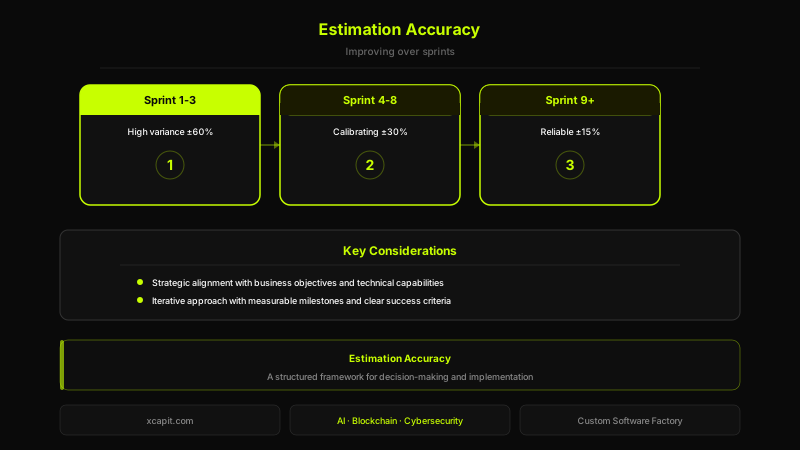
Estimation accuracy should be tracked over time — not to penalize engineers for being wrong, but to calibrate the team's estimation process. If a team consistently underestimates by 30%, the right response is to adjust the process (perhaps by reviewing estimation criteria or adding a standard buffer) rather than to pressure engineers to estimate lower. Psychological safety around estimation honesty is not a soft cultural concern; it's a prerequisite for generating useful forecasts.
The teams we've seen produce the best estimates share three characteristics: they review their estimation accuracy retrospectively, they maintain consistent Definition of Done criteria that all estimates implicitly include, and they have explicit conversations with stakeholders about the difference between estimates and commitments. Building these habits takes time, but the payoff in reduced planning dysfunction is substantial.
Estimation is one of the highest-leverage skills in software product management, and getting it right requires both the right techniques and the organizational culture to use them honestly. At Xcapit, we apply these frameworks across every engagement — from early-stage discovery with startups to complex multi-phase programs for enterprise clients. If your team is struggling with predictability or stakeholder trust around delivery timelines, explore our approach to custom software development at /services/custom-software or reach out to discuss your specific context.

Santiago Villarruel
Product Manager
Industrial engineer with over 10 years of experience excelling in digital product and Web3 development. Combines technical expertise with visionary leadership to deliver impactful software solutions.
You Might Also Like
The Custom Software Development Process: A Step-by-Step Guide
A comprehensive guide to the custom software development lifecycle — from discovery and requirements gathering through architecture, development, testing, deployment, and ongoing support.
The field's digital notary: what blockchain is (and why you don't need to understand the code to use it)
You don't need to know how a combine harvester's computer works to operate it. Blockchain is the same: a write-only record that guarantees provenance and cannot be forged.
Custom software or an existing solution? How to make the best decision for your company
Buy or build is one of the most important decisions in any digital transformation project. When each option makes sense, why the right question is not binary, and how to assess long-term impact.