

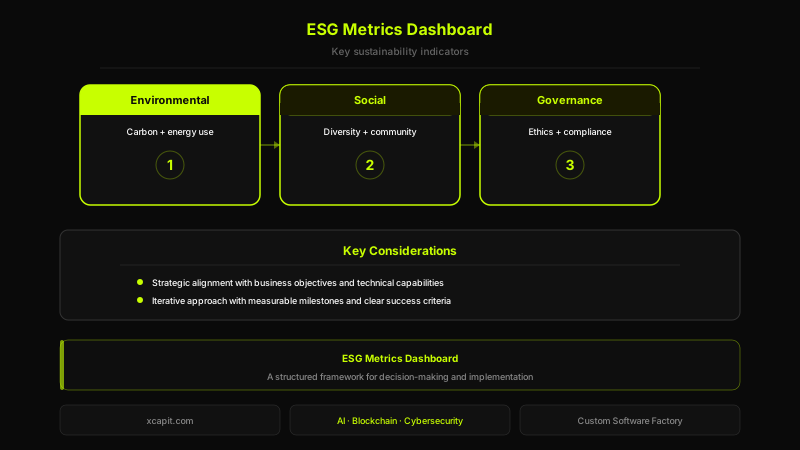
When I joined Xcapit from Deloitte, where I had spent years in corporate finance, ESG was transitioning from a voluntary reporting exercise to a regulated requirement with real financial consequences. That transition has accelerated dramatically. The European Union's Corporate Sustainability Reporting Directive (CSRD) now applies to large EU companies and, importantly, to non-EU companies with significant EU operations — which captures most global technology companies. The SEC's climate disclosure rules in the United States, while contested, signal the direction of travel. Institutional investors managing trillions in assets have made ESG performance a criteria in capital allocation decisions.
What is less discussed is that ESG metrics, done properly, are not just about compliance or investor relations. They are a management tool. The same discipline that produces an accurate carbon footprint report forces you to understand your energy consumption at a level of detail most technology companies do not currently have. The data infrastructure required to report on workforce diversity, equity, and inclusion gives you visibility into talent gaps and culture risks that would otherwise surface only when someone leaves or an incident occurs. ESG reporting done well is operational intelligence, not just disclosure.
Why ESG Matters for Technology Companies Specifically
Technology companies have a particular relationship with ESG that differs from industrial or consumer sectors. On the environmental dimension, tech companies' direct operations — offices, data centers, devices — are more energy-intensive than they appear in marketing materials, and their supply chains (particularly hardware manufacturing) generate emissions orders of magnitude larger than their own operations. A software company that runs its infrastructure on cloud providers might feel insulated from this, but Scope 3 accounting increasingly requires including the emissions of purchased cloud services, employee commuting and remote work energy consumption, and the manufacturing footprint of company-issued devices.
On the social dimension, technology companies are disproportionately influential relative to their employee headcount. A platform serving millions of users has social impact that dwarfs its personnel file. Moderating content, designing algorithms, handling user data, and determining who has access to digital services — these are governance and social impact decisions, whether or not they are currently framed as ESG matters. The regulatory environment is catching up to this reality rapidly.
On the governance dimension, technology companies face unique risks around data privacy, algorithmic accountability, and the concentration of market power. Governance quality — measured through board composition, executive compensation alignment, audit independence, and risk management processes — is increasingly correlated with both regulatory risk and investor valuation multiples. The companies that perform best on governance metrics tend to have fewer regulatory surprises and higher employee trust.
The ESG Reporting Frameworks: GRI, SASB, and TCFD
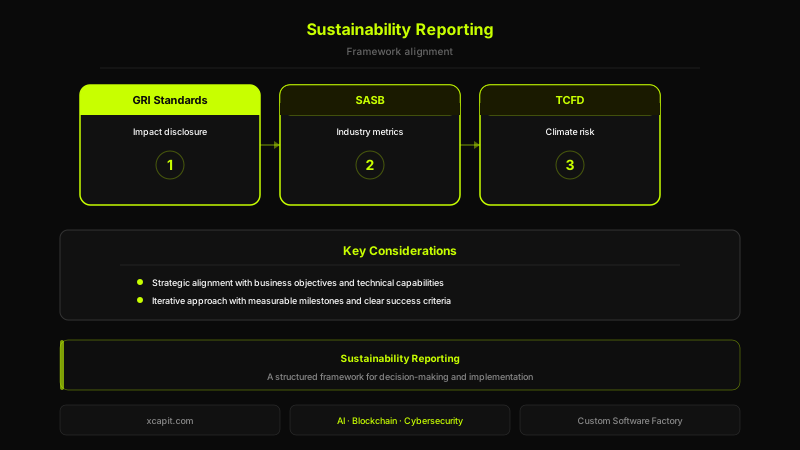
The three dominant frameworks for ESG reporting are the Global Reporting Initiative (GRI), the Sustainability Accounting Standards Board (SASB), and the Task Force on Climate-related Financial Disclosures (TCFD). They serve different purposes and are increasingly used in combination rather than as alternatives. Understanding their design logic is essential for building a reporting approach that serves multiple audiences without creating parallel measurement systems.
GRI is the broadest framework, covering a comprehensive range of environmental, social, and governance topics. Its strength is its comprehensiveness and its stakeholder orientation — GRI reporting is designed to communicate impact to a wide range of interested parties, not just financial investors. Its weakness is that comprehensiveness can become a substitute for materiality: companies can produce lengthy GRI reports full of metrics that are low in strategic significance. The GRI Universal Standards, last updated in 2021, now require companies to disclose how they identify which topics are material to their stakeholders — a meaningful improvement that forces greater analytical rigor.
SASB takes a different approach: sector-specific standards that identify the small number of sustainability topics most likely to be financially material for a given industry. For the technology sector, SASB identifies data privacy, data security, employee diversity and inclusion, and energy management as the highest-priority topics. SASB's strength is its focus on financial materiality, which makes it useful for investor-facing disclosures. Its weakness is that it covers only what is financially material to the company — not what is materially impactful on society or the environment.
TCFD was developed specifically to address climate risk in financial reporting. Its four pillars — governance, strategy, risk management, and metrics and targets — provide a structured framework for disclosing how climate risks and opportunities are integrated into business strategy and financial planning. For technology companies, the most challenging TCFD element is typically the scenario analysis requirement: modeling how the business performs under different climate scenarios (1.5°C, 2°C, 3°C warming) requires capabilities in climate science and financial modeling that most companies are still developing.
Key Metrics: What Technology Companies Should Actually Measure
The environmental metric that matters most — and that technology companies most consistently underestimate — is total carbon footprint including all three scopes. Scope 1 covers direct emissions from owned or controlled sources (generators, company-owned vehicles). Scope 2 covers indirect emissions from purchased electricity and heat. Scope 3 covers all other indirect emissions across the value chain. For most technology companies, Scope 3 represents 70 to 90% of total emissions — and much of it is concentrated in two categories: purchased goods and services (including cloud infrastructure), and use of sold products.
Energy consumption metrics should include total energy consumed, the percentage from renewable sources, the energy intensity ratio (energy per unit of revenue or per user), and the trajectory of each over time. Power Usage Effectiveness (PUE) is the standard metric for data center efficiency — a PUE of 1.0 would be perfect efficiency; typical enterprise data centers run at 1.5 to 2.0; leading hyperscale data centers achieve close to 1.1. If your company uses cloud infrastructure, ask your providers for your share of their energy consumption and PUE data — this is increasingly available through environmental reports and APIs.
Social metrics that are genuinely informative include workforce demographic composition by gender, ethnicity, and level (not just overall percentages, but representation at each level of seniority), pay equity ratios comparing compensation across demographic groups for equivalent roles, voluntary attrition rates by demographic group (which reveal whether diversity efforts are succeeding at retention as well as hiring), and employee engagement scores broken out by demographic group and location. The last two metrics are rarely published but are the most revealing about whether DEI initiatives are producing genuine organizational change.
Governance metrics include board independence (percentage of directors who are independent of management), board diversity (gender and ethnic diversity of directors), CEO pay ratio (CEO compensation as a multiple of median employee compensation), and the existence and independence of key committees (audit, compensation, nominating). For technology companies, data governance metrics are increasingly important: the existence of a Chief Privacy Officer role, the number of data breach incidents and their severity, and the percentage of user data covered by a formal data retention and deletion policy.
Blockchain for Transparent ESG Reporting
At Xcapit, we have worked on blockchain applications for supply chain transparency and emissions tracking, which has given us a clear-eyed view of where blockchain genuinely adds value in ESG contexts and where it is oversold. The core value proposition of blockchain for ESG reporting is immutability and third-party verifiability: once emissions data is recorded on a public or consortium blockchain, it cannot be retroactively altered, and any party with access to the chain can independently verify the records without relying on the company's self-reporting.
This matters most for supply chain emissions tracking — Scope 3 Category 1, purchased goods and services. Mapping emissions across a complex supply chain requires trusting that each supplier is accurately reporting their own emissions. A blockchain-based system can create shared data infrastructure where each entity in the supply chain records its own emissions data in a format that is auditable by downstream partners. This does not solve the measurement problem — the data still has to be accurate when it goes in — but it solves the verification problem, which is often what creates the most friction in multi-party supply chain audits.
Tokenized carbon credits represent another genuinely useful application. The traditional carbon credit market has significant transparency problems: the same credit can be double-counted, retired credits are not always verifiably retired, and the provenance of older credits is often unclear. Blockchain-based carbon credit platforms create non-fungible representations of specific credits that are verifiably unique, have a clear chain of custody, and are provably retired when used to offset emissions. Several major standard setters, including Verra and Gold Standard, are actively developing blockchain integration for their registries. For companies whose ESG strategy includes carbon offsetting, understanding this emerging infrastructure is strategically important.
The Greenwashing Risk: How to Avoid the Most Damaging Mistakes
Greenwashing — overstating or misrepresenting environmental credentials — has moved from a reputational risk to a legal and financial risk. The EU's Green Claims Directive, adopted in 2024, creates liability for unsubstantiated environmental marketing claims. The FTC's Green Guides in the United States provide guidance that regulators are increasingly willing to enforce. Asset managers are facing scrutiny for ESG fund labeling. The risks are real and growing.
The most common greenwashing errors in technology companies are not outright lies but rather selective disclosure and misleading framing. Announcing a commitment to 'net zero by 2040' without a credible near-term reduction pathway and interim targets is increasingly understood as a greenwashing signal. Claiming 100% renewable electricity when the claim is based on purchasing Renewable Energy Certificates (RECs) from distant markets rather than matching actual electricity consumption with local renewable generation is technically accurate but misleading about actual grid emissions impact. Reporting total diversity percentages without disclosing representation at senior levels obscures the leadership pipeline problem that diversity initiatives are supposed to address.
The antidote to greenwashing is the same as the antidote to bad financial reporting: independent verification, consistent methodology, and unflinching disclosure of the metrics that look worst alongside the ones that look best. Getting your ESG report independently assured — not just audited for process compliance but substantively verified for accuracy — is becoming standard practice for leading companies and will likely become mandatory for large companies in many jurisdictions within the next few years.
A Practical Implementation Roadmap
For technology companies starting their ESG journey, the practical sequence that has worked best across the organizations we have worked with is as follows. Months one through three: conduct a materiality assessment to identify which ESG topics are most relevant to your stakeholders and your business model; establish your measurement baseline for the highest-priority metrics; and audit your current data infrastructure to identify what you can measure accurately versus what requires new tooling or processes.
Months four through nine: build out the data collection and reporting infrastructure for your priority metrics; establish internal governance for ESG data (who owns each metric, what the review process is before publication, how discrepancies are handled); and prepare your first formal ESG disclosure, even if it is modest in scope. The first disclosure is always the hardest, and doing it imperfectly and improving it is better than waiting until everything is perfect.
Months ten through eighteen: pursue independent assurance for your highest-priority metrics; align your reporting to the relevant frameworks (GRI for comprehensive disclosure, SASB for investor audiences, TCFD for climate risk); and begin setting science-based targets for emissions reduction if you have not already. Science-based targets — validated by the Science Based Targets initiative (SBTi) — provide a credible, independently verified framework for emissions reduction commitments that is increasingly expected by institutional investors.
- Start with materiality, not comprehensiveness: identify the 5 to 8 ESG topics most relevant to your stakeholders and business model, then measure those rigorously
- Scope 3 emissions dominate: for most tech companies, over 70% of the carbon footprint is in the supply chain and product use — measure it even if the data is incomplete
- Separate commitments from progress: a net zero commitment without a credible near-term reduction pathway is a greenwashing risk, not an ESG achievement
- Build data infrastructure before writing the report: ESG reporting quality is constrained by measurement infrastructure quality — invest in the data systems first
- Pursue independent assurance: third-party verification of ESG data is transitioning from best practice to regulatory requirement in most major markets
- Blockchain adds real value for supply chain verification and carbon credit integrity — evaluate it specifically for Scope 3 and offsetting use cases
At Xcapit, sustainability is not a marketing commitment — it is part of how we build products and manage our operations, reflected in our work with the UNICEF Innovation Fund and our approach to blockchain infrastructure for transparent reporting. If your organization is developing its ESG measurement and reporting capabilities, or evaluating technology infrastructure to support sustainability data management, our custom software team can help design the data architecture and reporting pipelines that make ESG intelligence actionable. Learn more at xcapit.com/services/custom-software.

Antonella Perrone
COO
Previously at Deloitte, with a background in corporate finance and global business. Leader in leveraging blockchain for social good, featured speaker at UNGA78, SXSW 2024, and Republic.
You Might Also Like
Technology Solutions for ESG Reporting: Automation, Blockchain Audit Trails, and AI Analytics
How enterprises can leverage AI, blockchain, and automation to transform ESG reporting from a manual compliance burden into a strategic capability — covering CSRD, TCFD, and GRI frameworks with practical implementation guidance.
Agenda 2030 as a value accelerator: the hidden market behind agricultural traceability
Corporate sustainability targets are not a bureaucratic burden: they are the biggest accelerator of new markets agribusiness has seen this century. How to capture that value.
The field's digital notary: what blockchain is (and why you don't need to understand the code to use it)
You don't need to know how a combine harvester's computer works to operate it. Blockchain is the same: a write-only record that guarantees provenance and cannot be forged.