
Xcapit operates with engineering, product, and operations teams across three cities — Córdoba, Lima, and Miami — spanning time zones that create a daily overlap window of roughly four hours. When I joined as COO, we had the structure of a distributed company but the habits of a co-located one. Meetings were scheduled for whenever was convenient for one office. Documentation was an afterthought. The engineers in one city had no visibility into what the other cities were building until a sprint review revealed an integration conflict. We were distributed in geography but not in practice.
Over three years, we rebuilt the operational model around the realities of distributed work. What follows is the framework we developed — not a theoretical ideal, but the actual practices that changed how we operate. I present versions of this at conferences because the challenges are nearly universal: I have spoken with engineering leaders at companies with teams in New York and Bangalore, London and Warsaw, Buenos Aires and Berlin, and the patterns repeat.
The Async-First Mindset: More Than a Communication Style
Async-first does not mean async-only. It means that your default assumption, when deciding how to communicate something, is that the recipient cannot respond immediately — and your message should be designed accordingly. In practice, this transforms how people write. An async-first culture produces messages that include context, the specific question or decision required, relevant constraints, and a timeline. A sync-first culture produces messages that say 'can we jump on a call?' — and then the call is scheduled, the person being asked has to prepare on the spot, and the meeting ends without a written record.
The transition to async-first took us about nine months of deliberate reinforcement. We started with a simple rule: before requesting a meeting, write down what you need to discuss, what decision you need to make, and what information would unblock you. If you can write that down in a way that the other person can respond to asynchronously, the meeting is optional. If writing it down reveals that you need a real-time conversation, then the meeting is more focused and shorter. Within six months, our average meeting count per engineer dropped by roughly 40%, and — this was the surprising part — engineers rated meeting quality significantly higher despite the reduced volume.
The second principle of async-first communication is that decisions must be documented at the point they are made, not reconstructed afterward. This sounds obvious, but it is extraordinarily hard to maintain under deadline pressure. We use a lightweight architectural decision record (ADR) format for any technical decision that affects more than one person: a one-paragraph description of the problem, the options considered, the decision made, and the rationale. These records are stored in the same repository as the code they affect. When an engineer in Lima comes online and finds a change she did not expect, the ADR tells her not just what changed but why. That context eliminates a category of confusion that used to generate hours of slack threads and retrospective meetings.
The Overlap Window Strategy
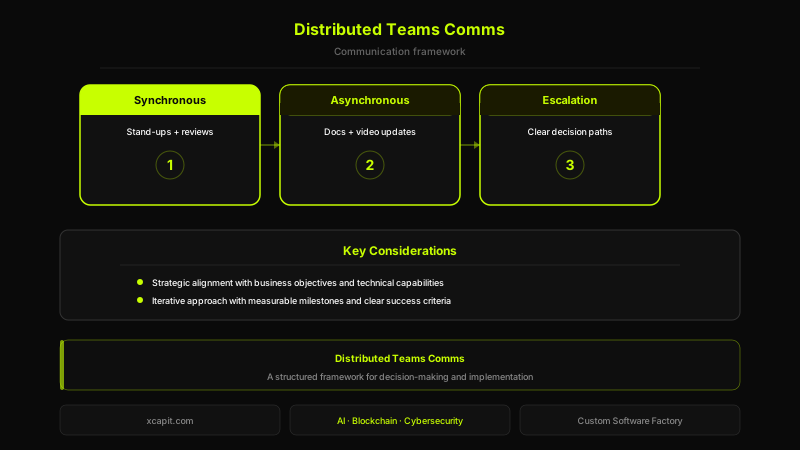
With offices in Córdoba (GMT-3), Lima (GMT-5), and Miami (GMT-5 to GMT-4), we have a natural overlap period of roughly 10am to 2pm Eastern time, when all three locations are within normal working hours. How you spend those four hours is the highest-leverage decision in managing a multi-timezone team. Spend them on status updates and you have wasted the one window when synchronous decision-making is possible. Spend them on deep collaboration, decisions that require real-time negotiation, and relationship building — and you use the overlap for its actual strategic purpose.
Our overlap window protocol is explicit: no status update meetings during overlap hours. Those happen asynchronously, via written standup updates posted before the overlap window opens. The overlap window is reserved for architecture discussions, cross-team dependency resolution, stakeholder reviews, and the relationship-building conversations that cannot happen through text. We also protect a weekly overlap slot for an all-hands brief — 20 minutes, no slides, just a verbal summary of the week's priorities and one question that each team is working to answer.
A related strategy is what we call the 'morning broadcast.' Each team lead writes a morning update — typically 3 to 5 bullet points — at the start of their workday describing what they are working on, what decisions they need from other teams, and what blockers they are carrying. This update is posted to a shared channel before the overlap window opens. When the overlap window begins, both sides have context on what the other is facing, and the synchronous time can go straight to the issues that need resolution.
Documentation Culture: Building the Second Brain
The most consistent failure mode in distributed teams is knowledge living in individuals' heads rather than in shared systems. When a key engineer takes vacation, the team grinds to a halt. When someone leaves, institutional knowledge walks out the door. When a new team member joins, they spend three months asking questions that have been answered hundreds of times before. The solution is documentation culture — and it is harder to build than the tooling suggests.
Documentation culture does not emerge from mandating that people write things down. It emerges from making the cost of not documenting visible and the act of documenting frictionless. We made the cost visible by tracking what we called 'repeat questions' — questions that appeared more than once in our team channels. When we surfaced the data, teams were surprised by how much time was being spent answering the same questions. We made documentation frictionless by standardizing formats, providing templates for the most common document types, and treating good documentation as a visible contribution during performance conversations.
The specific document types that matter most for distributed software teams are: the project brief (what are we building, why, and how does it fit the larger architecture), the runbook (how do you do the most common operational tasks on this system), the decision log (what significant decisions were made about this project and why), and the onboarding guide (how does a new engineer get productive on this codebase in two weeks). Each of these document types addresses a different failure mode of distributed work: misaligned understanding of the project, operational knowledge gaps, decision context loss, and slow ramp-up.
Sprint Ceremonies Designed for Distributed Reality
Standard agile ceremony design assumes everyone in the same room or at least the same time zone. Sprint planning as commonly practiced — a 3-hour synchronous session where the team estimates and commits together — works reasonably well in a co-located environment. In a distributed environment, it is an exhausting way to spend a significant portion of your overlap window, and it produces lower-quality estimates because engineers in one timezone have just started their day while others are finishing. We redesigned our sprint ceremonies from the ground up with distributed constraints as the primary design requirement.
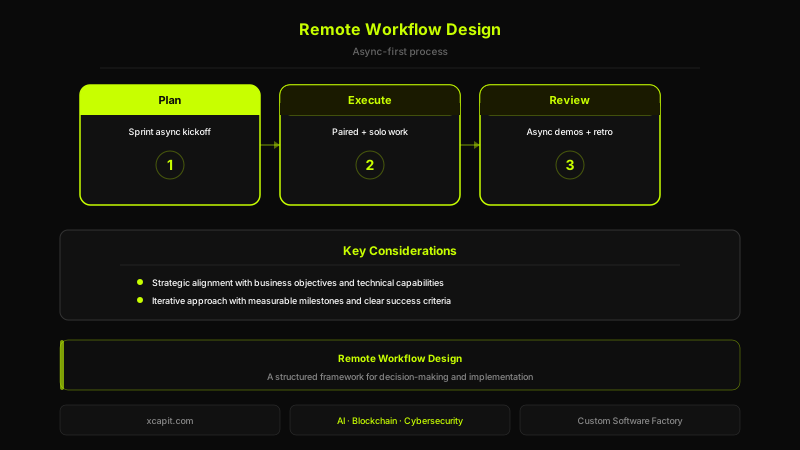
Sprint planning at Xcapit happens in two parts. The first part is asynchronous: 24 hours before sprint planning, the product manager posts the proposed sprint backlog with written context on each item. Engineers in all locations review the backlog asynchronously, leave written estimates and questions as comments, and flag any dependencies or concerns they see. The second part is synchronous: a 60-minute session focused exclusively on the items where there was disagreement or complexity that needs real-time discussion. Everything with clear agreement is already committed by the time the synchronous session starts.
Retrospectives were the ceremony we struggled with most. The traditional retrospective format — go around the room, everyone shares a feeling, the team votes on items to discuss — does not translate well to remote settings where some people feel more or less comfortable speaking up based on cultural background and relationship comfort. We shifted to an async-first retrospective format: team members submit anonymous feedback in three categories (what went well, what was difficult, what we should experiment with) before the session. The facilitator synthesizes the written input, surfaces patterns, and the synchronous session focuses on deciding which experiments to run. Response rates went from about 60% in a live format to over 90% in the async format.
Cultural Awareness as Operational Practice
Operating across Latin America and the United States means operating across genuinely different cultural orientations toward hierarchy, directness, time, and disagreement. In some of our teams, direct feedback in a group setting is comfortable; in others, a direct critique in front of peers would be experienced as deeply shaming. Building a distributed team that works requires not just tolerating this variation but designing for it. The async-first culture helps: written feedback is easier to calibrate for directness, easier to revise before sending, and easier to receive at one's own pace.
The 1:1 cadence is the single most important tool for cultural navigation in a distributed team. We run weekly 1:1s between managers and direct reports, with a standing agenda that always includes: how is the work going, what is blocking you, how are you feeling about the team dynamics, and one question about the person's professional development. That last item is not peripheral — it is how you discover that someone is considering leaving, or is burned out, or has a skill they want to develop that could benefit the team. In a distributed environment, you cannot pick up these signals by walking past someone's desk. You have to create space for them explicitly.
Onboarding Remote Engineers: The First 30 Days
Poor remote onboarding is the single largest driver of early attrition we have observed. Engineers who do not feel productive within their first two weeks question whether they made the right decision. The challenge is that good remote onboarding requires more structure, not less — because the casual context that a new hire picks up by sitting near experienced colleagues does not happen automatically in a distributed environment.
Our 30-day onboarding structure assigns every new engineer a dedicated onboarding buddy — a senior engineer specifically tasked with helping them get productive, not their manager. The buddy conducts daily 15-minute check-ins for the first two weeks, then moves to every-other-day check-ins for weeks three and four. The new engineer is given a structured task list that covers environment setup, codebase orientation, a first contribution (typically a well-scoped bug fix or documentation improvement), and a first feature ticket. The task list is designed to ensure the engineer has a visible commit in the production codebase within their first week — not because the contribution is significant, but because the act of shipping something creates momentum and belonging.
Measuring Productivity Without Micromanaging
The pressure to micromanage remote teams comes from anxiety about visibility — if I cannot see someone working, how do I know they are working? The answer is to shift from measuring inputs (hours online, messages sent, commits made) to measuring outputs (features shipped, decisions unblocked, dependencies resolved, code review time). Input metrics create perverse incentives: engineers who optimize for looking busy rather than being effective. Output metrics create alignment with what actually matters.
At the team level, we track four metrics on a weekly basis: cycle time (from ticket creation to deployment), code review response time (how quickly pull requests receive a first review), deploy frequency (how often we are shipping to production), and blocker resolution time (how quickly team members respond to requests for decisions or information). These four metrics capture the health of the delivery process without measuring individual behavior in a way that creates surveillance anxiety.
- Async-first means designing messages for recipients who cannot respond immediately — include context, the specific question, relevant constraints, and a timeline
- Protect the overlap window for decisions and relationship-building, not status updates — status happens asynchronously via morning broadcasts
- Architectural Decision Records stored in the codebase eliminate the category of confusion that comes from undocumented decisions
- Sprint planning in two parts — async preparation plus focused synchronous session — produces better estimates in less time than a single long meeting
- Weekly 1:1s with a standing agenda that includes professional development are the primary early-warning system for burnout, attrition risk, and team friction
- Measure cycle time, review response time, deploy frequency, and blocker resolution — not hours online or messages sent
At Xcapit, these practices were developed through iteration across our offices in Córdoba, Lima, and Miami — and refined further through the distributed delivery models we use with clients across Latin America and the United States. If you are building a distributed engineering organization and want to understand how we structure our delivery model, visit xcapit.com/how-we-work for a detailed overview of our operational approach.

Antonella Perrone
COO
Previously at Deloitte, with a background in corporate finance and global business. Leader in leveraging blockchain for social good, featured speaker at UNGA78, SXSW 2024, and Republic.
You Might Also Like
The field's digital notary: what blockchain is (and why you don't need to understand the code to use it)
You don't need to know how a combine harvester's computer works to operate it. Blockchain is the same: a write-only record that guarantees provenance and cannot be forged.
Custom software or an existing solution? How to make the best decision for your company
Buy or build is one of the most important decisions in any digital transformation project. When each option makes sense, why the right question is not binary, and how to assess long-term impact.
What is a Product Builder and why will it be one of the most important roles in digital transformation?
When building gets faster and faster, the challenge becomes knowing what is worth building. What a Product Builder does, how they connect business and technology, and why AI amplifies their work without replacing their judgement.