

What Technical Debt Actually Means
Ward Cunningham coined the technical debt metaphor in 1992 to describe a specific and defensible business decision: shipping code that works but isn't designed as well as it could be, in exchange for shipping it faster. Like financial debt, technical debt has a principal (the work deferred) and interest (the extra time required for every future change because of the shortcuts taken). The metaphor is powerful because it frames the trade-off in terms that non-technical stakeholders understand: borrowing against the future to move faster today.
What the metaphor doesn't fully capture is the diversity of debt types. Not all technical debt arises from conscious shortcuts. Some arises from evolving requirements that make previously correct designs obsolete. Some arises from outdated dependencies, deprecated frameworks, or the natural aging of libraries that are no longer maintained. Some arises from early architectural decisions that were reasonable at small scale but don't survive growth. And some — the most problematic kind — arises from negligence, ignorance, or the absence of engineering standards.
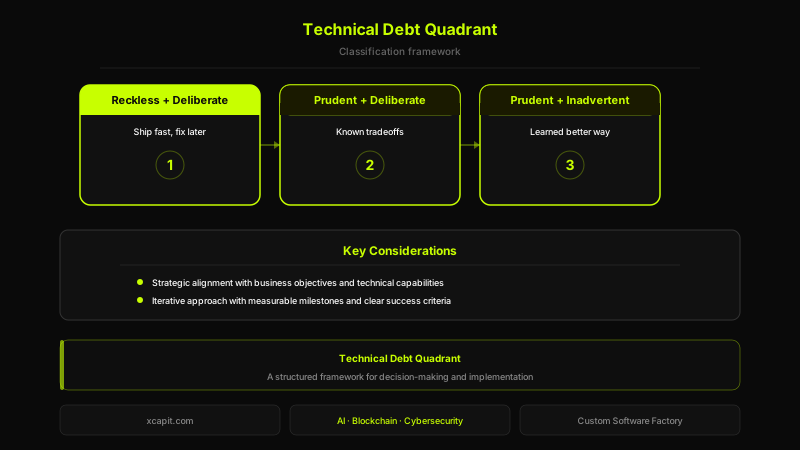
Martin Fowler's technical debt quadrant maps this diversity across two dimensions: intentionality (deliberate vs. inadvertent) and prudence (reckless vs. prudent). Understanding which quadrant a piece of debt falls into determines how it should be addressed. Deliberate and prudent debt is a strategic tool. Deliberate and reckless debt is a red flag about team culture. Inadvertent and prudent debt is the inevitable output of learning and growth. Inadvertent and reckless debt is a symptom of broken engineering practices that need structural intervention.
The Four Quadrants in Practice
Deliberate, prudent debt is the only kind you should accept consciously. A classic example: you know your data model is wrong for how the product will eventually be used, but refactoring it will take three weeks and delay a launch that's critical for investor relations or a customer commitment. You ship with the current model, document the decision and the planned refactor, and schedule the debt repayment in the next quarter. This is debt as a strategic tool — used judiciously with a clear repayment plan.
Deliberate, reckless debt is the 'we don't have time for tests' mentality adopted as a permanent posture rather than a temporary emergency measure. Teams that routinely ship without tests, skip code review, or copy-paste implementations without understanding the underlying code are accumulating reckless debt that grows compounding interest. The distinction from prudent debt is the absence of a repayment plan and the normalization of shortcuts as acceptable practice rather than emergency measures.
Inadvertent, prudent debt is the natural output of learning. You built a service with the best understanding you had at the time, and over the following year your understanding of the domain deepened, the product evolved, and the original design no longer fits well. No one made a bad decision — the world changed. This is the most common form of debt in fast-moving startups, and it's manageable when treated as a normal part of the software lifecycle rather than a failure.
Inadvertent, reckless debt is the most dangerous category because it's invisible. It arises when teams don't know enough to recognize that their approach is creating future problems — using an ORM incorrectly in ways that generate N+1 queries, building authentication without understanding security implications, or designing a database schema that can't support the query patterns the product will eventually require. This debt requires investment in skills and standards to address, not just time.
When Speed Beats Quality: The Startup Context
The startup context fundamentally changes the calculus of technical debt. A product that has not yet found product-market fit — where the core hypothesis about customer value is still being tested — should absolutely prioritize speed of experimentation over architectural purity. Building a perfect codebase for a product that doesn't solve a real problem is a waste of time that better-funded competitors will exploit.
The critical distinction is between pre-PMF and post-PMF development. Before product-market fit, the risk of moving too slowly is existential — you might run out of runway before validating your hypothesis. After product-market fit, the risk profile flips: the product works and users depend on it, which means reliability and maintainability start to matter much more, and the cost of accumulated technical debt starts to compound against a larger user base and a more complex feature set.
We've observed this pattern consistently across the products we've built, including our own fintech products that reached over 4 million users. Early-stage velocity requires accepting some architectural debt. But teams that don't shift their debt posture after achieving PMF find themselves 18-24 months later with a codebase where adding any new feature requires 3-4x the effort it used to require — the classic symptom of accumulated interest consuming engineering capacity.
The practical guideline: accept deliberate, prudent debt freely in the pre-PMF phase, document every instance explicitly in a debt register, and plan a structural refactoring sprint immediately after your first significant growth milestone. Waiting longer than one quarter post-PMF to begin systematic debt reduction is almost always a mistake.
Measuring Technical Debt Impact
Technical debt is notoriously difficult to quantify, which makes it difficult to prioritize against other engineering investments. The most useful metrics are not code quality scores from static analysis tools — which measure symptoms rather than business impact — but operational indicators that reveal where debt is actually affecting team performance.
Change failure rate — the percentage of deployments that result in a production incident, rollback, or hotfix — is one of the clearest signals of debt in critical code paths. If changing a specific service consistently causes incidents, that service has debt that's making it fragile. Tracking failure rate by service or domain over time reveals which areas are most debt-laden and where investment will have the most impact.
Lead time for changes — the time from a code commit to deployment in production — is another high-signal metric. In a debt-free environment, lead time is driven by review and deployment infrastructure. In a debt-heavy environment, engineers spend significant time understanding old code, navigating complex interdependencies, and writing workarounds for brittle systems. Rising lead time in a stable team is almost always a debt signal.
Developer time surveys, while qualitative, are surprisingly predictive. Asking engineers 'what percentage of your time last week was spent on new features versus fighting existing code?' correlates well with debt accumulation. Teams spending more than 30% of their time on maintenance, debugging, and workarounds are in a debt crisis. Teams spending under 15% have their debt under control.
Tools like SonarQube, CodeClimate, and Codacy provide code quality metrics (test coverage, code complexity, duplications, known vulnerability patterns) that serve as leading indicators. They won't tell you the business impact of debt, but they provide consistent measurement that tracks direction over time. A codebase where complexity is decreasing and coverage is increasing is heading in the right direction, regardless of the absolute values.
Refactoring Strategies That Don't Stall Feature Delivery
The most common refactoring mistake is the Big Bang rewrite — stopping feature development for a quarter to rebuild the codebase from scratch. This approach almost always fails. The new codebase accumulates its own debt during the rewrite, requirements change during the extended development period, and the team loses momentum and morale. More fundamentally, the business doesn't stop needing features while the rewrite is in progress.
The Strangler Fig pattern, named by Martin Fowler after a vine that gradually replaces its host tree, is the most reliable alternative. Instead of replacing the old system all at once, you build new functionality in the target architecture alongside the old system and gradually migrate traffic from the old to the new. The old system 'dies' as its responsibilities are transferred, usually over a period of months rather than a single sprint. The key advantage is that the migration is always reversible — if the new implementation has problems, you can route traffic back to the old one without a crisis.
Boy Scout Rule refactoring — 'always leave the code cleaner than you found it' — is the complementary micro-level practice. When an engineer touches a module to add a feature or fix a bug, they make one small improvement to the surrounding code: rename a confusing variable, extract a long function into smaller units, add a missing test for an existing behavior, or update a deprecated dependency in that module. Applied consistently, this practice prevents debt from accumulating in frequently-touched code without requiring dedicated refactoring sprints.
Feature flags are an underappreciated tool for managing debt reduction risk. When replacing a critical component, wrapping both the old and new implementations behind a feature flag allows you to release to a small percentage of traffic initially, monitor for differences in behavior or performance, and gradually expand the rollout with the ability to revert instantly if problems appear. This reduces the risk of major architectural changes to a level that makes stakeholders comfortable with the investment.
The 20% Rule: A Sustainable Debt Reduction Cadence
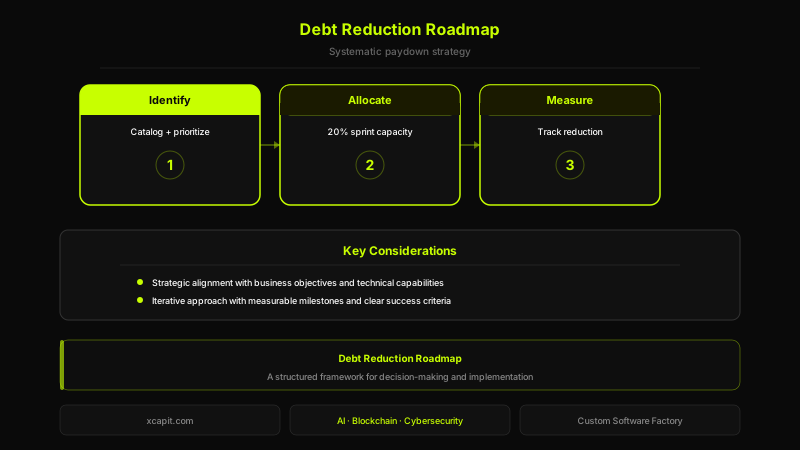
The 20% rule — popularized by Google's practice of allowing engineers to spend 20% of their time on self-directed projects — has a debt management analog: allocating 20% of engineering capacity to technical debt reduction as a standing sprint commitment. In practice, this means one day per week or one sprint per five is dedicated to the debt backlog rather than the product backlog.
The key to making the 20% rule work is treating debt reduction work with the same rigor as feature work: defined tasks, acceptance criteria, code review, and tests. 'Refactor the authentication module' is not a task — 'extract the JWT validation logic into a reusable middleware, add unit tests covering the six documented edge cases, and remove the three duplicate implementations' is a task. Vague debt tasks evaporate under sprint pressure; specific, scoped tasks can be defended.
The 20% allocation also needs to be defended in planning ceremonies. Sprint planning that consistently defers debt work 'because there are important features this sprint' will find that important features never stop arriving. Engineering leaders need to treat the debt allocation as a fixed cost — like rent, it's paid every period — rather than a discretionary investment that competes with feature work on merit each cycle.
Some teams prefer a quarterly 'debt sprint' — a full iteration dedicated entirely to technical improvements — over the weekly 20% allocation. This approach concentrates debt work into a period where engineers can tackle larger, more complex improvements that require sustained focus rather than context-switching. The risk is that debt accumulates for four months between debt sprints. The right choice depends on the team's debt accumulation rate and the nature of the debt — if most of it is large architectural items that benefit from a week of concentrated work, quarterly sprints make sense; if debt is diffuse and manageable in small increments, weekly allocation is better.
Building a Technical Debt Register
A technical debt register is a living document that tracks known debt items with enough information to prioritize and schedule them. The minimum viable register entry includes: a description of the debt, the quadrant it falls into (deliberate-prudent is most common in managed environments), the estimated cost to repay in developer-days, the estimated cost of not repaying (in increased maintenance time, bug risk, or blocked capabilities), and the planned repayment date or trigger.
The repayment trigger is often more useful than a repayment date. Instead of 'we'll fix the payment processing module in Q2,' the trigger is 'we'll refactor the payment processing module when we need to add a second payment provider, which will require touching it anyway.' This connects the debt repayment to the natural forcing function of product requirements, which makes the repayment easier to schedule and justify.
Tools for tracking the debt register range from a simple Notion or Confluence table to dedicated technical debt boards in Jira, Linear, or Shortcut. The sophistication of the tooling matters less than the discipline of updating it. A simple table that's reviewed monthly and updated whenever new debt is incurred is far more valuable than an elaborate system that's ignored after the first quarter.
Communicating Technical Debt to Non-Technical Stakeholders
The most common failure mode in technical debt management is the communication gap between engineering and leadership. Engineers who can't translate 'our service mesh has accumulated significant coupling that makes feature development increasingly slow' into business terms will struggle to get the investment they need. Engineers who frame debt in business terms — reliably — will find leadership partners more willing to allocate time and resources.
The translation framework has three components. First, quantity the current cost: 'The authentication module's technical debt currently costs us approximately 8 developer-hours per sprint in workarounds, debugging, and code archaeology — that's one full developer-day per week, or roughly $X in annual engineering time.' This converts abstract code quality concepts into concrete resource costs.
Second, quantify the opportunity cost: 'The complexity of our current architecture means any new feature that touches the payment flow takes 3x longer to develop and test than it would in a well-structured system. Three specific features on the roadmap are blocked or significantly slowed by this debt: [list them].' This connects debt to product delivery timelines that leadership already cares about.
Third, propose a specific investment with a measurable expected return: 'Four weeks of refactoring would reduce the payment module's complexity to a level where payment-related features take roughly the same effort as features in our other modules. Based on the three blocked features, this investment pays back within two quarters.' Specificity builds credibility and gives stakeholders something concrete to evaluate.
- Track and report key debt metrics (change failure rate, lead time, developer maintenance ratio) on a regular cadence so trends are visible before they become crises.
- Use the debt quadrant to classify new debt at the moment it's incurred — this creates a shared vocabulary and prevents debate about whether a shortcut is acceptable.
- Set a 'debt alarm' threshold: if the developer maintenance ratio exceeds 25%, trigger a formal debt reduction initiative rather than waiting for the annual planning cycle.
- Celebrate debt reduction wins visibly — when a refactoring project measurably improves development velocity or reduces incidents, communicate the impact to the full team and to leadership.
- Involve product managers in debt prioritization — they can help sequence debt reduction work to coincide with natural opportunities (feature work that touches the same code, low-roadmap-pressure periods) where the cost of paying down debt is lowest.
Real Examples: Debt Patterns in Fast-Growing Products
Across our work building digital products — from blockchain wallets to AI-powered enterprise systems — we've encountered the same debt patterns repeatedly. Knowing these archetypes helps teams recognize them early.
The 'monolith masquerading as microservices' pattern is common in products that decomposed into services too early or too quickly. The services are deployed independently but share a database, making them logically coupled despite being operationally separate. This debt is expensive to resolve because it requires migrating data, establishing service boundaries through APIs, and often renegotiating service ownership across teams. It's best avoided by starting with a well-structured monolith and extracting services only when clear service boundaries emerge from the domain.
Implicit business logic in the database is another common pattern. When validation, business rules, and data transformation logic live in stored procedures, triggers, or application code that directly manipulates the database, they become invisible to the application layer and impossible to test in isolation. This debt typically accumulates when development moves faster than the architectural patterns are established, and it makes eventual database migration — which every growing product eventually needs — extremely expensive.
Hardcoded configuration is debt that seems trivial in development and becomes critical in production. Environment-specific values (API endpoints, feature flags, timeout values, rate limits) embedded in source code rather than externalized configuration make environment promotion error-prone, prevent runtime configuration without redeployment, and create security risks when credentials migrate into source control. The fix is straightforward but requires touching every affected service — making it a good candidate for the Boy Scout approach.
Technical debt is not a sign of failure — it's a sign that a team has moved fast enough to matter. The discipline lies in managing it intentionally rather than accumulating it blindly. At Xcapit, we bring this framework to every custom software engagement: helping teams assess their current debt load, establishing sustainable practices for ongoing management, and executing targeted refactoring that improves velocity without halting delivery. If your engineering team is feeling the drag of accumulated debt, explore our custom software capabilities at /services/custom-software or get in touch to discuss your situation.

Santiago Villarruel
Product Manager
Industrial engineer with over 10 years of experience excelling in digital product and Web3 development. Combines technical expertise with visionary leadership to deliver impactful software solutions.
Need custom software that scales?
From MVPs to enterprise platforms — built right.
You Might Also Like
Custom software or an existing solution? How to make the best decision for your company
Buy or build is one of the most important decisions in any digital transformation project. When each option makes sense, why the right question is not binary, and how to assess long-term impact.
Software Factory vs In-House Development: A Decision Framework for 2026
A balanced, data-driven guide for CTOs and engineering leaders comparing in-house development teams with software factory partnerships. Includes cost breakdowns, decision criteria, hybrid models, and a structured framework to make the right choice for your organization.
Outsourcing Software Development to Argentina: A 2026 Guide for US & European Companies
Everything you need to know about outsourcing software development to Argentina -- from timezone advantages and talent pool to legal frameworks, costs, and how to choose the right partner.