
For years, the blockchain industry struggled with a credibility problem. The technology promised to transform everything, but the most visible use cases -- speculative tokens, volatile cryptocurrencies, NFT profile pictures -- felt disconnected from the way businesses actually operate. That is changing. Real-world asset (RWA) tokenization is emerging as the use case that bridges blockchain infrastructure and traditional business, converting physical and financial assets into programmable digital tokens that can be traded, fractionalized, and managed on-chain. And unlike many blockchain narratives, this one is backed by institutional capital, regulatory progress, and measurable adoption.
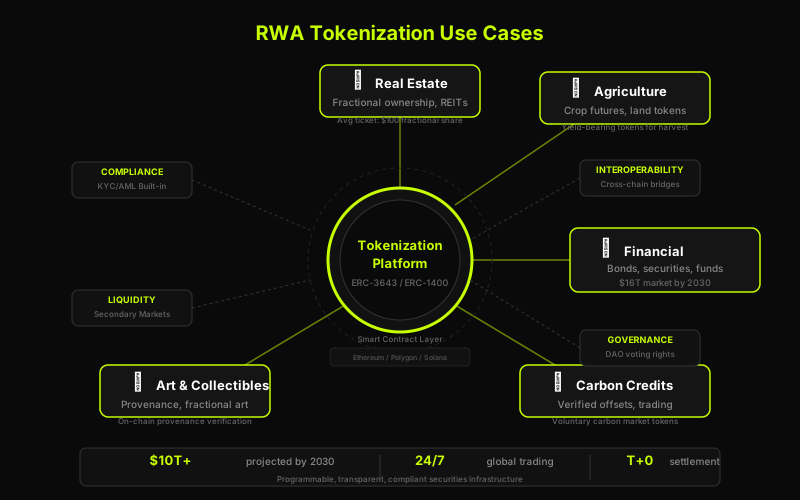
Boston Consulting Group projects the tokenized asset market to reach $16 trillion by 2030. BlackRock launched its BUIDL tokenized Treasury fund in 2024 and expanded it across multiple chains. Franklin Templeton's tokenized money market fund surpassed $700 million in assets. JP Morgan's Onyx processes billions in tokenized repo transactions daily. These are not startups experimenting -- they are some of the world's largest financial institutions committing real capital to tokenized infrastructure.
What Tokenization Actually Means
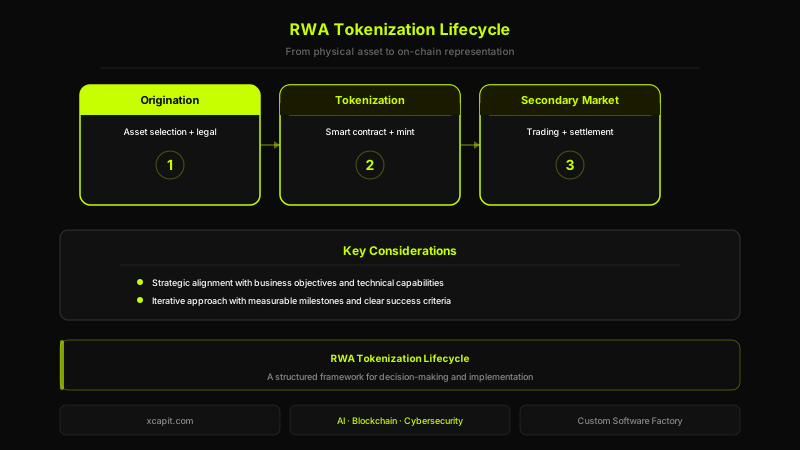
At its core, tokenization is the process of creating a digital representation of an asset on a blockchain. The token does not replace the underlying asset -- it represents ownership, rights, or claims associated with that asset in a form that is natively digital, programmable, and transferable on a distributed ledger. An asset is identified and valued, placed into a legal structure (typically a special purpose vehicle, trust, or similar wrapper), and smart contracts are deployed that encode the rights token holders receive: who can hold the tokens, how transfers work, when income is distributed, and what happens in edge cases like defaults or liquidations.
The key properties that make tokenization valuable are not individual features but their combination. Fractional ownership allows a $50 million building to be divided into 50,000 tokens of $1,000 each. Programmable compliance means transfer restrictions and investor accreditation checks are enforced automatically at the smart contract level. Near-instant settlement replaces T+2 or T+3 cycles with atomic transactions that clear in seconds. And 24/7 market access removes the constraint of trading hours and geographic boundaries.
Real Estate: Fractional Ownership at Scale
Real estate is the largest asset class in the world -- valued at over $326 trillion globally -- and also one of the most illiquid. In a tokenized structure, a property is placed into a legal vehicle -- a REIT, an SPV, or in Latin America, a fideicomiso financiero. Tokens represent fractional interests in this vehicle, entitling holders to proportional shares of rental income, capital appreciation, and voting rights. Smart contracts automate rental distributions, management fee calculations, and the enforcement of holding periods or accreditation requirements.
The practical benefits are substantial. A developer in Buenos Aires can raise capital from global investors in $500 increments rather than requiring $100,000 minimums. Platforms like RealT, Lofty, and Tokeny have collectively tokenized hundreds of properties with real tenants paying real rent distributed to token holders via smart contracts. But the challenges are equally real: legal enforceability varies by jurisdiction, property management still requires human intervention, and secondary markets for tokenized real estate remain thin.
Agricultural Commodities: From Grain Tokens to Carbon Credits
Agriculture represents a compelling tokenization opportunity, particularly in commodity-exporting economies like Argentina, Brazil, and the United States. Grain tokenization is the most straightforward application: a farmer deposits harvested grain in a certified storage facility, tokens are minted against the verified inventory, and those tokens can be sold to investors, used as collateral for financing, or traded on secondary markets. Smart contracts enforce quality verification, storage fee deductions, and delivery settlement. The farmer gets immediate liquidity instead of waiting for seasonal sale windows.
Carbon credits are a more complex but equally promising use case. The voluntary carbon market has been plagued by credibility issues -- double-counting, phantom credits, and opaque verification processes. Blockchain provides a transparent, immutable registry where each credit is issued once, traded with full provenance, and retired permanently when used for offsetting. At Xcapit, we built a three-token energy platform for EPEC and the government of Cordoba, Argentina, that tracks renewable energy from generation at solar parks through to the issuance of verifiable Renewable Energy Certificates on blockchain. For the full implementation details, read our EPEC energy tokenization case study. This kind of infrastructure -- connecting physical generation to digital certificates with full traceability -- is exactly what the carbon credit market needs.
Supply chain transparency extends the value further. When a commodity is tokenized at origin, every subsequent transfer, quality check, and processing step can be recorded on-chain. A European buyer importing Argentine soybeans can verify the entire chain of custody from farm to port, including environmental compliance data -- increasingly mandated by regulations like the EU Deforestation Regulation.
Financial Instruments: Bonds, Invoices, and Receivables
Financial instruments are where institutional adoption is most advanced. Bonds, notes, and receivables are already abstract -- they exist as entries in databases, not as physical objects. Converting them to blockchain-based tokens is less of a conceptual leap. The European Investment Bank issued a EUR 100 million digital bond on Ethereum in 2021, and the pace has accelerated since. BlackRock's BUIDL fund reached over $500 million within months. The World Bank, the Bank of Israel, and the Hong Kong Monetary Authority have all issued tokenized bonds.
Invoice and receivables tokenization addresses a different segment. Small and medium businesses globally hold an estimated $3 trillion in outstanding invoices at any time. Tokenizing these receivables lets businesses sell them at a discount to investors, converting future cash flows into immediate working capital. Smart contracts automate invoice verification, discount rate calculation, and payment settlement. Platforms like Centrifuge and Goldfinch have built DeFi protocols specifically for this, connecting real-world borrowers with on-chain capital. JP Morgan estimates tokenization could save the fixed income market $20 billion annually in settlement and custody costs.
Art and Collectibles: Provenance and Fractional Access
The art market has two fundamental problems tokenization can solve. Provenance -- establishing ownership history -- relies on paper records, expert opinions, and trust in auction houses; forgery and disputed provenance cost billions annually. Accessibility limits participation to ultra-high-net-worth individuals. Tokenization addresses both: a physical artwork receives a unique digital identity on blockchain, with every subsequent sale, exhibition, and ownership transfer recorded immutably. Fractional ownership tokens let investors purchase shares in high-value artworks -- platforms like Masterworks allow investments for as little as $20 in paintings by Basquiat, Banksy, and Warhol.
The limitations are significant, however. Art is inherently illiquid regardless of the wrapper, valuation is subjective in ways that bonds are not, and the legal framework for fractional art ownership is still developing in most jurisdictions.
The Regulatory Landscape
Regulation is both the biggest enabler and the biggest bottleneck for RWA tokenization. The EU's MiCA regulation, fully effective since December 2024, provides the most comprehensive framework, with its DLT Pilot Regime allowing regulated infrastructures to trade and settle tokenized instruments on distributed ledgers. In the United States, the SEC channels tokenization through existing securities pathways -- Regulation D, Regulation S, and Regulation A+ -- producing a growing number of compliant offerings through platforms like Securitize and tZERO.
Latin America is moving quickly. Argentina's CNV established a tokenization sandbox through Resolutions 1069, 1081, and 1087, enabling digital representation of shares, bonds, and trust certificates on blockchain through August 2026. Brazil's CVM has authorized tokenized receivables. Switzerland, Singapore, the UAE, and Hong Kong have each developed tailored frameworks. The challenge is cross-border recognition -- a token issued under Argentine law may not be recognized in Germany without additional legal work, and this jurisdictional fragmentation is a problem technology alone cannot solve.
Technical Architecture for Regulated Tokens
ERC-3643: The Standard for Regulated Tokens
ERC-3643, also known as T-REX (Token for Regulated EXchanges), has emerged as the leading Ethereum-based standard for security tokens. Unlike ERC-20, which allows unrestricted transfers, ERC-3643 embeds compliance checks directly into the transfer function. Every transfer is validated against on-chain rules: is the sender verified? Is the receiver in a permitted jurisdiction? Has the holding period expired? The standard includes an on-chain identity layer where verified claims -- accredited investor status, jurisdiction, KYC completion -- are stored as attestations issued by trusted claim issuers. Over $28 billion in assets have been tokenized using ERC-3643.
Oracle Integration and Custody
Tokenized real-world assets require reliable connections between on-chain smart contracts and off-chain data. Oracle networks -- Chainlink, Pyth, RedStone -- provide price feeds, proof of reserves, and event triggers. Chainlink's Proof of Reserve service is particularly relevant, providing automated on-chain verification that off-chain reserves actually exist and match the token supply. On the custody side, regulatory frameworks universally require qualified custodians for underlying assets. The dual custody challenge -- securing both the physical asset (title held by a trust company, grain in a certified warehouse) and the digital token (via institutional-grade MPC wallets from Fireblocks, Copper, or BitGo) -- is unique to RWA tokenization.
Challenges That Remain
- Legal enforceability: The connection between a digital token and legal rights over a physical asset depends entirely on the legal structure. If the SPV holding a building is dissolved or challenged in court, token holders may find their on-chain ownership does not translate to enforceable claims.
- Secondary market liquidity: Tokenization creates infrastructure for liquidity, but liquidity requires active markets. Most tokenized asset markets today are thin, with wide bid-ask spreads. Until regulated exchanges list tokenized assets alongside traditional securities, liquidity remains more promise than reality.
- Custody complexity: Securing a physical asset and its digital representation simultaneously creates dual points of failure. Insurance, redundancy, and operational risk management must cover both layers.
- Oracle reliability: If a price oracle is manipulated or a proof of reserve is not updated in time, on-chain logic will execute incorrectly with potentially significant financial consequences.
- Regulatory fragmentation: A compliant token in Switzerland may be an unregistered security in the United States. Until cross-border harmonization advances, this fragmentation limits the global reach of tokenized assets.
Where the Market Is Heading
Several convergent forces are accelerating RWA tokenization. CBDCs and regulated stablecoins are creating on-chain settlement rails. Traditional infrastructure providers -- DTCC, Euroclear, Clearstream -- are building DLT capabilities. Institutional allocators are running tokenization pilots because cost savings in settlement and custody are too large to ignore.
We expect tokenized government bonds and money market funds to become the dominant institutional entry point, followed by real estate and private credit as secondary market infrastructure matures. Emerging markets -- particularly in Latin America -- will see disproportionate adoption because tokenization solves problems that are more acute there: limited capital market access, illiquid local exchanges, currency instability, and high barriers to cross-border investment. Ultimately, the distinction between tokenized and traditional assets will blur as legacy infrastructure adopts DLT at the settlement layer.
At Xcapit, we have been building tokenization infrastructure since before the market had a name for it. From our three-token energy platform for EPEC and the government of Cordoba to digital asset platforms reaching over 4 million users in 167 countries, our team combines deep smart contract engineering with the regulatory navigation and custody integration that RWA tokenization demands. We hold ISO 27001 certification and bring production experience with ERC-3643, oracle integration, and compliant token architectures across Latin American and international jurisdictions. If you are evaluating tokenization for real estate, commodities, financial instruments, or any other asset class, we can help you design the legal structure, build the technical platform, and launch with confidence. Reach out at /contact or explore our blockchain development services at /services/blockchain-development.

Santiago Villarruel
Product Manager
Industrial engineer with over 10 years of experience excelling in digital product and Web3 development. Combines technical expertise with visionary leadership to deliver impactful software solutions.
Building regulated financial products?
From digital wallets to tokenized collateral and secure platforms, we build fintech systems designed for production.
You Might Also Like
Tokenized Warrants Are Changing How Latin American Agriculture Gets Credit
Why the next generation of agricultural credit in Latin America runs on tokenized commodity warrants — and what the 2026 stack actually looks like.
Breaking the illiquidity barrier: tokenization as a financial bridge for agriculture
Farms are full of high-value, illiquid assets: stored grain, growing herds, forward contracts. How real-world asset tokenization turns them into digital collateral without liquidating them.
Argentina is writing the rules of the onchain financial future. We're already playing.
Argentina's CNV extended the regulatory sandbox until 2027 with RG 1137. More eligible assets, smaller issuers, and a global RWA market of US$30B. Why this regulatory moment matters — and why Xcapit already has the infrastructure ready.