
Argentina has emerged as one of Latin America's most proactive jurisdictions in regulating digital assets. In less than two years, the country's securities regulator -- the Comision Nacional de Valores (CNV) -- has moved from exploratory guidelines to a structured tokenization framework that enables the digital representation of real-world assets on blockchain networks. Combined with the Central Bank's (BCRA) evolving stance on allowing banks to offer crypto services and the passage of Law 27,739 creating a formal Virtual Asset Service Provider (VASP) regime, Argentina is building a regulatory infrastructure that is unusually coherent for the region. This article breaks down what these regulations actually say, how they compare to international frameworks, and what they mean in practice for founders, legal teams, and technical architects building tokenization projects in Argentina.
For anyone who has worked in blockchain development across Latin America, Argentina's current trajectory is remarkable. This is a jurisdiction that, until recently, had no formal crypto legislation and relied on a patchwork of central bank communications, tax authority interpretations, and ad hoc enforcement. The speed at which a cohesive framework has materialized reflects both political will under President Milei's market-liberalization agenda and practical necessity -- Argentina already has one of the highest crypto adoption rates in the world, driven by decades of currency instability and triple-digit inflation that made digital dollars and stablecoins essential financial tools for millions of citizens.
The CNV Tokenization Framework: Resolutions 1069, 1081, and 1087
The cornerstone of Argentina's token regulation is a series of General Resolutions issued by the CNV that progressively expand the scope of assets eligible for tokenization.
Resolution 1069 established the initial framework, creating a regulatory sandbox for the tokenization of publicly offered financial trusts (fideicomisos financieros) and closed-end mutual funds composed of real-world assets. It formally recognized distributed ledger technology (DLT) as a valid modality for representing tradable securities -- placing tokenized assets on equal legal footing with traditional certificated or book-entry forms. Resolution 1081 then formalized the operational parameters of the sandbox and its technology infrastructure requirements.
The most significant expansion came on October 22, 2025, with Resolution 1087. This resolution widened eligible instruments to include shares (acciones), negotiable obligations (obligaciones negociables, equivalent to corporate bonds), debt representation securities, certificates of participation in financial trusts, and units of closed common credit investment funds with a public offering. The sandbox remains active through August 21, 2026.
Key Operational Rules Under Resolution 1087
Resolution 1087 introduced several provisions with direct implications for platform design. Settlement and clearing agents can now serve as registered holders of tokenized assets, bridging traditional securities infrastructure with blockchain issuances. Certain digital asset service providers can also join the central securities depository (Caja de Valores) as depositors. Issuers must include detailed disclosures about the digital representation -- associated risks, the identity of any VASPs involved, and the specific technology stack -- protecting investors while giving the CNV the technical information needed to assess systemic risks.
One of the most market-friendly provisions is the elimination of the listing requirement for fully tokenized issuances. When a security is 100% digitally represented, it no longer needs to be listed on an authorized market. The framework does exclude certain instruments: social, green, and sustainable (SGS) or sustainability-linked (SL) securities, as well as low-impact automatic public offerings, are not eligible under the current regime.
Token Classification Under Argentine Law
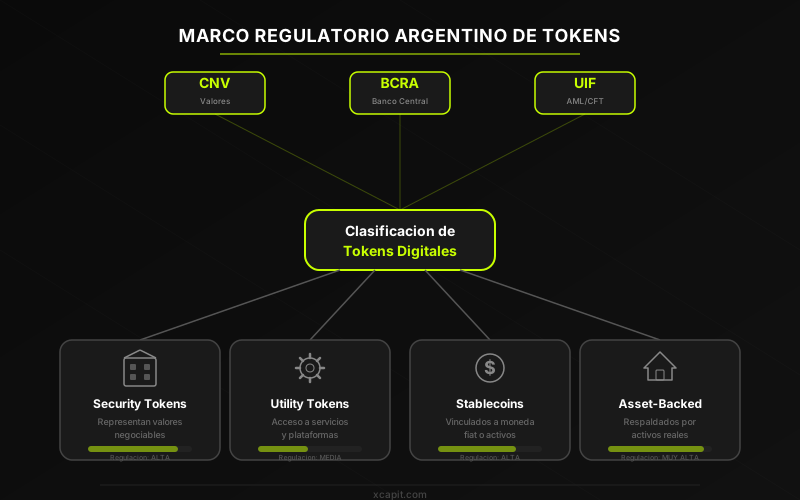
While Argentina does not yet have a unified token taxonomy comparable to MiCA's classification into asset-referenced tokens (ARTs), e-money tokens (EMTs), and other crypto-assets, the regulatory framework implicitly creates several functional categories.
Security tokens -- representing ownership in financial instruments such as shares, bonds, or trust certificates -- fall squarely under the CNV's tokenization framework and must comply with public offering requirements and sandbox conditions. Utility tokens that provide access to a service but do not represent financial instruments occupy a grayer space; if they do not meet the definition of a security under Ley 26,831, they may fall outside the CNV's direct jurisdiction. However, if a utility token creates an expectation of profit derived from the efforts of others -- a test similar to the U.S. Howey test -- the CNV may assert authority.
Stablecoins like USDT and USDC, widely used in Argentina as an inflation hedge, fall under the VASP regime rather than the tokenization framework. Asset-backed tokens -- digital representations of real estate, agricultural commodities, or carbon credits -- represent the most commercially significant category. When structured as participation certificates in financial trusts, they fit neatly under the CNV framework. Other structures may require creative legal engineering.
The VASP Registration Regime: Law 27,739 and Resolution 1058
Law 27,739 (passed March 2024) established Argentina's VASP regime and designated the CNV as the supervisory authority for crypto service providers. The CNV's General Resolution 1058 operationalized the requirements. Registration is mandatory for entities with monthly transaction volumes exceeding 35,000 UVA (approximately $29,000 USD), and also captures foreign entities generating more than 20% of their turnover from Argentine users, using an ".ar" domain, or targeting Argentine residents through advertising. Registration deadlines were staggered through September 2025, and entities that failed to register face enforcement actions.
Compliance Obligations for Registered VASPs
The compliance requirements under Resolution 1058 are substantial. VASPs must implement strict KYC procedures, including identity verification and enhanced due diligence for higher-risk accounts. Continuous transaction monitoring is required, with suspicious activity reports filed to the Unidad de Informacion Financiera (UIF) within 150 calendar days. Fund segregation is mandatory -- client assets must be held separately from operational funds, with regular audits. Monthly CNV reporting covers transaction volumes, user counts, custody balances, and security incidents.
VASPs must also implement cybersecurity programs (penetration testing, vulnerability management, incident response) and present clear risk disclosures to users covering price volatility, custody risks, and the distinction between insured bank deposits and uninsured digital asset holdings.
The BCRA's Shift: Banks and Crypto Services
In May 2022, the BCRA banned banks from facilitating any crypto transactions. The proposed reversal, reportedly being drafted for implementation by April 2026, would allow banks to integrate crypto services directly into their platforms through separate legal entities subject to elevated capital, security, and liquidity requirements.
If enacted, this would fundamentally reshape Argentina's digital asset landscape. Banks bring institutional-grade custody, existing KYC/AML systems, and the trust of retail customers hesitant to use standalone crypto platforms. It would also create a natural on-ramp for tokenized securities issued under the CNV framework. The BCRA has not published a final timeline, and key open questions remain around which assets banks may support, capital reserve requirements for custody, and interoperability between banking systems and decentralized protocols.
Comparison with MiCA and International Frameworks
MiCA provides a single, unified regulation across all 27 EU member states, with detailed rules for three crypto-asset categories, a comprehensive CASP authorization process, and prescriptive requirements for whitepapers and consumer protection. Over 90 firms have been authorized under MiCA as of early 2026.
Argentina's approach is more modular: Law 27,739 for VASPs, CNV Resolutions for tokenized securities, BCRA communications for banking integration, and UIF guidelines for AML/KYC. This allows faster iteration -- the CNV can expand the sandbox without legislative action -- but creates complexity as practitioners navigate multiple regulatory bodies. Compared to Brazil, which has focused on exchange licensing and Pix integration, Argentina's framework is more ambitious on tokenized securities, though Brazil's more established banking infrastructure gives it advantages in payments and stablecoins.
Tokenization Use Cases: Real Estate, Agriculture, and Carbon Credits
The practical significance of Argentina's tokenization framework becomes clear when you consider the asset classes it enables. Three categories stand out as particularly relevant to the Argentine economy and the country's competitive advantages.
Real Estate Tokenization
Argentina's real estate market has historically been dollar-denominated and reliant on cash transactions, making it illiquid and inaccessible to smaller investors. Tokenization through financial trusts enables fractional ownership, automated distributions via smart contracts, and secondary market liquidity. Under the CNV framework, a developer could structure a financial trust backed by properties, tokenize the participation certificates, and distribute them to investors gaining proportional exposure to rental income and appreciation -- all on-chain.
Agricultural Commodities
As one of the world's largest agricultural exporters, Argentina is well-positioned for tokenization of commodities -- soybeans, wheat, corn, sunflower. Tokenized grain certificates backed by physical reserves in certified storage facilities could democratize access to agricultural investment, currently dominated by large traders. Smart contracts can automate settlement based on verified delivery, price feeds, and quality certifications, reducing counterparty risk.
Carbon Credits
Argentina's vast forests, wetlands, and renewable energy potential make it a natural source of carbon credits. Tokenized carbon credits address the persistent double-counting problem by providing an immutable record of issuance, trading, and retirement, while reducing ESG reporting complexity by 30-40%. While the CNV currently excludes sustainability-linked securities, viable pathways exist through financial trust structures or the VASP regime.
KYC/AML and Compliance Requirements
Compliance is not optional in Argentina's regulated token ecosystem. The UIF -- which reports to the Ministry of Economy and Public Finance -- enforces AML/KYC requirements across all financial intermediaries, including VASPs and entities operating under the CNV tokenization framework.
Platforms must verify customer identity through government-issued documentation, cross-reference against UIF's lists of politically exposed persons (PEPs), and conduct enhanced due diligence for high-risk profiles. KYC is not a one-time event but a continuous obligation including periodic re-verification and transaction pattern analysis.
Transaction monitoring must flag structuring patterns, unusual geographic flows, rapid movement through multiple wallets, and transactions inconsistent with a customer's declared profile. Suspicious transaction reports (ROS, Reporte de Operacion Sospechosa) must be filed with the UIF. Custody requirements mandate that client assets be held in segregated accounts with regular external audits and sufficient reserves to honor withdrawals at all times.
Technical Requirements for Compliant Token Platforms
Smart contract auditing is an implicit requirement. While the resolutions do not prescribe specific audit standards, the disclosure obligations -- including detailed technology information -- create a practical necessity for third-party audits. Any vulnerability in a smart contract governing tokenized securities constitutes a material risk that must be disclosed. Formal verification, comprehensive test coverage, and independent audit reports are essential.
On-chain compliance mechanisms should be embedded at the smart contract level. Transfer restrictions enforcing holding periods, accredited investor verification, and jurisdictional limitations can be implemented through standards such as ERC-3643 (T-REX) for permissioned token transfers. The CNV framework is technology-agnostic, but practical considerations favor networks with established security track records, mature tooling, and EVM compatibility. Platforms must also integrate with off-chain systems for fiat on/off ramps, identity verification, price oracles, and reporting pipelines to the CNV and UIF.
Infrastructure security must meet Resolution 1058 standards: penetration testing, vulnerability management, incident response, and business continuity. A breach compromising investor data or asset custody would trigger reporting obligations to both the CNV and UIF, and could result in sandbox revocation.
Practical Steps for Companies Entering the Market
For founders and legal teams considering tokenization projects in Argentina, the path to market involves a structured sequence of regulatory, legal, and technical preparations.
- Determine your regulatory perimeter. Classify your token and business model: security token issuances fall under the CNV sandbox, while exchanges, custody providers, and token sale platforms need VASP registration under Law 27,739. Many projects will need both.
- Engage Argentine legal counsel early. The framework is new and its interpretation is being shaped by early sandbox participants. Advisors with direct CNV and UIF experience are essential for correct structuring.
- Register with the CNV if required. VASP registration requires demonstrating compliance with KYC/AML, fund segregation, cybersecurity, and reporting. Begin well before your planned launch.
- Structure through financial trusts. For asset-backed tokenization -- real estate, commodities, carbon credits -- the fideicomiso financiero is the most established legal pathway, providing a clear wrapper for underlying assets.
- Build compliance into your technology from day one. On-chain transfer restrictions, KYC verification, transaction monitoring, and audit logging should be architectural requirements. The CNV requires detailed technology disclosures, and a robust technical infrastructure strengthens your authorization application.
- Plan for the sandbox timeline. The sandbox is active through August 2026 -- design systems flexible enough to adapt to final regulations without fundamental redesign.
- Monitor the BCRA's banking framework. If banks can offer crypto services by April 2026, it could create distribution partnerships for tokenized securities. Building bank relationships and platform interoperability now provides a first-mover advantage.
The Opportunity Ahead
Argentina's framework is not perfect -- the treatment of utility tokens is ambiguous, CNV-BCRA jurisdictional interplay needs clarification, and the sandbox's temporary nature introduces uncertainty. But compared to two years ago, the progress is substantial. The combination of a securities tokenization framework, a VASP registration regime, and a potential banking integration pathway creates an environment that can support institutional-grade projects.
The window is open now. Projects that enter the sandbox, build compliant infrastructure, and establish relationships with regulators during this formative period will have a significant advantage when the permanent framework is finalized. Those that wait for perfect clarity may find the market has already been defined by early movers.
At Xcapit, we have been building blockchain infrastructure since before regulation caught up with the technology. Our team has deployed smart contracts and compliant token platforms across Latin America, reaching over 4 million users in 167 countries. We hold ISO 27001 certification and bring deep expertise in smart contract auditing, on-chain compliance design, and Argentine regulatory requirements. If you are planning a tokenization project -- whether in real estate, agricultural commodities, carbon credits, or financial instruments -- we can help you navigate the regulatory landscape and build infrastructure that is compliant, secure, and ready for scale. Visit /services/blockchain-development or contact us to start the conversation.

José Trajtenberg
CEO & Co-Founder
Lawyer and international business entrepreneur with over 15 years of experience. Distinguished speaker and strategic leader driving technology companies to global impact.
Building on blockchain?
Tokenization, smart contracts, DeFi — we've shipped it all.
You Might Also Like
Argentina is writing the rules of the onchain financial future. We're already playing.
Argentina's CNV extended the regulatory sandbox until 2027 with RG 1137. More eligible assets, smaller issuers, and a global RWA market of US$30B. Why this regulatory moment matters — and why Xcapit already has the infrastructure ready.
Asset Tokenization in Argentina 2026: Regulatory Framework, Technical Architecture, and Why the Fideicomiso Is the Legal Vehicle
Argentina's CNV has an active tokenization sandbox expiring in August 2026. This article covers the full regulatory landscape (CNV, PSAV, BCRA), the technical architecture for tokenizing real-world assets using ERC-3643 and blockchain-native signatures, and why the fideicomiso financiero is the strongest legal vehicle available today.
Can a cow become financial collateral? The case for livestock tokenization
Unique traceability, immutable digital representation and coordinated execution with authorized livestock brokers: how a herd becomes liquid collateral without ever leaving the farm.