
Ethereum is no longer just the backbone of decentralized finance experiments. In 2026, it is the infrastructure layer for tokenized securities, enterprise wallets, cross-chain supply chains, and regulated financial products. But the ecosystem moves fast, and the standards landscape has changed dramatically since the Pectra and Fusaka upgrades shipped in 2025. For enterprise leaders evaluating blockchain adoption -- or already building on Ethereum -- understanding which standards matter and which are still maturing is the difference between a strategic advantage and an expensive rewrite.
This guide walks through the most consequential Ethereum standards for enterprise adoption, explains what changed in the 2025 protocol upgrades, and offers practical guidance on which standards to build on now versus which to watch for maturity. We will focus on the product and business implications -- not just the technical specifications.
Why Ethereum Standards Matter for Enterprise Adoption
Standards are the connective tissue of any technology ecosystem. In enterprise software, they reduce integration costs, ensure interoperability between vendors, and provide the predictability that procurement teams and compliance officers require. Ethereum's token standards serve the same function: they define how assets behave, how wallets interact with them, and how smart contracts compose with each other. Adopting a well-established standard means access to audited implementations, battle-tested tooling, and a talent pool that already knows the interface. Building on a niche or immature standard means custom tooling, higher audit costs, and the risk that the ecosystem moves in a different direction.
Token Standards: The Foundation Layer
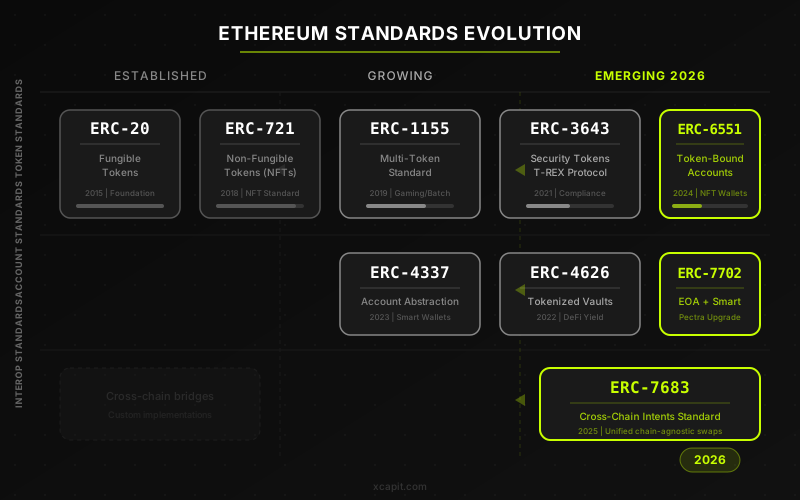
ERC-20, the original fungible token standard from 2015, remains the most widely deployed standard in the ecosystem -- nearly every DeFi protocol, exchange, and wallet supports it natively. ERC-721 introduced non-fungible tokens with unique identifiers, enabling digital ownership of distinct assets. ERC-1155, the multi-token standard, allows a single contract to manage both fungible and non-fungible tokens, reducing deployment costs for use cases like gaming, supply chain, and credential issuance.
These foundational standards are not going away. But they were designed for permissionless, trustless environments. Enterprises operating in regulated industries need additional layers: identity verification, transfer restrictions, compliance automation, and standardized yield interfaces. That is exactly what the newer standards provide.
ERC-3643 (T-REX): The Standard for Regulated Tokenized Securities
If your enterprise is exploring tokenized securities, real estate, bonds, or any regulated financial instrument on Ethereum, ERC-3643 should be at the top of your evaluation list. Originally developed by Tokeny under the name T-REX (Token for Regulated EXchanges), ERC-3643 adds the compliance and governance layer that ERC-20 fundamentally lacks.
The standard implements permissioned transfers with on-chain identity verification. Before any token transfer executes, the protocol checks that both the sender and receiver meet the issuer's compliance requirements -- jurisdiction restrictions, accredited investor status, holding period limits, and any other rule the issuer defines. This compliance check happens on-chain, automatically, for every transaction. There is no off-chain compliance system to maintain or reconcile.
The numbers speak for themselves. As of early 2026, over $32 billion in real-world assets have been tokenized using ERC-3643, with institutional backing from organizations like DTCC. The ERC-3643 Association has grown to over 90 member organizations, and a formal ISO standardization initiative is underway through ISO TC 307 -- which would make it the first Ethereum token standard to receive ISO recognition.
- Permissioned transfers enforced on-chain via identity registry and compliance modules
- Modular compliance rules: jurisdiction restrictions, investor accreditation, holding periods, transfer limits
- On-chain identity through ONCHAINID -- self-sovereign identity claims verified by trusted issuers
- Full lifecycle management: issuance, transfers, forced transfers (regulatory seizure), token recovery, and pause functionality
- Growing ecosystem with 90+ member organizations and ISO standardization in progress
For enterprises in financial services, real estate, or any industry dealing with regulated assets, ERC-3643 provides the compliance infrastructure to tokenize assets without sacrificing regulatory oversight. It is production-ready, well-audited, and has the institutional momentum that reduces adoption risk.
ERC-4626: Tokenized Vaults for Enterprise Yield
ERC-4626 standardizes how yield-bearing vaults work on Ethereum. A vault accepts deposits of an underlying ERC-20 token (such as USDC), deploys those deposits into a yield strategy, and issues shares representing the depositor's proportional claim. The standard defines a uniform API for deposits, withdrawals, and share accounting -- which means any ERC-4626-compliant vault works with any ERC-20-compatible protocol, wallet, or aggregator.
Before ERC-4626, every yield protocol invented its own interface -- Yearn vaults, Aave aTokens, and Compound cTokens all handled deposits and accounting differently. ERC-4626 eliminates that fragmentation. For enterprises, the implications extend beyond DeFi yield farming. ERC-4626 vaults are being used for tokenized Treasury bills, fractional real estate income, and invoice factoring pools -- exactly the patterns that institutional financial products follow. As more than 90% of major financial institutions now have active stablecoin strategies, standardized vault infrastructure is becoming the expected interface for on-chain treasury management.
ERC-6551: Token-Bound Accounts
ERC-6551 assigns every NFT its own Ethereum account -- a smart contract wallet that the NFT controls. When the NFT is transferred, the account (and everything inside it) transfers with it. This turns NFTs from static metadata pointers into autonomous agents that can hold assets, sign transactions, and interact with any dApp.
The enterprise use cases are compelling. A membership NFT can accumulate loyalty tokens, credentials, and access rights over time -- and when it transfers, its entire history goes with it. A supply chain tracking NFT can own documentation tokens, quality certificates, and provenance records. For asset management, ERC-6551 enables on-chain portfolios where an NFT represents an investment vehicle that itself holds ERC-20 tokens, other NFTs, or ERC-4626 vault shares -- composability that was not possible when NFTs were just metadata.
The standard is implemented and functional, but enterprise tooling is still catching up. Wallet support, accounting integrations, and compliance overlays for token-bound accounts are improving but not yet at the maturity level of ERC-20 or ERC-721 tooling. For most enterprises, ERC-6551 is a near-term opportunity worth prototyping rather than a production deployment target for Q1 2026.
The Pectra Upgrade: What Changed and Why It Matters
Ethereum's Pectra upgrade activated on May 7, 2025, delivering the most significant changes to the protocol since The Merge. For enterprises, three changes stand out: native account abstraction via EIP-7702, expanded blob data capacity, and validator consolidation.
EIP-7702: Native Account Abstraction
EIP-7702 is the headline feature for enterprise adoption. It introduces a new transaction type (0x04) that allows standard externally owned accounts (EOAs) to temporarily behave like smart contract wallets within a single transaction. The private key owner retains full control, but during that transaction, the account can execute batched operations, delegate gas payment to a sponsor, use alternative authentication methods, and interact with ERC-4337 infrastructure.
For enterprise wallet products, this eliminates the most painful friction point in blockchain onboarding. Before EIP-7702, smart wallet capabilities required deploying a new contract account and migrating assets. Now, any existing Ethereum address can access gas sponsorship (users never need to hold ETH), transaction batching (approve and swap in one click), session keys for limited delegation, and custom security policies -- all without migration or contract deployment.
If you are building an enterprise wallet, a payment product, or any user-facing blockchain application, EIP-7702 removes the single biggest objection enterprise users raise: the gas management burden. Combined with ERC-4337 infrastructure (bundlers and paymasters), enterprises can offer users a completely gasless, traditional-feeling experience while settling on Ethereum's security model.
Expanded Blob Capacity and Validator Changes
Pectra doubled the target blob count per block from 3 to 6 and raised the maximum from 6 to 9, directly reducing data availability costs for Layer 2 rollups. For enterprises building on or deploying their own L2s, this translates to lower operating costs and higher throughput.
On the validator side, Pectra increased the maximum effective balance per validator from 32 ETH to 2,048 ETH (EIP-7251), reduced deposit activation time to approximately 13 minutes (EIP-6110), and made attestation verification roughly 60x more efficient (EIP-7549). For enterprises running staking programs, these changes simplify operations and reduce the number of validators needed.
Fusaka: Scaling for the Next Wave
Ethereum's Fusaka upgrade activated on December 3, 2025, building on Pectra's foundation with its headline feature: PeerDAS (Peer Data Availability Sampling, EIP-7594). PeerDAS fundamentally changes how Ethereum handles data by distributing blob data across nodes so that each node stores only one-eighth of the total data. This enables a theoretical 8x increase in data throughput compared to pre-Fusaka capacity.
For enterprises operating Layer 2 solutions, Fusaka's expanded data bandwidth directly reduces costs and increases the viable throughput of rollup-based architectures. Combined with the gas limit increase to 60 million gas, Fusaka positions Ethereum as infrastructure that can realistically support enterprise-scale transaction volumes without prohibitive costs.
The next major upgrade, tentatively called Glamsterdam, is targeted for 2026 and will focus on enshrined proposer-builder separation (ePBS) -- shifting block construction into the protocol itself to reduce centralization risks in the block building market.
ERC-4337: Account Abstraction Infrastructure
While EIP-7702 provides the protocol-level account abstraction primitive, ERC-4337 defines the infrastructure layer -- bundlers that submit user operations, paymasters that sponsor gas, and entry point contracts that coordinate execution. ERC-4337 was designed to work without any protocol changes, and with EIP-7702, it now works seamlessly with standard EOAs as well.
For enterprises, ERC-4337's bundler and paymaster infrastructure is what makes gas abstraction practical at scale. A paymaster contract can be configured to sponsor transactions for your users, pay gas in stablecoins instead of ETH, enforce spending limits and rate controls, and integrate with your existing billing system. The combination of EIP-7702 (protocol-level) and ERC-4337 (infrastructure-level) gives enterprise teams a complete toolkit for building user-facing blockchain products where the blockchain complexity is entirely invisible to end users.
ERC-7683: Cross-Chain Intents
As Ethereum's Layer 2 ecosystem expands, cross-chain interoperability has become one of the most urgent pain points for enterprises. ERC-7683, developed by Across Protocol and Uniswap Labs, standardizes how cross-chain value transfers are expressed and executed. Rather than requiring users or applications to understand bridge mechanics, ERC-7683 introduces an intent-based model: you declare what you want to happen, and a network of competitive solvers finds the optimal execution path.
The Ethereum Foundation reinforced this direction in early 2025 by launching the Open Intents Framework (OIF), a modular framework supported by over 30 teams including Arbitrum, Optimism, Polygon, and zkSync. Uniswap has already integrated Across's intents-based infrastructure into its interface and wallet, bringing cross-chain swaps to millions of users. For enterprises operating across multiple L2s, ERC-7683 eliminates the need to integrate with individual bridges or build custom cross-chain logic. It is becoming the standard plumbing for multi-chain enterprise architectures.
Layer 2 Standards and Enterprise Interoperability
The Layer 2 landscape in 2026 is dramatically different from even two years ago. Optimism's Superchain, Base's compliance-oriented environment, and application-specific rollups have created an ecosystem where enterprises can choose the execution environment that fits their needs -- public, private, or hybrid -- while settling to Ethereum for security. The Ethereum Interoperability Layer (EIL) initiative aims to abstract away individual L2 complexities, making the multi-chain architecture feel like a single network.
Trust-minimized ZK bridges using validity proofs are replacing the trusted intermediary model, and L2 settlement times are targeted for significant reduction. However, enterprise teams should be clear-eyed: many L2s still rely on centralized sequencers, upgrade keys controlled by small multisigs, and closed-source components. Before committing to a specific L2, evaluate the decentralization roadmap, the security model, and the exit mechanism.
How to Evaluate Which Standards Matter for Your Use Case
Not every standard is relevant to every enterprise. The evaluation should start with your use case, not the technology.
- Tokenizing regulated financial assets (securities, bonds, real estate): ERC-3643 is the clear choice, with ERC-4626 for yield-bearing instruments
- Building user-facing wallet or payment products: EIP-7702 + ERC-4337 for gas abstraction and smart account features
- Managing digital assets, credentials, or inventories: ERC-1155 for multi-token management, ERC-6551 for composable asset bundles
- Operating across multiple L2s or chains: ERC-7683 for cross-chain intents, monitor EIL and shared sequencing developments
- Enterprise DeFi or treasury management: ERC-4626 vaults for standardized yield interfaces, ERC-3643 for compliance overlays
- Supply chain, provenance, or credential issuance: ERC-721 or ERC-1155 as the base, with ERC-6551 for rich asset composition
For any standard you are evaluating, ask three questions. First, is it finalized with audited, production-grade implementations? Second, does the tooling ecosystem -- wallets, block explorers, custody providers -- support it? Third, is there institutional adoption momentum that reduces the risk of it being superseded?
Build Now vs. Wait: A Practical Decision Framework
The pace of Ethereum's evolution creates a legitimate tension: build now and risk standards drift, or wait and miss market opportunities. Based on our experience delivering blockchain solutions across financial services, energy, and government, here is how we think about it.
Build Now
- ERC-3643 for regulated tokenized assets -- production-ready, institutional adoption, ISO process underway
- EIP-7702 + ERC-4337 for account abstraction -- shipped in Pectra, supported by major wallet providers, critical for user experience
- ERC-4626 for tokenized vaults -- widely adopted across DeFi, clean interface for institutional yield products
- ERC-20 and ERC-721 for standard token and NFT issuance -- foundational, universal tooling support
Prototype and Plan
- ERC-6551 for token-bound accounts -- functional but enterprise tooling still maturing
- ERC-7683 for cross-chain intents -- strong momentum with OIF and Uniswap adoption, but settlement infrastructure is evolving
- L2-specific standards -- evaluate the L2 you are considering carefully for decentralization, security model, and exit mechanisms
Monitor
- Glamsterdam upgrade features (ePBS) -- significant for validator economics but unlikely to change application architecture in the short term
- Shared sequencing standards -- promising for multi-L2 architectures but not yet production-ready
- New ERC proposals for identity, reputation, and credential management -- active area of development with no clear winner yet
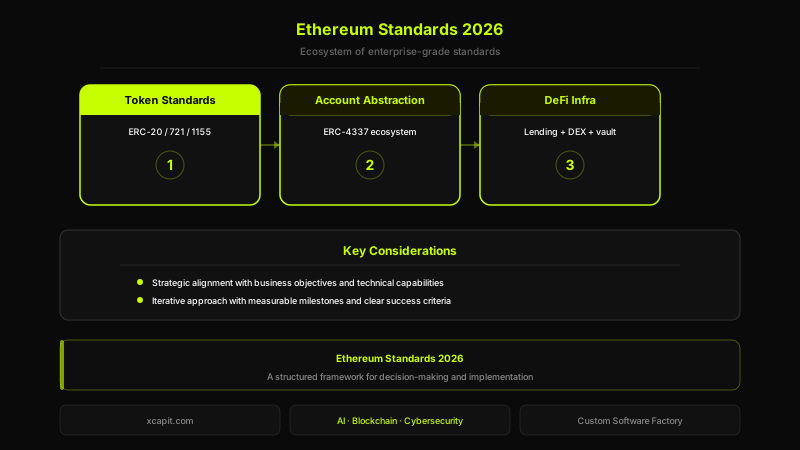
The Ethereum standards landscape in 2026 is mature enough for serious enterprise adoption but moving fast enough that choosing the right standards -- and the right timing -- requires both technical depth and strategic judgment. The enterprises that will extract the most value from blockchain are those that adopt production-ready standards today while maintaining the architectural flexibility to incorporate emerging ones as they mature.
At Xcapit, our blockchain development team has built production applications on Ethereum that have reached over 4 million users across 167 countries. We help enterprises navigate the standards landscape, select the right architecture for their specific use case, and build solutions that are production-grade from day one. Whether you are tokenizing assets with ERC-3643, implementing account abstraction for your wallet product, or designing a multi-chain enterprise architecture -- our team has the hands-on experience to get it right. Reach out to start the conversation.

Santiago Villarruel
Product Manager
Industrial engineer with over 10 years of experience excelling in digital product and Web3 development. Combines technical expertise with visionary leadership to deliver impactful software solutions.
Building on blockchain?
Tokenization, smart contracts, DeFi — we've shipped it all.
You Might Also Like
Asset Tokenization in Argentina 2026: Regulatory Framework, Technical Architecture, and Why the Fideicomiso Is the Legal Vehicle
Argentina's CNV has an active tokenization sandbox expiring in August 2026. This article covers the full regulatory landscape (CNV, PSAV, BCRA), the technical architecture for tokenizing real-world assets using ERC-3643 and blockchain-native signatures, and why the fideicomiso financiero is the strongest legal vehicle available today.
Verifiable AI Agents: Why Enterprise Trust Requires Blockchain-Grade Audit Trails
Autonomous AI agents are making decisions faster than our governance can keep up. This article argues that enterprise adoption won't scale without verifiable identity, provenance, and audit trails — and why blockchain is the natural substrate to deliver them.
Account Abstraction: ERC-4337 and the Future of Crypto UX
Learn how ERC-4337 account abstraction eliminates seed phrases and gas fees. Explore the architecture, capabilities, implementations, and how to build with it.