
Crypto has a user experience problem. After more than a decade of development, interacting with a blockchain still requires managing a 12-word seed phrase that can never be recovered if lost, maintaining a native token balance just to pay gas fees on every transaction, and signing cryptic hexadecimal messages without clear context. These are not edge cases -- they are the default experience for every new user. And they represent the single largest barrier to mainstream blockchain adoption.
Account abstraction is the most significant UX improvement in Ethereum's history. It replaces the rigid, key-dependent account model with programmable smart contract wallets that can implement any authentication logic, sponsor gas for users, recover access through trusted contacts, and batch multiple operations into a single click. This guide provides a comprehensive technical walkthrough of how account abstraction works, the standards that make it possible, and how development teams can build with it today.
The UX Problem with Externally Owned Accounts
Ethereum has two types of accounts: externally owned accounts (EOAs) and contract accounts. Since the network launched in 2015, every user-facing interaction has been initiated by an EOA -- an account controlled by a single private key derived from a seed phrase. This design made sense as a starting point, but it has created a set of UX constraints that are fundamentally incompatible with mainstream adoption.
The first problem is key management. A seed phrase is a single point of failure with no recovery mechanism. If you lose it, your funds are gone permanently. If someone else obtains it, your funds are gone permanently. There is no password reset, no customer support, and no account recovery. The entire security model rests on the assumption that every user can securely store and never lose a sequence of 12 random words -- an assumption that fails regularly, even among technical users.
The second problem is gas. Every transaction on Ethereum requires the sender to pay gas in ETH. This means that even if a user receives USDC, an NFT, or any other token, they cannot do anything with it until they also acquire ETH. For new users, this creates a chicken-and-egg problem: they need ETH to use the application, but acquiring ETH is itself a multi-step process involving exchanges, KYC, and bridging. Applications lose users at every one of these friction points.
The third problem is transaction rigidity. An EOA can only execute one operation per transaction, must sign every operation individually, and cannot enforce custom validation logic. You cannot set spending limits, require multi-party approval, automate recurring payments, or delegate temporary permissions -- all features that traditional financial software provides by default. Every transaction requires the full private key to sign, every time, with no exceptions.
What Account Abstraction Actually Means
Account abstraction is the concept of making every account on Ethereum a smart contract. Instead of accounts being controlled by a single private key with hardcoded ECDSA signature verification, accounts become programmable -- they can define their own validation logic, execute arbitrary code during transactions, and implement any authentication scheme the developer chooses.
The word abstraction here is used in the computer science sense: separating the interface from the implementation. Currently, Ethereum's protocol hardcodes how accounts work -- ECDSA signatures, single-key control, gas payment by the sender. Account abstraction removes these hardcoded assumptions and lets each account define its own rules. The protocol only cares that the account says the transaction is valid, not how it determines validity.
This is not a minor improvement. It is an architectural shift that transforms what a blockchain account can be. A smart contract account can verify signatures from any scheme -- ECDSA, Ed25519, BLS, passkeys, or multisig. It can implement social recovery through guardian addresses. It can batch multiple operations into a single atomic transaction. It can delegate permissions with session keys that expire. And it can have its gas paid by a third party, so users never need to hold ETH.
The Road to ERC-4337: A Brief History
Account abstraction is not a new idea. The Ethereum community has been working toward it since the early days of the network, but the path has been long and complex because the obvious implementations required changes to Ethereum's core protocol -- changes that are difficult to coordinate and risky to deploy.
EIP-86, proposed by Vitalik Buterin in 2017, was one of the earliest formal proposals. It suggested allowing transactions to originate from any address (not just EOAs) and letting contracts pay their own gas. However, it required deep changes to the transaction format and validation pipeline, making it too risky for a hard fork. EIP-2938, proposed in 2020, refined the approach by introducing a new transaction type specifically for account abstraction, but it still required consensus-layer changes and faced the same deployment challenges.
ERC-4337, authored by Vitalik Buterin, Yoav Weiss, Kristof Gazso, Namra Patel, Dror Tirosh, and Shahaf Nacson, took a fundamentally different approach. Published in 2021 and deployed to Ethereum mainnet in March 2023, it achieves account abstraction entirely at the application layer -- without any protocol changes. It does this by introducing a higher-level transaction system that runs on top of Ethereum's existing infrastructure, using a separate mempool, specialized actors called bundlers, and a singleton smart contract called the EntryPoint.
ERC-4337 Architecture Deep Dive
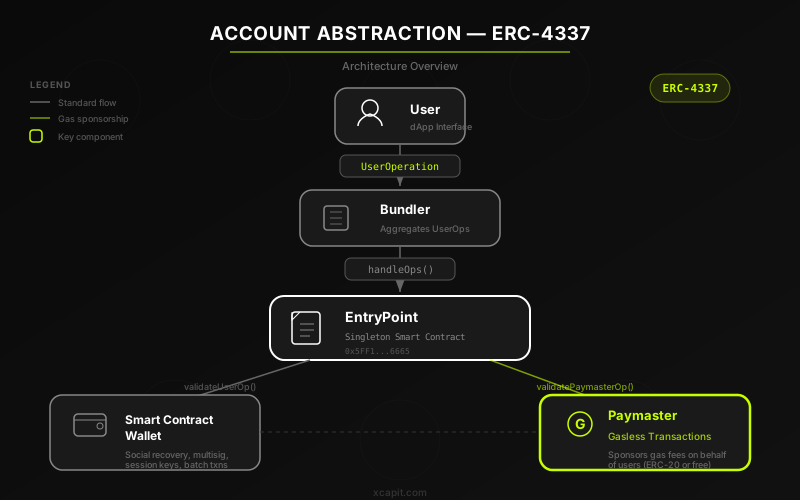
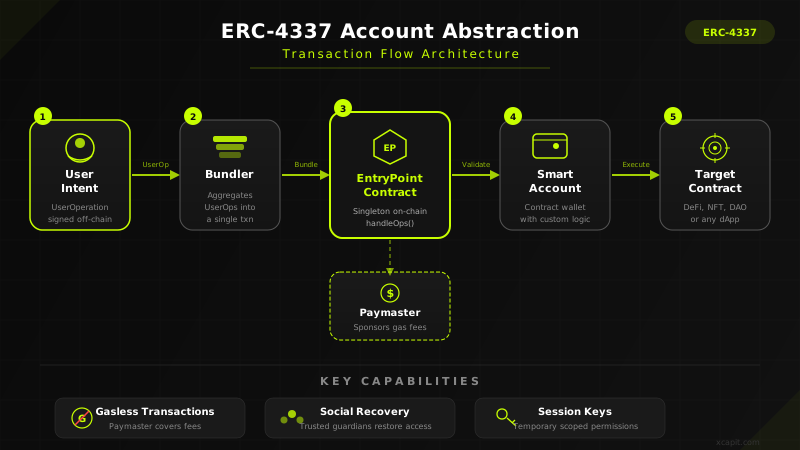
Understanding ERC-4337 requires understanding its five core components: UserOperations, the alt mempool, Bundlers, the EntryPoint contract, and Paymasters. Each plays a distinct role in the system, and together they replicate the functionality of Ethereum's native transaction pipeline -- but with programmable accounts instead of EOAs.
UserOperations
A UserOperation (or UserOp) is the ERC-4337 equivalent of a transaction. It is a data structure that describes what a smart contract account wants to do. Unlike a traditional transaction, which is signed by a private key and sent directly to the Ethereum mempool, a UserOp is sent to an alternative mempool where bundlers pick it up for processing.
A UserOp contains fields analogous to a regular transaction -- sender, nonce, calldata, gas limits -- plus additional fields specific to account abstraction: initCode (for deploying the account on first use), paymasterAndData (for gas sponsorship), and signature (which can be any format the account contract expects, not necessarily ECDSA). The sender field is the address of the smart contract account, not a private key holder.
Bundlers
Bundlers are off-chain actors that monitor the UserOperation mempool, collect valid UserOps, and bundle them into a single regular Ethereum transaction. The bundler calls the EntryPoint contract's handleOps function, passing an array of UserOps. From the Ethereum protocol's perspective, this is a standard transaction sent by the bundler's EOA -- the protocol has no knowledge of account abstraction.
Bundlers serve a role analogous to block builders in Ethereum's existing transaction pipeline. They validate UserOps, simulate execution, order operations, and submit the bundle on-chain. They are compensated through gas refunds and optional tips. Anyone can run a bundler, and multiple bundler services exist -- from Alchemy's Rundler to Stackup, Pimlico, and Biconomy.
The EntryPoint Contract
The EntryPoint is a singleton smart contract deployed at a canonical address on every EVM chain. It is the central coordinator of the entire ERC-4337 system. When a bundler submits a batch of UserOps, the EntryPoint processes each one through a two-phase execution model.
In the verification phase, the EntryPoint calls the validateUserOp function on the sender's smart contract account. The account can implement any validation logic -- checking an ECDSA signature, verifying a multi-sig threshold, validating a passkey assertion, or any custom scheme. If validation succeeds, the EntryPoint proceeds to the execution phase, where it calls the account contract to execute the actual operation described in the UserOp's calldata. This two-phase model ensures that validation is separated from execution, preventing malicious accounts from manipulating the bundler.
Paymasters
Paymasters are the component that enables gasless transactions -- the single most impactful UX improvement in account abstraction. A Paymaster is a smart contract that agrees to pay the gas costs for a UserOperation on behalf of the user. When a UserOp includes a paymasterAndData field, the EntryPoint calls the Paymaster's validatePaymasterUserOp function to confirm it will sponsor the gas.
The business models for Paymasters are diverse. An application can sponsor gas for all users to remove friction (like how web apps do not charge users for HTTP requests). A Paymaster can accept ERC-20 tokens as payment, so users pay gas in USDC or DAI instead of ETH. A Paymaster can implement subscription models, free tiers, or conditional sponsorship based on user behavior. The key insight is that gas payment is decoupled from the user entirely -- someone else can pay, and the user experience becomes indistinguishable from a traditional web application.
Aggregators
Aggregators are an optional but powerful component for scaling. They allow multiple UserOperations that use the same signature scheme to have their signatures aggregated into a single compact proof. For BLS signatures, for example, hundreds of individual signatures can be combined into one, dramatically reducing the on-chain data and gas cost per UserOp. While not widely adopted yet, aggregators become increasingly important as account abstraction scales to millions of users.
Key Capabilities Unlocked by Account Abstraction
The architecture described above is not just a technical refactoring -- it enables entirely new user experiences that were previously impossible with EOAs.
- Gasless transactions: Paymasters allow applications to sponsor gas, letting users interact with dApps without ever acquiring ETH. This single change removes the most common onboarding barrier in crypto.
- Social recovery: Instead of relying on a seed phrase, users can designate guardian addresses -- friends, family, or institutional custodians -- who can collectively authorize a key rotation if the user loses access. No single guardian can act alone, and the user retains full control under normal operation.
- Session keys: Smart accounts can issue temporary, permission-scoped keys that allow an application to submit transactions on the user's behalf without requiring a signature for each one. A gaming application can request a session key valid for 30 minutes with a spending limit, enabling seamless gameplay without constant wallet popups.
- Batch transactions: Multiple operations can be bundled into a single atomic transaction. A DeFi user can approve a token, swap it, and stake the result in one click instead of three separate transactions, each requiring confirmation and gas payment.
- Multi-signature with better UX: Smart accounts can require multiple parties to approve a transaction while presenting a simple interface. Corporate treasuries can enforce two-of-three approval policies, spending limits, and whitelisted addresses -- all enforced by the account contract itself.
- Custom validation logic: Accounts can use any authentication method -- WebAuthn passkeys (biometric authentication via fingerprint or Face ID), hardware security modules, time-locked approvals, geographic restrictions, or any combination. The account defines its own security policy.
Real-World Implementations
Account abstraction is not theoretical -- it is deployed on mainnet and used by millions of accounts across the EVM ecosystem. Several major implementations have emerged, each with a different focus and target audience.
Safe (formerly Gnosis Safe) is the most battle-tested smart contract wallet, securing over $100 billion in assets. Originally designed for multi-signature wallets, Safe has adopted ERC-4337 compatibility, allowing its modular architecture to integrate with bundlers and paymasters. Safe's module system lets developers extend wallet functionality by adding modules for social recovery, spending policies, automated DeFi strategies, and more -- all without modifying the core wallet contract.
ZeroDev provides a developer-focused SDK built on the Kernel smart account, a lightweight and modular ERC-4337 account. ZeroDev's kernel architecture uses validators (for custom signature verification), executors (for extended transaction logic), and hooks (for pre/post execution checks). Its SDK abstracts the complexity of UserOps, bundlers, and paymasters into simple API calls, making it straightforward for developers to integrate account abstraction into existing applications.
Biconomy offers a full-stack account abstraction platform with its Nexus smart account, bundler infrastructure, and Paymaster service. Their SDK supports session keys, batch transactions, and cross-chain operations out of the box. Biconomy has focused heavily on developer experience, providing drop-in React hooks and a dashboard for managing gas sponsorship policies.
Alchemy's Account Kit provides an end-to-end infrastructure layer that combines a smart account implementation (Modular Account), a high-performance bundler (Rundler, written in Rust), and gas manager APIs. Their embedded wallet solution integrates email and social login with smart accounts, creating an onboarding experience where users create a blockchain account using their Google credentials without ever seeing a seed phrase or gas fee.
ERC-7702 and the Pectra Upgrade: Native Account Abstraction
While ERC-4337 achieves account abstraction at the application layer, ERC-7702 -- included in Ethereum's Pectra upgrade -- brings native account abstraction to the protocol level. Proposed by Vitalik Buterin and Sam Wilson, ERC-7702 introduces a new transaction type that allows an EOA to temporarily delegate its execution logic to a smart contract for the duration of a transaction.
The mechanism is elegantly simple. A new transaction type includes an authorization list -- a set of (contract address, signature) pairs. When the transaction is processed, the EOA's code field is temporarily set to a delegation designator pointing to the specified contract. For that transaction, the EOA behaves as if it were a smart contract, gaining access to batch execution, sponsored gas, and custom validation logic. After the transaction completes, the delegation persists until explicitly revoked.
This is significant because it solves the migration problem. With ERC-4337, users must deploy a new smart contract account and migrate their assets from their existing EOA -- a friction point that has slowed adoption. ERC-7702 allows existing EOAs to gain smart account capabilities in place, without moving funds or changing addresses. The billions of dollars held in EOAs across Ethereum can be upgraded without a single transfer.
ERC-7702 and ERC-4337 are complementary, not competing. ERC-7702 handles the protocol-level account upgrade, while ERC-4337's infrastructure -- bundlers, paymasters, and the UserOperation mempool -- continues to provide the off-chain coordination layer. Together, they create a complete account abstraction stack that works for both new smart accounts and upgraded EOAs.
Impact Across Sectors
Account abstraction's impact extends far beyond improved wallet UX. It fundamentally changes what is possible across every sector that touches blockchain.
DeFi: One-Click Composability
In DeFi, account abstraction enables one-click swaps that combine token approval and execution in a single transaction. Yield farming strategies that require multiple sequential operations -- deposit, stake, claim rewards, reinvest -- can be batched into one click. Automated portfolio rebalancing can be delegated to a session key with strict spending limits, removing the need for a user to manually approve every rebalance. And Paymasters can accept the token being traded as gas payment, so a user swapping USDC for WBTC pays the gas fee in USDC rather than needing ETH.
Gaming: Invisible Blockchain
For blockchain gaming, account abstraction makes the blockchain invisible to the player. Session keys allow a game to submit transactions -- moving characters, crafting items, completing quests -- without a wallet popup on every action. The game requests a session key at login with a time limit and spending cap, and the player interacts as they would with any traditional game. Gas is sponsored by the game developer through a Paymaster, so the player never thinks about ETH. The blockchain becomes infrastructure, not interface.
Enterprise: Policy-Enforced Wallets
Enterprise adoption of blockchain has been hindered by the lack of access controls and compliance features in EOAs. Account abstraction solves this directly. A corporate treasury can implement a smart account with role-based access control -- junior staff can initiate transfers up to a limit, senior staff can approve larger amounts, and the CFO can authorize anything. Whitelisted destination addresses prevent unauthorized transfers. Time-locked operations add a review period before large transactions execute. These are not application-level controls that can be bypassed -- they are enforced by the account contract itself, on-chain and immutable.
Security Considerations
Smart contract wallets introduce a different security model than EOAs, and teams building with account abstraction must understand the tradeoffs.
Smart contract risk is the most fundamental concern. An EOA's security depends only on the private key -- the ECDSA algorithm is well-understood and has no known vulnerabilities. A smart contract account's security depends on the correctness of its code. A bug in the wallet contract, its modules, or its upgrade mechanism could compromise every account using that implementation. This is why battle-tested implementations like Safe, which has secured over $100 billion without a contract-level exploit, are strongly preferred over custom implementations.
Upgrade mechanisms require careful design. Most smart account implementations support upgrades so that new features can be added and bugs can be fixed. However, an unrestricted upgrade path means that whoever controls the upgrade authority can replace the wallet logic entirely. Best practices include time-locked upgrades (giving users time to exit before changes take effect), governance-controlled upgrades, and the option for users to opt out of upgrades by freezing their account implementation.
Guardian management for social recovery must be thought through carefully. Guardians should be diverse -- not all from the same platform or geographic region. The threshold for recovery should be high enough to prevent collusion but low enough to remain practical. Guardian rotation should be straightforward, and there should be a time delay on recovery actions to give the legitimate owner time to intervene if an attacker compromises a subset of guardians.
- Use established, audited smart account implementations rather than building custom wallet contracts
- Implement time-locked upgrades with a minimum delay period that gives users the ability to review and exit
- Design guardian sets with diversity in mind -- different devices, platforms, geographic locations, and trust relationships
- Set session key permissions to the minimum required scope and shortest practical duration
- Monitor for unusual patterns in bundler behavior and paymaster gas consumption
- Conduct regular security audits of any custom modules or validation logic added to the base account
Building with Account Abstraction Today
For development teams ready to integrate account abstraction, the ecosystem offers mature tooling and infrastructure. The choice of SDK and infrastructure provider depends on your application's specific needs -- whether you prioritize modularity, developer experience, or infrastructure control.
Start by choosing a smart account implementation. Safe's modular architecture is ideal for applications that need multi-sig, complex permissions, or composable modules. ZeroDev's Kernel account is lightweight and highly customizable, making it a strong choice for applications with specific validation logic requirements. Biconomy's Nexus and Alchemy's Modular Account provide opinionated, full-stack solutions that minimize integration complexity.
Next, select your bundler infrastructure. You can run your own bundler for maximum control, or use hosted services from Alchemy, Pimlico, Stackup, or Biconomy. For development and testing, local bundlers like those provided by the Infinitism reference implementation allow you to develop and test UserOp flows without depending on external services.
Configure your Paymaster strategy based on your business model. Sponsoring all gas during beta or for new users reduces onboarding friction dramatically. Accepting ERC-20 tokens for gas payment lets power users pay in their preferred token. Conditional sponsorship -- sponsoring gas for specific actions but not others -- gives you fine-grained control over your subsidy budget.
- Use permissionless.js or viem's account abstraction modules for TypeScript-first development with fine-grained control over UserOp construction
- Leverage Alchemy's aa-sdk or Biconomy's SDK for higher-level abstractions that handle bundler communication and paymaster integration automatically
- Test on Sepolia or other testnets where the EntryPoint is deployed and bundler services are available
- Implement ERC-4337 incrementally -- start with gasless transactions via Paymasters, then add session keys and batching as your users' needs evolve
- Monitor the ERC-7702 rollout and plan your migration strategy so existing EOA users can upgrade in place once Pectra activates
- Use tools like userop.js, the Bundler test suite, and the EntryPoint's simulation methods to validate UserOps locally before submitting to a live bundler
The Path Forward
Account abstraction represents a fundamental shift in how users interact with blockchain. The combination of ERC-4337's application-layer infrastructure and ERC-7702's protocol-level EOA upgrades creates a clear path toward a future where blockchain accounts are as flexible and user-friendly as accounts in any traditional software system -- but with the self-custody and censorship resistance that make blockchain valuable in the first place.
The technology is production-ready today. Major wallets, infrastructure providers, and applications have adopted ERC-4337. L2 networks like Base, Arbitrum, and Optimism see millions of smart account transactions monthly. The tooling is mature, the standards are stable, and the security track record is growing. For development teams building blockchain applications, there is no longer a reason to force users through the EOA experience. Account abstraction is how crypto becomes usable for everyone.
At Xcapit, our blockchain development team has deep experience building smart contract wallets, DeFi protocols, and Web3 infrastructure. Whether you are integrating ERC-4337 into an existing application, designing a new product with account abstraction from day one, or planning your ERC-7702 migration strategy, we can help you navigate the architecture decisions and deliver a production-ready implementation. Learn more about our blockchain development services.

Fernando Boiero
CTO & Co-Founder
Over 20 years in the tech industry. Founder and director of Blockchain Lab, university professor, and certified PMP. Expert and thought leader in cybersecurity, blockchain, and artificial intelligence.
Building on blockchain?
Tokenization, smart contracts, DeFi — we've shipped it all.
You Might Also Like
New Ethereum Standards in 2026: Enterprise Guide
A practical guide to Ethereum standards enterprises must track in 2026: ERC-3643 regulated securities, EIP-7702 account abstraction, and cross-chain intents.
Xcapit Labs & Naranja X: Credit with Smart Contracts
In November 2024, Xcapit Labs launched with Naranja X a guaranteed credit pilot using crypto-assets as collateral through smart contracts on Rootstock. A milestone in blockchain applied to financial services in Latin America.
How Xcapit Labs and Naranja X Validated a Secure, Auditable, Non-Custodial Guaranteed Credit Model: The Architecture Behind the Pilot
Technical deep dive into the guaranteed credit pilot architecture between Xcapit Labs and Naranja X: smart contracts, non-custodial wallet, KYC/AML compliance, interoperability, and scalability to new sectors.