

Every experienced engineer has lived the same nightmare: a 40-page requirements document that took three months to write, was outdated before the first sprint started, and contained enough ambiguity to generate six different interpretations across four teams. Specifications are supposed to be the contract between what stakeholders want and what developers build. In practice, they are the most fragile artifact in the entire software development lifecycle -- the document everyone references but nobody trusts.
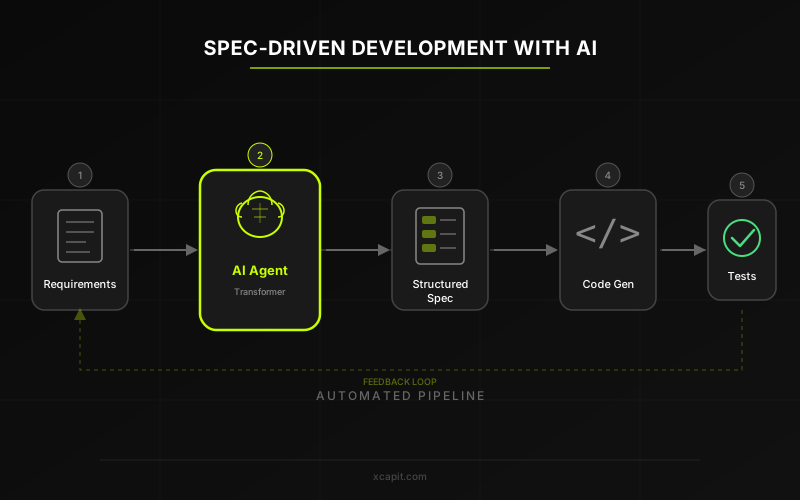
Spec-driven development is not a new idea. The principle -- write the specification first, then build to it -- has been around since formal methods emerged in the 1970s. What is new is that AI agents can now participate meaningfully in every stage of the specification lifecycle: drafting, validating, evolving, and enforcing specs in ways that were impractical with purely manual processes. This changes the economics of spec-driven development from a discipline that only large, slow-moving organizations could afford, to an approach that is viable for teams of any size shipping at modern velocity.
What Spec-Driven Development Actually Means
At its core, spec-driven development is a methodology where the specification is the single source of truth for a system's behavior. Code is generated from or validated against the spec. Tests are derived from the spec. Documentation is produced from the spec. The spec is not a planning artifact that gets archived after kickoff -- it is a living, versioned, machine-readable document that stays synchronized with the codebase throughout the project's lifetime.
The most familiar example is API-first development using OpenAPI (formerly Swagger). Teams write an OpenAPI specification that defines endpoints, request/response schemas, authentication requirements, and error codes. From that spec, they generate server stubs, client SDKs, documentation, and test suites. The spec is the contract -- if the implementation diverges from the spec, automated checks catch the drift.
But spec-driven development extends far beyond APIs. Database schemas, event contracts, state machines, business rules, access control policies, and integration protocols can all be specification-driven. The key insight is that any behavior that can be formally described can be formally verified -- and AI agents are exceptionally good at bridging the gap between informal human intent and formal machine-readable descriptions.
Why Traditional Spec Writing Fails
Before examining how AI changes the game, it is worth understanding why specifications have historically been such a pain point. The failure modes are well-documented and remarkably consistent across industries.
Ambiguity
Natural language is inherently ambiguous. A requirement like 'the system should handle high traffic gracefully' means something different to a product manager, a backend engineer, and an SRE. Even seemingly precise statements like 'users must be authenticated before accessing protected resources' leave open questions: What counts as a protected resource? Does authentication include API key access or only session-based login? What happens to in-flight requests when a session expires? Every ambiguity becomes a decision that some developer makes implicitly, without visibility to the rest of the team.
Incompleteness
Specifications almost always describe the happy path thoroughly and the edge cases barely at all. Error handling, concurrency behavior, backward compatibility constraints, performance requirements under load, and degradation modes are the areas where specs are thinnest -- and where production bugs are densest. The reason is simple: enumerating edge cases is cognitively exhausting and unrewarding work, so humans skip it.
Staleness
The half-life of a specification's accuracy is shockingly short. Within weeks of implementation starting, the code diverges from the spec as developers encounter realities the spec did not anticipate. Nobody updates the spec because updating documentation is low-status work that does not ship features. Within a quarter, the spec is a historical document -- useful for understanding original intent but unreliable as a description of current behavior. Teams learn to distrust specs, which undermines the entire premise of specification-driven development.
Cost
Writing thorough specifications is expensive. A detailed API specification for a mid-sized service might take a senior engineer two to three weeks to write properly -- including schema definitions, examples, error catalogs, and edge case documentation. Multiply that across dozens of services and the specification effort alone can consume a significant fraction of the engineering budget. Many teams rationally conclude that the cost of rigorous specs exceeds the cost of the bugs they would prevent.
How AI Agents Change the Specification Lifecycle
AI agents address each of these failure modes directly -- not by replacing human judgment, but by handling the mechanical, exhaustive, and tedious aspects of specification work that humans do poorly.
Automated Spec Generation from Requirements
The most immediate application is using LLMs to parse natural language requirements into structured specifications. A product manager writes 'We need an endpoint that lets users upload profile photos, with a 5MB size limit, support for JPEG and PNG formats, and automatic thumbnail generation.' An AI agent transforms this into a complete OpenAPI path definition with request body schema (multipart/form-data with file field), response schemas for success and each error case (413 Payload Too Large, 415 Unsupported Media Type, 422 for validation failures), appropriate HTTP status codes, and header specifications.
The agent does not just transcribe -- it fills in the gaps that the product manager left implicit. It adds the Content-Type header requirement, specifies the thumbnail dimensions as a configurable parameter, includes rate limiting headers in the response, and generates example payloads for each scenario. A human reviewer then validates these additions, which is far faster and more reliable than generating them from scratch.
Consistency Checking Against Existing Systems
One of the most valuable and underappreciated capabilities of AI agents is checking new specifications for consistency with existing systems. When you add a new endpoint to a service that already has 50 endpoints, the AI agent can verify that the new spec follows the same naming conventions, uses consistent error code patterns, does not introduce conflicting schema definitions, and aligns with the authentication model used across the service.
This goes beyond simple linting. The agent understands semantic relationships -- it can identify that your new 'user profile' endpoint returns a different representation of user data than the existing 'user account' endpoint, and flag the inconsistency for human review. It can detect that a new event schema uses a timestamp format that conflicts with the format used in the event bus your team already publishes to. These cross-cutting consistency checks are nearly impossible for humans to perform manually across large codebases.
Test Case Derivation
Given a formal specification, AI agents can systematically derive test cases that cover the specified behavior. This is not just generating a happy-path test -- the agent analyzes the spec to identify boundary conditions, error paths, state transitions, and interaction effects, then generates test cases for each.
For an API endpoint spec, the agent generates tests for valid requests with minimal fields, valid requests with all optional fields populated, requests missing each required field individually, requests with each field set to boundary values (empty string, maximum length, special characters), authentication failures, authorization failures, rate limit scenarios, and concurrent request handling. A human writing tests might cover 60-70% of these cases through experience and discipline. The agent covers 95%+ mechanically, every time.
The Spec-Driven Workflow with AI Agents
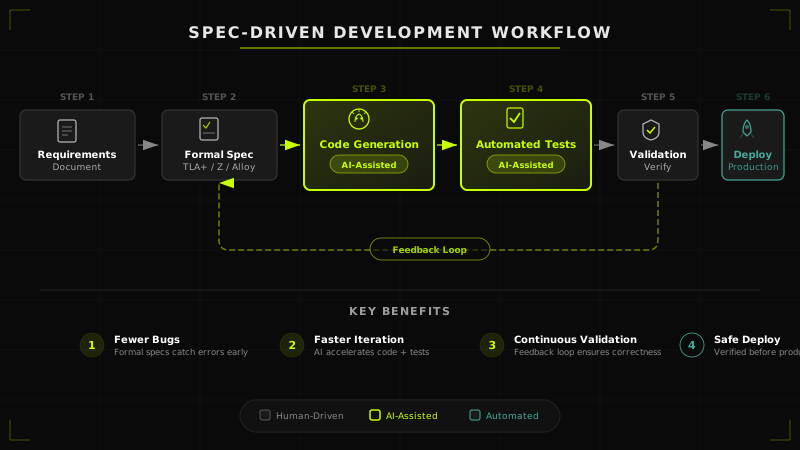
The practical workflow for spec-driven development with AI agents follows five stages, each with specific roles for humans and agents.
Stage 1: Requirements Capture
Stakeholders describe what they need in natural language -- user stories, feature briefs, Slack conversations, meeting transcripts, or existing documentation. The AI agent ingests these inputs and produces a structured requirements summary that identifies the core capabilities requested, the implicit constraints and assumptions, the open questions that need human clarification, and the dependencies on existing systems. This stage surfaces ambiguities early, before they propagate into the spec.
Stage 2: AI-Assisted Spec Drafting
The agent generates a first draft of the formal specification from the structured requirements. For an API, this is an OpenAPI document. For a state machine, this is a formal state transition table. For a business rule engine, this is a decision table with conditions and actions. The draft includes not just the positive behavior but error handling, edge cases, and integration points that the requirements did not explicitly address.
Stage 3: Human Validation and Refinement
Engineers and product owners review the generated spec, correct errors, resolve open questions, and refine details. This is the critical human-in-the-loop stage. The agent's draft gives reviewers something concrete to react to, which is far more efficient than starting from a blank page. Reviewers focus on business logic correctness and architectural decisions rather than spending time on formatting and mechanical completeness.
Stage 4: Code Generation and Implementation
From the validated spec, AI agents generate implementation scaffolding -- server stubs, client libraries, database migration scripts, and infrastructure-as-code templates. Developers fill in the business logic, with the agent-generated code handling boilerplate like request validation, error response formatting, and logging. The spec remains the authoritative definition; the implementation is derived from it, not the other way around.
Stage 5: Continuous Validation
After deployment, AI agents continuously verify that the implementation conforms to the spec. This includes contract testing that validates API responses against the spec schemas, drift detection that identifies when code behavior diverges from the specification, and automated spec updates when intentional changes are made to the implementation. This continuous validation loop is what prevents spec staleness -- the failure mode that kills most specification efforts.
Real Patterns: What This Looks Like in Practice
The abstract workflow becomes concrete through specific patterns that enterprise teams are adopting today.
LLM-Powered Requirements Parsing
The pattern works as follows: feed an LLM a natural language requirement document along with the existing API specification for context, and ask it to produce a diff -- the additions, modifications, and deprecations needed to implement the new requirements. The LLM's structured output capability (JSON mode or tool use) ensures the output is machine-parseable, not just human-readable. The diff is then applied to the spec, reviewed, and committed -- creating a clear audit trail from requirement to specification change.
Agent-Based Spec Validation Against Codebases
An AI agent with access to the codebase (via MCP servers or direct file access) can compare the specification against the actual implementation and produce a conformance report. It identifies endpoints that exist in code but not in the spec (undocumented behavior), endpoints in the spec that have no corresponding implementation (incomplete delivery), and schema mismatches where the code returns fields or types that differ from the specification. Running this validation in CI/CD ensures that every pull request is checked for spec conformance before merge.
Auto-Generated API Contracts
For microservice architectures, AI agents can generate and maintain contract tests between services. Given the specs for two services that communicate, the agent produces tests that verify the producer sends what the consumer expects. When either spec changes, the agent identifies breaking changes and generates updated contracts. This eliminates the category of bugs where Service A changes its response format and Service B breaks silently -- which is one of the most common and expensive failure modes in distributed systems.
Tools and Frameworks Powering This Shift
Several technologies are converging to make spec-driven development with AI agents practical at scale.
- Model Context Protocol (MCP) -- Anthropic's open standard for connecting AI models to external tools and data sources. MCP servers that expose codebase access, CI/CD pipelines, and specification repositories give AI agents the context they need to validate and generate specs against real systems.
- Structured outputs and function calling -- LLM capabilities that constrain model output to valid JSON schemas. This is essential for generating machine-readable specifications reliably, eliminating the parsing failures that plagued earlier approaches to LLM-generated structured content.
- OpenAPI, AsyncAPI, and Protocol Buffers -- Existing specification standards provide the target formats that AI agents generate into. The maturity of these ecosystems means generated specs can immediately plug into existing toolchains for code generation, documentation, and testing.
- AI coding agents (Claude Code, Cursor, Copilot Workspace) -- Development environments that can read specifications and generate conformant implementations, closing the loop from spec to working code with human oversight at each stage.
- Contract testing frameworks (Pact, Specmatic, Schemathesis) -- Tools that validate implementations against specifications automatically, providing the continuous conformance checking that prevents spec drift.
Best Practices for Spec-Driven AI Development
Based on our experience building AI-augmented development workflows for enterprise clients, these practices consistently separate successful implementations from failed experiments.
Keep Humans in the Loop for Business Logic
AI agents excel at mechanical completeness -- generating every error code, covering every edge case, maintaining consistent formatting. They struggle with business judgment -- deciding whether a feature should fail open or fail closed, choosing between consistency and availability in a distributed system, or determining the right abstraction level for an API. Structure the workflow so agents handle the exhaustive mechanical work and humans make the judgment calls. Never ship an AI-generated spec without human review of the business logic.
Version Specs Like Code
Specifications must live in version control alongside the code they describe. Every spec change should go through the same review process as code changes -- pull request, review, approval, merge. This creates an audit trail that connects every behavioral change to a specification change to a requirements change. For regulated industries, this traceability chain is not optional -- it is a compliance requirement.
Treat Specs as First-Class Artifacts
The specification is not documentation. It is a build artifact. It should have its own CI pipeline that validates syntax, checks for breaking changes, runs compatibility tests against dependent services, and generates downstream artifacts (documentation, client SDKs, mock servers). When the spec breaks, the build breaks -- just like when code breaks. This enforcement is what gives specs their authority and prevents the gradual degradation that makes teams stop trusting them.
Start with One Service, Not the Entire Architecture
Adopting spec-driven development across an entire platform at once is a recipe for organizational resistance. Start with a single service -- ideally one that is being newly built or significantly refactored. Prove the approach works, measure the time savings in bug reduction and onboarding speed, then expand. Teams that see the benefits firsthand become advocates; teams that are forced to adopt a new process become saboteurs.
When Spec-Driven Development with AI Makes Sense
Spec-driven development with AI agents is not universally appropriate. It adds process overhead that must be justified by the complexity and longevity of the system being built.
Strong Fit
- API-heavy systems where multiple teams or external consumers depend on stable contracts -- the cost of breaking changes is high enough to justify formal specification and automated validation.
- Microservice architectures where service-to-service contracts need to be maintained across independent deployment cycles -- spec-driven contract testing prevents the integration failures that plague distributed systems.
- Regulated industries (finance, healthcare, government) where traceability from requirements to implementation is a compliance requirement -- AI-generated audit trails satisfy auditors far more effectively than manual documentation.
- Platform teams building internal developer tools where consistency across APIs directly impacts developer experience and adoption -- AI agents enforce consistency at a scale no style guide can achieve.
- Long-lived systems expected to be maintained for years where the cost of accumulated technical debt and undocumented behavior compounds over time.
Poor Fit
- Early-stage prototypes where the goal is to discover what to build -- formal specifications add friction to the rapid iteration that prototyping requires.
- Internal tools with a single developer and no external consumers -- the overhead of maintaining formal specs exceeds the coordination benefits when there is no one to coordinate with.
- Highly exploratory R&D work where the system's behavior cannot be specified in advance because it is being discovered through experimentation.
- One-off data pipelines or migration scripts that will run once and be discarded -- investing in specifications for throwaway code is waste.
The Future: Toward Autonomous Development Pipelines
The current state of spec-driven development with AI agents is a transitional phase. Today, AI agents assist humans at each stage of the spec lifecycle. The trajectory points toward increasingly autonomous pipelines where the human role shifts from doing the work to governing the system that does the work.
In the near term -- the next 12 to 18 months -- we expect to see AI agents that can take a product brief and produce a complete, validated specification with minimal human intervention. The human reviews and approves rather than authors. Agents will also maintain living specifications that update automatically as code changes, flagging only the changes that represent intentional behavioral modifications versus unintended drift.
In the medium term -- two to three years out -- fully autonomous development pipelines will handle the complete flow from requirements to deployed, tested code for well-understood problem domains. A product manager describes a feature, an AI agent generates the spec, another agent generates the implementation, a third generates and runs tests, and the system deploys when all checks pass. Humans intervene only for novel architectural decisions and business logic that falls outside the system's training distribution.
This is not science fiction -- the individual components exist today. MCP provides the integration standard. LLMs provide the reasoning capability. Structured outputs provide the reliability. CI/CD provides the automation infrastructure. What remains is composing these components into end-to-end workflows and building the governance frameworks that give organizations confidence to trust the output. The teams that build this muscle now -- learning how to specify, validate, and govern AI-assisted development -- will have an enormous advantage when these autonomous pipelines mature.
At Xcapit, we help enterprises design and implement AI-augmented development workflows -- from spec-driven API development to fully integrated AI agent pipelines. Our ArgenTor multi-agent framework was itself built using spec-driven practices, with 483 passing tests derived from formal specifications across 13 modular crates. Our team has deep experience building production systems where AI agents participate in the development lifecycle, not just the end product. If you are exploring how AI can improve your team's specification and development practices, we would welcome the conversation. Learn more about our AI development services at /services/ai-development or our custom software capabilities at /services/custom-software.

Fernando Boiero
CTO & Co-Founder
Over 20 years in the tech industry. Founder and director of Blockchain Lab, university professor, and certified PMP. Expert and thought leader in cybersecurity, blockchain, and artificial intelligence.
Ready to leverage AI & Machine Learning?
From predictive models to MLOps — we make AI work for you.
You Might Also Like
MWC 2026: The Agentic Era Is No Longer a Promise — It's Strategy
Three lessons from Mobile World Congress 2026 redefining how enterprises adopt AI: from pilot to real value, from isolated agents to orchestrated enterprises, and why company size no longer matters.
From OpenClaw to Agentor: Building Secure AI Agents in Rust
How a security audit of an open-source AI agents framework revealed Python's limits and led us to build Agentor -- a Rust-based framework optimized for code generation.
Designing Autonomous Agents with LLMs: Lessons Learned
How we architect autonomous AI agents in production -- from perception-planning-execution loops to orchestration patterns, memory systems, and guardrails.