
The word 'autonomous' does a lot of heavy lifting in AI marketing. It conjures images of systems that run themselves -- receiving a goal, disappearing into the digital ether, and returning with a perfect result. The reality of building autonomous agents with large language models is both less dramatic and more interesting. After designing and deploying agent systems across enterprise clients at Xcapit -- including our ArgenTor multi-agent AI framework built in Rust -- the most important lesson I can share is this: autonomy is not a binary state. It is a spectrum, and the most effective agents are the ones whose position on that spectrum is deliberately designed, not accidentally discovered.
A prototype agent that works 80% of the time is impressive. A production agent that works 80% of the time is a liability. The gap between those two realities is where architecture, orchestration, and hard-won lessons live. This post is the playbook we have built over two years of shipping autonomous agent systems -- the patterns that survived production, the orchestration approaches that scale, and the mistakes that taught us the most.
What Autonomy Actually Means in Production
In research papers, autonomy means the agent pursues goals without human intervention. In production, it means the agent makes decisions within a defined scope, escalating when it encounters situations outside its competence or when the stakes exceed its authorization level. Designing for full autonomy produces fragile systems; designing for graduated autonomy produces reliable ones.
We think about autonomy in four levels. Level 1 is assisted -- the agent suggests actions but a human approves each one. Level 2 is supervised -- the agent acts autonomously on routine tasks but pauses for approval on high-stakes decisions. Level 3 is monitored -- the agent operates independently with humans reviewing outcomes after the fact. Level 4 is fully autonomous. Almost every production system we have built operates at Level 2 or Level 3 -- not because we cannot build Level 4, but because the risk profile of most enterprise tasks does not justify it. Your agent architecture must treat human interaction as a first-class capability, not an afterthought.
The Five-Stage Agent Architecture
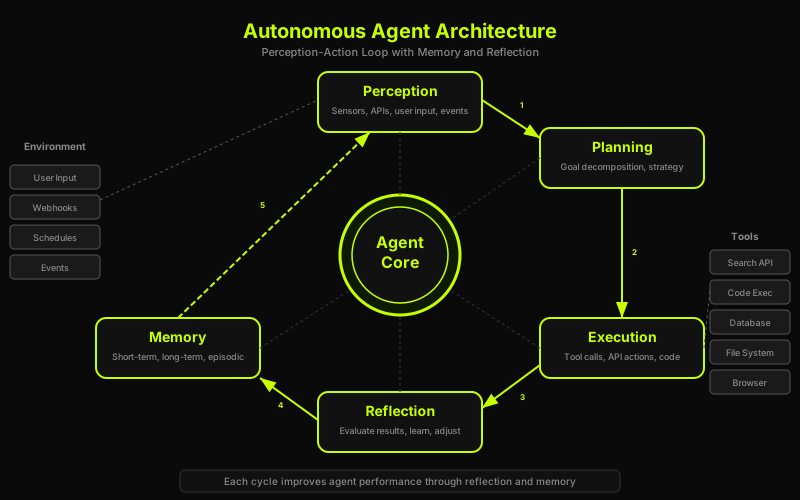
Every autonomous agent we build follows a five-stage processing loop: Perception, Planning, Execution, Reflection, and Memory. These stages map directly to system components with distinct responsibilities, failure modes, and scaling characteristics.
Perception: Making Sense of Inputs
The perception stage is where the agent receives and normalizes inputs -- parsing user messages, processing documents and structured data, ingesting context from connected systems via MCP servers, and interpreting multimodal inputs. The critical design decision is how much preprocessing to do before the LLM sees the input. We use a two-pass approach: a lightweight deterministic step that normalizes formats and extracts metadata, followed by the LLM processing the structured input with full context.
Planning: Decomposing Complex Tasks
Planning is where the agent breaks a high-level goal into actionable steps. This is the most critical stage for reliability, because a bad plan executed perfectly still produces bad results. For simple tasks, we use inline planning where the LLM generates and begins execution in a single call. For complex tasks, we use explicit planning where the agent generates a structured plan, validates it against constraints, and executes step by step with the ability to replan on failure.
The most common planning failure is over-decomposition -- the agent breaks a simple task into too many substeps. We address this with explicit instructions to prefer fewer, broader steps. The heuristic: if a subtask can be completed in a single tool call, do not break it down further.
Execution: Tool Use That Actually Works
Execution is where theory meets the reality of brittle APIs, rate limits, and network timeouts. Our tool design follows three principles: tools should be narrow and composable, tool descriptions must be precise enough for the LLM to select correctly without trial and error, and every tool must return structured output including metadata -- execution time, data freshness, and suggested next steps.
We use MCP servers as our primary tool integration standard. Each server exposes a focused set of capabilities with standardized authentication, error handling, and capability discovery. This modular approach means we can add capabilities by connecting a new MCP server without modifying the agent's core logic, and the same servers can be shared across different agents.
Reflection: Self-Evaluation and Course Correction
Reflection separates a sophisticated agent from a simple chain-of-tool-calls. We implement it as a dedicated LLM call that receives the original goal, current plan, action taken, and result. The model classifies the outcome, determines whether the plan needs adjustment, identifies new information, and decides whether to continue, replan, escalate, or terminate. This explicit step catches errors that would otherwise compound -- an agent without reflection will continue a failing plan long after it should have changed course.
Memory: Learning from Experience
We implement three tiers of memory. Short-term memory is the conversation context, managed through the LLM's context window with progressive summarization to balance detail and token budgets. Working memory is a structured state object stored outside the context window that tracks the current goal, plan, and progress -- preventing the agent from losing its place in complex tasks. Long-term memory combines a vector store for semantic retrieval with a knowledge graph for structured relationships, allowing agents to improve over time by accumulating operational experience in retrievable form.
Orchestration Patterns That Scale
ReAct: Reasoning and Acting
ReAct alternates between reasoning steps and action steps. It is the simplest pattern and the right default for most single-agent tasks. Its strength is transparency -- every action is preceded by explicit, auditable reasoning. Its weakness is sequential execution, which limits throughput for parallelizable subtasks.
Plan-and-Execute
Plan-and-Execute separates planning from execution into distinct phases. The planner generates a complete task plan; the executor works through it step by step. If a step fails, the planner regenerates the remaining plan. This pattern is more cost-efficient for long tasks because the planner can use a capable, expensive model while the executor uses a faster, cheaper one for routine steps.
Hierarchical Multi-Agent
When a task exceeds a single agent's scope, we decompose it across specialized agents coordinated by a manager. The key challenge is coordination -- sharing context without overwhelming context windows, handling dependencies between agents, and managing failure propagation. We use a shared state store and event-driven communication that keeps agents loosely coupled while enabling the coordination complex workflows require.
Guardrails and Safety: The Non-Negotiables
An autonomous agent without guardrails is not a product. It is an incident waiting to happen. Every agent we deploy includes multiple layers of protection.
- Output validation: Every LLM output is validated against expected schemas before being acted upon. Malformed tool arguments trigger retries with corrective feedback, not downstream failures.
- Action approval gates: High-stakes actions (modifying production data, sending external communications, spending money) require explicit approval from a human or a validation agent.
- Cost limits: Hard caps on tokens per task, tool calls per task, and daily spend per agent. Budget overruns trigger escalation, not silent continuation.
- Timeout policies: Every operation has a maximum execution time. Agents stuck longer than expected are likely in a loop -- timeouts trigger escalation, not silent failure.
- Scope boundaries: Agents access only explicitly granted tools and data. No implicit privilege escalation. Missing capabilities are requested through defined escalation paths.
- Adversarial input handling: Every agent is tested with prompt injections, contradictory instructions, and out-of-scope requests before reaching production.
Debugging Autonomous Agents
Debugging agents differs fundamentally from debugging traditional software. The LLM's stochastic nature means the same input can produce different execution paths, making bugs intermittent and context-dependent. We address this with three capabilities: comprehensive trace logging that records every reasoning step, tool call, and decision with full context; replay capability that lets us re-run logged traces with different inputs or model responses at any point; and automated anomaly detection that monitors behavioral metrics and alerts when an agent deviates from its baseline.
The single most valuable debugging investment is structured logging of the agent's reasoning -- not just what it did, but why. When production issues occur, the reasoning trace almost always points directly to the root cause.
Lessons Learned: What We Wish We Had Known
Start Simpler Than You Think
Every team wants to build the multi-agent system with dynamic planning and long-term memory. Almost every team should start with a single ReAct agent with three to five tools and no persistent memory. The simple system ships faster, fails in understandable ways, and teaches you what the complex system actually needs. We have seen projects burn months on orchestration infrastructure for problems a well-prompted single agent solves in an afternoon.
Make the Deterministic Parts Deterministic
Not every part of an agent pipeline needs an LLM. Input validation, output formatting, authentication, rate limiting, and logging should be regular code. The LLM should only handle the parts that genuinely require judgment. This reduces cost, increases reliability, and makes debugging straightforward because you know exactly which failures come from the model and which come from infrastructure.
Human-in-the-Loop Is Not a Failure
An agent that recognizes the limits of its competence and escalates appropriately is a well-designed agent. The failure case is the agent that confidently takes the wrong action because it was not designed to know when to ask for help. Our most successful deployments have explicit human checkpoints that decrease over time as autonomous scope expands -- but never disappear entirely.
Test with Adversarial Inputs from Day One
If you only test with well-formed, cooperative inputs, you are testing the happy path of a system that will never see the happy path in production. Real users send ambiguous instructions, upload corrupted documents, and change their mind mid-task. Adversarial testing is not a pre-launch phase -- it is a continuous practice. We maintain a growing library of adversarial test cases and run them against every agent update.
Scaling: From One Agent to Many
The most effective scaling pattern is starting with independent agents that share tools but not state, then gradually introducing coordination as workflows require it. The coordination patterns we use most are task handoff (sequential pipelines), shared blackboard (collaborative analysis), and hierarchical delegation (complex tasks requiring dynamic decomposition). The choice depends on the workflow, but the principle is consistent: add coordination complexity only when a specific use case demands it.
Where This Is Heading
The autonomous agent landscape is evolving rapidly, but the fundamentals -- the five-stage architecture, graduated autonomy, disciplined tool design, and robust guardrails -- become more important as models get more capable, because more capable models cause more damage when they fail. The most exciting near-term development is agent learning: systems that improve from operational experience through accumulated knowledge in long-term memory. We are seeing agents that resolve tasks 40% faster after a month of operation compared to their first week. This is where autonomous agents deliver compounding returns rather than linear productivity gains.
At Xcapit, we design, build, and operate autonomous agent systems for enterprise clients -- from single-purpose agents that automate specific workflows to multi-agent platforms that coordinate across departments. Our approach is grounded in graduated autonomy, robust guardrails, and an obsessive focus on what works in production rather than what looks impressive in a demo. If you are building or evaluating autonomous agent systems, we would welcome the conversation. Learn more about our AI agent development services at /services/ai-agents or explore our broader AI capabilities at /services/ai-development.

Fernando Boiero
CTO & Co-Founder
Over 20 years in the tech industry. Founder and director of Blockchain Lab, university professor, and certified PMP. Expert and thought leader in cybersecurity, blockchain, and artificial intelligence.
Ready to leverage AI & Machine Learning?
From predictive models to MLOps — we make AI work for you.
You Might Also Like
Multi-Model AI Agents: Combining Claude, GPT & Open-Source
How to architect AI agent systems that combine Claude, GPT, and open-source models in one workflow -- routing patterns, cost optimization, and lessons.
If everyone has Artificial Intelligence, where will the competitive advantage be?
AI is no longer a barrier to entry: today it is within reach of companies of every size. Why the difference is no longer about using AI, but about how it is used and the quality of the architecture that integrates it.
Will Artificial Intelligence replace developers? Why software engineering matters more than ever
AI automates code generation, testing and documentation, but it does not replace engineering. Why, as writing code becomes easier, the value of those who design architectures and understand the business goes up.