

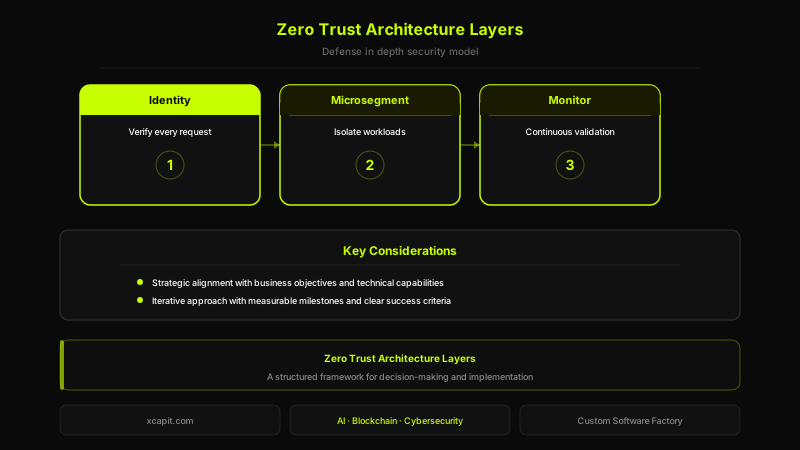
Why Perimeter Security Fails
The castle-and-moat model of network security was built on a premise that held reasonably well through the 1990s and early 2000s: your assets are inside the castle, attackers are outside, and if you build the moat tall enough, you're safe. Trust everything inside the perimeter, trust nothing outside. This model shaped a generation of enterprise security architecture, and we're still paying for it today.
The premise failed for several concurrent reasons. Remote work — turbocharged by the pandemic but already underway — put legitimate users outside the perimeter permanently. Cloud services moved critical workloads to infrastructure you don't own or control. SaaS applications moved sensitive data to third-party services. Mobile devices put organizational resources in users' pockets, physically outside the building. The attack surface moved from 'everything inside the firewall' to 'every device, every user, every network, everywhere.'
The result is that attackers don't need to breach the perimeter anymore — they bypass it. Phishing credentials from a remote employee, compromising a cloud storage bucket, exploiting a poorly configured SaaS integration. Once inside, lateral movement through an implicitly trusted internal network is trivially easy. The average time for an attacker to move laterally from initial compromise to high-value targets dropped below 60 minutes in recent data. Once they're inside a flat, implicitly trusted network, there's nothing to slow them down.
In my work helping organizations recover from security incidents — and at Xcapit, where our ISO 27001-certified security practice spans fintech, government, and energy clients — the same pattern repeats. The attacker got in through a credential or a misconfigured cloud resource. Then they moved laterally for days or weeks undetected because the internal network offered no resistance. Zero Trust Architecture is the systematic answer to this pattern.
Zero Trust Principles: The NIST 800-207 Foundation
Zero Trust is not a product you buy or a vendor you choose. It's an architectural philosophy with specific, well-defined principles. NIST Special Publication 800-207 is the definitive reference, and its seven core tenets form the basis of any genuine ZTA implementation:
- All data sources and computing services are considered resources — regardless of physical location or network ownership
- All communication is secured regardless of network location — there is no trusted internal network; TLS everywhere is the minimum baseline
- Access to individual resources is granted on a per-session basis — no standing access, no persistent sessions without re-verification
- Access to resources is determined by dynamic policy based on observable client identity, application/service, and the requesting asset — not just a username and password
- All owned and associated devices are monitored for security posture — device health is a continuous input to access decisions, not a one-time onboarding check
- All resource authentication and authorization is dynamic and strictly enforced — the Policy Enforcement Point (PEP) and Policy Decision Point (PDP) evaluate every access request
- The enterprise collects as much information as possible about the current state of assets, network infrastructure, and communications, and uses it to improve security posture
The critical word throughout these tenets is 'dynamic.' Zero Trust is not a one-time access grant based on who you are — it's a continuous evaluation of who you are, what device you're using, what you're trying to access, from where, and whether that combination of factors is consistent with expected behavior. Every access request is treated as if it originates from an untrusted network, because it might.
Identity-Centric Security: The Foundation of ZTA
If Zero Trust has a center of gravity, it's identity. In a ZTA, identity replaces the network perimeter as the primary security boundary. The question is no longer 'is this traffic coming from inside our network?' but 'is this verified identity authorized for this specific resource at this specific time?'
Identity Provider Consolidation
The first step in any ZTA implementation is consolidating identity onto a single, authoritative Identity Provider (IdP). Organizations with multiple identity silos — Active Directory for internal systems, a separate directory for contractors, individual credentials for each SaaS tool — cannot implement Zero Trust. You need a single source of truth for identity that can enforce consistent policies across all resources.
Modern cloud IdPs (Okta, Azure AD, Google Workspace, Ping Identity) provide the foundation: centralized authentication, federation to downstream services via SAML/OIDC, and integration with MFA providers. The choice of IdP is less important than the discipline of consolidating all identities onto it and eliminating local accounts and shared credentials entirely.
Multi-Factor Authentication
MFA is not optional in a ZTA. A compromised password without a second factor is a complete identity compromise. However, not all MFA is equal. SMS-based MFA is vulnerable to SIM-swapping and can be phished via real-time relay attacks. TOTP (authenticator apps) is better but still phishable. FIDO2/WebAuthn hardware keys (YubiKey, etc.) or platform authenticators (Touch ID, Windows Hello) are phishing-resistant and represent the appropriate minimum for high-sensitivity access. Enforce the right MFA type based on the sensitivity of what's being accessed.
Privileged Access Management
Administrative and privileged accounts require additional controls beyond standard MFA. Just-in-time (JIT) privileged access — where admin rights are granted for a specific session and automatically revoked — eliminates the standing privileged access that attackers rely on for persistence. Implement a Privileged Access Management (PAM) solution that requires explicit requests, approval workflows, and full session recording for all privileged operations.
Device Security and Posture Assessment
In a ZTA, the device accessing a resource is as important as the identity using it. A valid user credential on a compromised device is not a trusted access request. Device security posture — whether the device is managed, patched, running EDR software, compliant with security policies — must be a continuous input to access decisions.
Implement Mobile Device Management (MDM) or Unified Endpoint Management (UEM) for all devices accessing organizational resources. Use the MDM system's compliance signals — patch level, disk encryption status, screen lock policy, presence of required security software — as inputs to your Policy Decision Point. Non-compliant devices should receive reduced access: they can access the identity provider and the MDM enrollment portal, but not production systems or sensitive data.
For organizations with BYOD (Bring Your Own Device) policies, implement containerization that separates organizational apps and data from personal apps. The organizational container can be managed and wiped remotely without touching personal data — a requirement that also supports privacy compliance with regulations like GDPR.
Micro-Segmentation
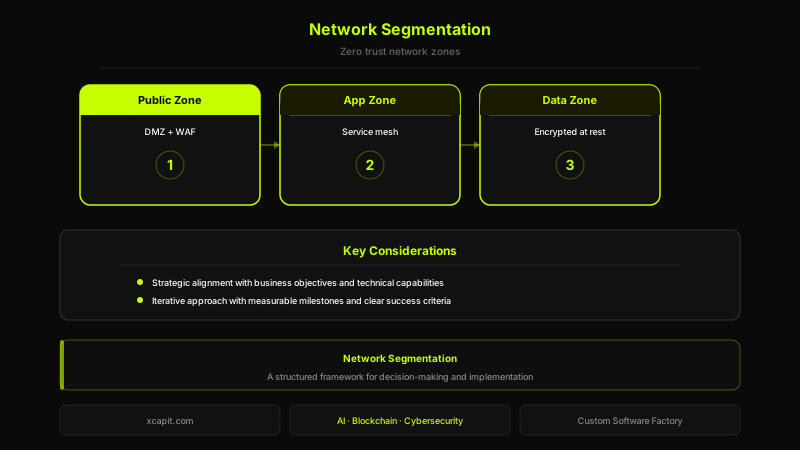
Network micro-segmentation is the network-layer implementation of Zero Trust principles. Instead of a flat internal network where any host can reach any other host, micro-segmentation divides the network into isolated segments and enforces explicit allow-listing of all traffic between segments. An attacker who compromises one workload cannot reach others without explicitly authorized paths.
Software-Defined Perimeters
Traditional VLANs and firewall rules are too coarse-grained and too static to implement genuine micro-segmentation. Software-Defined Perimeter (SDP) approaches — using tools like Cloudflare Access, Zscaler Private Access, or Palo Alto Prisma — create dynamic, identity-aware tunnels that connect specific users to specific resources without exposing those resources to the broader network. The resource is literally invisible to the network until the authenticated, authorized user establishes their session.
East-West Traffic Control
Most security tools focus on north-south traffic (into and out of the organization) while leaving east-west traffic (between internal systems) largely unrestricted. Micro-segmentation reverses this: implement explicit policies for all east-west traffic between workloads, requiring that every service-to-service communication is authenticated, authorized, and logged. Service mesh technologies like Istio or Consul Connect implement mutual TLS (mTLS) for all service-to-service communication and provide the observability you need to define and enforce east-west policies.
The Five-Phase Implementation Roadmap
ZTA implementation is a multi-year journey, not a product deployment. Here is the phased approach I recommend for medium to large organizations, based on experience implementing Zero Trust in regulated industries:
Phase 1: Define the Protect Surface (Months 1-2)
Before you can implement Zero Trust controls, you need to know what you're protecting. Identify your most sensitive data, assets, applications, and services (DAAS). This becomes your Protect Surface — the subset of your environment that represents the highest value to attackers and the highest risk to your organization. Unlike the attack surface (which is everything), the Protect Surface is intentionally small and well-defined. Zero Trust controls are implemented around the Protect Surface first.
Phase 2: Map Transaction Flows (Months 2-3)
Understand how your Protect Surface assets communicate. Which users access them? Which services call them? From where? What protocols do they use? This mapping is essential for defining micro-segmentation policies and for understanding the normal baseline of behavior that your monitoring systems will use to detect anomalies. Many organizations discover unknown data flows during this phase that represent significant security risks in themselves.
Phase 3: Build the Zero Trust Architecture (Months 3-9)
Deploy the technical components: IdP consolidation and MFA, MDM/UEM for device management, SDP for network access, PAM for privileged accounts, and a Security Information and Event Management (SIEM) system to aggregate logs. Implement policies progressively — start in monitoring mode, then enforce. Build out micro-segmentation around your Protect Surface first, then expand outward. Establish your Policy Decision Point and Policy Enforcement Point infrastructure.
Phase 4: Create Zero Trust Policies (Months 6-12)
Define explicit access policies for every resource in your Protect Surface. Who can access it, under what conditions, using what device posture, from what locations, at what times? Policies should be as specific as possible — a policy that says 'all employees can access the HR system' is less secure than one that says 'HR team members can access the HR system from managed devices with compliant posture, during business hours, with step-up MFA for sensitive operations.' The granularity of your policies directly determines the quality of your Zero Trust implementation.
Phase 5: Monitor, Maintain, and Iterate (Ongoing)
Zero Trust is not a destination — it's an operational posture. Continuous monitoring of all access requests, anomaly detection, policy review, and threat intelligence integration are the ongoing operational requirements. Establish a Zero Trust maturity measurement framework — CISA's ZTA Maturity Model provides a useful five-level scale — and track your progress against it quarterly.
Common Implementation Pitfalls
- Treating Zero Trust as a product purchase rather than an architectural transformation — no single vendor product delivers ZTA; it requires multiple integrated components and organizational change
- Starting with network controls instead of identity — identity is the foundation; without it, micro-segmentation alone is fragile
- Trying to boil the ocean — implement ZTA incrementally, starting with your highest-value assets, rather than trying to transform everything simultaneously
- Neglecting the user experience — overly restrictive policies that impede legitimate work will be worked around; invest in seamless MFA and SSO to reduce friction
- Skipping the transaction flow mapping phase — without understanding normal behavior, you can't define good policies and you can't detect anomalies
- Confusing Zero Trust marketing with Zero Trust architecture — many vendors attach 'Zero Trust' to products that implement only fragments of the framework; evaluate against NIST 800-207, not vendor claims
Measuring ZTA Maturity
CISA's Zero Trust Maturity Model defines five levels across five pillars (Identity, Device, Network/Environment, Application Workload, Data): Traditional, Initial, Advanced, Optimal, and Adaptive. Conduct an honest assessment of where your organization falls in each pillar before starting implementation, and use it to set realistic targets. A common mistake is targeting 'Optimal' across all pillars simultaneously — this is unnecessarily expensive and delays benefits that could be achieved by reaching 'Advanced' in your highest-risk pillar first.
Implementing Zero Trust Architecture is among the most impactful security investments an organization can make, but it requires expertise across identity, networking, endpoint management, and application security simultaneously. At Xcapit, our ISO 27001-certified cybersecurity team has led Zero Trust implementations across fintech, energy, and government clients. We approach ZTA as a phased organizational transformation, not a product deployment — and we can help you design a roadmap that fits your risk profile, budget, and operational constraints. Reach out through xcapit.com/services/cybersecurity.

Fernando Boiero
CTO & Co-Founder
Over 20 years in the tech industry. Founder and director of Blockchain Lab, university professor, and certified PMP. Expert and thought leader in cybersecurity, blockchain, and artificial intelligence.
Need a security partner you can trust?
Pentesting, ISO 27001, SOC 2 — we secure your systems.
You Might Also Like
The field's digital notary: what blockchain is (and why you don't need to understand the code to use it)
You don't need to know how a combine harvester's computer works to operate it. Blockchain is the same: a write-only record that guarantees provenance and cannot be forged.
Custom software or an existing solution? How to make the best decision for your company
Buy or build is one of the most important decisions in any digital transformation project. When each option makes sense, why the right question is not binary, and how to assess long-term impact.
Digital transformation for utilities: modernizing energy without replacing the core
A practical guide for utilities and energy companies: how to integrate SCADA, IoT, AI, tokenization, and cybersecurity to modernize operations without replacing critical systems.