
The most common mistake in AI agent architecture is also the most understandable one: picking a single model and using it for everything. It makes sense on paper -- one vendor, one API, one set of quirks to learn. In practice, it is the equivalent of using a Swiss Army knife to build a house. You can do it, but you are paying a premium for every task while getting suboptimal results on most of them.
After building multi-model agent systems across fintech, energy, and enterprise clients at Xcapit, I can state this with confidence: the future of production AI is not about finding the best model. It is about building systems that use the right model for every task. This article covers the architecture patterns, routing strategies, and production lessons that make multi-model workflows practical.
Why Single-Model Architectures Limit You
Every model has a profile -- a unique combination of strengths, weaknesses, pricing, latency, and context window characteristics. When you commit to a single model for all tasks, you inherit all of its limitations alongside its strengths. The constraints compound in four specific ways.
First, cost inefficiency. Frontier models cost 10-30x more per token than capable smaller models. If 60-70% of your agent's tasks are straightforward -- classification, extraction, formatting -- you are paying frontier prices for work that a $0.15/million-token model handles equally well. For an agent processing 5,000 sessions per day, this over-provisioning wastes $3,000-$8,000 monthly.
Second, capability gaps. No model excels at everything. Claude is exceptional at nuanced reasoning and long-context processing but a specialized code model might generate more reliable completions. GPT-4o has mature function calling but may not match Claude's depth on safety-critical analysis. A single-model architecture means accepting mediocre performance wherever your chosen model is not the strongest option.
Third, vendor lock-in. Building around one provider's API creates dependency risk. API deprecations, pricing changes, and service outages all become single points of failure. In January 2026, a major LLM provider changed its rate limiting policy with 14 days' notice -- single-model teams scrambled while multi-model teams shifted traffic to alternatives within hours.
Fourth, latency mismatch. A user-facing classification needs a response in under 500 milliseconds. A complex analysis can take 30 seconds. Single-model architectures force you to choose one latency profile and live with the mismatch everywhere else.
The Multi-Model Thesis
The core thesis is straightforward: different models excel at different tasks, and a well-designed system should exploit this specialization. This is not new in engineering -- we already do this with databases (PostgreSQL for relational data, Redis for caching, Elasticsearch for search) and with compute (CPUs for general work, GPUs for parallel processing). AI model selection should follow the same principle.
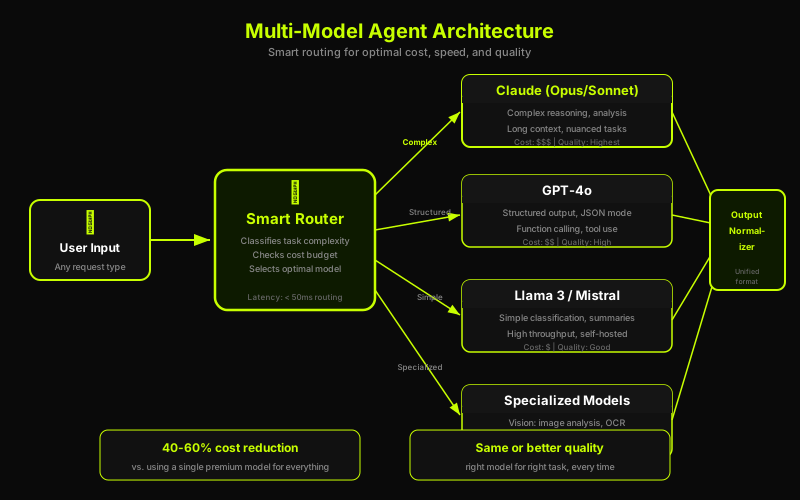
Your agent system needs a routing mechanism that understands what each model does well and dispatches tasks accordingly. In our production deployments, multi-model architectures reduce costs 40-60% compared to single-model approaches while improving overall output quality, because each task is handled by the model best suited for it.
Model Strengths: A Practical Map
Before designing routing logic, you need a clear map of what each model family brings to the table -- based on empirically observed strengths in production workloads, not marketing claims.
Claude (Anthropic) excels at complex multi-step reasoning, faithfully following long system prompts, processing documents up to 200K tokens, and safety-critical tasks. Claude's extended thinking capability makes it particularly strong for compliance checks, risk assessments, and tasks where the reasoning process matters as much as the output.
GPT-4o and the o-series (OpenAI) offer broad general capability with mature function calling and strong multimodal support. GPT-4o's structured output mode reliably produces valid JSON, making it excellent for data extraction pipelines. The o-series models add strong chain-of-thought reasoning for mathematical and logical tasks.
Open-source models (Llama 3, Mistral Large) are the workhorses of multi-model architectures. Deployed on your own infrastructure, zero data leaves your environment -- non-negotiable for finance, healthcare, and government clients. Self-hosted models convert variable API expenses into fixed infrastructure costs that become economical at moderate volume. Fine-tuned smaller models (7B-13B parameters) frequently match frontier performance on classification and extraction tasks.
Specialized models round out the ecosystem. Code models (Codestral, DeepSeek Coder) outperform general-purpose models on code generation. Vision models handle OCR and image analysis. Audio models handle transcription. Embedding models power semantic search. A multi-model architecture lets you plug in the right specialist without rearchitecting your system.
Architecture Patterns
Model Routing
The most straightforward pattern: classify the incoming task, then dispatch it to the best-suited model. A customer support agent might route classification queries to a fast model, complex policy questions to Claude, and data extraction to GPT-4o for structured output. The routing decision happens once per task. The main risk is misclassification -- routing a complex task to a cheap model produces poor results.
Model Cascading
Start every task with a cheap, fast model and escalate only when needed. The fast model returns both its output and a confidence score. High confidence -- use the output directly. Low confidence or failed validation -- escalate to a frontier model. In our deployments, 60-80% of queries resolve at the first tier, dropping average per-query costs 40-70%. The trade-off is added latency for escalated queries and the complexity of implementing reliable confidence scoring.
Model Ensemble
Run the same task through multiple models and aggregate outputs. The most expensive pattern, but it produces the highest quality for critical decisions. A compliance agent might run a document through Claude, GPT-4o, and a fine-tuned open-source model, flagging discrepancies for human review. Reserve ensembles for high-stakes, low-volume tasks where the cost of an error far exceeds the cost of running multiple models.
Building the Router
Three approaches exist, in increasing order of sophistication. Rule-based routing uses deterministic rules: code tasks go to the code model, long documents go to Claude, simple classification goes to the cheapest model. Easy to understand and debug, but brittle when tasks do not fit predefined categories.
Classifier-based routing trains a lightweight model on labeled examples of tasks and their optimal model assignments. It analyzes content, length, complexity, and domain signals to predict which model will produce the best result. This approach handles ambiguous tasks better and improves continuously as you collect data.
LLM-based routing uses a small, fast LLM as the router itself. The router receives the task and a description of available models, then reasons about which to use. This handles novel task types gracefully at negligible cost -- a few hundred tokens through a cheap model. In production, we start with rules and migrate to LLM-based routing as data accumulates. Good routers achieve 85-95% routing accuracy.
Practical Implementation
Shared Context Management
When different models handle different parts of a workflow, they need access to the same context. But models from different providers use different tokenization, different context windows, and different formatting conventions. You need a context management layer that maintains a canonical conversation state and translates it into the format each model expects.
Response Normalization
Different models structure outputs differently -- Claude returns detailed explanations, GPT-4o returns concise structured responses, open-source models may include reasoning traces. A normalization layer extracts actionable content and presents it consistently to downstream components. Without this, every consumer needs model-specific parsing logic.
Fallback Chains
Every model will occasionally fail -- timeouts, rate limits, outages, malformed responses. Define explicit fallback chains per task type: if Model A fails, try Model B; if all models fail, degrade gracefully with a cached response or human escalation.
Cost Optimization: The Numbers
Here is a realistic comparison from a customer support agent processing 3,000 sessions per day. Single-model approach: approximately 45 million tokens per month at frontier pricing, resulting in $6,000-$9,000 monthly. Multi-model with cascading: 70% handled by a fast model at $0.15/million tokens, 25% by a mid-tier model at $1/million tokens, 5% escalated to frontier at $15/million tokens. Monthly spend: $2,000-$3,500 -- a 55-65% reduction with no quality degradation.
The savings scale with volume. At 10,000 sessions per day, absolute savings grow to $12,000-$20,000 monthly. At enterprise scale, multi-model routing is not an optimization -- it is a financial requirement.
The MCP Advantage: Unified Tool Access
Multi-model architectures create a practical problem: if each model needs the same tools, do you implement integrations separately for each model's function-calling format? The Model Context Protocol (MCP) eliminates this. Build your MCP tool server once and any compliant model can use it. Add a new model -- it automatically has access to all tools. Add a new tool -- every model can use it immediately.
Without MCP, adding a model means reimplementing every tool integration -- cost grows linearly with tool count. With MCP, the cost of adding a model is constant. This makes it economically feasible to maintain larger model pools and switch models fluidly based on performance, cost, and availability.
Challenges and Trade-Offs
- Inconsistent behavior -- Different models have different personalities and failure modes. Users may notice tonal shifts when different models handle sequential questions. Mitigate with strong system prompts and response normalization.
- Testing complexity -- You test against every model in your pool, plus routing logic, plus fallback chains. Test surface area grows multiplicatively. Invest in automated evaluation frameworks early.
- Debugging across models -- When a workflow produces a bad output, determine which model was responsible: the router, the first-tier model, or the confidence scorer. End-to-end tracing with per-model attribution is essential.
- Operational overhead -- More models means more API keys, more rate limit monitoring, and more vendor relationships. Manageable but real.
Our Production Architecture
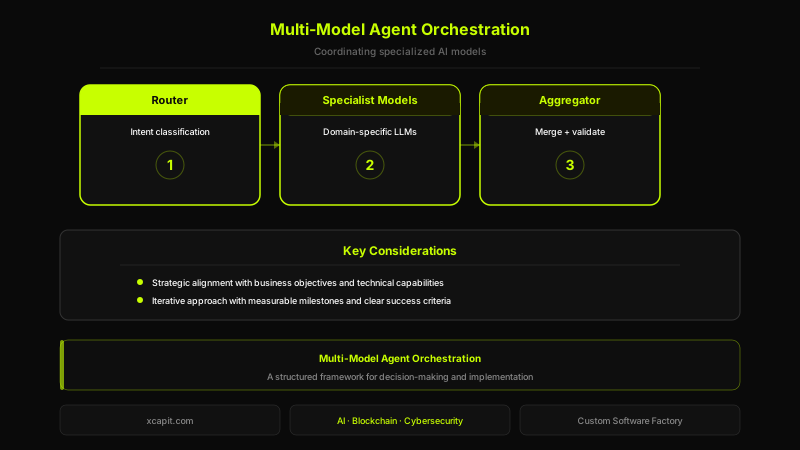
At Xcapit, our production agent systems use a four-layer multi-model architecture refined across dozens of client deployments. Our ArgenTor multi-agent framework, built in Rust with 13 modular crates, exemplifies this approach with 5 communication channels and MCP integration. The routing layer classifies tasks by type, complexity, and domain. The model pool is curated per project -- typically Claude for reasoning and long-context tasks, GPT-4o for structured extraction, and self-hosted open-source models for high-volume classification and data-sovereign workloads. The MCP tool layer exposes client-specific tools through the universal protocol. The orchestration layer manages context transitions, response normalization, fallback chains, and end-to-end observability.
This architecture consistently delivers 40-60% cost savings over single-model approaches while improving reliability through redundancy and quality through task-model matching.
Getting Started
You do not need a fully optimized multi-model system on day one. Start with a single model, instrument your system to log task types and performance, and identify tasks where your model is either too expensive or underperforming. Add a second model for those tasks. Implement rule-based routing. Measure impact. Iterate. The critical first step is instrumentation -- if you are not tracking task type, response quality, latency, and cost per request, you cannot make informed routing decisions.
At Xcapit, we help enterprises design and implement multi-model AI architectures -- from model selection and routing strategy through production deployment and ongoing optimization. If you are running a single-model agent and hitting cost or quality walls, we can help you map out a migration path that delivers measurable improvements within weeks.
The era of single-model AI architectures is ending. The organizations that learn to orchestrate multiple models -- matching the right model to each task, managing context across model boundaries, and optimizing cost continuously -- will build AI systems that are more capable, more reliable, and more financially sustainable than anything a single model can deliver alone. Explore our AI agent development services at /services/ai-agents to learn how we can help you make this transition.

Fernando Boiero
CTO & Co-Founder
Over 20 years in the tech industry. Founder and director of Blockchain Lab, university professor, and certified PMP. Expert and thought leader in cybersecurity, blockchain, and artificial intelligence.
Ready to leverage AI & Machine Learning?
From predictive models to MLOps — we make AI work for you.
You Might Also Like
Designing Autonomous Agents with LLMs: Lessons Learned
How we architect autonomous AI agents in production -- from perception-planning-execution loops to orchestration patterns, memory systems, and guardrails.
If everyone has Artificial Intelligence, where will the competitive advantage be?
AI is no longer a barrier to entry: today it is within reach of companies of every size. Why the difference is no longer about using AI, but about how it is used and the quality of the architecture that integrates it.
Will Artificial Intelligence replace developers? Why software engineering matters more than ever
AI automates code generation, testing and documentation, but it does not replace engineering. Why, as writing code becomes easier, the value of those who design architectures and understand the business goes up.