
It's the first question every executive asks and the last one most development companies want to answer directly: how much does custom software actually cost? The hesitation is understandable — software projects vary enormously in scope, complexity, and requirements. But vague answers don't help you plan, budget, or make informed decisions.
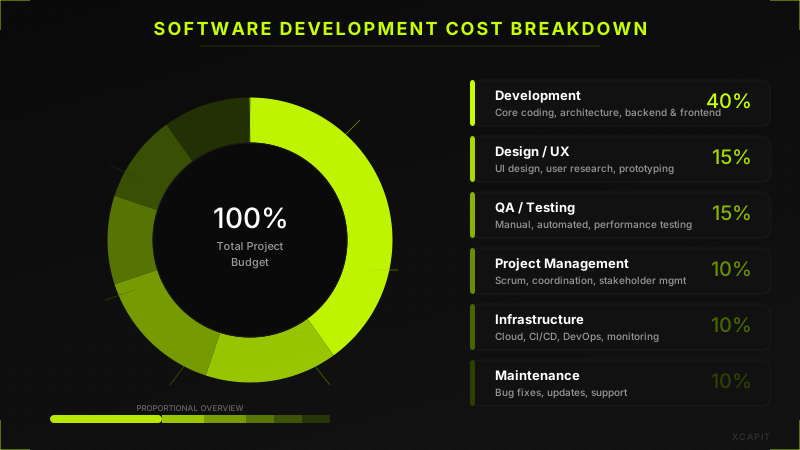
This guide provides honest, data-informed cost ranges for custom software development in 2026, explains what drives those costs, and gives you a framework for budgeting effectively. No bait-and-switch pricing, no 'it depends' without context.
The Short Answer
Most custom software projects in 2026 cost between $50,000 and $500,000+. That range is wide because 'custom software' encompasses everything from a focused MVP to an enterprise platform serving millions of users.
Here's a more useful breakdown: a simple internal tool or MVP typically runs $25,000 to $75,000. A mid-complexity business application (custom CRM, operations platform, client portal) falls in the $75,000 to $250,000 range. An enterprise-grade platform with complex integrations, high security requirements, and large user bases costs $200,000 to $500,000 or more. AI and machine learning products, depending on data complexity and model requirements, range from $100,000 to $400,000.
These numbers represent total development cost through initial launch — they don't include ongoing maintenance, which we'll cover separately. They also assume engagement with a professional development team (not freelancers, not big-four consultancies — both of which sit at opposite extremes of the cost spectrum).
What Drives the Cost
Understanding cost drivers helps you control them. Here are the five factors that have the largest impact on your final bill.
Complexity and Scope
This is the single largest cost driver. Complexity isn't just about the number of features — it's about the depth of each feature, the number of user roles, the business rules behind workflows, and how edge cases are handled. A simple CRUD application with 10 screens is fundamentally different from a financial platform with real-time calculations, multi-currency support, regulatory compliance, and audit trails — even if both have 'similar' feature counts on paper.
Integrations multiply complexity. Each external system your software connects to (payment processors, ERPs, CRMs, IoT devices, government APIs) adds development time, testing requirements, and ongoing maintenance. A project with zero integrations versus one with eight integrations can differ by 40-60% in total cost.
Team Composition
The team required for your project directly impacts cost. A typical mid-complexity project requires a project manager, a UX/UI designer, 2-3 backend developers, 1-2 frontend developers, and a QA engineer. More specialized projects add roles: a DevOps engineer for complex infrastructure, a data engineer for AI/ML projects, a security specialist for compliance-heavy applications.
Senior developers cost more per hour but typically deliver faster, write more maintainable code, and make better architectural decisions that prevent expensive refactoring later. A team of senior developers may cost 50% more per hour but finish the project in 60% of the time — making the total cost comparable while the quality is significantly higher.
Technology Stack
The choice of programming languages, frameworks, and infrastructure affects both development speed and long-term costs. Mainstream stacks (React/Node.js, Python/Django, .NET) have larger talent pools, more community resources, and faster development cycles. Niche technologies (Rust, Elixir, specialized blockchain frameworks) offer performance or capability advantages but come with higher hourly rates and smaller candidate pools for future maintenance.
Cloud infrastructure choices also matter. A serverless architecture on AWS Lambda might cost less to operate at low traffic but more to develop initially. A containerized Kubernetes deployment has higher operational complexity but offers more control at scale. The right choice depends on your expected usage patterns and growth trajectory.
Timeline and Urgency
Compressed timelines cost more. If a project that would normally take 6 months needs to launch in 3, you'll need a larger team working in parallel, which increases coordination overhead and total cost by 20-40%. Rush timelines also increase the risk of technical debt that will need to be addressed post-launch.
Conversely, artificially extending a timeline doesn't save money. A project stretched over 18 months accumulates context-switching costs, team turnover, and the compounding effect of changing requirements. The optimal timeline is the one that matches the project's natural pace of development with a focused, appropriately sized team.
Geography and Engagement Model
Hourly rates vary significantly by region. US-based developers typically charge $150-$250/hour. Western European teams range from $100-$200/hour. Latin American teams (Argentina, Brazil, Mexico, Colombia) offer $50-$120/hour with strong technical talent and timezone alignment with North America. Eastern European teams (Ukraine, Poland, Romania) range from $40-$100/hour. Southeast Asian teams are $25-$60/hour.
However, hourly rate is not total cost. A team charging $50/hour that takes twice as long costs the same as a team charging $100/hour that delivers on schedule. The real metric is cost per delivered feature at the quality level you need. Nearshore teams in Latin America increasingly offer the best balance of rate, quality, and communication for North American and European companies.
Cost by Project Type
Here are realistic budget ranges for common project categories, based on our experience delivering over 100 custom software projects across fintech, enterprise, and international development.
MVP or Proof of Concept: $25,000 - $75,000
An MVP validates a business hypothesis with the minimum viable set of features. It typically includes a core user flow (3-5 screens), basic authentication, one or two key integrations, and a simple backend. Development takes 6 to 12 weeks with a small team (1-2 developers, 1 designer). The goal is learning, not perfection.
At the lower end ($25K-$40K), you get a functional prototype suitable for user testing and investor demos. At the higher end ($50K-$75K), you get a production-ready MVP that can handle real users and real data, ready for a public launch.
Business Application: $75,000 - $250,000
This category covers custom CRMs, operations platforms, client portals, inventory management systems, and similar applications that automate or improve core business processes. These projects involve multiple user roles, moderate business logic, reporting and analytics, and integration with 2-5 external systems.
Development takes 3 to 8 months with a team of 3-6 people. The range depends heavily on the number of integrations, the complexity of the business rules, and the level of UX polish required. A basic internal tool with standard UI sits at the lower end; a client-facing platform with custom dashboards, real-time data, and mobile responsiveness sits at the higher end.
Enterprise Platform: $200,000 - $500,000+
Enterprise platforms are large-scale systems with complex architectures, multiple modules, extensive integrations, strict security requirements, and large user bases. Examples include supply chain management platforms, multi-tenant SaaS products, financial trading systems, and healthcare data platforms.
These projects require teams of 6-12+ people over 6 to 18 months. The architecture must handle high concurrency, data consistency across distributed systems, comprehensive audit logging, role-based access control, and compliance with industry regulations. The $500K+ end of the range typically involves custom AI components, real-time processing, or operation across multiple geographic regions with data sovereignty requirements.
AI/ML Product: $100,000 - $400,000
AI and machine learning products add unique cost factors: data collection and preparation (which often consumes 40-60% of the total budget), model training and evaluation, MLOps infrastructure for deployment and monitoring, and ongoing model retraining. A document processing system using pre-trained models with fine-tuning sits at the lower end. A custom computer vision or NLP system trained on proprietary data with real-time inference sits at the higher end.
In 2026, the rise of foundation models and AI APIs has reduced the cost of many AI applications. Tasks that required custom model training in 2023 can now be achieved through API calls to models like GPT-4, Claude, or open-source alternatives, significantly reducing the data science portion of the budget while increasing the software engineering and integration work.
Engagement Model Impact on Cost
How you structure the commercial relationship with your development partner affects both cost and risk. The three primary models each have distinct cost implications.
Dedicated Team
You hire a team (typically 3-8 people) that works exclusively on your project for a sustained period. You pay a monthly rate per team member regardless of output. This model works best for long-term projects (6+ months) where requirements evolve over time. It gives you the most control and flexibility, but you bear the utilization risk — if the team is idle between sprints, you still pay.
Typical cost: $30,000-$80,000/month depending on team size and seniority. Best for enterprise platforms and ongoing product development.
Fixed-Price
The development company commits to delivering a defined scope for a fixed budget. You know the total cost upfront, which makes budgeting straightforward. The trade-off is flexibility: changes to scope trigger change orders with additional costs. Fixed-price works well for projects with clearly defined requirements and limited expected changes.
Risk note: fixed-price contracts incentivize the vendor to minimize scope and effort. Ensure the specification is detailed enough that 'done' is clearly defined, and budget 15-20% contingency for inevitable scope adjustments.
Time and Materials (T&M)
You pay for actual hours worked at agreed rates. This is the most flexible model — you can adjust scope, priorities, and team size sprint by sprint. The downside is less cost predictability. T&M with sprint-based budgeting (agreeing on a budget per 2-week sprint) offers a practical middle ground: flexibility within bounded costs.
T&M is the most common model for custom software projects in 2026, and for good reason. It aligns incentives: the development team is rewarded for doing good work efficiently, and you maintain the ability to pivot based on user feedback and changing business needs.
Hidden Costs Most Companies Miss
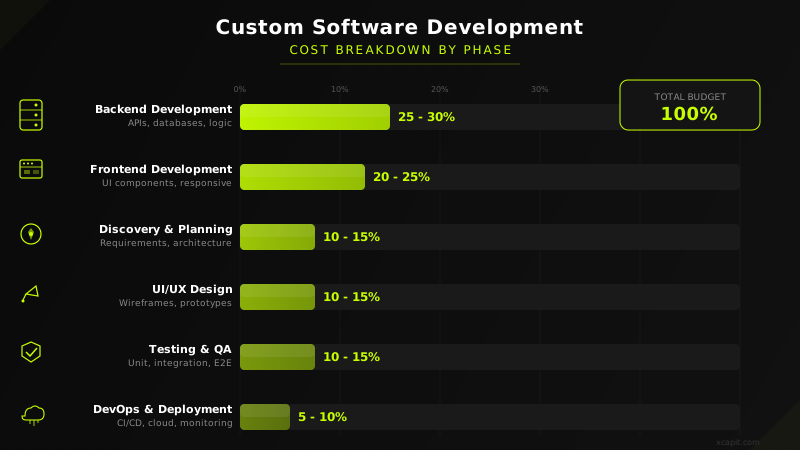
The development invoice is not the total cost of your software. Here are the costs that catch companies off guard because they weren't included in the initial estimate.
- Quality Assurance and Testing — Thorough testing (unit, integration, end-to-end, performance, security) adds 20-30% to development time. Skipping it is a false economy that leads to costly production bugs and security vulnerabilities.
- Security Audits and Penetration Testing — For any application handling sensitive data, an independent security audit before launch is essential. Budget $10,000-$30,000 depending on scope. For regulated industries, this is mandatory, not optional.
- Cloud Infrastructure and DevOps — Hosting, CDN, database services, monitoring, alerting, CI/CD pipelines, and disaster recovery. Monthly infrastructure costs range from $500/month for a simple application to $10,000+/month for enterprise platforms with high availability requirements.
- Maintenance and Updates — Post-launch maintenance (bug fixes, security patches, dependency updates, minor improvements) typically costs 15-20% of the initial development budget annually. A $200K application costs $30K-$40K/year to maintain properly.
- User Training and Change Management — New software is only valuable if people use it correctly. Budget for documentation, training sessions, and a transition period where productivity temporarily dips.
- Data Migration — If you're replacing an existing system, migrating data is rarely trivial. Data cleaning, format transformation, validation, and testing can take 2-6 weeks depending on volume and complexity.
A realistic total budget for a $200K custom software project, including all hidden costs for the first year, is $260K-$310K. Plan for this from the beginning rather than scrambling to find budget later.
How to Budget Effectively
The most expensive mistake in software budgeting is committing the entire budget upfront to a fixed scope. Requirements change, markets shift, and you learn things during development that alter priorities. Here's a more effective approach.
Start with Discovery
Invest 5-10% of your total budget in a Discovery phase before committing to full development. A proper Discovery engagement (typically $10K-$25K over 2-4 weeks) produces detailed requirements, architecture recommendations, a realistic timeline, and a refined cost estimate based on actual analysis — not guesswork. This small upfront investment regularly saves 20-40% on total project cost by preventing wrong turns and misaligned expectations.
Phase the Development
Break the project into phases with clear milestones and decision points. Phase 1 delivers core functionality (the 20% of features that deliver 80% of the value). Phase 2 adds secondary features and integrations. Phase 3 covers optimization, scale, and advanced capabilities. Each phase has its own budget, and you make a go/no-go decision based on results before committing to the next.
This phased approach reduces risk dramatically. If the project needs to be paused for business reasons, you have a working product from Phase 1. If priorities change, you can redirect Phase 2 budget to different features. You're never more than one phase away from a usable outcome.
Budget for the Full Lifecycle
When presenting the business case internally, budget for three years, not just the initial build. Include development, infrastructure, maintenance, and planned enhancements. A three-year budget for a $150K initial build might look like: Year 1 — $190K (development + launch + infrastructure). Year 2 — $55K (maintenance + minor features + infrastructure). Year 3 — $60K (maintenance + enhancements + infrastructure). Total three-year cost: $305K. This gives leadership a realistic picture and prevents the painful conversation six months post-launch when maintenance costs aren't budgeted.
ROI of Custom Software: When the Numbers Make Sense
Custom software is an investment, not an expense. The ROI comes in forms that are measurable — if you set up the right metrics before you start.
Labor Cost Reduction
A manufacturing company automating quality inspection with a custom computer vision system might spend $180K on development. If the system replaces 3 full-time inspectors ($55K/year each), the payback period is just over one year, and the annual savings of $165K continue indefinitely. Over five years, the ROI is over 350%.
Revenue Acceleration
A financial services company building a custom client portal that reduces onboarding time from 2 weeks to 2 days. If the faster onboarding allows them to take on 40 additional clients per year at $10K average annual revenue each, the portal generates $400K/year in incremental revenue against a $200K development cost — a 2x return in the first year alone.
SaaS License Replacement
A company spending $350K/year on a combination of SaaS tools (CRM, project management, client portal, reporting) builds a unified custom platform for $300K. After Year 1 (development cost + $50K maintenance), they break even. From Year 2 forward, they save $300K annually while having a system that fits their workflow precisely. Over five years, the net savings exceed $1M.
Competitive Advantage
Some ROI is harder to quantify but no less real. A proprietary platform that enables you to serve customers in ways competitors cannot creates market differentiation that drives growth. When UNICEF needed a digital wallet that could work across 167+ countries with unique requirements for financial inclusion, no off-the-shelf solution existed. The custom platform we built now serves over 4 million users — a scale of impact that would have been impossible with commercial software.
Custom software development is a significant investment, but when the conditions are right, it's one of the highest-ROI investments a company can make. The key is approaching it with clear objectives, realistic budgets, and the right development partner.
If you're in the early stages of planning a custom software project and want to understand the real costs for your specific situation, we can help. At Xcapit, we start every engagement with a transparent Discovery process that gives you a detailed scope, architecture plan, and budget estimate — before you commit to a full build. Learn more about how we work.

José Trajtenberg
CEO & Co-Founder
Lawyer and international business entrepreneur with over 15 years of experience. Distinguished speaker and strategic leader driving technology companies to global impact.
Need custom software that scales?
From MVPs to enterprise platforms — built right.
You Might Also Like
Custom software or an existing solution? How to make the best decision for your company
Buy or build is one of the most important decisions in any digital transformation project. When each option makes sense, why the right question is not binary, and how to assess long-term impact.
What is technical debt and why can it slow down a company's innovation?
Technical debt does not appear on any balance sheet, but it makes every new feature more expensive and limits your ability to adopt AI or automation. What it is, how to spot it, and why modernizing does not mean starting from scratch.
Will Artificial Intelligence replace developers? Why software engineering matters more than ever
AI automates code generation, testing and documentation, but it does not replace engineering. Why, as writing code becomes easier, the value of those who design architectures and understand the business goes up.