

In emerging markets, 92% of credit applications are rejected. Not because applicants can't pay — but because they can't prove they will. No credit history, no formal employment record, no banking relationship. The result: billions of people locked out of the financial system, forced into informal lending with predatory rates or simply excluded from services that require a credit card. In Argentina alone, 43% of all credit operations happen in the informal market.
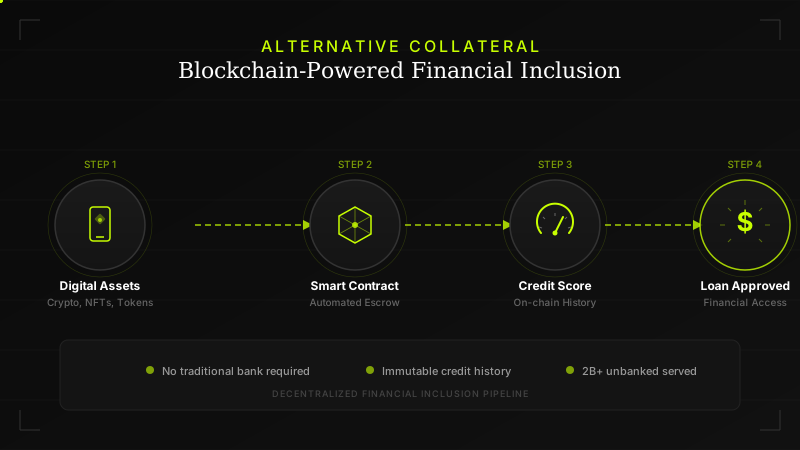
But what if there were a way to guarantee credit without relying on credit history? What if people could use digital assets they already own — stablecoins pegged to the US dollar — as collateral to unlock their first credit card? That's exactly what we built and tested.
The Credit Exclusion Problem
Credit scoring systems were designed for people who already participate in the formal financial system. If you've never had a loan, a credit card, or a bank account with regular activity, you're invisible to these systems. And being invisible means being rejected.
This affects immigrants who move to a new country and start from zero. Freelancers and gig workers whose income doesn't fit traditional employment models. Young adults entering the workforce. People in rural areas far from bank branches. In Argentina, where 32% of the population applied for credit in 2022, millions face rejection every year — not because of bad financial behavior, but because of no financial history at all.
The consequences go beyond inconvenience. In economies with high inflation, a credit card is a survival tool. It provides access to online purchases, discounts of up to 30%, and interest-free installment plans stretching 12 to 18 months — a critical mechanism for preserving purchasing power when prices rise monthly. Without a credit card, you pay more for everything.
The Opportunity: Stablecoins as Alternative Collateral
Stablecoins are digital currencies pegged 1:1 to a reference currency — typically the US dollar. USDC, for example, is backed by cash reserves and short-term US treasuries, and is regulated by US financial authorities. Unlike volatile cryptocurrencies like Bitcoin, stablecoins maintain a stable value, making them suitable as financial collateral.
The insight is simple: if a person can deposit stablecoins as a guarantee — locked in a smart contract that neither the user, the bank, nor any intermediary can access unilaterally — the bank faces zero default risk. The collateral covers the credit line. If the user pays their bills, they keep their deposit. If they default, the collateral is automatically liquidated to cover the debt. No collections process, no write-offs, no risk.
For the user, the stablecoin deposit serves a dual purpose: it's a savings vehicle denominated in US dollars (critical in inflationary economies) and a key that unlocks formal financial services. Over time, as the user builds payment history with their new credit card, they can transition to traditional unsecured credit — the collateral becomes a bridge, not a permanent requirement.
How the Model Works
The technical implementation uses blockchain infrastructure to create a trustless escrow system. Here's the flow:
- A credit-rejected user receives a notification offering an alternative path to approval through digital collateral
- The user accesses a dedicated platform where they can purchase USDC with local currency or transfer stablecoins they already hold
- With a single action, the user locks their chosen amount in a smart contract — a self-executing program on the blockchain that holds the funds in escrow
- The smart contract is fully decentralized: neither the technology provider nor the bank can access the locked funds
- Within 24 hours, the bank confirms the collateral and issues the credit card with a limit matching the deposit
- Monthly payments work normally. If the user defaults, the smart contract automatically releases the collateral to the bank
- After months of consistent payments, the user has built credit history and can apply for traditional unsecured credit
The self-custodial design is critical. Users maintain control of their funds through cryptographic keys. The smart contract enforces the rules automatically — no human intervention needed for either collateral release or liquidation. This removes counterparty risk for both sides.
Proof of Concept: Results from a Real Pilot
We tested this model with one of Argentina's largest credit card issuers, reaching users who had been rejected through traditional channels. For the full implementation details and metrics, see our Naranja X blockchain collateral case study. The results exceeded expectations across every metric.
Engagement was strong from the start. The initial email campaign achieved a 35% open rate (vs. 26% industry average) and a 9.18% click-through rate (vs. 3.6% industry average). These numbers reflect genuine demand — people who had been told "no" were eager to explore an alternative path.
Of those who clicked through, 3.70% completed the full process from collateral deposit to approved credit card. The average collateral deposit was 38 USDC — a modest amount that demonstrates the model works for real people, not just high-net-worth crypto holders.
Post-approval metrics were equally compelling:
- 81% activated their card within the first 30 days
- 100% rated their experience as good or very good
- 100% said they would recommend the solution, with an average score of 8.9 out of 10
- 52% already held crypto and simply transferred it — showing higher adoption readiness than expected
- Spending patterns showed basic consumption (groceries, Mercado Libre), not speculative or luxury purchases
The user profile was diverse: 44% were foreigners with Argentine residency, 50% lived in mid-size or small cities, and 25% were self-employed. These are precisely the demographics that traditional credit scoring fails to serve.
The Human Side of Financial Inclusion
Behind every data point is a person who was told they didn't qualify. The pilot revealed stories that no metric can fully capture.
"It's my first credit card," said Marilina Rojas. For someone who had never been approved by any financial institution, the impact goes beyond purchasing power — it's recognition as a participant in the formal economy.
"No bank would give me a card because I'm from another country," explained André Simoes. Immigrants face a paradox: they need credit history to get credit, but they can't build credit history without access to credit products.
"I've lived in Argentina for 15 years and was never able to get one," said Carlos Quena. Fifteen years of economic participation, tax payments, and daily life — invisible to a credit scoring algorithm.
When surveyed about what they valued most, 50% of users highlighted that the solution doesn't require traditional credit approval, and 33% valued that it's accessible to everyone regardless of background.
Beyond Credit Cards: Scaling the Model
The credit card pilot was a starting point, but the underlying infrastructure supports much broader applications. The same collateral mechanism can enable:
- Personal loans backed by stablecoin deposits, expanding the product suite beyond credit cards
- Credit limit increases for existing cardholders who were denied higher limits — addressing an additional 1.4 million annual rejections at the pilot partner alone
- Business credit for sole proprietors and micro-enterprises that lack the documentation required by traditional commercial lending
- Cooperative and mutual lending platforms where community-based financial institutions can offer credit backed by members' digital collateral
- Cross-border credit access, enabling people to build credit relationships in countries where they have no financial history
The economic projections are significant. At the pilot partner, applying a conservative 9% conversion rate to 3.5 million annual card rejections could generate over $23 million in collateral deposits and substantial fee revenue. Adding credit limit increases and other products multiplies the opportunity further.
Building the Infrastructure for Inclusive Finance
The challenge of financial exclusion won't be solved by incremental improvements to existing credit scoring models. It requires new infrastructure — systems that can evaluate creditworthiness through alternative signals and reduce risk through programmable, transparent mechanisms.
Blockchain-based collateral is one piece of this puzzle. It works today, with real users, real banks, and measurable results. It doesn't require people to wait for better algorithms or regulatory changes. It meets them where they are — with the digital assets they already hold or can easily acquire — and gives them a path into the formal financial system.
At Xcapit, we build the technology that makes this possible: self-custodial wallets, smart contract escrow systems, bank integration APIs, and the full infrastructure needed to deploy alternative collateral programs. If your institution serves markets where credit exclusion is a reality — and wants to turn rejected applicants into loyal customers with zero default risk — we should talk.

Antonella Perrone
COO
Previously at Deloitte, with a background in corporate finance and global business. Leader in leveraging blockchain for social good, featured speaker at UNGA78, SXSW 2024, and Republic.
Building regulated financial products?
From digital wallets to tokenized collateral and secure platforms, we build fintech systems designed for production.
You Might Also Like
Programmable guarantees: what we learned deploying smart contracts in the real financial system
From our work with Banco Industrial and a leading fintech to the mutual guarantee ecosystem: how smart contracts shield credit risk and cut guarantee issuance from weeks to minutes.
Shelter: the infrastructure that delivers aid where the system gives up
Blockchain, SMS and stablecoins serving those who need them most. No banks. No middlemen. No friction. Shelter is Xcapit's humanitarian aid disbursement platform — 167 countries reached, 70K+ people impacted, 3 pilots completed, 2 weeks of technical integration.
Tokenized Warrants Are Changing How Latin American Agriculture Gets Credit
Why the next generation of agricultural credit in Latin America runs on tokenized commodity warrants — and what the 2026 stack actually looks like.