
Every digital transformation engagement starts the same way: we present a roadmap. Five phases, clear milestones, logical dependencies, estimated timelines. It looks authoritative on a slide deck. Clients nod along. And then reality happens. Requirements shift. Budgets get revisited. A quick win reveals that the original priority was wrong. The roadmap changes -- and it should. After leading digital transformation projects for over a decade, the most important thing I've learned is that the roadmap's value isn't in being followed exactly. Its value is in giving everyone a shared framework for making better decisions when things inevitably change.
This post walks through the roadmap template we use at Xcapit, why most clients change it, and how we've designed the process to make those pivots productive rather than disruptive.
Why Most Digital Transformation Roadmaps Fail
Industry research consistently shows that between 60% and 80% of digital transformation initiatives fail to deliver their intended outcomes. The reasons are remarkably consistent across industries and company sizes, and they have almost nothing to do with technology.
The first failure mode is rigidity. Organizations invest months producing 80-page strategy documents and Gantt charts that stretch to the horizon. The plan becomes an artifact to be defended rather than a tool to be used. When reality diverges -- and it always does -- teams face a choice between following a plan they know is wrong or admitting the plan needs revision. Most choose the former, because changing course feels like failure.
The second failure mode is ambition without sequencing. The executive team wants AI analytics, a modernized portal, automated workflows, and a mobile app -- all within 18 months. Combined, they overwhelm the organization's capacity for change. Nothing ships because everything depends on everything else.
The third failure mode is the disconnect between strategy and operations. A roadmap designed in a boardroom reflects strategic intent. The people who actually use the systems every day have a fundamentally different understanding of what's broken and what matters. When the roadmap doesn't incorporate their reality, the resulting technology solves the wrong problems.
Our Initial Roadmap Template: Five Phases
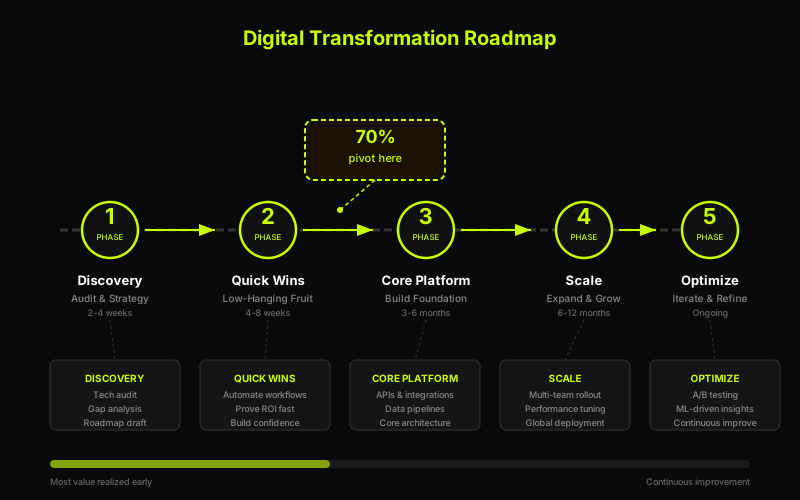
When we engage with a new client, we present a five-phase roadmap as a starting framework. I emphasize 'starting framework' because the specific activities within each phase are tailored to the client, and the boundaries between phases shift based on what we learn. The phases are Discovery, Quick Wins, Core Platform, Scale, and Optimize.
Phase 1: Discovery (4-8 Weeks)
Discovery is where we immerse ourselves in the client's business context, technology landscape, and organizational dynamics. We interview stakeholders across functions and levels, audit existing systems and data flows, map current processes, and identify the gaps between where the organization is and where it wants to be. The output is not just a requirements document -- it's a shared understanding that aligns everyone on priorities, constraints, and trade-offs.
Phase 2: Quick Wins (4-12 Weeks)
Before committing to the big bet, we identify and deliver two to four quick wins -- improvements that are high-impact, low-risk, and achievable within weeks rather than months. These might be automating a painful manual process, building a dashboard that eliminates hours of spreadsheet work, or integrating two systems that currently require manual data entry. Quick wins build trust, generate momentum, and -- critically -- reveal insights about the organization that inform the rest of the roadmap.
Phase 3: Core Platform (3-9 Months)
This is where the primary transformation happens. Based on what we learned in Discovery and Quick Wins, we build the core platform or system that addresses the organization's most important capability gap. This might be a custom enterprise application, an AI-powered decision support system, a blockchain-based process, or a modernized data infrastructure. Development follows agile methodology with two-week sprints, continuous stakeholder feedback, and regular course corrections.
Phase 4: Scale (Ongoing)
Once the core platform is live and validated, we extend it -- rolling out to additional departments, geographies, or use cases. Scale is where the initial investment compounds, but it also introduces new complexity around training, change management, and integration with systems we didn't touch in Phase 3.
Phase 5: Optimize (Ongoing)
With the platform in production and real usage data flowing, we shift focus to optimization. Performance tuning, feature refinement based on actual user behavior, new integrations that extend the platform's value, and continuous improvement driven by data rather than assumptions. This phase never truly ends -- it evolves into the organization's normal product development cadence.
Why 70% of Clients Change the Roadmap
Here's the statistic that surprises most people: roughly 70% of our clients make significant modifications to the roadmap after the discovery phase. Not minor tweaks -- meaningful changes to scope, sequencing, or priorities. And we consider this a success, not a failure.
The roadmap we present at the beginning is our best hypothesis based on initial conversations and experience with similar organizations. But a hypothesis is not a plan. The discovery phase is designed to stress-test that hypothesis against reality. When clients change the roadmap, it means the discovery process worked -- they're making decisions based on evidence rather than assumptions. The alternative, rigidly following the original plan despite new information, is how transformations fail.
The Most Common Pivots
After dozens of transformation engagements, we see recurring patterns in how roadmaps change. Understanding these patterns can help you anticipate and prepare for them.
- Scope reduction after reality check -- Discovery reveals that the organization's data infrastructure, integration landscape, or team capacity can't support the original scope. Rather than building on a shaky foundation, we descope Phase 3 and add a foundational phase to address the gaps. This feels like a setback but prevents far more expensive failures downstream.
- Priority shifts after quick wins reveal insights -- A quick win that was supposed to be a simple automation reveals a deeper process problem, or user feedback on an early deliverable redirects the team toward a different capability entirely. Quick wins are diagnostic tools disguised as deliverables.
- Tech stack changes based on discovered constraints -- The initial proposal assumed a certain technology stack, but discovery uncovers compliance requirements, existing vendor contracts, or team skill gaps that make a different approach more pragmatic. We've had engagements where the entire architecture changed after we audited the client's actual data landscape.
- Timeline extension with scope preservation -- Sometimes the scope is right but the timeline was optimistic. This usually happens when the discovery phase reveals more integration complexity or change management requirements than anticipated. We'd rather extend the timeline and deliver properly than compress it and deliver poorly.
- Entire phase reordering -- Occasionally, what we planned as Phase 4 becomes urgent and needs to happen first, or what we planned as Phase 3 turns out to be less critical than initially assumed. Business conditions change, market pressures shift, and the roadmap should reflect the organization's current reality, not its reality from three months ago.
The Discovery Phase: What We Actually Do
Discovery is the most undervalued phase of any transformation. Clients are often eager to skip it -- they know what they want, they've already written the requirements, can we just start building? The answer is always no. What clients think they need and what they actually need are almost never the same thing -- not because clients are wrong about their business, but because the gap between a business problem and a technology solution is filled with assumptions that need to be validated.
We conduct structured interviews with stakeholders at every level. Executives know where the organization needs to go but often underestimate the complexity of getting there. Middle managers know what actually works and what's held together with workarounds. End users know where the real friction lives. Each group holds a different piece of the puzzle.
We also perform technical audits of existing systems, data quality assessments, and integration mapping. Legacy systems often have undocumented dependencies that aren't visible until you look under the hood. We've had engagements where the entire approach changed because the client's data was in far worse shape than anyone realized -- building an AI analytics platform on unreliable data is an expensive exercise in generating confident-looking wrong answers.
The Quick Wins Strategy: Trust Before the Big Bet
Quick wins serve three purposes beyond their immediate business value. First, they build trust. Before asking a client to commit significant budget to a multi-month platform build, we demonstrate that we can deliver tangible value quickly. Trust is earned through delivery, not through slide decks. Second, they generate organizational momentum. When employees see a painful process automated or a time-consuming report generated instantly, they become advocates rather than resistors.
Third -- and this is the part most people miss -- quick wins are intelligence-gathering operations. Every quick win involves working within the client's actual systems, data, and processes. We learn how data actually flows (versus how the architecture diagram says it flows), how responsive the IT team is to change requests, and how users interact with technology. These insights directly shape the core platform design in Phase 3.
Handling the 'We Want Everything Now' Conversation
Every transformation engagement includes the moment where a senior stakeholder asks why we can't do everything in parallel. Build the platform, implement the AI models, and modernize the data infrastructure simultaneously. The logic seems sound: more resources, more parallelism, faster results.
The honest answer is that parallel workstreams create integration complexity that grows exponentially, not linearly. Three parallel workstreams don't require three times the coordination -- they require six times, because each must integrate with every other. The overhead consumes the very capacity you're trying to maximize. More importantly, parallel execution eliminates the learning loops that make sequential phases valuable. If you're building the core platform while running quick wins, you can't incorporate what the quick wins teach you.
We handle this conversation by reframing speed. The fastest path to value is not the path that starts everything simultaneously -- it's the path that delivers validated, usable capabilities in the shortest sequence. A focused team delivering one thing well every six weeks will outperform a stretched team attempting four things simultaneously and delivering none of them for six months.
Measuring Transformation Success
One of the most common mistakes in digital transformation is measuring success with lagging indicators only -- revenue growth, cost reduction, market share. These metrics matter, but they materialize months or years after the work is done. If you wait for lagging indicators to tell you whether the transformation is working, you've lost the ability to course-correct.
We establish leading indicators at the start of every engagement -- metrics that tell you whether you're on track before the final results are in. Common examples include user adoption rates, process completion times, data quality scores, and employee satisfaction with new tools.
- Leading indicators (measure weekly/monthly): user adoption rate, process completion time, system uptime, data quality score, employee satisfaction with new tools, number of manual workarounds eliminated
- Lagging indicators (measure quarterly/annually): revenue impact, cost reduction, customer satisfaction improvement, time-to-market for new capabilities, competitive positioning
- Health indicators (monitor continuously): team velocity and burnout signals, technical debt accumulation, integration stability, change request volume and nature
The distinction between leading and lagging indicators also helps manage executive expectations. When a board member asks 'is the transformation working?' three months in, you need an answer that's more substantive than 'we'll know in a year.' Leading indicators provide that answer with data, not optimism.
Change Management: The Non-Technical Part That Makes or Breaks It
Here's an uncomfortable truth that technology companies -- including us, early in our history -- are slow to acknowledge: the technology is usually the easy part. The hard part is getting people to change how they work. A perfectly engineered platform that nobody uses is a perfectly engineered waste of money.
Change management is not a workshop you run before go-live. It's a continuous process that starts in discovery and never truly ends. During discovery, we identify organizational dynamics -- who the champions are, who the skeptics are, and what previous change initiatives succeeded or failed and why. This social architecture is as important as the technical architecture.
During development, we involve end users as co-designers from the beginning, not just as beta testers in the final weeks. When people participate in creating something, they own it. When something is imposed on them, they resist it. We also establish internal champions who can translate between our team and theirs, and who know which concerns are legitimate versus reflexive resistance that fades once people experience the benefits.
Training is the final piece, and it needs to be ongoing, not one-and-done. We design training programs that match how adults actually learn -- hands-on practice in realistic scenarios, reference materials for common tasks, and accessible support channels for when they get stuck.
The Roadmap Is the Conversation, Not the Document
After years of leading transformation engagements, I've come to think of the roadmap not as a document but as a structured conversation between our team and the client organization. The document is just the artifact that captures the current state of that conversation. It's meant to evolve.
The organizations that get the most value from digital transformation are the ones that embrace this dynamic. They use the roadmap as a decision-making tool rather than a compliance checklist. They measure progress by value delivered, not by adherence to the original timeline. And they understand that the 'right' answer is rarely the one they started with -- it's the one they arrived at through discovery, experimentation, and adaptation.
At Xcapit, we've guided transformations across fintech, energy, government, and international development -- from building UNICEF's digital wallet infrastructure to modernizing enterprise platforms for regulated industries. Every engagement has reinforced the same lesson: a flexible, phased roadmap executed with discipline and transparency consistently outperforms an ambitious plan executed with rigidity.
If you're planning a digital transformation and want a partner who builds roadmaps designed to evolve, we'd welcome the conversation. Explore how we approach these engagements at /services/custom-software, or reach out through our contact page to discuss your specific situation.

Santiago Villarruel
Product Manager
Industrial engineer with over 10 years of experience excelling in digital product and Web3 development. Combines technical expertise with visionary leadership to deliver impactful software solutions.
Need custom software that scales?
From MVPs to enterprise platforms — built right.
You Might Also Like
Custom software or an existing solution? How to make the best decision for your company
Buy or build is one of the most important decisions in any digital transformation project. When each option makes sense, why the right question is not binary, and how to assess long-term impact.
Software Factory vs In-House Development: A Decision Framework for 2026
A balanced, data-driven guide for CTOs and engineering leaders comparing in-house development teams with software factory partnerships. Includes cost breakdowns, decision criteria, hybrid models, and a structured framework to make the right choice for your organization.
Outsourcing Software Development to Argentina: A 2026 Guide for US & European Companies
Everything you need to know about outsourcing software development to Argentina -- from timezone advantages and talent pool to legal frameworks, costs, and how to choose the right partner.