

Every product roadmap I have seen in the past two years includes some version of the same line item: 'Add AI.' Sometimes it arrives with a specific use case attached. More often, it arrives as a mandate -- a strategic directive born from the fear that competitors are doing it, that customers expect it, or that the market will punish anyone who does not have it.
After ten years of building digital products -- and the last three navigating the AI question across dozens of projects -- I have developed a strong opinion: the most valuable AI decision a product team can make is the decision not to use AI where it does not belong. The second most valuable is knowing exactly where it does belong and building it so well that users never think about the technology.
This article distills lessons from real projects -- some where AI transformed the product experience, others where we recommended against it and saved our clients months of wasted effort. The framework here is the one we use internally at Xcapit when evaluating AI integration.
The AI Feature Trap
The AI feature trap works like this: someone in the organization -- a CEO who attended a conference, a board member who read an article, a sales director who lost a deal -- declares that the product needs AI. A sprint is allocated. A model is trained or an API is integrated. A feature ships. And then nothing meaningful changes.
Users try it once, find it unreliable, and revert to their previous workflow. The feature lingers in the interface, consuming maintenance budget and creating technical debt. The team has successfully added AI to the product. They have not successfully added value.
This pattern is remarkably common. A 2024 study by Pendo found that the average adoption rate for AI features in enterprise software is under 25 percent after 90 days. The problem is not the technology. Teams are working backward -- starting with a solution and searching for a problem, rather than starting with a genuine user need and evaluating whether AI is the best way to address it.
Signs Your AI Feature Is a Gimmick
Over the years, I have identified reliable indicators that an AI feature is decorative rather than functional. Recognizing these signs early saves teams from investing in features that erode trust.
- Users bypass it. The clearest signal is that users develop workarounds to avoid the feature. They skip the AI-generated summary and read the source material. They ignore the recommendation and apply their own filters. If users consistently route around a feature, it is not solving their problem -- it is standing in the way of it.
- It does not improve core metrics. A genuinely valuable feature moves the numbers that matter: task completion rate, time to resolution, error rate, retention. If the feature has been live for three months and core metrics are flat, it is not adding value -- it is generating impressive demos but not changing outcomes.
- It was added for marketing. If the primary motivation was to include the word 'AI' in marketing materials rather than to solve a specific user problem, the feature is a gimmick by definition. Marketing-driven features optimize for first impressions rather than sustained utility.
- It requires users to change their workflow. The best AI features are invisible. They enhance existing workflows rather than demanding new ones. If users must learn new interaction patterns or navigate to a separate interface, adoption will be low and abandonment will be high.
- The team cannot articulate what happens without it. If we removed this feature tomorrow, what specific task would become harder or slower? If the answer is vague, the feature is not solving a real problem.
Our Framework for Evaluating AI Integration
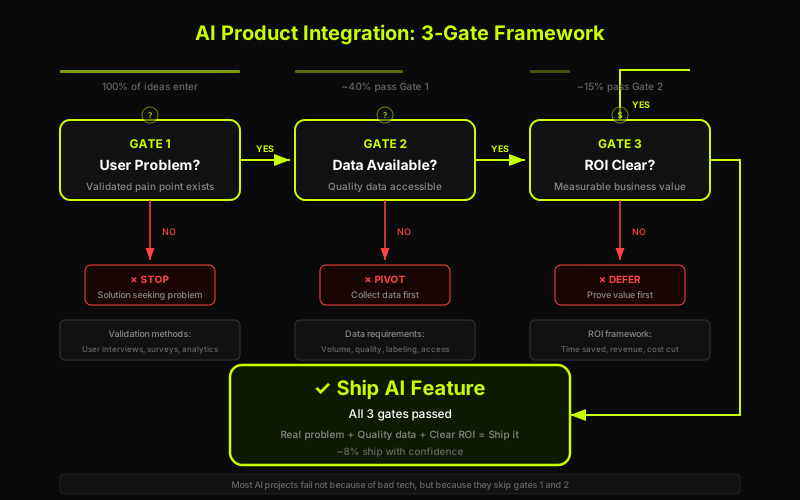
At Xcapit, every AI integration proposal goes through a three-gate evaluation before it reaches the engineering backlog. The framework is deliberately simple because complex evaluations become rubber stamps. Simple gates force honest answers.
Gate 1: Does It Solve a Real User Problem?
Before discussing models or APIs, we require a clear articulation of the user problem, grounded in evidence -- user research, support tickets, behavioral data, or observation. We ask: who is the user, what are they trying to accomplish, what prevents them today, and how will AI address that barrier better than alternatives? If the answer is unconvincing, we explore simpler solutions first.
Gate 2: Is the Data Available and Sufficient?
The gap between 'we have data' and 'we have data that can train a useful model' is enormous. This gate evaluates four dimensions: volume, quality, freshness, and access. Most AI features that fail in production fail because of data problems, not model problems. This gate catches those failures early.
Gate 3: Is the ROI Clear?
AI features are expensive -- not just to build, but to maintain, monitor, retrain, and support. We require a clear ROI case accounting for full cost of ownership: development, GPU infrastructure, model maintenance, data pipelines, and opportunity cost. The ROI must be expressed in business terms: revenue impact, cost reduction, risk mitigation, or competitive differentiation. 'It would be cool' is not an ROI case.
Where AI Genuinely Adds Value
When a use case passes all three gates, AI can be transformative. The highest-value applications fall into five categories.
- Automation of repetitive cognitive tasks. Document classification, invoice processing, data extraction, compliance screening -- these high-volume tasks are where AI delivers immediate, measurable ROI by reducing both cost and error rates.
- Personalization at scale. Serving different content, recommendations, or experiences based on user behavior and context is something AI does extraordinarily well and rules-based systems struggle with at scale.
- Anomaly detection. Identifying unusual patterns in large datasets -- fraudulent transactions, security threats, equipment failures -- is a classic AI strength. Humans cannot monitor millions of data points in real time. AI can, with consistent attention and without fatigue.
- Natural language interfaces. When users need to interact with complex systems using natural language -- querying databases, summarizing content, generating reports -- large language models provide a genuinely superior experience compared to traditional search.
- Predictive analytics. Forecasting demand, churn risk, maintenance needs, or resource requirements shifts decision-making from reactive to anticipatory -- but only when predictions are accurate enough to be actionable.
The Implementation Approach: Start Simple, Escalate Deliberately
One of the most common mistakes in AI product development is reaching for the most sophisticated tool first. Teams jump to LLM integration when a rules engine would solve the problem faster, cheaper, and more reliably. Our philosophy follows a deliberate escalation path.
Start with rules. For any classification or decision-making task, begin with explicit rules based on domain expertise. Rules are interpretable, debuggable, and deterministic. They handle the 80 percent of cases that follow predictable patterns. Document where rules fail -- those failures become training data for the next step.
Add machine learning when rules break down. When rules become too numerous or when patterns exist that domain experts cannot articulate, ML earns its place. Start with simple models -- logistic regression, decision trees, gradient boosting -- before neural networks. Simpler models are easier to explain and often perform comparably on structured data.
Use LLMs for language tasks. Large language models are extraordinary at understanding and generating natural language but overkill for classifying structured data or performing calculations. Reserve them for tasks that genuinely require language understanding: summarizing documents, extracting entities from unstructured text, answering natural language queries, or generating human-readable reports.
The Data Question: Why Most AI Features Fail
I want to be direct about something the AI industry does not discuss enough: the majority of AI feature failures are data failures, not model failures. The model is rarely the bottleneck.
Data problems manifest predictably. Insufficient volume means the model memorizes rather than learns. Poor labeling means it learns wrong patterns. Distribution mismatch means training data does not represent production conditions. Concept drift means patterns changed but the model was not retrained. Every one of these is a data infrastructure problem, not a model architecture problem.
The practical implication: before investing in model development, invest in data infrastructure. Build robust pipelines. Implement quality monitoring. Create labeling workflows. Establish retraining schedules. These unglamorous investments determine whether AI features work in production, not the choice between GPT-4 and Claude or between TensorFlow and PyTorch.
UX Patterns for AI Features That Users Actually Trust
Even a technically excellent AI feature will fail if the UX is poorly designed. AI introduces uncertainty -- the output might be wrong, and users know this. Good design acknowledges that uncertainty and turns it into trust. Here are the patterns we apply consistently.
Progressive Disclosure
Show the AI output first, then provide easy access to the reasoning or source material behind it. A summarizer should present the summary prominently but make it trivial to view the original text. A recommendation engine should let users see the factors that influenced the suggestion. This respects users' time while preserving their ability to verify and override.
Confidence Indicators
When the model is uncertain, tell the user. A confidence score, a visual indicator, or a simple 'low confidence' label communicates that the system knows its limitations. This is counterintuitive for teams trained to project confidence, but it dramatically increases trust. Users who understand when the system is uncertain make better decisions about when to rely on it.
Graceful Degradation
AI features will fail. Models will return low-confidence predictions, APIs will time out, edge cases will produce nonsensical outputs. Design for these failures explicitly. When the AI cannot provide a useful result, fall back to a non-AI experience. Never let an AI failure become a product failure.
Human-in-the-Loop
For high-stakes decisions, position AI as an assistant rather than a decision-maker. The AI surfaces the analysis and suggests an action -- but a human makes the final call. This is essential in domains where errors have significant consequences: healthcare, finance, legal, and security. It also creates a feedback loop: human corrections become training data that improves the model over time.
Measuring AI Feature Success
If you cannot measure whether an AI feature is working, you cannot justify its existence. We define success metrics before development begins. The metrics that matter most are not model accuracy metrics -- they are product metrics.
- Task completion rate: What percentage of users who engage with the AI feature successfully complete their intended task? High model accuracy with low task completion means the experience is failing users.
- Time saved: How much faster do users accomplish their goal compared to without the feature? Measure this with real users in real workflows, not controlled testing. If it does not save meaningful time, it is adding complexity without benefit.
- Error reduction: Does the AI reduce errors compared to fully manual processes? Measure both errors prevented and new errors introduced. Net error reduction is what matters.
- Adoption rate: What percentage of eligible users actively use the feature after 30, 60, and 90 days? Declining adoption signals the feature is not delivering sustained value. Distinguish trial usage from habitual usage.
- Override rate: How often do users reject or modify the AI output? A moderate rate is healthy. A very high rate means the AI is not helpful. A very low rate in high-stakes domains might mean over-reliance.
Lessons from Real Projects
Our experience at Xcapit has given us a nuanced view of where AI integration succeeds and where it does not. Without revealing client specifics, here are the patterns.
In a financial services project, we built an anomaly detection system that flagged unusual transaction patterns for human review. The system reduced fraud losses by over 40 percent in its first quarter. The key was not model sophistication -- it was data quality. We spent two months building the data pipeline and three weeks on the model.
In another engagement, a client wanted an AI chatbot for their enterprise platform. After evaluation, we recommended against it. Their users were technical specialists who needed precise answers, not conversations. The existing search system, improved with better information architecture, outperformed every chatbot prototype. The client saved six months of development by not using AI.
In a third project, we integrated natural language querying into a data analytics platform. Users could ask questions in plain English and receive visualizations. This succeeded because the need was genuine -- analysts spent hours writing SQL for ad hoc questions -- and the data was well-structured enough for reliable natural language translation. Adoption reached 70 percent within 60 days.
The through-line in all these cases is the same: the technology decision was subordinate to the product decision. We started with the user, not the model.
Making the Right Call
The organizations that will benefit most from AI are not those that adopt it fastest but those that adopt it most thoughtfully. A disciplined approach -- starting with real user problems, demanding data readiness, insisting on clear ROI, and measuring outcomes honestly -- produces features that users rely on rather than features they ignore.
The AI feature trap is avoidable. It requires the courage to say 'not yet' when the evidence does not support AI, and the conviction to invest deeply when it does. Teams that master this discipline build products that are genuinely better -- not because they have more AI, but because the AI they have actually works.
At Xcapit, we help teams navigate the AI integration question with the rigor it deserves. Whether you are evaluating where AI belongs in your roadmap, building your first AI-powered feature, or auditing features that are not delivering results, we bring a product-first perspective grounded in real implementation experience. Contact us to discuss how we can help -- or to have an honest conversation about where AI might not be the right answer.

Santiago Villarruel
Product Manager
Industrial engineer with over 10 years of experience excelling in digital product and Web3 development. Combines technical expertise with visionary leadership to deliver impactful software solutions.
Ready to leverage AI & Machine Learning?
From predictive models to MLOps — we make AI work for you.
You Might Also Like
Innovating faster doesn't mean building faster: it means validating first
AI makes it possible to build prototypes in hours, but it introduces a new risk: building too fast without having validated whether the solution answers a real need. Why speed today is measured by the ability to validate.
What is a Product Builder and why will it be one of the most important roles in digital transformation?
When building gets faster and faster, the challenge becomes knowing what is worth building. What a Product Builder does, how they connect business and technology, and why AI amplifies their work without replacing their judgement.
From requirements to discovery: why companies need to rethink the way they build technology
The model of handing a requirements document to a technical team is starting to show its limits. Why the real challenge is no longer executing a list of features, but understanding precisely the problem you are trying to solve.