

You shipped the demo. The model works. Stakeholders are impressed. And then someone asks the question that separates AI demos from AI products: how do you know it's actually working? The honest answer, for most teams, is that they don't -- because they're measuring the wrong things. After a decade of building digital products and the last several years focused on AI-powered systems, I've watched teams fall into the same trap: applying traditional software metrics to non-deterministic systems. The result is products that look successful on dashboards but fail in the real world.
Why AI Products Need Different Metrics
Traditional software is deterministic. Given the same input, you get the same output. Your CI pipeline catches regressions. Your test suite proves correctness. AI products break these assumptions. Given the same input, you might get different outputs. "Correct" is a spectrum, not a binary. And the system's behavior changes over time as data distributions shift -- even when you haven't touched a single line of code.
Standard software metrics -- uptime, response time, error rate, test coverage -- are necessary but radically insufficient. An AI system can have 99.9% uptime, sub-100ms response times, zero server errors, and still be making terrible predictions that destroy user trust. The metrics that matter for AI products measure a different axis: how well the system understands the world and how much value that understanding creates for users.
The MVP Trap: Shipping a Demo Is Not Shipping a Product
Modern AI tooling has made it dangerously easy to build impressive demos. You can have a working prototype -- complete with a slick interface and a wow-inducing model -- in a weekend. This is simultaneously the best and worst thing to happen to AI product development. Best, because it lowers the barrier to experimentation. Worst, because it creates a false sense of progress.
The demo-to-product gap in AI is wider than in any other type of software. A demo works on curated inputs under controlled conditions. A product works on messy, adversarial, edge-case-laden real-world data. A demo impresses with its best outputs. A product is judged by its worst ones. I've seen teams polish the demo for months while ignoring that their model fails on 15% of real-world inputs they never encountered in testing.
The core problem is measurement. If you're only tracking demo-friendly metrics -- cherry-picked accuracy numbers, hand-selected examples, aggregate scores that hide failure modes -- you will never see the gap between what your system can do and what it does in production. Closing this gap requires metrics that are honest, granular, and tied to user outcomes.
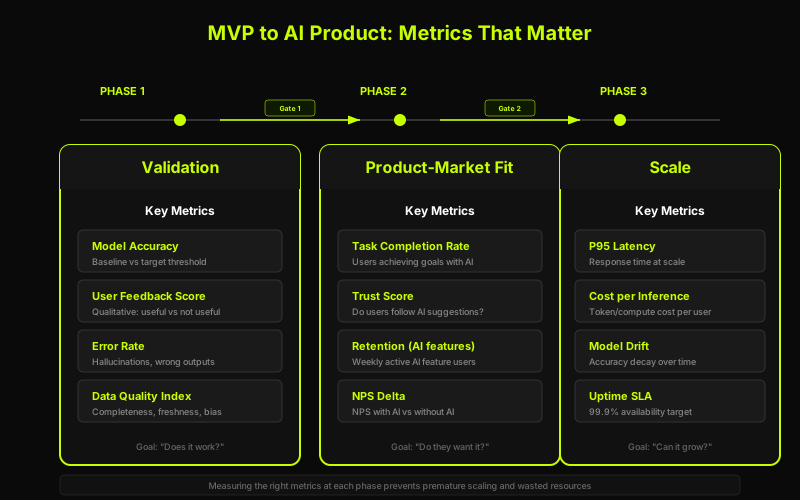
Phase 1 Metrics: Validation
In the validation phase, you're answering one question: is the model solving the right problem well enough to be useful? This is not about production readiness. It's about determining whether the AI approach is fundamentally viable for your use case.
Prediction Accuracy in Context
Raw accuracy is the most commonly cited and most commonly misunderstood AI metric. A model that's 95% accurate sounds great until you learn that the baseline (always predicting the majority class) is 94%. Accuracy must always be reported alongside the baseline rate, broken down by segment, and evaluated against the cost of errors. A fraud detection model that's 99% accurate but misses 40% of actual fraud is useless.
During validation, measure accuracy on held-out data that reflects real-world distributions. Use stratified metrics: precision, recall, F1 score, and -- critically -- per-class performance. The aggregate number hides the details that determine whether your product actually works for the people who need it most.
User Feedback Loops
Quantitative model metrics tell you how the model performs in isolation. User feedback tells you how it performs in context. Instrument every interaction to capture explicit feedback (thumbs up/down, corrections, overrides) and implicit feedback (time spent reviewing AI output, acceptance rate, edit distance between AI suggestion and final action). These signals tell you not just whether the model is accurate, but whether its accuracy is useful.
Data Quality Scores
Your model is only as good as your data. During validation, establish data quality baselines: completeness (percentage of expected fields populated), consistency (same entities with consistent representations), freshness (data age relative to the real world), and label quality (inter-annotator agreement rate). Data quality issues unmeasured during validation become intractable problems during scale.
Phase 2 Metrics: Product-Market Fit
You've validated that the model works. Now you need to prove that users want it -- and that they trust it enough to rely on it. Product-market fit metrics for AI products focus on the intersection of model performance and user behavior.
Task Completion Rate
The single most important metric for AI product-market fit is task completion rate: what percentage of users who start a task with your AI system successfully complete it? This measures the entire experience -- not just model accuracy, but also interface design, error handling, and edge case coverage. A model with 92% accuracy but a 60% task completion rate has a product problem, not a model problem. Track completion rates by user segment and task complexity to identify where users drop off.
Time-to-Value
How quickly does the AI deliver value compared to the manual alternative? If your document classification model takes 200ms per document but requires 45 minutes of setup, the time-to-value story is weaker than it appears. Measure end-to-end time from task initiation to value delivery, including human-in-the-loop steps. The AI doesn't need to be faster at every step -- it needs to make the overall workflow faster.
Error Recovery Rate and User Trust Signals
Every AI system makes mistakes. What matters for product-market fit is how users respond when it does. Track error recovery rate -- when the AI gets something wrong, what percentage of users correct it and continue versus abandon the task? Track trust signals over time: are users accepting AI suggestions more frequently? Are they spending less time reviewing outputs (growing trust) or more (eroding trust)? A healthy AI product shows increasing trust signals as users learn the system's strengths and limitations.
Phase 3 Metrics: Scale
Product-market fit confirmed. Now you need to make it economically sustainable and operationally robust at scale. Phase 3 metrics shift from user behavior to system performance, cost efficiency, and long-term reliability.
Inference Latency and Throughput
Latency matters differently for AI products than for traditional web applications. A 200ms increase in page load time might not affect a SaaS product. A 200ms increase in inference latency can break a real-time recommendation system. Measure P50, P95, and P99 latency at the inference level, and set SLAs based on your specific use case. Throughput -- predictions per second -- determines your infrastructure costs and capacity planning.
Cost per Prediction
This is the metric that kills AI products at scale. A model that costs $0.02 per prediction is fine at 1,000 requests per day. At 1,000,000 requests per day, that's $20,000 daily -- $7.3 million annually. Calculate your fully loaded cost per prediction: compute, data pipeline, model serving infrastructure, monitoring, and amortized retraining costs. Then compare this to the value each prediction generates. If the ratio is unfavorable, optimize the model, reduce serving costs, or rethink pricing before scaling further.
Model Drift and Retention
AI products degrade silently. Unlike traditional software, where bugs cause visible errors, model drift causes slowly declining performance that users experience as the product "getting worse" without articulating why. Monitor distribution drift (input data changing relative to training data), prediction drift (model outputs shifting when inputs are stable), and performance drift (accuracy declining over time). Pair these with retention: weekly active users, feature usage frequency, and churn rate. A drift in model performance almost always precedes a drift in retention -- catch the former early enough, and you prevent the latter.
Vanity Metrics to Avoid
Not all metrics that feel important are important. AI teams are especially susceptible to vanity metrics because impressive-sounding numbers are easy to generate.
- Raw accuracy without context -- 97% accuracy means nothing without knowing the baseline, the class distribution, and the cost of errors in each direction. Always report accuracy alongside these contextual factors.
- Model size and parameter count -- a 70B parameter model is not inherently better than a 7B parameter model for your use case. Bigger models cost more to serve, have higher latency, and are harder to fine-tune. The right model is the smallest one that meets your accuracy and latency requirements.
- Number of 'AI-powered' features -- shipping 12 AI features is not better than shipping 3 that users actually rely on. Feature count is vanity. Feature adoption and task completion are substance.
- Training data volume -- having 10 million training examples is meaningless if they're noisy, biased, or unrepresentative. A curated dataset of 50,000 high-quality, representative examples will outperform a massive, messy one.
- Benchmark scores -- performance on academic benchmarks rarely translates directly to production performance. Benchmark tasks are clean, well-defined, and representative of a narrow distribution. Your production data is none of these things.
The Feedback Loop Problem
The hardest measurement challenge in AI products is collecting ground truth when the AI is making the decisions. This is the feedback loop problem, and it's more dangerous than most teams realize.
Consider a content recommendation system. The AI decides what users see. Users can only interact with what they see. So engagement metrics only reflect preferences among the options the AI presented -- not preferences across all possible content. The AI's decisions shape the very data you use to evaluate and retrain it, creating a self-reinforcing loop where the system grows increasingly confident in a narrow view while missing content users would love but never get shown.
Strategies for breaking the feedback loop include randomized exploration (showing a small percentage of non-optimized results to gather unbiased data), counterfactual evaluation (estimating how alternatives would have performed using logged data), human auditing (regularly sampling AI decisions for expert review), and delayed ground truth collection (connecting eventual outcomes back to predictions, as with loan default). None of these are free -- they cost user experience, engineering effort, or both. But without them, you're flying blind.
Cost Metrics: The Business Reality
AI products have a cost structure that traditional software teams are unprepared for. Beyond inference costs, track data pipeline costs (acquisition, cleaning, labeling, storage), retraining costs (compute, human evaluation, integration testing), monitoring costs (drift detection, alerting, dashboards), and opportunity costs (engineering time on model maintenance versus new features).
Retraining frequency is a particularly important cost driver. Some models need weekly retraining. Others go months without degradation. Measure the relationship between retraining frequency and performance to find the optimal balance. Often, teams retrain too frequently out of anxiety rather than evidence -- a monthly retrain that maintains 94% accuracy is far more cost-effective than a weekly retrain that achieves 95%.
Model Monitoring: Catching Problems Before Users Do
Production model monitoring is not optional -- it's the difference between a product that improves over time and one that silently degrades. A robust monitoring stack covers three dimensions.
Drift Detection
Monitor both data drift (changes in input feature distributions) and concept drift (changes in the relationship between inputs and correct outputs). Statistical tests like Kolmogorov-Smirnov for continuous features and chi-squared for categorical features detect shifts automatically. Set thresholds that trigger alerts when drift exceeds acceptable bounds, and establish runbooks for responding -- retraining, investigating upstream data changes, or adjusting feature pipelines.
Performance Degradation
Track accuracy on a rolling basis using available ground truth -- user corrections, downstream outcomes, expert audits. Segment by time period, user cohort, and input characteristics to catch localized degradation that aggregate metrics would miss. A model that performs well on average but fails for a specific user segment is a liability, not an asset.
Fairness Metrics
If your AI product makes decisions that affect people -- hiring, credit scoring, content moderation, medical screening -- you must monitor for bias. Track performance parity across demographic groups, measure disparate impact ratios, and implement automated fairness checks in your deployment pipeline. Fairness is not a one-time audit. Model behavior can become biased through drift even when the original training was carefully debiased.
What We Measure for AI Products We've Built
At Xcapit, we've built AI systems across financial services, document processing, and enterprise automation. We've converged on a core metrics framework that we apply -- with domain-specific adaptations -- to every AI product engagement.
For validation, we measure per-class precision and recall against real-world distributions, inter-annotator agreement, and data quality scores across four dimensions. For product-market fit, we track task completion rate as the north star, supplemented by time-to-value relative to the manual baseline, user override rates as a trust proxy, and error recovery rates. For scale, we monitor cost per prediction with full infrastructure loading, P95 inference latency, weekly drift scores, and the correlation between model performance and user retention.
The most valuable lesson: no single metric tells the story. A dashboard showing accuracy, cost, latency, trust, and retention together gives you an honest picture of your AI product's health. The relationships between metrics are where insights live: when accuracy drops 2% but task completion stays flat, users tolerate that imprecision. When accuracy is stable but trust signals decline, you have a UX problem. When cost per prediction rises but retention rises faster, you're creating net value. Read the metrics as a system, not as isolated numbers.
Building Your AI Metrics Stack
Getting AI product metrics right is not a one-time exercise. It requires infrastructure to collect ground truth, discipline to measure honestly, and organizational commitment to act on what the data tells you -- even when it tells you that your impressive demo isn't solving the problem.
At Xcapit, we help teams build AI products that work beyond the demo -- from defining the right metrics framework through production deployment and ongoing monitoring. If you're navigating the journey from MVP to production AI, we'd welcome the conversation. Explore our AI development services or get in touch through our contact page.

Santiago Villarruel
Product Manager
Industrial engineer with over 10 years of experience excelling in digital product and Web3 development. Combines technical expertise with visionary leadership to deliver impactful software solutions.
Ready to leverage AI & Machine Learning?
From predictive models to MLOps — we make AI work for you.
You Might Also Like
Innovating faster doesn't mean building faster: it means validating first
AI makes it possible to build prototypes in hours, but it introduces a new risk: building too fast without having validated whether the solution answers a real need. Why speed today is measured by the ability to validate.
What is a Product Builder and why will it be one of the most important roles in digital transformation?
When building gets faster and faster, the challenge becomes knowing what is worth building. What a Product Builder does, how they connect business and technology, and why AI amplifies their work without replacing their judgement.
From requirements to discovery: why companies need to rethink the way they build technology
The model of handing a requirements document to a technical team is starting to show its limits. Why the real challenge is no longer executing a list of features, but understanding precisely the problem you are trying to solve.