

The geography of global software development is shifting faster than most organizations realize. A decade ago, offshore development meant India or Eastern Europe — either the scale of the Indian IT industry or the technical depth of Polish and Ukrainian engineering. Latin America was an afterthought. Today, that calculus has changed significantly, and the change is structural rather than cyclical. The companies that recognized this shift early and built their technology partnerships in the region now have durable advantages in development velocity, team continuity, and total cost of engagement. Those still defaulting to older offshore paradigms are leaving real value on the table.
I write this from the perspective of someone who has built and managed distributed technology teams in Latin America for over fifteen years, with Xcapit's engineering presence centered in Córdoba, Argentina — widely considered one of the region's strongest technology talent markets — and with operations extending to Lima and Miami. We have worked through the challenges of cross-border technology partnerships firsthand, and we have experienced the real advantages that the region provides. This is not a promotional argument. It is a data-grounded analysis of why the LATAM option deserves serious consideration in any technology resourcing decision.
Time Zone Alignment: The Underrated Strategic Advantage
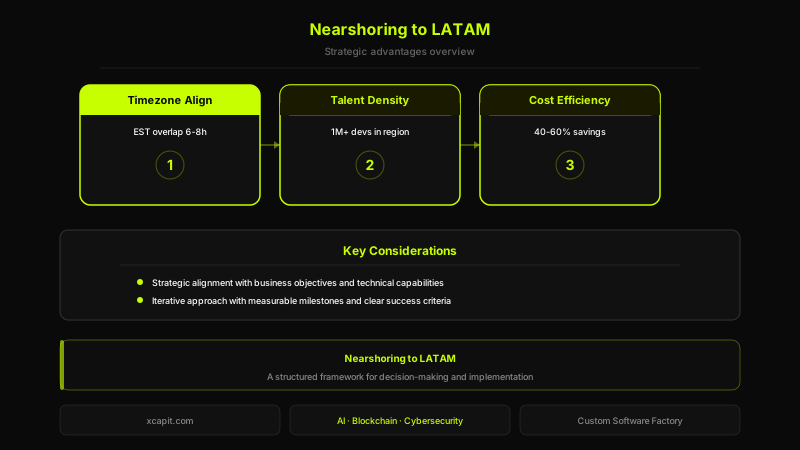
Of all the advantages Latin America offers as a nearshoring destination, time zone alignment may be the most operationally significant and the least quantified in total cost analyses. The entire region falls within 0 to 3 hours of US Eastern time and 0 to 5 hours of the US West Coast. Argentina and Colombia sit at UTC-3 and UTC-5 respectively — essentially aligned with US Eastern business hours year-round.
This matters for reasons that go beyond scheduling convenience. Software development involves a continuous stream of decisions — architectural choices, requirement clarifications, user experience calls, technical trade-offs. In offshore arrangements with 8-12 hour time differences, those decisions wait in queues. A question raised at 3 PM in New York generates a response at 9 AM the following day in Bangalore — 18 hours of decision latency. Multiply that latency across dozens of decision points per week and you have a structural slowdown that no amount of process optimization fully compensates for.
With Latin American teams, a question raised at 3 PM in New York receives a response before end of day in Buenos Aires. Sprint planning meetings happen live, not via recorded videos for an async review. When a client stakeholder has an urgent requirement change, the development team can respond in hours, not the following business day. Over a 12-month engagement, this acceleration compounds into a real delivery advantage.
Cost Comparison: LATAM vs. US, Eastern Europe, and India
Cost is the dimension most organizations lead with, and the numbers for Latin America are genuinely compelling — particularly when total cost of engagement is calculated rather than just hourly rates.
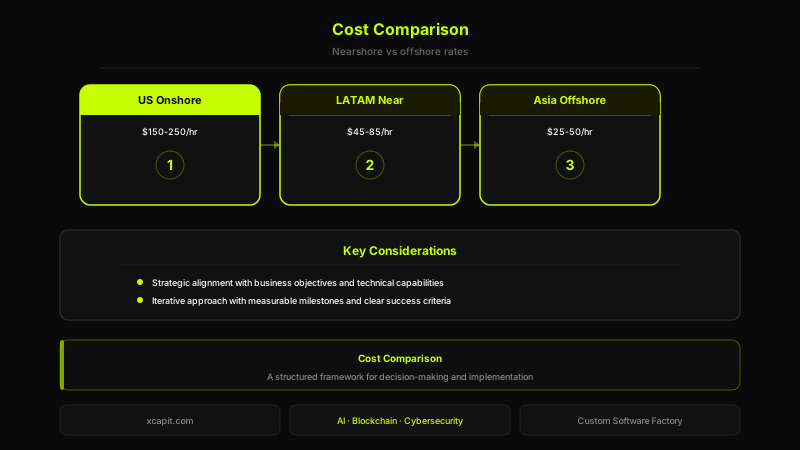
Senior software engineers in the US command $150,000 to $200,000 in fully-loaded annual compensation in high-demand markets, translating to effective hourly rates of $75 to $110 for standard consulting engagements. Senior engineers in Eastern Europe (Poland, Romania, Czech Republic) run $50 to $80 per hour, with Eastern Europe's cost advantages now compressing due to increased competition for top talent following years of strong demand. Indian offshore rates for equivalent senior talent range from $35 to $60 per hour for quality firms, with significant variance in actual quality delivered at the lower end of that range.
Latin America sits at $40 to $80 per hour for senior talent across the quality firms — overlapping with Eastern Europe in cost but dramatically superior in time zone alignment. When you factor in the coordination costs that time zone differences impose — the management overhead, the delayed decision cycles, the increased defect rates from asynchronous communication — the all-in cost of comparable output from a well-managed LATAM team frequently beats the apparent cost advantage of offshore alternatives.
Argentina specifically offers an additional cost dynamic driven by its economic environment. Argentina has historically operated with significant currency and inflation pressures, and for foreign-currency-denominated contracts, this has created periods of exceptional cost competitiveness for international clients. That dynamic has moderated in recent years, but Argentina remains highly competitive on a talent-quality-to-cost basis — which is why Xcapit continues to anchor its engineering operations in Córdoba even as we expand our commercial presence in Miami.
Talent Pool: Size, Quality, and Growth Trajectory
Latin America's software engineering talent pool is large, growing rapidly, and concentrated in specific cities and countries with strong technology ecosystems. According to IDC and regional technology industry data, Latin America has over 700,000 software developers, with the number growing at approximately 8% annually — faster than the US or Western Europe. By 2030, the region is projected to have over one million software professionals.
Quality distribution is uneven, as it is everywhere, but the top tier of LATAM engineering talent is genuinely world-class. The region's university systems, particularly in Argentina, Brazil, and Colombia, have strong engineering faculties that produce graduates who compete effectively in global markets. Developers from Argentina's Universidad Nacional de Córdoba, ITBA, or Universidad de Buenos Aires consistently perform well on international technical assessments. Medellín's Ruta N technology district has produced a generation of engineers with strong product sensibilities. Brazil's São Paulo and Campinas technology ecosystems are producing AI and machine learning specialists who are recruited globally.
- Argentina: strongest in software engineering per capita, with deep expertise in fintech, blockchain, AI, and cybersecurity. Córdoba and Buenos Aires are the main technology hubs. English proficiency is high among technical professionals. Argentina consistently ranks in the top 3 for developer quality in regional surveys.
- Colombia: fastest-growing technology ecosystem in the region, with Medellín and Bogotá both developing strong technology sectors. Government investment in digital skills has accelerated talent development. Strong in software development, UX, and product management.
- Brazil: the largest talent pool in the region by volume, with particular strength in data science, AI, and enterprise software. São Paulo, Campinas, and Recife are major hubs. Language (Portuguese rather than Spanish) means a distinct talent market with less competition from other LATAM buyers.
- Mexico: proximity to the US market and USMCA creates strong commercial ties. Mexico City and Guadalajara have substantial technology ecosystems. Lower average cost than Argentina, with strong availability of mid-level engineering talent.
English Proficiency: Better Than the Stereotype
One of the most persistent misconceptions about Latin American technology talent is that English proficiency is a limiting factor. The reality, particularly among technology professionals, is significantly more positive. EF's English Proficiency Index consistently places several Latin American countries in the 'moderate' to 'high' proficiency bands among non-native English-speaking countries, with Argentina and Costa Rica leading the region.
Among software engineers specifically — who consume English-language documentation, participate in global open-source communities, and often work in international teams — English proficiency rates are substantially higher than the general population average. In our own engineering teams in Córdoba, all senior engineers conduct technical discussions, code reviews, and client meetings in English without meaningful friction. Technical vocabulary is genuinely universal in software development; the language of GitHub, Stack Overflow, and technical documentation is English, and any engineer working at a professional level has necessarily developed proficiency in it.
Business communication in Spanish — for clients who operate in Spanish-speaking markets — is an additional advantage for LATAM partnerships that offshore alternatives cannot replicate. For companies with commercial operations in Latin America, having a technology partner who understands both the language and business culture of the regional market is operationally valuable beyond the development work itself.
Cultural Compatibility: More Than Language
Cultural compatibility in the context of technology partnerships means more than speaking a mutually intelligible language. It encompasses working hours, professional norms, communication directness, attitudes toward hierarchy and decision authority, and the shared references that enable casual but productive collaboration. Latin America's cultural proximity to the US and Western Europe — shaped by shared historical, intellectual, and commercial connections — translates to a working relationship that requires less active management than partnerships across larger cultural distances.
Latin American professionals generally share the Western business norm of direct professional communication — feedback is given directly, problems are surfaced clearly, disagreement is expressed rather than implied. This directness contrasts with some higher-context communication cultures where concern about hierarchical harmony can cause problems to be communicated ambiguously or late. In software development, where identifying and resolving problems quickly is essential, cultural directness in communication is a tangible operational advantage.
IP Protection: Addressing the Most Common Concern
Intellectual property protection is the question that comes up most consistently when enterprises consider Latin American technology partnerships, and it deserves a direct and honest answer. The legal framework for IP protection in Latin America's major technology markets has improved substantially over the past decade and now provides real protections that are comparable to European standards and, in some cases, stronger than those available in some Asian offshore markets.
Argentina, Brazil, Colombia, and Mexico are all signatories to the major international IP treaties — the Berne Convention, the TRIPS Agreement, and the WIPO Copyright Treaty — and have domestic laws that provide for copyright protection of software, trade secret protections, and contractual IP assignment. The enforceability of IP agreements in these jurisdictions has improved with judiciary development, and for enterprise-level engagements, contractual IP provisions are well-established and generally effective.
Practical IP protection in technology partnerships depends more on contracting discipline and operational security than on jurisdiction alone. Clear IP assignment provisions, non-disclosure agreements, access controls on sensitive codebases, and code repository governance practices collectively provide the protection that matters — and these are equally available with Latin American partners as with any other. At Xcapit, our ISO 27001 certification reflects the information security rigor we apply to client code and data, which provides clients with a third-party validated assurance of our security practices regardless of IP jurisdiction concerns.
The Xcapit Distributed Model: Córdoba, Lima, Miami
Xcapit's own organizational structure embodies the distributed model that we help clients build. Our engineering capability is anchored in Córdoba, Argentina — one of the strongest technology talent markets in Latin America, home to major universities with strong engineering faculties and a dense ecosystem of technology companies. Our Lima, Peru presence expands our regional talent access and serves clients with Andean market operations. Our Miami presence provides US-timezone commercial coverage and proximity to the US and Latin American enterprise clients we serve.
This three-node structure has taught us practical lessons about managing distributed teams across time zones, cultures, and regulatory environments. We have learned that the cultural diversity of a Latin American distributed team — with different national professional cultures, different universities, and different industry backgrounds — is a feature rather than a liability. It produces teams that approach problems from multiple angles, surface assumptions that homogeneous teams miss, and bring regional market insight that purely remote teams cannot.
Our 4M+ users across 167+ countries, our UNICEF Innovation Fund portfolio participation, and our Digital Public Good designation did not happen despite our Latin American origin — they happened in part because of it. The innovation ecosystem in the region, combined with the cost efficiency that allows us to take on high-risk, high-impact projects that might not be commercially viable at US rates, has enabled a scope of work that continues to expand our capabilities and our clients' outcomes.
Making the Nearshoring Decision: Key Evaluation Questions
For organizations considering Latin American nearshoring, the evaluation should go beyond country selection to specific firm selection within the region. Quality varies significantly, and the advantages the region offers are only realized through partnerships with capable, well-governed firms. The questions that most effectively differentiate quality providers:
- What is the firm's approach to team continuity across engagements, and what is their actual average tenure for senior engineers? High turnover imposes training costs on clients regardless of geography.
- Can they demonstrate domain expertise in your specific technical area — not just general software development capability, but genuine depth in the technologies and industries your initiative requires?
- What governance certifications do they hold, and can they show you their security and quality management practices in practice rather than just on paper?
- What is their track record with clients of similar size and complexity, and can they provide references who will speak candidly about challenges as well as successes?
- How do they handle the communication and collaboration infrastructure for distributed teams — what tools, processes, and cultural norms do they use to keep remote teams aligned?
- What is their specific plan for English-language communication in your engagement, and can you speak directly with the proposed senior engineers to assess communication effectiveness?
We have spent fifteen years refining our approach to distributed software development from Latin America — building the team continuity, communication practices, and governance infrastructure that makes nearshoring deliver on its promise. If you are evaluating your technology resourcing strategy and want to understand what a Latin American nearshoring partnership actually looks like in practice, we would be glad to share our model in detail. Learn more about how we work at /how-we-work.

José Trajtenberg
CEO & Co-Founder
Lawyer and international business entrepreneur with over 15 years of experience. Distinguished speaker and strategic leader driving technology companies to global impact.
Need custom software that scales?
From MVPs to enterprise platforms — built right.
You Might Also Like
Ecosystem, talent and scale: why Argentina is ready to lead the global tokenized asset market
Agribusiness scale, world-class technical talent and adoption fitness. The triple helix that positions Argentina in the global RWA and sustainable finance market.
Custom software or an existing solution? How to make the best decision for your company
Buy or build is one of the most important decisions in any digital transformation project. When each option makes sense, why the right question is not binary, and how to assess long-term impact.
What is technical debt and why can it slow down a company's innovation?
Technical debt does not appear on any balance sheet, but it makes every new feature more expensive and limits your ability to adopt AI or automation. What it is, how to spot it, and why modernizing does not mean starting from scratch.