
Why Blockchain Needs Its Own DevSecOps Discipline
When I joined the blockchain space after a decade in enterprise software, my first instinct was to apply the DevSecOps practices I already knew. Shift-left testing, static analysis, dependency scanning, automated deployments — these concepts weren't new to me. What caught me off guard was how radically different the threat model is when your code runs on a public, immutable ledger and manages real value.
In traditional software, a vulnerability means data breach risk or service disruption. In blockchain, a vulnerability in a smart contract can mean $50 million drained in a single transaction, with no rollback button. The Ronin bridge hack ($625M), the Wormhole exploit ($320M), the Euler Finance attack ($197M) — these aren't stories about poor operational security. They're stories about code deployed without adequate security gates in the development pipeline.
After building Xcapit's Blockchain Lab, auditing protocols, and shipping production applications on Ethereum, Polygon, and Stellar — reaching over 300,000 users — I've distilled what a purpose-built blockchain DevSecOps pipeline needs to look like. This is that blueprint.
Phase 1: Pre-Commit Security Gates
Security starts before code ever reaches your CI system. Pre-commit hooks are your first and cheapest line of defense. They run locally on the developer's machine and should fail fast on obvious issues.
Secret Detection
Private keys committed to a repository — even a private repository — are compromised keys. Full stop. The attack surface includes your entire git history, any developer who has cloned the repo, and any CI system that checks it out. Tools like Gitleaks and Trufflehog should run as pre-commit hooks on every developer's machine and as a mandatory CI check. Configure them with a custom ruleset that understands blockchain-specific patterns: mnemonics, derivation paths, and Ethereum keystore files.
The correct configuration in your project's `.pre-commit-config.yaml` should include Gitleaks with a custom `gitleaks.toml` that adds patterns for 12-word and 24-word BIP-39 mnemonic phrases. This is something a general-purpose secret scanner won't catch out of the box.
Dependency Scanning
Blockchain projects typically combine multiple package ecosystems. An Ethereum project might use npm for frontend and Hardhat tooling, Rust for any WASM or native components, and Python for data analysis scripts. Each ecosystem has its own vulnerability database and scanning tool. `npm audit` handles Node dependencies, `cargo audit` covers Rust crates, and `pip-audit` handles Python packages. All three should run as CI gates, and you should enforce that no known high-severity CVEs exist in your dependency tree before a merge can proceed.
One nuance specific to blockchain: many projects depend on OpenZeppelin contracts or similar audited libraries. A vulnerability discovered in a version of OpenZeppelin you've imported is not just a library update — it may require a full contract redeployment. Build your dependency versioning strategy with this upgrade cost in mind from day one.
Phase 2: Smart Contract Static Analysis
This is where blockchain DevSecOps diverges most sharply from standard practice. Static analysis for smart contracts is a specialized discipline, and the tools are sophisticated enough that using them correctly — and interpreting their output — requires real expertise.
Slither: The Foundation of Your Static Analysis Stack
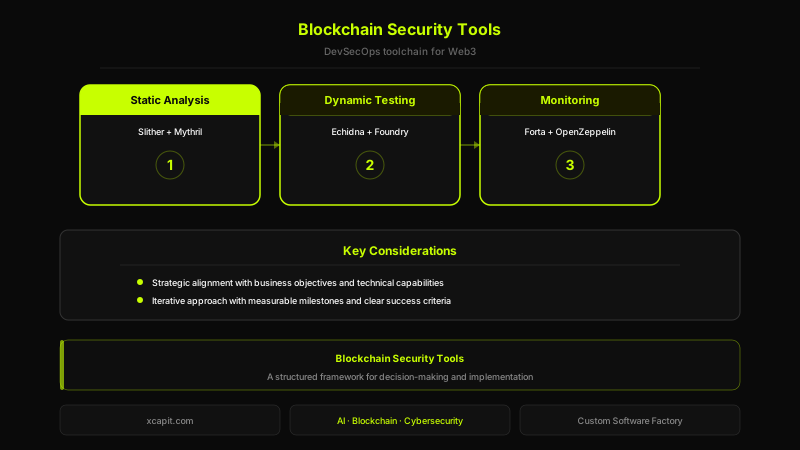
Slither, developed by Trail of Bits, is the most comprehensive open-source static analyzer for Solidity. It runs a suite of 90+ detectors covering reentrancy, incorrect ERC-20 implementations, dangerous delegatecall usage, unprotected upgrade functions, and dozens of other vulnerability classes. In your CI pipeline, Slither should run against every pull request and the output should be treated as a blocking gate — not a suggestion.
The key to using Slither effectively in CI is baseline management. On a new project, Slither will flag many issues, some of which are informational or false positives. Establish a baseline with `slither --json slither-baseline.json` and use `--exclude-dependencies` to focus on your own code. From that point, any new detector finding that wasn't in your baseline blocks the merge. This prevents regression while avoiding noise.
Mythril: Symbolic Execution for Deeper Bugs
Where Slither performs pattern-based static analysis, Mythril uses symbolic execution to explore possible execution paths and find vulnerabilities that only manifest under specific conditions. Reentrancy bugs, integer overflows in edge cases, and state machine violations that require a specific sequence of transactions to trigger — Mythril can find these where Slither cannot.
The trade-off is time. Mythril can take minutes to hours to analyze complex contracts. In CI, run Mythril with a timeout — `myth analyze --execution-timeout 300` — and accept that it will catch a subset of what a full unbounded analysis would find. Run the full, unbounded Mythril analysis as part of pre-release auditing, not on every commit.
Gas Optimization Checks
Gas cost is a security concern as much as a UX concern. Transactions that cost more gas than users expect can effectively DOS a protocol if users simply refuse to execute them. Gas-limit issues can also create griefing vectors where an attacker forces expensive operations on others. Foundry's `forge snapshot` command captures gas usage per test case, and you can configure CI to fail if gas usage for key functions exceeds defined thresholds. Tracking gas consumption over time is as important as tracking code coverage.
Phase 3: Automated Audit Pipelines
Beyond individual tools, you need to think about how to structure your pipeline to produce audit-ready artifacts automatically. When you engage an external auditor — and you should, for any protocol managing real value — the quality of what you hand them dramatically affects the quality of the audit.
Foundry and Hardhat Test Suites
Maintain a comprehensive test suite using Foundry for unit and fuzz testing, and Hardhat for integration scenarios that require forking mainnet state. Foundry's fuzzing is particularly powerful for blockchain security: define invariants — properties that should always hold regardless of inputs — and let the fuzzer try to violate them. Invariant testing has caught real vulnerabilities in production-grade DeFi protocols that passed manual review and standard unit testing.
Your CI pipeline should generate a full coverage report — `forge coverage --report lcov` — and enforce a minimum coverage threshold. For a DeFi protocol, 95%+ line coverage and 90%+ branch coverage are reasonable minimums. Any PR that drops coverage below threshold should not merge.
Automated Documentation Generation
Use `forge doc` to generate NatSpec documentation from your contract code, and commit that documentation to your repository. When an auditor opens your codebase, they need to understand not just what the code does, but what it's supposed to do — and any deviation from the specification is a potential vulnerability. Automating documentation generation ensures it stays in sync with the code.
Phase 4: Secrets Management and Key Infrastructure
Blockchain deployments require private keys. Managing those keys securely is one of the most critical infrastructure decisions you'll make, and it's an area where I see even experienced teams cut corners.
For testnets, use dedicated deployer wallets with small balances funded from faucets. These keys can live in environment variables or CI secrets, but they should never be reused across environments and should be rotated regularly. For mainnet deployments, the deployer key must come from a hardware security module (HSM) or a multi-signature wallet. Hardhat and Foundry both support deploying through Ledger hardware wallets directly. Configure your deployment scripts to require hardware wallet confirmation for mainnet operations — make it impossible to deploy to mainnet without a hardware key, by design.
In CI, use your platform's native secrets management (GitHub Actions encrypted secrets, GitLab CI/CD variables) and never print key material to logs. Add an explicit step that scans CI output for key patterns before the job completes — a safety net against accidental leakage through debug output.
Phase 5: Deployment Automation for Testnets and Mainnets
The deployment pipeline for blockchain projects should be deterministic and reproducible. This is harder than it sounds because smart contract deployments have state: the deployed address depends on the nonce at time of deployment, and upgradeable contracts have storage layouts that must be preserved across upgrades.
Environment Promotion Strategy
Structure your environments in a clear promotion ladder: local Hardhat network → public testnet (Sepolia for Ethereum, Amoy for Polygon) → mainnet. Every code change must traverse this ladder sequentially. Skipping testnet deployment for a 'minor' change is how critical bugs reach mainnet. Automate testnet deployments from your main branch and require manual approval for mainnet promotion — but make the manual step a governance action (e.g., a multi-sig transaction) rather than a simple button click.
Deployment Verification
After deployment, your CI pipeline should automatically verify the deployed bytecode matches your compiled artifact, verify the contract source on the block explorer using the Etherscan API, and run a smoke test suite against the live contract. Any mismatch between expected and actual deployed bytecode should trigger an immediate incident response. This sounds paranoid — it's not. Supply chain attacks targeting build systems exist, and verifying what actually got deployed is a necessary control.
Phase 6: Post-Deployment Monitoring and Incident Response
Traditional DevSecOps stops at deployment. Blockchain DevSecOps cannot. The public nature of blockchain means that attackers can monitor your contracts on-chain indefinitely, and sophisticated attackers will study your deployed bytecode to find vulnerabilities that your audit missed. Post-deployment monitoring is not optional.
On-Chain Event Monitoring
Set up real-time monitoring for all events emitted by your contracts. Tools like Tenderly, OpenZeppelin Defender, and Forta can alert you when specific events occur or when anomalous patterns emerge — for example, an unusually large single withdrawal, a sequence of transactions resembling a flash loan attack preparation, or governance actions submitted with unusually short timelock delays. Configure alerts with appropriate thresholds and ensure they reach an on-call channel monitored 24/7.
Circuit Breakers and Pause Mechanisms
Your contracts should include pause mechanisms that can be triggered either manually or automatically when monitoring detects an anomaly. Design the pause mechanism during development — retrofitting it is painful and may require a proxy upgrade. The pause should be callable by a guardian address controlled by a hardware wallet or multi-sig, with the ability to pause in seconds but requiring full governance to unpause. Fast pause, slow unpause is the correct security posture.
Incident Response Playbooks
Document your incident response procedures before you need them. When an attack is in progress, you have minutes to respond, not hours. Your playbook should define: who gets called first, what the decision tree is for pausing versus not pausing, how you communicate with users and the broader community, how you preserve evidence on-chain for post-mortem analysis, and what the recovery path looks like if funds are at risk.
Putting It All Together: CI/CD Pipeline Design
Here is the structure of a production-grade blockchain DevSecOps pipeline, with approximate run times for a medium-complexity protocol:
- Pre-commit hooks: Gitleaks secret scan + Solhint linting — under 10 seconds, runs locally on each developer's machine
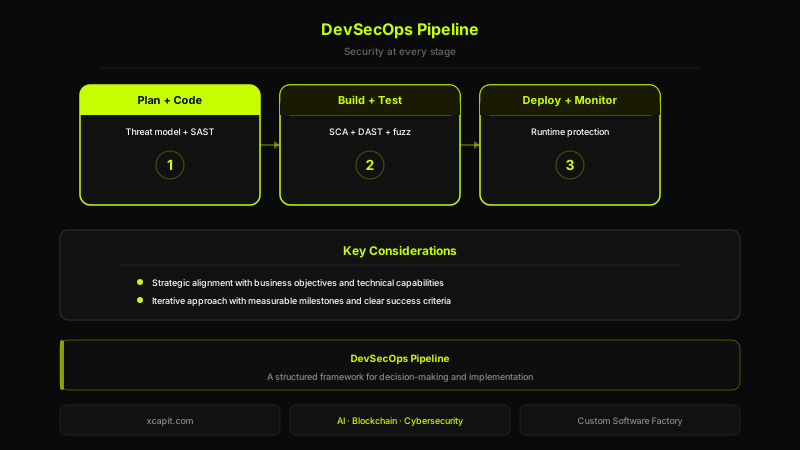
- PR validation: Slither analysis with baseline diff + Mythril with 5-minute timeout + dependency audit across npm/cargo + Foundry test suite with coverage report — 15 to 20 minutes total
- Merge to main: Full Mythril unbounded analysis + Echidna/Foundry invariant fuzzing with extended corpus + documentation generation + gas snapshot update — 1 to 3 hours, runs asynchronously
- Testnet deploy: Automated deployment with bytecode verification + smoke test suite + Etherscan source verification + monitoring webhook registration — 10 to 15 minutes
- Mainnet promote: Manual approval gate via multi-sig governance + same deployment pipeline as testnet + post-deployment monitoring alert configuration
The total pipeline is longer than a typical web application CI/CD, and that's appropriate. The cost of a failed deployment in blockchain is not a 5-minute rollback — it may be unrecoverable. Investing 3 hours of automated analysis before merging to main is cheap insurance.
Common Mistakes I've Seen in Practice
- Treating Slither output as advisory rather than blocking — teams get alert fatigue and start ignoring findings, then miss a critical one
- Using the same deployer key across testnets and mainnet — a compromised testnet key becomes a mainnet key if you reuse it
- Not testing upgrade paths — upgradeable contract bugs in the upgrade logic itself have caused millions in losses
- Assuming your auditor will catch everything — external auditors are a second opinion, not a replacement for your own security pipeline
- Monitoring only for downtime — on-chain liveness monitoring misses the most common attack patterns entirely
- No documented incident response before launch — teams that figure out their incident response during an attack always respond slower and less effectively
At Xcapit, our cybersecurity team has designed and operated these pipelines across production blockchain systems on Ethereum, Polygon, and Stellar. We combine ISO 27001-certified security practices with hands-on blockchain engineering experience — the same team that builds writes the security gates. If you're shipping a blockchain product and want to harden your development pipeline, our cybersecurity services team can help you build it right from the start. Learn more at xcapit.com/services/cybersecurity.

Fernando Boiero
CTO & Co-Founder
Over 20 years in the tech industry. Founder and director of Blockchain Lab, university professor, and certified PMP. Expert and thought leader in cybersecurity, blockchain, and artificial intelligence.
Building on blockchain?
Tokenization, smart contracts, DeFi — we've shipped it all.
You Might Also Like
Digital transformation for utilities: modernizing energy without replacing the core
A practical guide for utilities and energy companies: how to integrate SCADA, IoT, AI, tokenization, and cybersecurity to modernize operations without replacing critical systems.
Blockchain Security Audit Checklist for DeFi Projects
A comprehensive security audit checklist for DeFi smart contracts and protocols. Common vulnerabilities, testing methodologies, and best practices for blockchain security.
Smart Contract Security: 10 Common Vulnerabilities and How to Prevent Them
Explore the 10 most common smart contract vulnerabilities including reentrancy attacks, flash loan exploits, and oracle manipulation. Learn prevention strategies and security best practices to protect your blockchain applications.