

DeFi protocols manage billions of dollars in user funds, making them high-value targets for attackers. In 2025 alone, over $1.8 billion was lost to smart contract exploits, flash loan attacks, and bridge vulnerabilities. A thorough security audit is not optional — it's the minimum standard for any serious DeFi project.
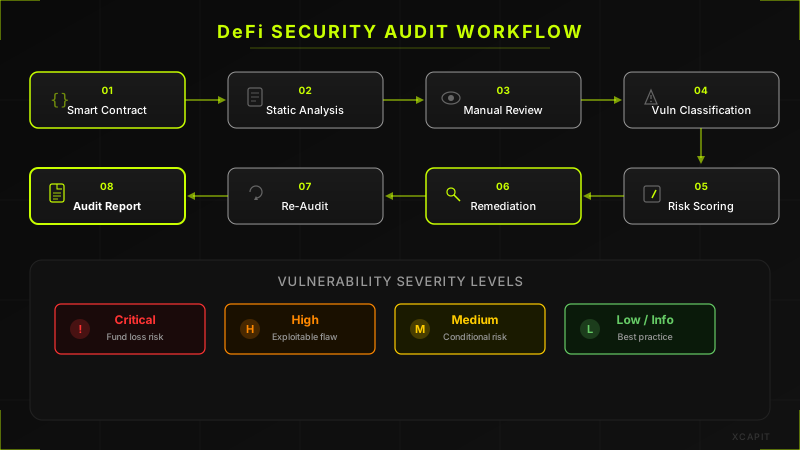
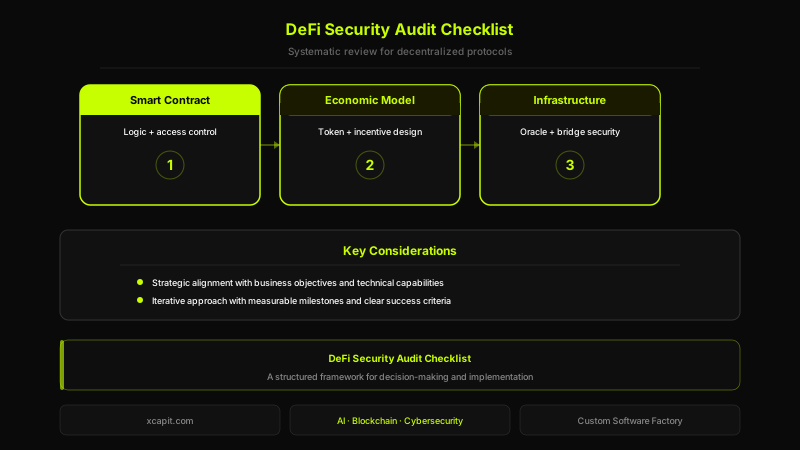
This checklist covers the key areas every DeFi security audit should address, from smart contract code review to economic attack modeling.
Pre-Audit Preparation
- Complete and finalized codebase with comprehensive documentation
- Test suite with >90% code coverage including edge cases
- Architecture documentation explaining system design and token flows
- Threat model identifying potential attack vectors and trust assumptions
- List of all external dependencies, oracles, and integrations
Projects that come to audit unprepared waste time and money. The audit team shouldn't be the first people to review your code. Internal reviews, automated analysis, and comprehensive testing should happen before engaging external auditors.
Smart Contract Code Review
Access Control
- Role-based access control is properly implemented and tested
- Admin functions have appropriate access restrictions
- Ownership transfer follows a two-step process (propose + accept)
- Time-locks are implemented for critical parameter changes
- Emergency pause mechanisms exist with multi-sig controls
Reentrancy Protection
- All external calls follow the checks-effects-interactions pattern
- Reentrancy guards are used on state-changing functions
- Cross-function reentrancy is addressed (not just single-function)
- Read-only reentrancy vectors through view functions are considered
Arithmetic and Data Handling
- No unchecked arithmetic in critical calculations (or explicit justification)
- Division before multiplication is avoided to prevent precision loss
- Token decimal handling is consistent across all calculations
- Proper rounding direction is used (round in protocol's favor)
- Array length checks prevent out-of-bounds access
Oracle and Price Feed Security
- Price feeds have freshness checks (stale price protection)
- Multiple oracle sources with fallback mechanisms
- TWAP or similar mechanisms resist flash loan price manipulation
- Circuit breakers for extreme price deviations
- Oracle manipulation attack scenarios are modeled and tested
Economic Attack Modeling
Technical code correctness is necessary but not sufficient. DeFi protocols must also be resilient to economic attacks that exploit the protocol's logic rather than code bugs.
- Flash loan attack simulations for all value-extraction paths
- Sandwich attack resistance for DEX and AMM functions
- Governance manipulation scenarios (vote buying, flash loans for voting power)
- Liquidation cascade modeling under extreme market conditions
- MEV extraction analysis and mitigation strategies
Infrastructure Security
- Deployment scripts are version-controlled and reproducible
- Contract verification on block explorers (Etherscan, etc.)
- Upgrade mechanisms use transparent proxy patterns with proper storage layout
- Multi-sig wallet for admin operations (3/5 or 4/7 minimum)
- Monitoring and alerting for unusual on-chain activity
- Incident response plan with defined roles and communication channels
Testing Methodology
Automated Analysis
- Slither static analysis with all detectors enabled
- Mythril symbolic execution for reachability analysis
- Echidna or Foundry fuzz testing with property-based invariants
- Gas optimization analysis for transaction cost reduction
- Formal verification for critical mathematical properties
Manual Review
- Line-by-line code review by multiple auditors independently
- Business logic validation against specification
- Edge case analysis for boundary conditions
- Cross-contract interaction review for composability risks
- Documentation accuracy verification
Post-Audit Best Practices
- Fix all critical and high-severity findings before deployment
- Engage the audit team for re-review of all fixes
- Publish the audit report for transparency
- Implement a bug bounty program (Immunefi, etc.)
- Schedule periodic re-audits as the codebase evolves
- Monitor for newly discovered vulnerability patterns in your dependencies
Choosing an Audit Partner
Not all audit firms are equal. Look for teams with specific DeFi experience, multiple auditors reviewing the same code independently, and a track record of finding critical issues. The audit should include both automated tooling and deep manual review.
At Xcapit, our cybersecurity team combines smart contract expertise with ISO 27001 certification. We've audited DeFi protocols, built production blockchain applications reaching millions of users, and understand both the technical and economic dimensions of blockchain security. If your project needs a security audit, we can help.

Fernando Boiero
CTO & Co-Founder
Over 20 years in the tech industry. Founder and director of Blockchain Lab, university professor, and certified PMP. Expert and thought leader in cybersecurity, blockchain, and artificial intelligence.
Building on blockchain?
Tokenization, smart contracts, DeFi — we've shipped it all.
You Might Also Like
Digital transformation for utilities: modernizing energy without replacing the core
A practical guide for utilities and energy companies: how to integrate SCADA, IoT, AI, tokenization, and cybersecurity to modernize operations without replacing critical systems.
Building DevSecOps Pipelines for Blockchain Projects
How to design and implement a DevSecOps pipeline purpose-built for blockchain development — covering smart contract static analysis, automated audit pipelines, secrets management, deployment automation, and post-deployment monitoring.
Smart Contract Security: 10 Common Vulnerabilities and How to Prevent Them
Explore the 10 most common smart contract vulnerabilities including reentrancy attacks, flash loan exploits, and oracle manipulation. Learn prevention strategies and security best practices to protect your blockchain applications.