
AI agents represent the most significant shift in enterprise software since mobile. Unlike traditional automation — which follows rigid, predefined rules — and chatbots — which generate text responses — AI agents can reason about complex problems, plan multi-step actions, use external tools, and adapt their approach based on results. They don't just answer questions. They get work done.
But building a production-grade AI agent for enterprise is fundamentally different from building a chatbot or a demo. Enterprise agents need to be reliable, secure, auditable, cost-efficient, and integrated with existing systems. This guide covers the architecture, tools, and practices required to build AI agents that actually work in production.
What Is an AI Agent?
An AI agent is a software system that uses a large language model (LLM) as its reasoning engine to autonomously pursue goals. Given a task, the agent decides what steps to take, executes those steps using available tools, evaluates the results, and iterates until the goal is achieved or it determines it cannot proceed.
Agents vs. Chatbots
A chatbot takes user input and produces text output. It's fundamentally reactive — it waits for a prompt and generates a response. An AI agent, by contrast, is proactive. Given a goal like 'analyze last quarter's sales data and prepare a board presentation,' the agent breaks this into subtasks, queries databases, performs calculations, generates visualizations, and assembles a document — making decisions at each step about what to do next.
Agents vs. Traditional Automation
Traditional automation (RPA, workflow engines, scripts) follows deterministic paths defined by developers. If a document format changes slightly, the automation breaks. AI agents handle ambiguity and variability gracefully because they reason about inputs rather than pattern-matching against rigid rules. They combine the reliability of structured tool use with the flexibility of natural language understanding.
The practical distinction matters: automation is for processes you can fully specify in advance; agents are for tasks that require judgment, adaptation, and interaction with unstructured information.
Enterprise AI Agent Architecture
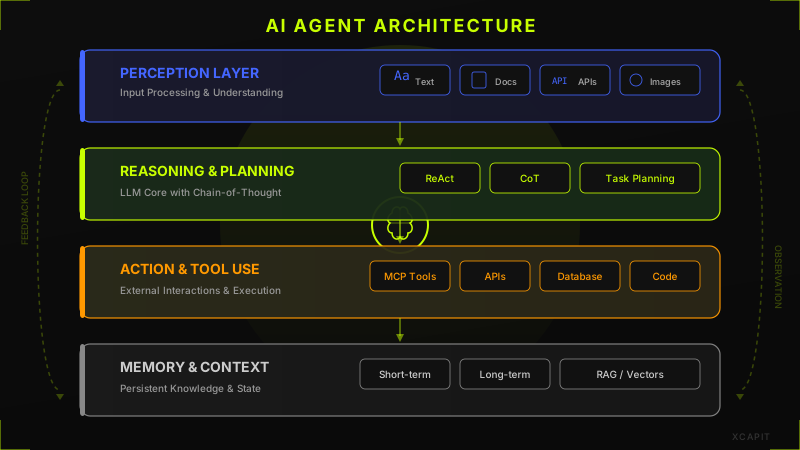
A well-architected AI agent consists of four core layers, each with distinct responsibilities and design considerations.
Perception Layer
The perception layer is how the agent receives and processes inputs from the world. This includes parsing user messages, processing uploaded documents (PDFs, spreadsheets, images), ingesting data from APIs, monitoring event streams, and receiving webhooks from external systems.
In enterprise settings, the perception layer often needs to handle multimodal inputs — a user might upload a contract PDF, reference a Salesforce record, and ask a question in natural language, all in the same interaction. The perception layer normalizes these diverse inputs into a format the reasoning layer can work with, typically a structured context object that preserves source attribution for auditability.
Reasoning and Planning Layer
The reasoning layer is the agent's brain — powered by one or more LLMs. It receives the processed context from the perception layer and decides what to do. For simple tasks, this might be a single inference call. For complex tasks, the reasoning layer decomposes the goal into subtasks, plans an execution sequence, and manages state across multiple steps.
Key patterns for the reasoning layer include ReAct (Reasoning + Acting), where the model alternates between thinking and tool use; Chain-of-Thought, where the model explains its reasoning before acting; and Tree-of-Thought, where the model explores multiple approaches before committing to one. For enterprise applications, ReAct is the most proven pattern, combining reliability with interpretability.
The reasoning layer also handles error recovery. When a tool call fails or returns unexpected results, the agent needs to reason about what went wrong and try an alternative approach — not simply crash or retry the same failed action.
Action and Tool Use Layer
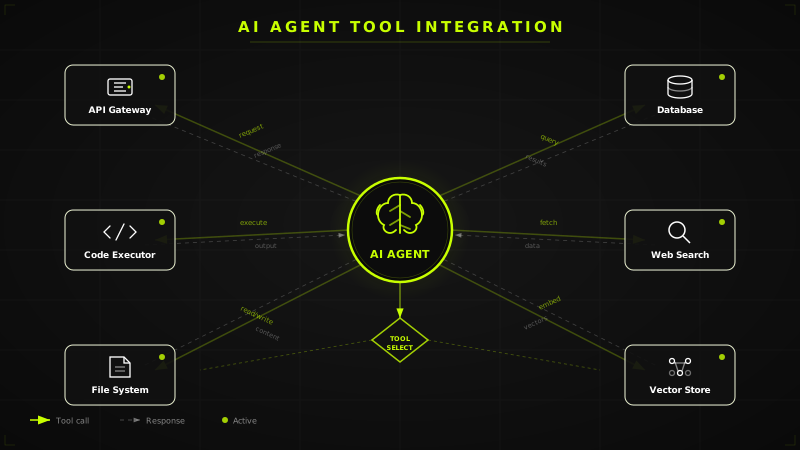
The action layer is where the agent interacts with external systems — databases, APIs, file systems, email servers, and enterprise applications. Tools are the agent's hands, and the quality of tool definitions directly impacts agent performance. Each tool needs a clear name, a precise description of what it does and when to use it, well-defined input parameters with validation, and structured output that the reasoning layer can interpret.
In enterprise environments, tools typically wrap existing APIs and services. A CRM tool might expose functions like 'search contacts,' 'update deal stage,' and 'create task.' A document tool might provide 'extract text from PDF,' 'search knowledge base,' and 'generate report.' The art is in designing tool interfaces that are specific enough to be useful but general enough to handle edge cases.
Memory and Context Layer
Enterprise agents need both short-term and long-term memory. Short-term memory (the conversation context) tracks the current task, actions taken, results received, and remaining steps. Long-term memory stores user preferences, past interactions, organizational knowledge, and learned patterns.
Context management is one of the hardest problems in agent design. LLMs have finite context windows, and enterprise tasks can generate enormous amounts of intermediate data. Effective strategies include summarizing completed subtasks to free context space, using retrieval-augmented generation (RAG) to pull in relevant information on demand, and maintaining structured state objects that capture essential information without consuming the entire context window.
The MCP Standard: Model Context Protocol
One of the most important developments in the AI agent ecosystem is the Model Context Protocol (MCP), an open standard created by Anthropic that defines how AI models connect to external data sources and tools. MCP is to AI agents what USB was to computer peripherals — a universal interface that replaces custom integrations with a standardized protocol.
What MCP Solves
Before MCP, every tool integration required custom code for each model-tool combination. If you had 5 enterprise systems and wanted to support 3 LLM providers, you needed 15 custom integrations. MCP provides a single protocol that any compliant model can use to interact with any compliant tool server, reducing the integration matrix from N*M to N+M.
MCP defines a client-server architecture where the AI model acts as the client, and tool providers implement MCP servers that expose their capabilities. The protocol handles capability discovery (the model can ask what tools are available), invocation (standardized request/response format for tool calls), authentication (delegated auth with proper scoping), and streaming (real-time results for long-running operations).
Why MCP Matters for Enterprise
For enterprise AI, MCP provides three critical benefits. First, vendor independence — your tool integrations work across different LLM providers, preventing lock-in. Second, security standardization — MCP defines how credentials are managed and scoped, reducing the surface area for security mistakes. Third, composability — teams across your organization can build and share tool servers, creating a growing library of agent capabilities.
How We Use MCP at Xcapit
At Xcapit, we build MCP-compliant tool servers for enterprise clients, enabling their AI agents to interact securely with internal systems — from CRMs and ERPs to custom databases and legacy applications. The MCP standard means these integrations work today with Claude, and they'll work tomorrow with whatever model best fits the use case, without rewriting a single line of integration code.
Choosing Your LLM Strategy
The LLM is the most critical component of your agent, and choosing the right strategy involves balancing capability, cost, latency, data privacy, and vendor risk.
API-Based vs. On-Premise Deployment
API-based models (Claude, GPT, Gemini) offer the highest capability with minimal infrastructure overhead. You pay per token, scale instantly, and benefit from continuous model improvements. For most enterprise use cases, API-based models are the right starting point.
On-premise or private cloud deployment (using open models like Llama, Mistral, or Qwen) makes sense when data cannot leave your infrastructure for regulatory reasons, when you need guaranteed availability independent of third-party services, or when per-token costs at scale justify the infrastructure investment. The trade-off is lower model capability and higher operational overhead.
Cost Optimization and Token Proxy Patterns
Enterprise agents can consume significant token volumes — a document processing agent handling 1,000 documents per day might use 50-100 million tokens monthly. Cost optimization strategies include routing simple tasks to smaller, cheaper models while reserving frontier models for complex reasoning; caching common queries and tool results; using structured prompts that minimize token waste; and implementing token budgets per task with graceful degradation when limits are approached.
A token proxy pattern is particularly effective: place a routing layer between your agent and the LLM APIs that dynamically selects models based on task complexity, caches responses, enforces budgets, and provides unified logging. This proxy becomes a central control point for cost, performance, and compliance.
Multi-Agent Systems
As agent capabilities grow, single-agent architectures hit limits. Complex enterprise workflows often benefit from multi-agent systems — multiple specialized agents collaborating to accomplish tasks that are too complex or too broad for any single agent.
When to Use Multi-Agent Architecture
Multi-agent systems make sense when the task requires fundamentally different skill sets (e.g., legal analysis and financial modeling), when the workflow has natural parallelization opportunities, when different steps require different security contexts or tool access, or when the complexity exceeds what a single agent can reliably manage in one context window.
Orchestration Patterns
The most common orchestration patterns are hierarchical (a manager agent delegates to specialist workers), sequential (agents form a pipeline where each processes and passes results to the next), and collaborative (agents negotiate and share information peer-to-peer). For enterprise applications, hierarchical orchestration is typically the most reliable because it provides clear accountability and simpler debugging.
For example, a due diligence agent system might have a manager agent that receives the request and plans the workflow, a financial analysis agent that reviews financial statements, a legal review agent that analyzes contracts and compliance, a market research agent that gathers competitive intelligence, and a synthesis agent that compiles findings into a unified report. Each specialist agent has access to different tools and operates within its own security context.
Building for Production
The gap between a demo agent and a production agent is enormous. Production agents need to handle failures gracefully, protect sensitive data, provide visibility into their behavior, and operate within cost constraints — all while maintaining the flexibility that makes agents valuable.
Reliability and Fallbacks
Production agents must handle every failure mode gracefully. LLM API timeouts, malformed tool responses, ambiguous user instructions, rate limiting, and context window overflow all need explicit handling. Implement retry logic with exponential backoff for transient failures, circuit breakers for persistent outages, and graceful degradation paths that accomplish what they can and clearly communicate what they cannot.
Human-in-the-loop checkpoints are essential for high-stakes decisions. The agent should autonomously handle routine tasks but escalate to a human when confidence is low, when the action is irreversible (sending an email, modifying a database), or when the request falls outside its defined scope.
Security and Access Control
AI agents introduce a new security surface: they have access to tools, data, and actions that traditional software doesn't. Security must be layered. At the authentication level, the agent operates with the permissions of the user who invoked it — never with elevated privileges. At the tool level, each tool enforces its own authorization checks. At the model level, system prompts define behavioral boundaries, and output filtering catches policy violations.
Prompt injection is a real threat in enterprise settings. User-controlled inputs (uploaded documents, email content, web pages) can contain instructions that attempt to manipulate the agent. Defense-in-depth strategies include input sanitization, separating user content from system instructions, and validating agent actions against expected patterns before execution.
Monitoring and Observability
You cannot operate what you cannot observe. Production agents need comprehensive logging of every reasoning step, tool invocation, and decision point. This serves three purposes: debugging when things go wrong, auditing for compliance, and optimization based on real usage patterns.
Key metrics to track include task completion rate, average steps per task, tool call success rate, latency per step, token consumption per task, escalation rate (how often the agent defers to humans), and user satisfaction scores. Dashboard these metrics in real-time and set alerts for anomalies.
Cost Management
Without guardrails, agent costs can spiral quickly — a reasoning loop that fails to converge can burn through thousands of dollars in tokens. Implement hard limits on tokens per task, steps per task, and daily spend per user or department. Use tiered model selection to route simple subtasks to cheaper models. Cache aggressively — many enterprise queries repeat or have overlapping context.
Budget visibility matters too. Provide cost attribution per user, department, and use case so stakeholders can make informed decisions about which agent capabilities deliver sufficient ROI to justify their cost.
Real-World Enterprise Use Cases
AI agents are already delivering value across enterprise functions. The most successful deployments share a common trait: they target specific, high-value workflows rather than trying to build a general-purpose assistant.
- Document processing and analysis — agents that ingest contracts, invoices, and regulatory filings; extract structured data; flag anomalies; and route items for human review. These agents typically reduce processing time by 80% while improving accuracy.
- Intelligent customer support — agents that understand customer context from CRM data, diagnose issues by querying knowledge bases and system logs, execute resolution steps (refunds, account changes, ticket creation), and escalate complex cases with full context attached.
- Automated code review and security scanning — agents that review pull requests for bugs, security vulnerabilities, and style compliance; cross-reference changes against requirements; and generate detailed review comments with suggested fixes.
- Data analysis and reporting — agents that accept natural language questions ('What drove the revenue increase in Q3?'), query databases, perform statistical analysis, generate visualizations, and compile findings into executive-ready reports.
- Compliance monitoring — agents that continuously monitor regulatory feeds for relevant changes, assess impact on your organization, update internal policy documents, and generate compliance reports for auditors.
- IT operations and incident response — agents that detect anomalies in system metrics, correlate alerts across services, diagnose root causes using log analysis, execute automated remediation, and page on-call engineers when human intervention is required.
Getting Started: A Phased Approach
Building enterprise AI agents is best approached incrementally. Trying to build a fully autonomous, multi-agent system on day one is a recipe for failure. Instead, follow a phased approach that builds capability — and organizational confidence — progressively.
Phase 1: Single-Purpose Agent (4-6 weeks)
Start with a single, well-defined workflow — one that is high-volume, currently manual, and tolerant of imperfection. Build an agent with 3-5 tools that automates 80% of the task and routes the remaining 20% to humans. Measure accuracy, speed, and user satisfaction. This phase proves the concept and builds internal expertise.
Phase 2: Expand Capabilities (2-3 months)
Based on Phase 1 learnings, expand the agent's tool set, add more complex reasoning chains, and implement production hardening — retry logic, monitoring, cost controls, and security reviews. Begin building MCP-compliant tool servers for key enterprise systems to create reusable integration infrastructure.
Phase 3: Multi-Agent Orchestration (3-6 months)
With proven single agents in production, begin connecting them into multi-agent workflows. Implement orchestration patterns, cross-agent communication, and unified monitoring. This phase typically unlocks the highest-value use cases — complex workflows that span multiple systems and departments.
The Agent-First Future
AI agents will fundamentally reshape how enterprises operate — not by replacing people, but by handling the repetitive, data-heavy, and error-prone work that currently consumes valuable human attention. The organizations that build agent capabilities now will compound their advantage over competitors who wait.
At Xcapit, we help enterprises design, build, and operate AI agent systems -- from single-purpose prototypes to multi-agent production platforms. To see these principles in action, explore our ArgenTor multi-agent AI framework case study, a modular Rust-based system with 13 crates and 483 passing tests. Our experience building complex systems with LLMs, MCP integrations, and production-grade infrastructure means we focus on what actually works, not what sounds impressive in a demo.
If you're exploring AI agents for your organization, we'd love to discuss your use case and help you map out a realistic path from concept to production. Learn more about our AI development services at /services/ai-development.

Fernando Boiero
CTO & Co-Founder
Over 20 years in the tech industry. Founder and director of Blockchain Lab, university professor, and certified PMP. Expert and thought leader in cybersecurity, blockchain, and artificial intelligence.
Ready to leverage AI & Machine Learning?
From predictive models to MLOps — we make AI work for you.
You Might Also Like
MWC 2026: The Agentic Era Is No Longer a Promise — It's Strategy
Three lessons from Mobile World Congress 2026 redefining how enterprises adopt AI: from pilot to real value, from isolated agents to orchestrated enterprises, and why company size no longer matters.
AI Agents in Enterprises: Between the Hype and the Real ROI
A CEO's strategic framework for evaluating AI agents in the enterprise -- separating genuine ROI from hype, avoiding pilot purgatory, and scaling what works.
If everyone has Artificial Intelligence, where will the competitive advantage be?
AI is no longer a barrier to entry: today it is within reach of companies of every size. Why the difference is no longer about using AI, but about how it is used and the quality of the architecture that integrates it.