

Every boardroom I have walked into over the past eighteen months has had the same conversation: AI agents. Every vendor pitch deck promises autonomous systems that will transform operations overnight. And every executive I speak with is caught between two fears -- the fear of missing out and the fear of wasting millions on technology that does not deliver. After fifteen years of building technology companies and watching hype cycles come and go, I have developed a straightforward perspective: AI agents are real, the value is real, but the gap between what is being promised and what is being delivered has never been wider.
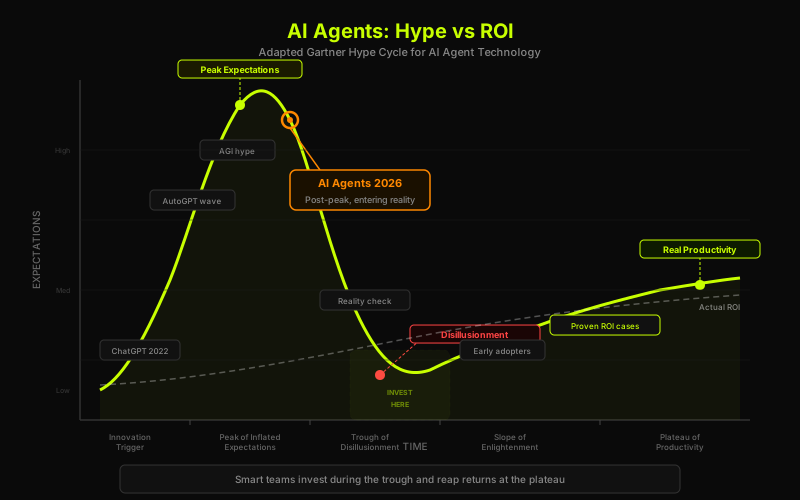
I am writing this as a CEO and a lawyer -- not as an engineer. My job is to help organizations make sound investment decisions about technology. What follows is the framework I use when advising clients, evaluating projects at Xcapit, and deciding where we invest our own resources.
The Hype Cycle: Everyone Wants AI Agents, Few Know Why
The pattern is remarkably consistent. A CEO reads about AI agents, watches a compelling demo, or hears that a competitor is 'deploying AI agents across the organization.' The next Monday morning, there is a directive: we need an AI agent strategy. What follows is a scramble -- vendors are evaluated, consultants map use cases, and within weeks there is a pilot project approved with a generous budget and vague success criteria.
This is a strategic problem, not a technology problem. The question 'should we use AI agents?' is wrong. The right question is: 'which specific workflows would benefit from AI-powered automation, and what measurable outcome are we targeting?' That distinction is the difference between a successful deployment and a six-figure demo that never reaches production. I have seen companies spend $300,000 on a proof of concept that impressed everyone in the demo room but was completely impractical for the real operational environment. The demo used clean data -- the real data was messy. The demo handled five query types -- real users had five hundred. None of these gaps were unsolvable, but they were never discussed because enthusiasm drove the project rather than analysis.
What AI Agents Can Actually Do Today
AI agents today can reliably automate multi-step workflows that follow a general pattern but vary in detail -- processing invoices arriving in different formats, routing customer inquiries through complex decision trees, extracting contract terms and comparing them against templates. They handle variability gracefully while still following a defined process, which is exactly where they outperform traditional automation.
Document processing is the highest-value application today. AI agents that ingest contracts, regulatory filings, or compliance documents, extract structured data, flag anomalies, and route exceptions for human review are consistently delivering 60-80% time savings. Customer inquiry handling is another area of genuine strength -- agents that understand CRM context, search knowledge bases, execute routine actions, and escalate complex cases with full context are running in production at thousands of companies. System monitoring, where agents analyze logs, correlate events, and take automated remediation actions, is a third proven category.
What AI Agents Cannot Reliably Do Yet
AI agents cannot reliably perform long chains of complex reasoning. They handle three or four steps well; by step eight or ten, error rates compound to the point where the output is unreliable. Unsupervised decision-making in high-stakes contexts -- approving loans, making hiring decisions, determining compliance outcomes -- remains firmly out of reach. The technology can prepare analysis and make recommendations, but the final decision must remain with a qualified person.
Novel situations that fall outside the agent's training distribution remain a significant weakness. In a demo, you only see the inside of the operational envelope. In production, users find the edges on day one. Creative work, strategic planning, and nuanced judgment calls that depend on organizational context or cultural awareness are areas where agents are assistive at best -- they can gather and organize information, but they cannot replace the human judgment that synthesizes it into a decision.
The ROI Framework: Where AI Agents Pay for Themselves
After evaluating dozens of deployments, I have found that ROI breaks into three tiers. Understanding which tier your use case falls into is the single most important factor in predicting project success.
High ROI: Repetitive Knowledge Work
The strongest cases share four characteristics: high volume, a general pattern with variations in detail, currently requiring skilled but not senior staff, and a clear quality metric. Invoice processing, contract review, regulatory filing analysis, insurance claims handling, and compliance screening all qualify. These use cases typically show positive ROI within 3-6 months, with cost savings of 40-70% once the agent is optimized. The key insight is that the agent does not need to be perfect -- it needs to be good enough that humans reviewing its output spend dramatically less time than they would doing the work from scratch.
Medium ROI: Customer Support and Data Analysis
Customer support and data analysis occupy a middle tier where ROI takes 6-12 months to materialize. Interactions are more variable, quality failures are more visible, and integration requirements are heavier. A support agent handling 60% of inquiries autonomously is genuinely valuable, but building it requires deep integration with your CRM, knowledge base, and order management systems -- work that often costs as much as the agent itself.
Low ROI: Creative Work and Strategic Decisions
If someone proposes an AI agent for creative content, brand strategy, or executive decision support, proceed with extreme caution. Quality is subjective, the cost of bad output is significant, and ROI is often negative when you account for engineering investment and required human review. Save these for phase three of your AI journey.
The Pilot Purgatory Problem
Roughly 80% of AI agent pilot projects never make it to production. They succeed as demos, impress stakeholders, generate positive internal press -- and then stall indefinitely. The most common cause is that the pilot was designed to impress rather than to prove: built on clean data, tested with selected queries, measured by qualitative reactions rather than business metrics.
The second cause is the absence of a production pathway. The pilot was built without considering authentication, monitoring, error handling, or system integration. When the team estimates production-readiness costs, the number dwarfs the pilot investment and the project loses sponsorship. The third cause is organizational -- no one owns the transition. The innovation team built the pilot, the operations team runs production, and the project falls into the gap.
From Pilot to Production: What Separates the 20%
Organizations that successfully move AI agents to production do four things differently. First, they choose pilot use cases based on production viability, not demo impressiveness. Second, they define quantitative success criteria before the pilot begins -- processing time reduction, error rate, cost per transaction -- measured against the current human process, not against perfection.
Third, they build pilots with production architecture in mind. Not production-grade infrastructure from day one, but structural elements -- authentication hooks, logging, error handling -- that make the transition incremental rather than a rewrite. Fourth, they assign a single owner accountable for the entire lifecycle, from pilot through production and ongoing operation.
The Hidden Costs Nobody Talks About
- Integration engineering -- Connecting the agent to existing systems (CRM, ERP, ticketing) typically costs as much as building the agent. Every integration point is a potential failure mode requiring monitoring.
- Ongoing prompt engineering -- Production prompts require continuous refinement as edge cases emerge and models update. Budget for a senior engineer spending 15-25% of their time on this permanently.
- Model updates and migration -- LLM providers update models regularly, changing agent behavior in subtle ways. Every update requires regression testing and potential prompt adjustments.
- Monitoring and observability -- Comprehensive logging, quality evaluation, and cost attribution require specialized tooling adding 10-20% to total production costs.
- Human review infrastructure -- Even accurate agents need review workflows: queues, interfaces, escalation paths, and feedback loops. This investment is frequently overlooked.
Start Small, Measure Everything, Scale What Works
The approach that consistently delivers the best outcomes is deceptively simple. Start with a single, well-defined workflow in the high-ROI category. Define quantitative success metrics before writing code. Build with production architecture in mind. Measure relentlessly for 90 days. Then make a data-driven decision about whether to scale, pivot, or stop.
Resist launching five pilots simultaneously -- each requires dedicated attention, and spreading resources across multiple initiatives means none get the focus needed to succeed. One successful production deployment teaches your organization more than ten concurrent pilots that never graduate. Scale incrementally: once your first agent delivers measurable value, use the infrastructure, operational practices, and institutional knowledge you have built to deploy the second faster and cheaper. By the third or fourth deployment, you will have an internal playbook that dramatically reduces the cost and risk of each subsequent agent.
The CEO's Guide to Evaluating AI Agent Proposals
When a vendor, a consultant, or your own team presents an AI agent proposal, these are the questions that separate serious proposals from hype-driven pitches.
- What specific human workflow does this replace or augment? -- If the answer is vague ('it will improve productivity') rather than specific ('it will process incoming invoices, extract line items, and flag discrepancies'), the proposal is not ready.
- What is the expected accuracy, and what happens when the agent is wrong? -- Any honest proposal acknowledges mistakes will happen. What matters is whether there is a clear fallback: human escalation, graceful degradation, error correction.
- What are total first-year costs, including integration, monitoring, prompt engineering, and model updates? -- A credible proposal is transparent about ongoing operational expenses. Multiply whatever number you hear by 1.5 for a realistic budget.
- How will we measure ROI, and when should we expect positive returns? -- If the answer is 'you will see the benefits over time,' the proposal lacks accountability. Demand specific metrics and a timeline.
- What is the exit strategy if the project does not deliver? -- Every investment should have a defined evaluation point. A proposal without one is asking for an open-ended commitment.
The Bottom Line: Real Value Requires Real Rigor
AI agents are not a fad. The technology is powerful, the use cases are real, and organizations that deploy them well will have a meaningful competitive advantage. But doing it well requires the same rigor as any significant technology investment: clear objectives, realistic expectations, disciplined execution, and honest measurement.
The hype will fade -- it always does. What will remain are the organizations that looked past the demo and asked the hard questions. The ones that started small, proved value in production, and scaled based on evidence rather than enthusiasm. At Xcapit, this is how we approach every AI agent engagement -- starting with the business problem, building for production from day one, and telling clients when an AI agent is not the right solution. To see our production-first approach in practice, explore our ArgenTor multi-agent AI framework case study.
If you are evaluating AI agent opportunities and want an honest assessment of where the technology can deliver real value for your specific situation, we welcome the conversation. Our approach is to understand your workflows first, recommend only what we can back with evidence, and build systems designed for production -- not for the demo room. Learn more about our AI agent services at /services/ai-agents.

José Trajtenberg
CEO & Co-Founder
Lawyer and international business entrepreneur with over 15 years of experience. Distinguished speaker and strategic leader driving technology companies to global impact.
Ready to leverage AI & Machine Learning?
From predictive models to MLOps — we make AI work for you.
You Might Also Like
MWC 2026: The Agentic Era Is No Longer a Promise — It's Strategy
Three lessons from Mobile World Congress 2026 redefining how enterprises adopt AI: from pilot to real value, from isolated agents to orchestrated enterprises, and why company size no longer matters.
How to Build an AI Agent for Enterprise: Architecture, Tools & Best Practices
A technical guide to building production-grade AI agents for enterprise — covering architecture patterns, MCP integration, LLM strategy, multi-agent systems, and best practices for reliability, security, and cost management.
If everyone has Artificial Intelligence, where will the competitive advantage be?
AI is no longer a barrier to entry: today it is within reach of companies of every size. Why the difference is no longer about using AI, but about how it is used and the quality of the architecture that integrates it.