

Cybersecurity has always been an arms race. Attackers develop new techniques, defenders build countermeasures, attackers adapt -- the cycle has repeated for decades. But artificial intelligence has fundamentally changed the tempo of this race. Both sides now have access to capabilities that were science fiction five years ago: attackers can generate perfectly crafted phishing emails, clone voices for real-time social engineering, and discover zero-day vulnerabilities at machine speed. Defenders can analyze billions of events in real time, detect behavioral anomalies no human analyst would catch, and orchestrate automated responses faster than any SOC team could coordinate manually.
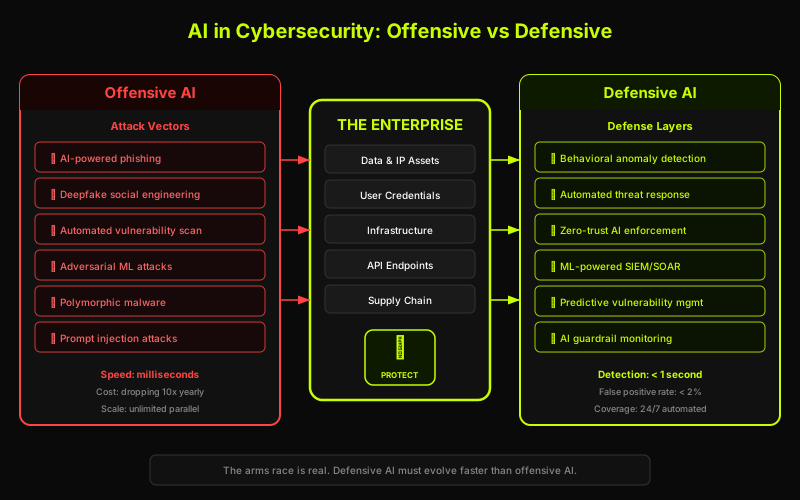
This is not a future scenario -- it is happening now. In 2024, AI-generated phishing attacks increased by over 1,200% according to multiple threat intelligence reports. Organizations that understand how AI operates on both sides of the cybersecurity divide will be dramatically better positioned than those that treat AI as just another buzzword. This article examines offensive and defensive AI in cybersecurity, the structural asymmetries that make defense harder, and the practical steps enterprises should take today.
The AI Arms Race: A New Era of Cyber Conflict
The introduction of large language models and generative AI into cybersecurity has created an inflection point. Previous cyber tools -- automated scanners, signature-based malware, rule-based detection -- operated within predictable parameters. AI changes the equation because it introduces adaptability. An AI-powered attack tool does not just follow a script; it observes, adjusts, and improvises. An AI-powered defense system does not just match signatures; it learns patterns, identifies deviations, and reasons about context. What makes this moment particularly dangerous is democratization. Sophisticated attack techniques that once required nation-state resources are now accessible to anyone with an LLM and basic prompt engineering skills. The skill floor for social engineering has dropped to near zero, while the ceiling for skilled attackers has risen dramatically.
Offensive AI: How Attackers Are Using Artificial Intelligence
Understanding offensive AI is not about fear-mongering -- it is about knowing what your security team is up against. Attackers are deploying AI across every phase of the kill chain, from reconnaissance to exfiltration, and the results are measurably more effective than traditional approaches.
AI-Generated Phishing and Social Engineering
Traditional phishing relied on volume -- send millions of generic emails and hope a small percentage clicks. AI has enabled a shift from volume to precision. LLMs generate hyper-personalized phishing emails that reference the target's specific role, recent projects, and professional relationships -- scraped automatically from LinkedIn and public filings. These emails are grammatically perfect, contextually appropriate, and virtually indistinguishable from legitimate communication. Deepfakes and voice cloning add another dimension. In 2024, a finance employee in Hong Kong transferred $25 million after a video call with what appeared to be the company's CFO -- all AI-generated deepfakes. Voice cloning can now replicate someone's voice from as little as three seconds of sample audio, turning social engineering into a scalable, automated operation.
Automated Vulnerability Discovery and Exploitation
AI is accelerating vulnerability research on both sides, but attackers benefit disproportionately because they can act on findings immediately. AI-powered fuzzing tools explore attack surfaces orders of magnitude faster than traditional fuzzers. LLMs can analyze source code for vulnerability patterns, generate proof-of-concept exploits, and chain multiple vulnerabilities into complete attack paths -- tasks that previously required weeks of expert analysis. AI also supercharges polymorphic malware -- code that rewrites itself to evade detection. AI-generated malware can analyze the target's security stack, determine which evasion techniques will succeed, and modify its behavior in real time. Signature-based detection is fundamentally incapable of keeping pace.
Adversarial Machine Learning Attacks
As organizations deploy more ML-based security tools, attackers have developed techniques to defeat them. Evasion attacks craft inputs that cause ML classifiers to misclassify malicious content as benign. Data poisoning corrupts the training data that security models learn from, gradually degrading effectiveness. Model extraction attacks reverse-engineer decision boundaries, then craft attacks that fall precisely in the blind spots. These adversarial techniques are particularly concerning because they undermine the very tools organizations deploy to counter AI threats.
Defensive AI: Fighting Fire with Intelligence
The scale and sophistication of AI-powered attacks make one thing clear: humans alone cannot keep up. A modern enterprise generates millions of security events per day across endpoints, networks, cloud services, and applications. No SOC team, regardless of size or skill, can manually review this volume. Defensive AI is not a luxury -- it is the only viable approach to matching the speed and scale of automated threats.
Behavioral Anomaly Detection
Traditional security monitoring compares events against known bad patterns -- signatures, rules, blacklists. This approach fails against novel attacks designed to look legitimate. Behavioral anomaly detection inverts the model: instead of defining what is bad, it learns what is normal and flags deviations. AI builds baseline behavioral profiles for every user, device, and application, then detects subtle anomalies -- a user accessing systems at unusual hours, a service account making API calls it has never made before. The power lies in cross-dimensional correlation. A login from a new location might be normal. A login from a new location followed by access to sensitive files, a large data transfer, and deletion of audit logs -- that pattern, detected in real time across multiple data sources, is precisely what AI excels at identifying.
Intelligent SIEM and Automated Threat Hunting
Traditional SIEM systems generate thousands of alerts per day, the vast majority false positives. AI-powered SIEM changes this by applying contextual intelligence -- correlating related events across time and systems, assessing severity based on the specific environment, and presenting analysts with enriched, prioritized incidents rather than raw alerts. AI-driven threat hunting goes further, proactively searching for indicators of compromise that have not triggered any alert. By analyzing network traffic, DNS queries, and authentication logs through ML models trained on MITRE ATT&CK, defensive AI can identify intrusions before the attacker achieves their objective -- shifting the advantage back to the defender.
Automated Incident Response
When a threat is detected, response speed is critical -- mean time from compromise to exfiltration has dropped to hours. AI-powered SOAR platforms execute response playbooks in seconds -- isolating compromised endpoints, revoking credentials, blocking malicious IPs, and initiating forensic collection simultaneously. Advanced systems dynamically adapt response actions based on threat characteristics and potential business impact.
The Asymmetry Problem
Cybersecurity has always suffered from a fundamental asymmetry: the attacker needs to find one way in, while the defender needs to protect every possible entry point, every minute of every day. AI amplifies this asymmetry in both directions.
On the offensive side, AI lowers the cost and expertise required to launch sophisticated attacks. A single attacker with AI tools can probe thousands of targets simultaneously and adapt tactics in real time. On the defensive side, AI enables a small security team to monitor an environment that would otherwise require ten times the staff. But the asymmetry persists -- one missed alert, one unpatched system, one employee who clicks a convincing phishing email, and the attacker wins. This means defensive AI strategy cannot be purely reactive. Organizations need an assume-breach mindset where AI is deployed at every layer, from endpoint to cloud. The attack will eventually get through; what matters is how quickly you detect it and how effectively you contain it.
AI in Penetration Testing: Offense as the Best Defense
One of the most productive applications of offensive AI is in the hands of defenders themselves -- specifically in penetration testing and red team operations. At Xcapit, we built AiSec, our AI-powered security analysis platform with 35 specialized agents and 250+ detectors that we use to enhance our security assessment capabilities, and the results are transformative.
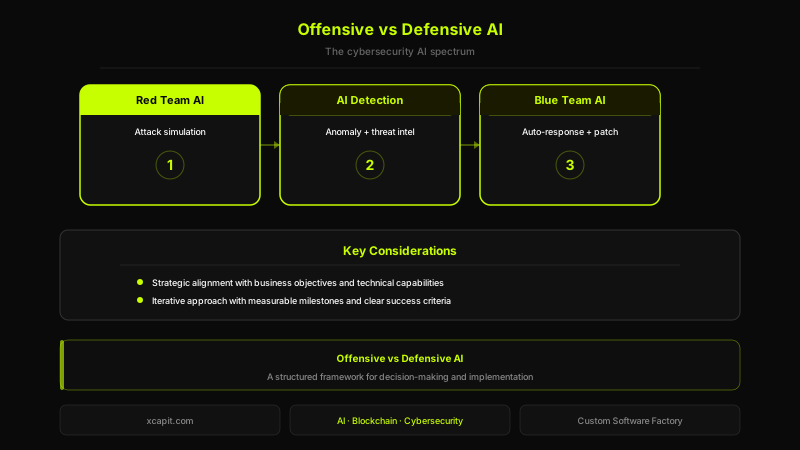
AI-assisted penetration testing accelerates reconnaissance by automatically correlating OSINT data and mapping attack surfaces that would take human testers days to enumerate. During exploitation, LLMs identify novel vulnerability chains by reasoning about application logic -- understanding business context, inferring implementation patterns, and generating targeted test cases. The result is not that AI replaces penetration testers -- it makes them dramatically more effective. A senior pentester with AI tools covers more attack surface and identifies more complex vulnerability chains in the same engagement window. Human expertise remains essential for scoping and contextual judgment; the AI handles breadth and speed.
AI in Threat Detection: Beyond Pattern Matching
Traditional detection relies on known indicators of compromise -- specific IP addresses, file hashes, and behavioral signatures from previous attacks. This is inherently backward-looking. AI-powered detection adds three transformative capabilities. First, pattern recognition across massive datasets -- correlating events from firewalls, endpoints, cloud platforms, and application logs to identify attacks spanning multiple systems. Second, false positive reduction -- ML models that learn which alerts in your specific environment are genuine threats, reducing alert fatigue by 80-90% in mature deployments. Third, predictive threat intelligence -- models that analyze emerging trends and dark web activity to predict which threats will target your organization.
The Risks of AI in Security
Deploying AI for security introduces its own risk surface. AI models have vulnerabilities fundamentally different from traditional software bugs.
- Data poisoning: Attackers who influence training data can systematically degrade a security model's effectiveness, causing it to treat specific attack patterns as normal behavior -- a persistent blind spot extremely difficult to detect.
- Model evasion: Adversarial perturbations to malware binaries, network traffic, or phishing content can cause confident misclassification while remaining functionally identical to the original malicious payload.
- Prompt injection: LLM-based security tools that process untrusted input are vulnerable to prompt injection attacks. A phishing email could contain hidden instructions that cause an LLM-based email filter to classify it as safe.
- Automation bias: When security teams trust AI implicitly, they may miss threats outside the model's training distribution. The most dangerous failure mode is a high-confidence false negative that causes analysts to dismiss a real threat.
- Supply chain risks: Pre-trained models, third-party ML pipelines, and open-source AI tools introduce dependencies that must be evaluated for integrity, just like any other software component.
LLMs in Security Operations
Large language models are finding practical applications across security operations. For code review, LLMs analyze pull requests for security vulnerabilities, identify insecure patterns, and flag hardcoded credentials -- catching low-hanging fruit that would otherwise consume reviewer bandwidth. For log analysis, LLMs accept natural language questions like 'Show me all failed authentication attempts from external IPs followed by successful logins from the same source' and generate the appropriate SIEM queries, reducing investigation time from hours to minutes. For incident triage, LLMs synthesize context from the SIEM, check vulnerability status, review change logs, and present analysts with pre-analyzed summaries. Compliance checking against frameworks like ISO 27001, SOC 2, or PCI DSS is another natural fit.
What Enterprises Should Prioritize Now
Not every organization needs to build AI security tools from scratch. But every organization needs an AI security strategy. Based on our experience across fintech, energy, and government sectors, here are the defensive AI capabilities that deliver the highest ROI today:
- AI-enhanced email security: AI-generated phishing has made traditional email gateways inadequate. Invest in solutions that use behavioral AI to detect anomalies in sender behavior, writing style, and request patterns.
- User and Entity Behavior Analytics (UEBA): Build behavioral baselines for users and devices, then detect deviations in real time. UEBA is particularly effective against insider threats and compromised credentials.
- AI-powered vulnerability management: Move beyond quarterly scans to continuous, AI-prioritized management that correlates vulnerability data with threat intelligence and exploit availability.
- Automated incident response playbooks: Implement SOAR platforms with AI-driven playbooks that execute containment actions within seconds of detection. The first five minutes determine whether a breach is contained or catastrophic.
- Security awareness with AI simulation: Use AI to generate realistic phishing simulations tailored to your organization. AI-personalized scenarios teach employees to recognize the specific tactics targeting them.
- LLM-assisted security operations: Integrate LLMs into your SOC workflow for log analysis, alert triage, and threat intelligence summarization. These tools amplify analyst effectiveness without replacing existing infrastructure.
The Human Factor: AI Augments, It Does Not Replace
Despite AI's transformative potential, the most critical variable remains human judgment. AI excels at processing volume and detecting patterns. It struggles with context requiring understanding of organizational politics, business strategy, and risk tolerance. An AI system can detect an anomaly; a human analyst determines whether it represents a genuine threat or an authorized but unusual operation.
The most effective security organizations treat AI as a force multiplier, not a replacement. They use AI to handle the 95% of events that are routine -- freeing analysts to focus on the 5% that require creative thinking and adversarial reasoning. The cybersecurity professionals who will thrive in the AI era are not those who compete with AI on speed -- they will lose that race. They are the ones who develop the judgment and adversarial creativity that AI amplifies but cannot generate on its own.
At Xcapit, we operate at the intersection of AI and cybersecurity. As an ISO 27001 certified company, we apply rigorous security standards to every engagement -- from AI-powered penetration testing and threat modeling to building defensive AI systems for enterprise clients. Whether you need a security assessment of your AI systems, want to integrate AI into your security operations, or need a comprehensive defensive AI strategy, we bring the technical depth and real-world experience to make it happen. Explore our cybersecurity services at /services/cybersecurity.

Fernando Boiero
CTO & Co-Founder
Over 20 years in the tech industry. Founder and director of Blockchain Lab, university professor, and certified PMP. Expert and thought leader in cybersecurity, blockchain, and artificial intelligence.
Ready to leverage AI & Machine Learning?
From predictive models to MLOps — we make AI work for you.
You Might Also Like
Digital transformation for utilities: modernizing energy without replacing the core
A practical guide for utilities and energy companies: how to integrate SCADA, IoT, AI, tokenization, and cybersecurity to modernize operations without replacing critical systems.
Why Vulnerability Scanners Don't Replace a Pentest — and How AI Changes the Equation
Scanners like Nuclei and ZAP detect known CVEs but miss the vulnerabilities that actually get companies breached: IDOR, privilege escalation, race conditions, and business logic flaws. This article explains why, shows benchmark data (47 findings vs 0), and introduces a third option: AI-driven pentesting that reasons like a human attacker at scanner speed and cost.
OpenClaw Security Anatomy: What AiSec's 35 Agents Found in the World's Most Popular AI Agent
We ran AiSec — our open-source AI security framework with 35 specialized agents — against OpenClaw, the most popular AI agent on GitHub (191K stars). In 4 minutes and 12 seconds, it found 63 vulnerabilities mapped to 8 security frameworks. Here is the full technical breakdown.