
Every January, I sit down with our leadership team and ask two questions: what did we get right last year, and what did we miss? It is a humbling exercise -- honest enough to force us to separate conviction from wishful thinking. This year, the answers were particularly revealing. Some of the trends we bet on in early 2025 materialized faster than we expected. Others took forms we did not anticipate. And a few emerged from directions we were not watching closely enough.
This is not a market forecast from an analyst who tracks industries from the outside. It is a practitioner's view -- from someone who runs a technology company that builds AI, blockchain, and cybersecurity solutions for clients across the Americas and Europe. The trends here are the ones shaping the projects on our desks right now and the capabilities we are investing in.
Looking Back at 2025: What We Got Right
At the start of 2025, we made three core predictions about where enterprise technology was heading. Reviewing them a year later, the scorecard is encouraging -- not because we are prescient, but because our predictions were rooted in what we were already seeing in client projects.
Prediction 1: AI Would Move Beyond Chatbots
We predicted that enterprises would stop treating AI as a conversational interface bolted onto existing workflows and start rebuilding processes around AI capabilities. This happened faster than we expected. By mid-2025, clients who came to us in 2024 asking for 'a chatbot for customer service' were now asking for autonomous document processing pipelines, AI-driven compliance monitoring, and intelligent workflow orchestration. The conversation moved from 'can AI answer questions?' to 'can AI do work?'
The catalyst was the maturation of agentic frameworks. Tools like LangGraph, CrewAI, and Anthropic's function-calling capabilities gave developers building blocks to create AI systems that could reason, plan, use tools, and execute multi-step tasks with minimal human intervention. By the second half of 2025, we were deploying agents that handled end-to-end processes -- from ingesting unstructured data to triggering actions in downstream systems. The gap between demo and production had finally narrowed.
Prediction 2: Blockchain Would Find Its Enterprise Groove
We predicted that blockchain would move past speculation-driven cycles and find durable institutional use cases. This was perhaps our most accurate call. The story of blockchain in 2025 was not about token prices or DeFi yields. It was about real-world asset tokenization, regulatory frameworks across multiple jurisdictions, and enterprise platforms choosing blockchain for specific use cases where transparency, auditability, and programmable compliance mattered.
Several developments confirmed this shift. BlackRock's tokenized fund crossed $1 billion in assets. The EU's MiCA regulation moved into full enforcement. In Latin America, Argentina and Brazil advanced tokenization frameworks. We saw it directly: RFPs that in 2024 mentioned blockchain as a 'nice to have' were in 2025 specifying it as a core requirement for supply chain provenance, carbon credit verification, and cross-border settlement.
Prediction 3: Cybersecurity Would Become an AI Battleground
We predicted that AI would transform both sides of the cybersecurity equation. This proved accurate in concerning ways. AI-generated phishing became indistinguishable from legitimate communications. Deepfake social engineering targeted executive teams. Automated vulnerability scanning powered by LLMs could exploit weaknesses faster than human teams could patch them.
On the defensive side, AI-powered threat detection and automated incident response moved from premium features to baseline requirements. Our security practice saw demand increase over 40% year-over-year. The lesson from 2025 is unambiguous: cybersecurity without AI is no longer cybersecurity. It is a liability.
What Surprised Us in 2025
No honest review skips the surprises. Two developments caught us off guard.
First, the speed of AI model commoditization. In January 2025, frontier AI models were concentrated among a few providers. By December, open-source models had closed the gap for the majority of enterprise use cases. The competitive advantage shifted from model access to implementation expertise -- from 'who has the best model' to 'who can deploy, integrate, and maintain AI systems in production.' For a company like Xcapit that competes on engineering depth rather than proprietary technology, this was favorable. But the speed surprised even us.
Second, the emergence of AI governance as a board-level concern. We expected governance conversations to stay in the CTO's office for another year. Instead, high-profile AI failures and accelerating regulation pushed AI governance onto board agendas by mid-2025. CEOs who had never considered model bias or algorithmic accountability were suddenly asking pointed questions. This acceleration directly influenced our decision to pursue ISO 42001 certification.
Our Predictions for 2026
Here is where we see the industry heading in 2026. These are not aspirational statements -- they are the trends we are already investing in.
Agentic AI Moves into Production at Scale
2025 proved that AI agents work. 2026 will be the year they work at scale. We expect AI agents handling complex business processes -- procurement workflows, compliance monitoring, financial reconciliation, customer onboarding -- with human oversight focused on exceptions rather than routine execution.
The key challenge will not be technical capability but operational maturity. Organizations will need robust monitoring, fallback mechanisms, audit trails, and escalation protocols. Building an agent is one thing. Running it in production with enterprise-grade reliability is another entirely. We have been investing heavily in this operational layer, drawing on our experience managing complex production systems for clients in financial services, energy, and government.
Multi-Modal AI Becomes the Default Interface
Text-only AI will increasingly feel like a limitation. In 2026, we expect multi-modal AI -- systems that process and generate text, images, audio, and structured data simultaneously -- to become the default interface for enterprise applications. Document processing will ingest PDFs with charts, handwritten annotations, and photos. Customer service platforms will handle voice, text, and visual inputs in a unified pipeline.
For development teams, this means rethinking application architecture. Multi-modal AI is not a feature you add to a text-based system. It requires different data pipelines, evaluation frameworks, and latency management approaches. Companies that start building multi-modal capabilities now will have a significant advantage over those that treat it as a 2027 initiative.
Blockchain Interoperability Becomes Table Stakes
The multi-chain future is already here, but interoperability remains fragile. In 2026, we expect cross-chain communication protocols to mature significantly, driven by enterprise demand for solutions that work across multiple networks without vendor lock-in. Tokenized assets will need to move between chains seamlessly, and data verified on a public chain will need to be consumed by private enterprise networks.
Standards like IBC, LayerZero, and Chainlink's CCIP are establishing the infrastructure. But the real shift will come when enterprise architects stop thinking about 'which blockchain' and start thinking about 'which capabilities' -- treating chains as infrastructure layers rather than platform choices. This means building chain-agnostic applications from day one rather than retrofitting interoperability later.
AI Governance Certification Becomes a Competitive Differentiator
ISO 42001 -- the first international standard for AI management systems -- will transition from a niche certification to a competitive requirement in 2026. As the EU AI Act's obligations take effect and similar regulations advance in the Americas, organizations deploying AI will need demonstrable governance frameworks. Clients will increasingly require their technology partners to prove -- not just claim -- responsible AI practices.
This is why we are pursuing ISO 42001 at Xcapit. Having achieved ISO 27001 in 2025, we understand both the effort and the transformative impact. ISO 42001 will do for AI governance what ISO 27001 did for cybersecurity: turn an abstract commitment into a verifiable, auditable practice. Companies that certify early will win contracts that uncertified competitors cannot bid on.
How We Are Preparing
Predictions without action are just opinions. Here is what we are doing to position ourselves -- and our clients -- for the landscape ahead.
Investing in Agent Development Capabilities
We are building a dedicated practice around AI agent development -- not as a side offering, but as a core capability alongside our blockchain and cybersecurity practices. This means training engineers in agentic frameworks, developing reference architectures for agent deployment, establishing testing methodologies for autonomous systems, and building the monitoring infrastructure that production agents require. Our goal is to offer the engineering expertise needed to take agentic AI from concept to reliable production.
Pursuing ISO 42001 Certification
We have begun the certification process for ISO 42001, approaching it with the same rigor we applied to ISO 27001 -- not as a compliance checkbox but as an opportunity to fundamentally improve how we develop and deploy AI systems. We are documenting AI policies, conducting impact assessments, establishing governance committees, and building the management system the standard requires. When we complete certification, it will represent genuine organizational change, not a certificate on the wall.
Deepening Our LATAM Expertise
Latin America is experiencing a technology renaissance. Argentina's regulatory environment is evolving rapidly, with new frameworks for digital assets creating opportunities for companies willing to navigate the complexity. Brazil's digital economy continues to grow at double-digit rates. We are deepening our presence across the region -- not just as a cost-competitive talent pool, but as a market with its own innovation dynamics and enterprise demand. Our ability to operate across LATAM while serving global clients is a strategic advantage we intend to amplify.
The Convergence Accelerates: AI + Blockchain + Security as a Unified Stack
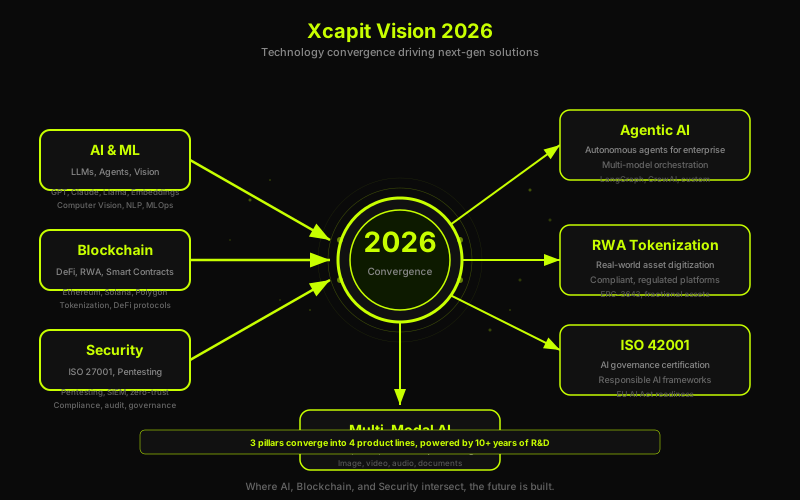
The most significant trend for 2026 is not any single technology -- it is the convergence of AI, blockchain, and cybersecurity into a unified enterprise stack. These three domains, traditionally treated as separate specialties, are becoming inseparable in practice.
Consider what a modern enterprise application requires: intelligence (AI for predictions and automated decisions), trust (blockchain for verifiable audit trails and programmable compliance), and security (protection against AI-powered threats across traditional and decentralized infrastructure). Building these in isolation creates integration gaps and security blind spots. Building them as a unified stack -- with shared data models and integrated governance -- produces systems that are more powerful, reliable, and maintainable.
This is the thesis we founded Xcapit on, and 2025 validated it more strongly than any previous year. Clients who came to us for blockchain are now asking about AI. Those who started with AI are asking about verifiable data provenance. And nearly everyone is asking about security across all layers. The convergence is not a marketing narrative -- it is what our inbox looks like every Monday morning.
What This Means for Our Clients
Based on these trends, here are the project types we expect to see more of in 2026.
- AI agent deployments for complex business processes -- financial services, compliance, operations -- where agents handle routine execution and humans focus on strategic decisions.
- Tokenization platforms for real-world assets -- real estate, carbon credits, trade finance instruments -- with integrated AI for valuation, risk assessment, and regulatory compliance.
- AI-augmented cybersecurity -- continuous threat monitoring, automated incident response, and AI-powered penetration testing to counter AI-powered attacks.
- Governance and compliance infrastructure -- ISO 42001-aligned AI management systems, verifiable audit trails on blockchain, and automated compliance monitoring for the EU AI Act and emerging LATAM regulations.
- Cross-chain enterprise applications -- supply chain, financial settlement, and identity systems that operate across multiple blockchain networks with unified governance and security.
If your organization is exploring any of these areas, you are not early -- you are on time. The enterprises that build these capabilities in 2026 will be well-positioned for 2027 and beyond. Those that wait will face the familiar penalty of late adoption: higher costs, scarcer talent, and competitors who moved first.
A Personal Note: Building from Argentina for the World
I want to close with something personal, because this matters to me not just as a CEO but as someone who chose to build a global technology company from Cordoba, Argentina.
There is a narrative that innovation happens in a handful of cities -- Silicon Valley, London, Tel Aviv -- and everywhere else is a talent pool to be tapped. I have spent fifteen years proving that wrong. Argentina produces world-class engineers and product thinkers. Our timezone alignment with the Americas, multilingual workforce, and experience operating in complex economic environments give us capabilities that insulated tech hubs do not have.
Building Xcapit from Argentina was a strategic decision. When you build technology for UNICEF reaching four million people in 167 countries, when you develop financial systems for both institutional clients and unbanked populations -- you learn things no amount of venture capital can teach. You build robust systems because users depend on them. You think globally because your market was never limited to one country.
As I look at 2026, I see more opportunity than ever. The demand for AI, blockchain, and cybersecurity expertise is global and growing. Distributed collaboration infrastructure has matured to where location is a choice, not a constraint. And the combination of technical depth, cultural adaptability, and competitive economics that LATAM offers is increasingly recognized worldwide.
We are not building a company that happens to be in Argentina. We are building a company that is better because it is in Argentina -- connected to the world, grounded in real-world challenges, and driven by a team that knows the best technology solves problems that matter.
Looking Forward Together
The technology landscape of 2026 will reward organizations that combine technical depth with strategic clarity -- that know not just how to build AI agents and tokenization platforms, but why they are building them and for whom. At Xcapit, that combination of execution and strategic purpose is what we bring to every engagement.
If these trends resonate with the challenges you are facing, I would welcome the conversation. Whether you are planning your first AI agent deployment, exploring asset tokenization, strengthening your cybersecurity posture, or building governance frameworks for responsible AI -- our team has the cross-domain expertise to help you move from strategy to execution. Reach out through our contact page -- I read every message personally.

José Trajtenberg
CEO & Co-Founder
Lawyer and international business entrepreneur with over 15 years of experience. Distinguished speaker and strategic leader driving technology companies to global impact.
Ready to leverage AI & Machine Learning?
From predictive models to MLOps — we make AI work for you.
You Might Also Like
Why We Bet on AI + Blockchain as Our Core Strategy
Xcapit's CEO on why specializing in AI and blockchain -- rather than building a generalist software factory -- creates unique client value and durable edge.
The end of the volume era: why tomorrow's agriculture sells trust, not just commodities
For decades, farming was measured in tonnes. Today the global market pays for verifiable evidence of origin, sustainability and process. How digitalization turns that evidence into margin.
Innovating faster doesn't mean building faster: it means validating first
AI makes it possible to build prototypes in hours, but it introduces a new risk: building too fast without having validated whether the solution answers a real need. Why speed today is measured by the ability to validate.