
Most software projects fit neatly into a single technical domain. You need a mobile app -- assemble a mobile team. You need a data pipeline -- hire data engineers. But the projects that create the most value are increasingly the ones that don't fit into any single domain. They need machine learning models AND smart contracts AND a traditional web application, all working together as a coherent product. These multi-technology projects demand a fundamentally different approach to team structure.
At Xcapit, we've built products that combine AI, blockchain, and traditional development for organizations ranging from UNICEF to fintech companies to energy utilities. Along the way, we've learned -- sometimes painfully -- that the team structure matters as much as the technology choices. A brilliant architecture executed by a poorly structured team will fail. A good-enough architecture executed by a well-structured team will succeed and improve over time. This post shares the squad model we've refined over years of multi-technology projects.
Why Traditional Team Structures Fail
The default approach is to group people by technical specialty -- a frontend team, a backend team, a DevOps team, a blockchain team, an AI/ML team. Each has its own backlog, sprint cadence, and priorities. This works when teams build independent components. But when a single feature requires changes across AI models, smart contracts, backend APIs, and a user interface, the layer-based structure creates three critical problems.
The Handoff Problem
Every feature that crosses team boundaries requires a handoff -- and every handoff introduces delay, information loss, and misalignment. The AI team builds a model and hands it to backend for integration. Backend builds an API and hands it to frontend. At each handoff, context is lost and assumptions diverge. A feature that should take two weeks takes six because three teams need to coordinate their sprints.
The Ownership Problem
When multiple teams contribute pieces of a feature, nobody owns the whole thing. If a user reports that the AI recommendation feature is slow, who owns the fix? The AI team? The backend team? The infrastructure team? In practice, the ticket bounces between teams while the user waits.
The Decision-Making Problem
Multi-technology features require constant trade-off decisions. Should the ML model run on-device or server-side? Should data live on-chain or off-chain? In a layer-based structure, these decisions require meetings with every team, consensus-building, and approval chains. In a squad model, the people who understand the full picture sit together and decide in minutes.
The Squad Model: Cross-Functional Ownership
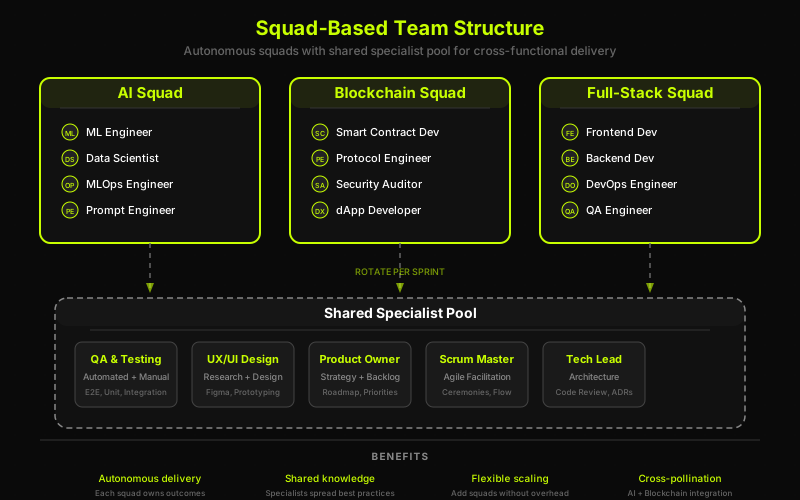
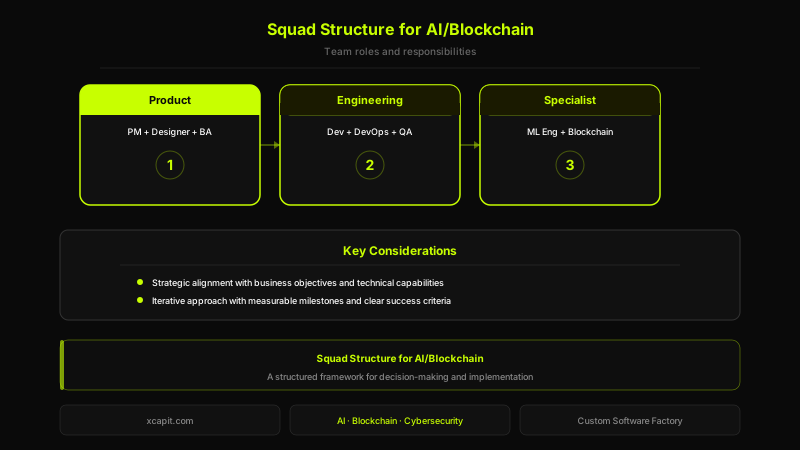
A squad is a small, cross-functional team -- typically 4 to 8 people -- that owns a product area end-to-end. Instead of organizing around technology layers, squads organize around product outcomes. A squad building tokenized asset management would include frontend and backend developers, a blockchain developer, and potentially an ML engineer, all working on that single product area. The key principles are straightforward but counterintuitive for organizations accustomed to functional silos.
- Product-aligned ownership -- each squad owns a product area, not a technology layer. They are responsible for everything from the smart contract to the UI button.
- End-to-end delivery -- a squad can take a feature from design through deployment without depending on external teams for core development work.
- Autonomous decision-making -- squads have the authority to make technical decisions within their product area, including technology choices, architecture patterns, and deployment strategies.
- Shared accountability -- the whole squad shares responsibility for the quality, performance, and reliability of their product area. There is no throwing work over the wall.
- Stable composition -- squads maintain the same core members over time, building deep context and strong working relationships that accelerate delivery.
This model isn't new -- Spotify popularized it over a decade ago. But applying it to projects that combine AI, blockchain, and traditional development introduces unique challenges that most squad-model guides don't address.
Squad Composition for Multi-Tech Projects
The specific composition of a squad depends on the product area it owns, but there are patterns that we've found consistently effective across different project types.
The Core Squad
Every squad has a core that remains constant regardless of the technologies involved: a tech lead who provides technical direction and makes architectural decisions, a product owner (or proxy) who defines priorities and acceptance criteria, and 2-3 full-stack developers who handle the majority of feature development. The tech lead is the most critical role -- more on that later.
AI-Heavy Squads
When a product area is heavily AI-driven -- a recommendation engine or a document processing pipeline -- the squad includes 1-2 ML engineers in addition to the core. They own model development, training, and evaluation, while full-stack developers handle data pipelines and the user-facing components. The key is that ML engineers are full squad members, not consultants from a separate AI team. They attend standups, participate in planning, and share ownership.
Blockchain-Heavy Squads
For product areas centered on blockchain -- tokenization platforms, DeFi protocols, or on-chain governance -- the squad includes 1-2 blockchain developers who own smart contract development, testing, and deployment. They work alongside full-stack developers building the off-chain services and frontend. Blockchain developers need deep Solidity expertise, but they also need to understand the full product context -- how on-chain and off-chain components interact and what the user experience should be.
Hybrid Squads
The most interesting squads combine all three domains. Consider a decentralized identity verification system: ML for document analysis, blockchain for credential storage, and traditional APIs for integration. This squad might include a cross-domain tech lead, 2 full-stack developers, 1 ML engineer, and 1 blockchain developer. The tech lead must be fluent enough in all domains to make sound architectural decisions and mediate trade-offs.
Managing Specialists Across Squads
Blockchain developers and ML engineers are expensive and scarce. You rarely have enough to assign one full-time to every squad. We use a flexible allocation model where specialists have a primary squad (60-80% of their time) and a secondary squad (20-40%, focused on architecture reviews, code reviews, and unblocking critical work).
This works because most product areas don't need a specialist every day. A blockchain developer might spend three days writing a smart contract, then shift to the secondary squad for architecture reviews while the primary squad focuses on frontend work. The key is transparency -- both squads know the specialist's schedule, and time is planned in advance, not allocated reactively. What doesn't work is treating specialists as a shared service that squads request through tickets. That recreates exactly the handoff problems of layer-based teams.
Communication Patterns That Actually Work
Without deliberate communication structures, teams either over-communicate (drowning in meetings) or under-communicate (building components that don't integrate). We've settled on three rituals that balance coordination with autonomy.
Daily Squad Standup (15 minutes)
Each squad holds its own standup, focused on what was accomplished, what's planned, and what's blocked. The standup includes all squad members -- including specialists, even on days when they're primarily with another squad (they can join asynchronously via a short written update). The standup is about coordination within the squad, not status reporting to management.
Weekly Cross-Squad Sync (30 minutes)
Once a week, tech leads from all squads meet to surface integration points and flag potential conflicts. This is where someone says, 'We're changing the token contract interface next sprint -- will that affect your squad?' It prevents two squads from independently making incompatible decisions. Keep it short and action-oriented -- deeper topics get their own meeting.
Biweekly Architecture Review (60 minutes)
Every two weeks, the full engineering group reviews significant technical decisions and new patterns. This catches architectural drift early, spreads knowledge, and gives junior engineers exposure to senior decision-making. For multi-tech projects, the architecture review is where cross-domain trade-offs get discussed -- for example, whether to move computation from a smart contract to an off-chain ML model to reduce gas costs.
The Role of the Tech Lead in Multi-Tech Squads
If the squad model has a single point of failure, it's the tech lead. In a multi-tech squad, the tech lead needs working fluency across AI, blockchain, and traditional development -- not to write production code in all three, but to make informed architectural decisions that span all three.
The multi-tech tech lead serves four critical functions. First, they translate between domains -- when the ML engineer says the model needs 50ms inference time and the blockchain developer says the on-chain verification requires 2 seconds, the tech lead designs an architecture that accommodates both. Second, they make trade-off decisions that no single specialist can make alone. Third, they maintain architectural coherence -- without this role, each specialist optimizes their own layer independently, creating a system that works in isolation but fails in integration. Fourth, they mentor generalists into multi-domain contributors, gradually building the cross-domain intuition that makes the whole squad more capable.
Finding people for this role is hard. The best multi-tech leads are generalists with deep curiosity who have spent time in at least two of the three domains and have a strong enough foundation in the third to ask the right questions.
Preventing Silos: Knowledge Sharing at Scale
The squad model solves the handoff problem but introduces a new risk: knowledge silos. When squads operate autonomously, tribal knowledge accumulates and the organization loses collective learning. We combat this with three practices.
Cross-Domain Pair Programming
We schedule dedicated pairing sessions where engineers from different specialties work together -- a full-stack developer pairs with a blockchain developer to write smart contract tests, or an ML engineer pairs with a backend developer to optimize model serving. These sessions aren't about short-term efficiency. They're about building T-shaped engineers with deep expertise in one area and working knowledge across others, reducing the bus factor for every squad.
Internal Tech Talks
Every two weeks, someone presents a 30-minute talk on a technical topic -- a postmortem, a tool evaluation, or a deep dive into a technology decision. These talks are recorded and archived. Topics naturally rotate across AI, blockchain, and traditional development, giving everyone exposure to domains outside their expertise. The most valuable talks are the ones where an engineer shares what went wrong.
Shared Architecture Decision Records
Every significant technical decision is documented in a lightweight Architecture Decision Record (ADR) that captures the context, the decision, alternatives considered, and the rationale. ADRs live in the repository and are searchable. When a new engineer joins or a squad encounters a similar problem, they can trace past reasoning instead of relitigating it. For multi-tech projects, ADRs capture cross-domain trade-offs that don't fit neatly into any single team's documentation.
Scaling: From 2 Squads to 10
What works with two squads breaks down at five, and what works at five needs additional structure at ten.
Two Squads: Keep It Simple
With two squads, coordination happens naturally. Tech leads talk informally, specialists know everyone personally, and the cross-squad sync can be a 10-minute conversation. The main risk is premature process -- don't introduce formal mechanisms you don't need yet.
Five Squads: Add Structure
At five squads, informal coordination breaks down. You need the weekly cross-squad sync on the calendar, a shared channel for integration discussions, and probably a platform squad -- a small team that owns CI/CD pipelines, monitoring, shared libraries, and development environments. Specialist allocation also gets harder. With three blockchain developers and five squads, you need a clear allocation model and someone -- usually an engineering manager -- who manages allocation based on sprint priorities.
Ten Squads: Introduce Tribes
At ten squads, you need an intermediate layer. We use 'tribes' -- groups of 3-4 squads working on related product areas, each with a tribe lead who coordinates across squads and represents them in broader planning. You also need guilds -- communities of practice for specific technologies (AI, blockchain, security) that meet regularly to share knowledge, maintain standards, and evaluate tools. Guilds provide the horizontal coordination that tribes don't, keeping architectural decisions consistent as teams become more autonomous.
Lessons Learned From Real Projects
Theory is clean. Reality is messy. Here are lessons we've accumulated from years of running multi-technology squads.
- Start with product boundaries, not technology boundaries -- the most common mistake is creating an 'AI squad' and a 'blockchain squad.' This recreates exactly the silo problems the squad model is designed to solve. Organize squads around what the user sees, not what the technology does.
- Invest heavily in the tech lead role -- a weak tech lead creates architectural chaos that takes months to untangle. Pay premium salaries for this role.
- Rotate specialists deliberately -- rotate every 6-12 months to spread knowledge and prevent expertise from becoming trapped in one squad.
- Don't let squads grow beyond 8 people -- communication overhead explodes and shared ownership evaporates. Split the squad instead.
- Treat the on-chain/off-chain boundary like a team boundary -- this interface is where most bugs occur. Define it formally with contract specs and test it obsessively.
- Budget 20% of sprint capacity for technical debt and knowledge sharing -- under delivery pressure, teams will skip pairing and tech talks. Protect this time explicitly.
- Make integration testing a first-class concern -- individual components often work in isolation and fail when combined. Invest in end-to-end tests that exercise the full stack.
Building Teams That Build Great Products
AI, blockchain, and traditional software development are no longer separate disciplines -- they are increasingly combined in products that demand new organizational approaches. The squad model, adapted for multi-technology projects, provides a proven framework for delivering on this complexity without drowning in coordination overhead.
Getting the team structure right pays dividends throughout the project lifecycle: faster decisions, clearer ownership, fewer integration failures, and more engaged engineers. It's not the only factor in project success -- but in our experience at Xcapit, it's the factor most organizations underestimate.
If you're planning a project that combines AI, blockchain, and traditional development and want to discuss how to structure your teams for success, we'd welcome the conversation. Learn more about our approach at /services/custom-software or explore how we work at /how-we-work.

Antonella Perrone
COO
Previously at Deloitte, with a background in corporate finance and global business. Leader in leveraging blockchain for social good, featured speaker at UNGA78, SXSW 2024, and Republic.
Ready to leverage AI & Machine Learning?
From predictive models to MLOps — we make AI work for you.
You Might Also Like
What is a Product Builder and why will it be one of the most important roles in digital transformation?
When building gets faster and faster, the challenge becomes knowing what is worth building. What a Product Builder does, how they connect business and technology, and why AI amplifies their work without replacing their judgement.
Digital transformation for utilities: modernizing energy without replacing the core
A practical guide for utilities and energy companies: how to integrate SCADA, IoT, AI, tokenization, and cybersecurity to modernize operations without replacing critical systems.
Our Vision 2025-2026: Where the Industry Is Heading
Xcapit's CEO reflects on what 2025 confirmed, what surprised us, and shares strategic predictions for 2026 -- from agentic AI to blockchain interoperability.