
Every Web3 project begins with a whitepaper. It describes the protocol, the token economics, the roadmap. What it almost never describes is what happens when the smart contract has a bug that cannot be patched, when the oracle provider you depend on goes offline, when the regulatory framework in your target market shifts overnight, or when your lead Solidity developer leaves and nobody else understands the codebase. These are the risks that actually kill Web3 projects -- and they are fundamentally different from the risks in traditional software development.
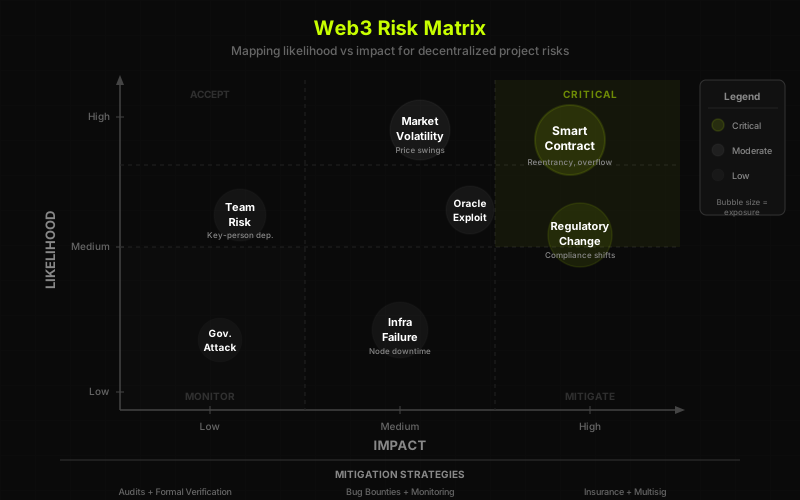
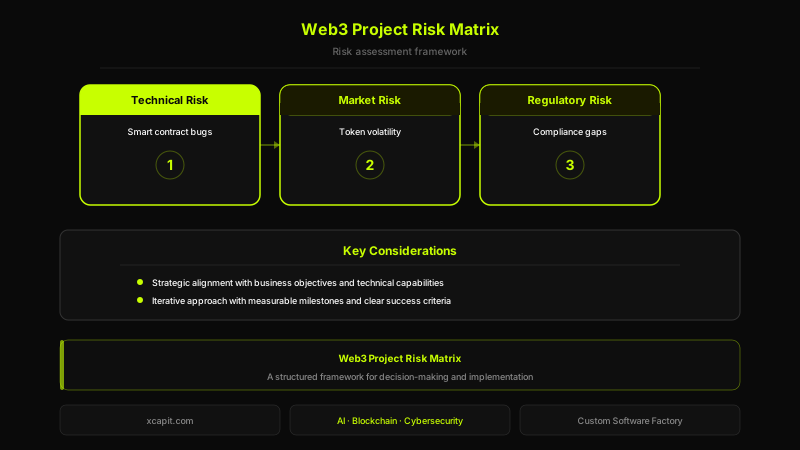
Having spent years in corporate finance and risk management at Deloitte before moving into blockchain, I have seen both worlds. Traditional software projects have mature risk frameworks -- PMI, PRINCE2, ISO 31000. Web3 projects need something different. Not because those frameworks are wrong, but because the underlying assumptions do not hold. You cannot roll back a deployed smart contract the way you roll back a server deployment. You cannot control your infrastructure the way you control your cloud instances. You cannot predict your regulatory environment the way you can in established industries. Web3 projects are built on layers of composable infrastructure -- protocols, oracles, bridges, RPC providers -- each introducing its own failure modes. Your risk surface extends far beyond your own codebase. This article lays out the risk categories that matter most and the mitigation strategies that actually work.
Smart Contract Risks: Bugs Are Forever
Smart contract risk is the most discussed but still the most underestimated category. Teams know they need audits. What many do not fully internalize is that audits are necessary but insufficient. A security audit is a point-in-time review by human beings who, no matter how skilled, cannot guarantee the absence of all vulnerabilities. The DAO hack, the Wormhole exploit, the Euler Finance attack -- all involved contracts that had been audited.
The real mitigation strategy is defense in depth. Multiple independent audits from firms with different methodologies. Formal verification of critical invariants -- mathematical proof that certain properties always hold. Comprehensive fuzzing that throws millions of random inputs at your contracts. Upgradeable proxy patterns with time-locked governance so you have a mechanism to respond if a vulnerability is discovered.
- Commission at least two independent security audits from firms with different specializations
- Implement formal verification for financial invariants -- token conservation, collateral ratios, access control
- Run continuous fuzz testing campaigns with Echidna or Foundry targeting millions of random transaction sequences
- Deploy behind upgradeable proxies with time-locked governance and multi-signature controls
- Establish a bug bounty program with rewards proportional to the value at risk
- Maintain a documented incident response plan with pause mechanisms and communication protocols
Protocol Dependency Risks: Building on Shifting Ground
Every Web3 project builds on other protocols -- Chainlink for price feeds, Uniswap for liquidity, LayerZero for cross-chain messaging. Each dependency is a risk vector. Protocols change their APIs, alter fee structures, get exploited, or shut down. The Multichain bridge collapse in 2023 affected dozens of projects that depended on it. None had a bug in their own code -- they were collateral damage from a dependency failure. Protocol forks add another dimension, forcing you to choose which version to support under time pressure and with incomplete information.
- Map every external protocol dependency and classify each by criticality -- which would halt your operations if they failed?
- Implement abstraction layers that let you swap providers without redeploying core contracts
- Maintain fallback providers for critical services: secondary oracle feeds, alternative bridges, backup RPC endpoints
- Monitor dependency protocols for governance proposals, upgrades, and security incidents
- Stress-test your system when dependencies return unexpected values or become unavailable
Regulatory Risks: The Rules Are Being Written Now
Regulatory risk in Web3 is not that regulations exist -- it is that they are changing, inconsistent across jurisdictions, and often retroactively applied. MiCA in the EU, the evolving SEC approach in the US, LATAM frameworks still in draft -- building a Web3 project today means building for a regulatory environment that may look completely different by launch. The practical challenge is that compliance affects architecture. KYC requirements change smart contract design, frontend routing, and data storage. Token classifications shift integration strategies. And the penalties are escalating -- enforcement actions in 2023 and 2024 resulted in fines measured in hundreds of millions of dollars.
- Engage specialized Web3 legal counsel in every jurisdiction where you operate
- Design modular compliance architecture from day one -- jurisdiction-specific feature toggling should be a core capability
- Monitor regulatory developments through dedicated services, not general news coverage
- Maintain detailed records of all compliance-related design decisions -- regulators evaluate intent and process
- Build geographic restriction capabilities before you need them, not after an enforcement action
Market Risks: When Tokenomics Meet Reality
If your project involves a token, market risk is existential. A 70% drawdown is not a theoretical scenario -- it is a routine occurrence in crypto markets. Token price volatility affects your treasury, development funding, user acquisition costs, and team retention. Liquidity risk is equally critical: a token with a $100 million market cap but only $500,000 in actual liquidity means any significant sell pressure crashes the price far beyond expectations. Slippage on thin liquidity has destroyed more token projects than smart contract exploits.
- Stress-test your financial model against a 70-90% token price decline -- if the project cannot survive it, the tokenomics need redesign
- Maintain twelve months of operating reserves in stablecoins or fiat, not in your own token
- Design vesting schedules with cliff periods and linear unlocks that prevent supply shocks
- Model liquidity depth requirements before launch and ensure sufficient provisioning
- Separate treasury management from protocol governance with clear mandates and risk limits
Team Risks: The Knowledge Concentration Problem
Web3 development requires specialized knowledge -- Solidity, Move, Rust, ZK proof systems, DeFi protocol design -- with a shallow talent pool. Most Web3 projects have dangerous knowledge concentration: one or two developers who understand the critical smart contracts, and nobody who can step in if they leave. This is not a human resources problem -- it is an operational risk. If your lead smart contract developer departs, your ability to respond to security incidents, implement upgrades, or explain your own system to auditors is compromised. I have seen projects stall for months because the remaining team could not safely modify contracts they did not fully understand.
- Enforce mandatory code review and pair programming on all smart contract work
- Maintain technical documentation that explains design decisions, economic assumptions, and known trade-offs
- Cross-train team members so at least two people can work on every critical component
- Implement regular knowledge transfer sessions and record them for future reference
- Consider an external development partner who maintains independent understanding of your codebase
Infrastructure Risks: Single Points of Failure
The irony of many Web3 projects is that they build decentralized protocols on centralized infrastructure. Your smart contract may be trustless, but if your frontend is served from a single cloud provider, your RPC calls go through one provider, and your price data comes from one oracle -- you have multiple single points of failure. RPC provider outages halt applications even though the blockchain operates normally. Oracle failures trigger incorrect liquidations or enable exploits. Bridge exploits have produced some of the largest losses in Web3 history -- Ronin ($624M), Wormhole ($320M), Nomad ($190M) -- over a billion dollars combined.
- Use multiple RPC providers with automatic failover
- Implement oracle redundancy with multiple independent price feeds and outlier rejection
- Minimize bridge dependency by maintaining native liquidity on target chains where possible
- Deploy frontends to decentralized hosting (IPFS, Arweave) alongside traditional CDNs
- Design graceful degradation paths for every infrastructure component failure
Operational Risks: Key Management and Governance
Operational risk in Web3 centers on key management and governance. Private keys control everything -- contract upgrades, treasury movements, protocol parameters. A compromised key is not like a compromised password; there is no reset. If the key controlling your upgrade mechanism is stolen, the attacker can replace your entire contract. If the key is lost, your protocol may become permanently ungovernable. Governance mechanisms add complexity: on-chain voting can be manipulated through flash loans, time-locks reduce emergency response speed, and multi-sig wallets create liveness risks if signers become unavailable.
- Use hardware wallets for all keys with operational authority -- never software wallets or servers
- Implement multi-signature requirements for high-value operations (3-of-5 minimum for treasury, 4-of-7 for upgrades)
- Establish key rotation procedures and practice them regularly
- Design tiered governance with fast-path emergency mechanisms and slow-path parameter changes
- Document all operational procedures in runbooks accessible to the full team
- Conduct regular governance drills to verify signer availability and coordination speed
A Practical Risk Framework
After managing risk across multiple Web3 projects -- from DeFi protocols to blockchain-based social impact platforms -- I have converged on a three-layer framework: pre-deployment risk gates, runtime monitoring, and incident response.
Pre-Deployment Risk Gates
- Gate 1 -- Specification Review: Written spec approved by technical and business stakeholders covering all functions, edge cases, and economic assumptions
- Gate 2 -- Internal Security Review: Code review by at least two developers who did not author the code
- Gate 3 -- Automated Analysis: Clean results from static analysis, symbolic execution, and fuzz testing
- Gate 4 -- External Audit: Independent security audit with all critical findings resolved and re-verified
- Gate 5 -- Testnet Deployment: Minimum two weeks on testnet with monitoring and integration testing
- Gate 6 -- Operational Readiness: Multi-sig configured, monitoring live, incident response plan reviewed
Runtime Monitoring
- Monitor contract events and compare transaction patterns against baseline behavior
- Track oracle feeds for staleness, price deviation, and unusual update patterns
- Set alerts for governance actions, large transfers, and admin function usage
- Track treasury and liquidity positions against predefined thresholds
Incident Response
- Define severity levels with objective criteria before you need them
- Pre-authorize emergency actions with lower multi-sig thresholds for speed
- Maintain communication templates for disclosure to users, regulators, and partners
- Conduct quarterly tabletop exercises with realistic incident scenarios
- After every incident, run a blameless post-mortem and update procedures
Principles That Separate Survivors from Cautionary Tales
Risk management comes down to four principles. First, build redundancy into everything -- two auditors, multiple oracle providers, cross-trained teams, multi-sig wallets. The cost of redundancy is always lower than the cost of a single point of failure. Second, separate your risks -- do not hold your treasury in your own token, do not run monitoring on the same infrastructure as your application, do not have the same person write and audit a contract. Third, practice your responses -- a plan that has never been tested is a document, not a capability. Fourth, stay humble about what you do not know -- the most dangerous risks are the ones you have not thought of yet, so build systems with enough margin to absorb surprises.
At Xcapit, we have delivered Web3 projects across DeFi, social impact, and enterprise blockchain -- from smart contract development and security audits to full protocol design and launch support. Our team combines deep technical blockchain expertise with corporate-grade risk management practices and ISO 27001 certification. If you are building in Web3 and want a partner who understands both the technology and the operational reality, let's talk about how we can help you build with confidence.

Antonella Perrone
COO
Previously at Deloitte, with a background in corporate finance and global business. Leader in leveraging blockchain for social good, featured speaker at UNGA78, SXSW 2024, and Republic.
Building on blockchain?
Tokenization, smart contracts, DeFi — we've shipped it all.
You Might Also Like
The Real State of Web3 Adoption in LATAM
A CEO's analysis of Web3 adoption across Latin America -- from stablecoin savings in Argentina to Brazil's Drex CBDC -- and the enterprise opportunities.
Shielding credit risk: how Web3 technology simplifies bank and guarantee society processes in agriculture
Autonomous collateral locking, real-time value monitoring and guaranteed algorithmic execution: the three tools reshaping risk analysis in agricultural credit.
The field's digital notary: what blockchain is (and why you don't need to understand the code to use it)
You don't need to know how a combine harvester's computer works to operate it. Blockchain is the same: a write-only record that guarantees provenance and cannot be forged.