
Latin America is not waiting for permission to adopt Web3. While regulators in the US and Europe debate frameworks, millions of people across LATAM are already using blockchain-based tools to solve problems that traditional finance either cannot or will not address. This is not theoretical adoption driven by speculation -- it is practical adoption driven by necessity. And that distinction makes all the difference.
As someone who has spent more than a decade building technology companies in this region, I have watched the Web3 narrative evolve from Bitcoin curiosity in 2015 to a mature, multi-layered ecosystem in 2024. At Xcapit, we built a self-custodial wallet that reached over 4 million users across 167 countries, with a disproportionate share coming from Latin America. We partnered with UNICEF to deploy blockchain-based financial tools for underserved populations. We are not observing this market from the outside -- we are building in it every day. Here is what we are actually seeing on the ground.
LATAM by the Numbers: A Region That Cannot Be Ignored
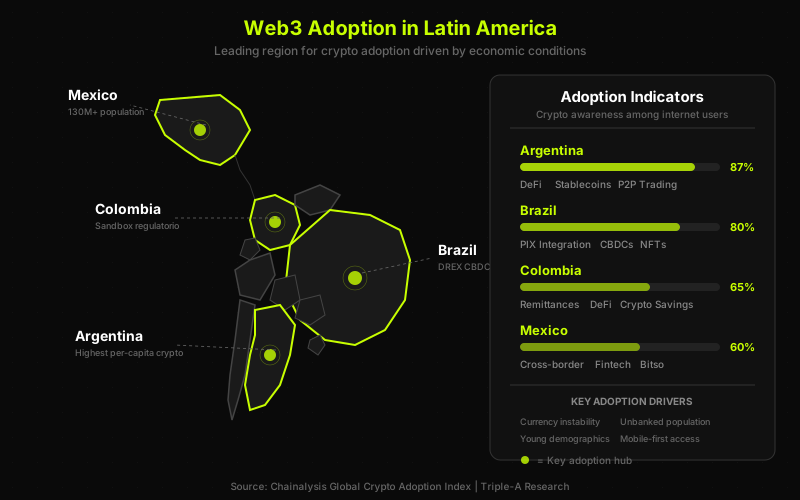
Chainalysis consistently ranks multiple Latin American countries among the top 20 globally for cryptocurrency adoption. In 2023, the region received an estimated $562 billion in on-chain value -- a figure that continued to grow into 2024. Brazil alone accounted for roughly $150 billion. Argentina, despite its smaller GDP, punches well above its weight in per-capita adoption, particularly in stablecoin usage.
But raw transaction volume only tells part of the story. What makes LATAM distinctive is the composition of that activity. Unlike markets driven primarily by trading and speculation, a significant share of Web3 activity here is utilitarian -- people using stablecoins as savings accounts, workers receiving remittances through crypto rails, small businesses settling cross-border invoices without traditional correspondent banking. This utility-first adoption creates a more durable foundation than speculative cycles, because users do not stop needing to save, send money, or pay suppliers when token prices drop.
Country Breakdown: Different Problems, Different Solutions
Argentina: The Stablecoin Capital of the World
Argentina's relationship with crypto is unlike any other country's, because Argentina's economic conditions are unlike any other country's. Annual inflation exceeded 200% in early 2024. Capital controls restrict access to foreign currency through official channels. The gap between the official exchange rate and the parallel ("blue dollar") rate creates constant arbitrage pressure. In this environment, stablecoins are not a speculative asset -- they are a survival tool.
Argentines hold an estimated $50 billion in US dollars outside the banking system. Stablecoins like USDC and USDT offer a digital alternative with clear advantages: accessible 24/7, no bank account required, instant global transfers, and immunity from currency controls. Monthly stablecoin transaction volumes in Argentina consistently rank among the highest per capita globally.
On the regulatory front, the Milei administration has signaled a more open stance toward crypto than previous governments. The elimination of the "cepo" (capital controls) remains a stated goal, with growing discussion around a formal digital asset framework. What is clear is that adoption has outpaced regulation -- millions of Argentines already use stablecoins daily, and any future framework will need to accommodate this reality.
Brazil: Building Institutional Infrastructure
Brazil's approach to Web3 is the most institutionally mature in the region. The Central Bank of Brazil is actively developing Drex, a wholesale central bank digital currency (CBDC) built on Hyperledger Besu -- a permissioned Ethereum-compatible blockchain. Drex is not a retail payment tool; it is infrastructure for tokenized asset settlement, programmable money, and interbank coordination.
The significance of Drex cannot be overstated. When a central bank builds on blockchain infrastructure, it validates the technology stack for the entire financial system. Pilot programs running through 2024 involve major Brazilian banks testing tokenized government bonds, real estate, and trade finance assets. If Drex succeeds at scale, it creates the rails on which private-sector Web3 applications can build with regulatory confidence.
Brazil also has the advantage of PIX, its instant payment system that processes over 3 billion transactions per month. PIX demonstrated that Brazilians adopt new financial technology rapidly when it solves a real problem. The convergence of PIX's ubiquity, Drex's institutional infrastructure, and a regulatory framework that already encompasses crypto exchanges (Lei 14.478) positions Brazil as the most likely LATAM market for institutional-grade Web3 adoption.
Colombia: Remittances and Financial Inclusion
Colombia receives approximately $10 billion in annual remittances, predominantly from the United States. Traditional remittance corridors charge 5-8% in fees and take 1-3 business days. Crypto-based remittance services have compressed this to under 1% and near-instant settlement, and they are gaining ground rapidly.
Colombia's sandbox regulatory approach has created space for innovation without the uncertainty that plagues less structured markets. Bitso, Binance, and local players have established significant operations, and peer-to-peer stablecoin trading volumes are among the highest in the region. With 45% of the population unbanked, Web3 tools that require only a smartphone can reach people that traditional banks never will.
Mexico: The Sleeping Giant
Mexico is the largest remittance market in LATAM, receiving over $63 billion in 2023 -- primarily from the United States. This single use case alone represents a massive addressable market for blockchain-based payment rails. Bitso processes a significant share of US-Mexico crypto remittances, demonstrating that the product-market fit exists.
However, Mexico's FinTech Law restricts crypto assets from being used as legal tender and limits how traditional financial institutions can interact with digital assets, creating a regulatory ceiling that has slowed institutional adoption compared to Brazil. The opportunity remains enormous -- Mexico's proximity to the US market, large diaspora population, and $1.3 trillion GDP make it inevitable that Web3 adoption will accelerate. The question is when, not if.
The Use Cases That Are Actually Working
Beyond the country-level view, it is worth examining the specific applications that are driving adoption across the region. These are not hypothetical use cases -- they are live, functioning products with real users.
Stablecoin Savings and Dollar Access
In economies with chronic inflation, the ability to save in a stable currency is not a luxury -- it is a fundamental need. Stablecoins provide dollar-denominated savings to anyone with a smartphone, without requiring a bank account, minimum balance, or identity verification at a foreign institution. In Argentina, we saw this firsthand with our wallet: users were not trading crypto for profit. They were converting their paychecks to USDC within hours of receiving them, treating stablecoins as a digital savings account. This pattern is replicated across Venezuela, Colombia, and increasingly in Brazil as well.
Cross-Border Remittances
Remittances are the most mature crypto use case in LATAM. The economics are straightforward: a worker in Miami sending $500 to family in Bogota pays $25-40 through Western Union. Through crypto rails, the same transfer costs $1-5 and settles in minutes rather than days. As stablecoin liquidity deepens and on/off ramps improve, the cost advantage only grows. The World Bank estimates that reducing remittance fees to the SDG target of 3% would put an additional $12 billion per year into the pockets of migrant families worldwide.
DeFi Lending and Yield
Decentralized lending protocols offer LATAM users access to yield on their savings and credit against their digital assets -- services that traditional banks in the region either do not offer or restrict to high-net-worth customers. At Xcapit, we integrated DeFi yield strategies directly into our wallet, allowing users to earn returns on stablecoin deposits through curated, risk-assessed protocols. The demand was significant: users who could not access a traditional savings account with competitive interest rates found DeFi protocols offering 4-8% APY on dollar-denominated stablecoins -- dramatically better than the near-zero real returns available through most LATAM banks.
Tokenized Real Estate and Real-World Assets
Tokenized real estate is gaining traction across LATAM, particularly in Brazil and Argentina. Fractional ownership through blockchain tokens lowers the entry barrier from tens of thousands of dollars to hundreds, enables liquidity in a traditionally illiquid asset class, and provides transparent, on-chain records of ownership and income distribution. Brazilian platforms are already tokenizing commercial real estate, and Argentina's emerging token regulation framework is creating pathways for compliant real-world asset tokenization.
Why LATAM Is Structurally Different
To understand why Web3 adoption in LATAM looks different from adoption in the US or Europe, you need to understand the structural conditions that make blockchain solutions more valuable here than in markets with stable currencies and deep banking infrastructure.
- Chronic inflation: When your currency loses 10-20% of its value per month, preserving purchasing power is the primary financial concern. Stablecoins provide an accessible solution that traditional banking products do not match.
- Large unbanked populations: Approximately 200 million adults in LATAM lack access to basic banking services. Web3 tools that require only a smartphone bypass the physical and bureaucratic barriers of traditional banking entirely.
- Mobile-first demographics: LATAM has over 450 million smartphone users, with mobile internet penetration exceeding 70% in most major markets. The region skipped the desktop era and went straight to mobile -- the same platform where crypto wallets live.
- Young population: The median age across LATAM is approximately 31 years, compared to 38 in the US and 44 in Europe. Younger populations adopt new technology faster and have fewer legacy financial relationships to protect.
- Remittance dependency: Hundreds of billions of dollars flow into LATAM annually as remittances. Every percentage point reduction in transfer fees represents billions in additional value reaching families.
These are not temporary conditions. Inflation may moderate, but currency instability is structural in several LATAM economies. The unbanked population will not gain bank access overnight. Mobile-first behavior is permanent. These factors mean that Web3 adoption in LATAM is not a cycle -- it is a trend with a very long runway.
Enterprise Opportunities: Where the Value Is
The consumer adoption story in LATAM is well-documented. What is less discussed -- and where we see the most compelling near-term opportunities -- is enterprise adoption. Companies operating in LATAM face specific challenges that blockchain technology can address directly.
Supply Chain Transparency
LATAM is a major global exporter of agricultural products, minerals, and energy. Supply chains in these sectors are notoriously opaque, with traceability gaps that create compliance risk for international buyers and reputational risk for producers. Blockchain-based provenance tracking -- from farm or mine to export port -- provides the verifiable, tamper-evident records that international trade increasingly demands. European deforestation regulations (EUDR), US conflict minerals rules, and ESG reporting requirements are all creating pull demand for this infrastructure.
Cross-Border B2B Payments
Settling a cross-border invoice between a Colombian supplier and a Brazilian buyer through traditional banking takes 3-5 days, costs 2-4% in fees and FX spreads, and involves multiple intermediary banks. Stablecoin-based B2B payment platforms reduce this to hours and basis points. For companies operating across multiple LATAM markets, the cumulative savings are substantial. We are seeing early enterprise adoption accelerate as CFOs recognize the impact on working capital and cash flow.
Financial Inclusion at Scale
This is the opportunity closest to our experience at Xcapit. Our partnership with UNICEF focused on deploying blockchain-based financial tools to populations with limited or no banking access. What we learned is that financial inclusion is not just a social good -- it is a massive commercial opportunity. Companies that build the rails for the next 200 million LATAM adults to access financial services will capture enormous value. The tooling exists: self-custodial wallets, stablecoin on/off ramps, DeFi lending protocols, and identity verification that works with government IDs rather than banking history. What is needed is the integration, user experience, and partnerships to deploy at scale.
The Regulatory Landscape: Progress, Not Perfection
Regulatory frameworks across LATAM are evolving rapidly, though unevenly. Brazil leads with comprehensive legislation (Lei 14.478) and the Drex CBDC initiative. El Salvador's Bitcoin legal tender experiment continues to generate debate. Argentina is developing token-specific regulation under the new administration. Colombia maintains its sandbox approach. Mexico's FinTech Law provides structure but limits certain crypto activities.
The overall trajectory is toward regulation, not prohibition. This is critical for enterprise adoption: companies need legal certainty before committing resources. What we advise our clients is to build with regulatory compliance in mind from day one, even in markets where the rules are not yet finalized. The cost of retrofitting compliance is always higher than building it in, and the regulatory direction across LATAM is clear -- frameworks are coming, and they will generally follow the patterns established by Brazil and the EU's MiCA regulation.
What Comes Next: 2024 and Beyond
Several developments will shape LATAM's Web3 trajectory over the next 12-24 months. Institutional adoption is accelerating as traditional banks in Brazil and Argentina begin offering crypto products to existing customer bases. Government pilots -- Drex in Brazil, digital identity projects in Argentina and Colombia -- are creating public-sector demand for blockchain infrastructure. The convergence of AI and blockchain is opening new possibilities for automated compliance and fraud detection.
The most significant shift, however, is attitudinal. Five years ago, serious enterprise conversations about blockchain in LATAM required overcoming deep skepticism. Today, the question has changed from "why blockchain?" to "how do we implement it?" That transition -- from skepticism to strategic planning -- is the clearest signal that the market has matured.
At Xcapit, we have spent years building for this market. Our wallet reached over 4 million users. Our UNICEF partnership proved that blockchain can deliver financial services to the most underserved populations. Our work with energy companies, government agencies, and financial institutions has taught us that the technology works -- the challenge is always in the implementation: regulatory navigation, user experience, integration with existing systems, and stakeholder alignment.
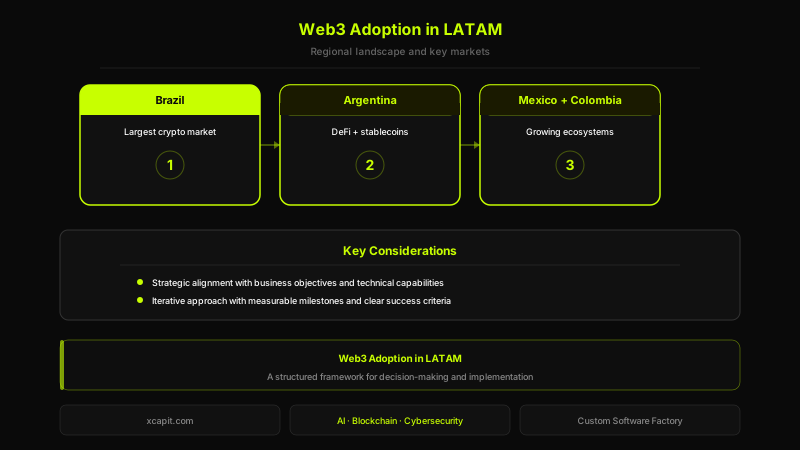
The opportunity in LATAM is not about the next bull market or the next token launch. It is about building the financial and commercial infrastructure that 650 million people need -- infrastructure that is more accessible, more transparent, and more resilient than what exists today. If your organization is exploring Web3 opportunities in Latin America -- whether in payments, financial services, supply chain, or tokenization -- we bring the technical depth and the regional experience to turn strategy into production systems. Let's talk.

José Trajtenberg
CEO & Co-Founder
Lawyer and international business entrepreneur with over 15 years of experience. Distinguished speaker and strategic leader driving technology companies to global impact.
Building on blockchain?
Tokenization, smart contracts, DeFi — we've shipped it all.
You Might Also Like
Risk Management in Web3: What Whitepapers Won't Tell You
A COO's operational guide to managing Web3 project risks -- from smart contract bugs and protocol dependencies to regulatory shifts and key management failures.
Ecosystem, talent and scale: why Argentina is ready to lead the global tokenized asset market
Agribusiness scale, world-class technical talent and adoption fitness. The triple helix that positions Argentina in the global RWA and sustainable finance market.
Shielding credit risk: how Web3 technology simplifies bank and guarantee society processes in agriculture
Autonomous collateral locking, real-time value monitoring and guaranteed algorithmic execution: the three tools reshaping risk analysis in agricultural credit.