
At least once a month, a client walks into our discovery sessions and says some version of the same thing: 'We want to put it on the blockchain.' When we ask why, the answers range from the genuinely compelling to the deeply misguided. That is fine -- the technology is still young enough that most decision-makers have been exposed to more marketing than engineering reality. The problem is not that they ask for blockchain. The problem is that nobody has given them an honest framework for deciding when blockchain is the right tool and when a database would serve them better, faster, and cheaper.
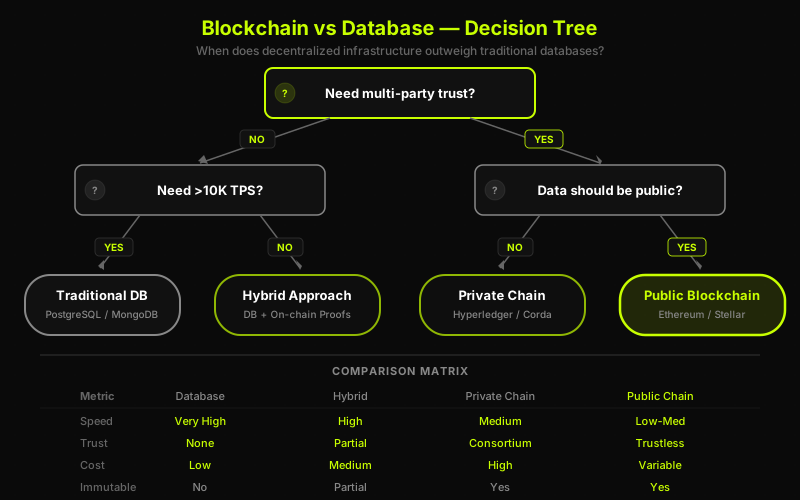
This guide comes from ten years of building digital products and several years of shipping production blockchain systems. It is not a blockchain advocacy piece or a database advocacy piece. It is the same framework we use internally when a client comes to us with a new project and we need to decide -- honestly -- which technology best serves their goals.
The Core Question Most People Skip
Before diving into feature comparisons, there is one question that determines the answer in roughly 80% of cases: who needs to trust whom? A blockchain is, at its core, a mechanism for establishing trust between parties who do not -- and perhaps should not -- trust each other or any single intermediary. It achieves this through consensus mechanisms, cryptographic verification, and immutable record-keeping. These properties come at a cost: lower throughput, higher latency, greater complexity, and increased operational expense compared to a traditional database.
A database, on the other hand, is optimized for a world where trust is already established. A single organization controls the data, defines access rules, and takes responsibility for integrity. Within that trust boundary, databases are extraordinarily efficient -- orders of magnitude faster, cheaper, and simpler than any blockchain. The question is not which technology is 'better.' It is which trust model matches your actual situation.
When Blockchain Makes Sense
Blockchain earns its complexity when certain conditions are present. Not one of these conditions in isolation, but typically two or more in combination. Here are the scenarios where, in our experience, blockchain consistently delivers value that a database cannot replicate.
Multi-Party Trust Without a Central Authority
When multiple organizations need to share data and none of them is willing to let another be the single source of truth, blockchain provides a neutral infrastructure. Each participant maintains an equal stake in the data's integrity. No one can alter records unilaterally. Supply chains with independent vendors, consortium-based industry platforms, cross-border trade documentation, and multi-institution financial settlement all fit this pattern. If you can point to a single trusted entity that all parties accept as the authority, you do not need blockchain. If that entity does not exist, blockchain is the natural solution.
Immutable Audit Trails
Some records must be tamper-evident by design -- not because you distrust your own team, but because external parties (regulators, auditors, counterparties, or the public) need verifiable proof that records have not been altered after the fact. Financial transactions, compliance certifications, intellectual property timestamps, and chain-of-custody documentation all benefit from blockchain's append-only architecture. A database can implement audit logging, but the administrator who controls the database can also modify or delete those logs. Blockchain removes that possibility by distributing the record across multiple independent nodes.
Tokenized Assets and Digital Ownership
When you need to create digital representations of assets -- whether physical (real estate, commodities) or purely digital (carbon credits, loyalty points, access rights) -- that can be transferred, fractionalized, and verified without a central registry, blockchain provides the infrastructure. Tokenization enables programmable ownership through smart contracts: automatic royalty distribution, conditional transfers, and fractional shares. A database can track ownership, but it cannot enable peer-to-peer transfers and programmable logic without a trusted intermediary managing every transaction.
Decentralized Governance and Cross-Organization Data Sharing
When decisions about data access or system upgrades need to be made collectively by stakeholders rather than dictated by a single operator, blockchain provides governance mechanisms (voting, multi-signature authorization, DAO structures) that are transparent and enforceable by code. When organizations need to share specific data sets without giving any single party full access to underlying systems, blockchain's selective transparency model -- where participants share what they choose while keeping proprietary data private -- is fundamentally different from the all-or-nothing access model of shared databases.
When a Database Is the Better Choice
We tell clients this more often than they expect: for the majority of software projects, a traditional database is the right answer. Not because blockchain is bad, but because most applications operate within a single trust boundary where blockchain's guarantees add cost without corresponding value.
- Single-organization data ownership -- If one company controls the data, defines the rules, and is accountable for integrity, a relational or document database is simpler, faster, and cheaper. Adding blockchain to a single-tenant system is like hiring a notary to verify your own grocery list.
- High throughput and low latency requirements -- If your application needs to process thousands of transactions per second with sub-millisecond response times, databases win by orders of magnitude. PostgreSQL can handle 50,000+ transactions per second. Most blockchain networks operate in the range of hundreds to low thousands, with latencies measured in seconds, not milliseconds.
- Simple CRUD operations -- Create, Read, Update, Delete. If your data model is straightforward, records need to be editable, and the primary operations are standard queries and updates, a database is purpose-built for this workload. Blockchain adds unnecessary complexity to what should be a solved problem.
- Mutable data requirements -- Blockchain's immutability is a feature in the right context and a constraint in the wrong one. If your application requires frequent updates, corrections, or deletions -- user profile changes, inventory adjustments, content management -- you need a system designed for mutability. Working around blockchain's immutability with 'correction records' creates complexity that a database handles natively.
- Cost sensitivity with standard requirements -- Running blockchain nodes, paying gas fees, and maintaining distributed infrastructure costs more than hosting a managed database. If your project has a tight budget and no specific need for decentralization, the premium is not justified.
- Prototyping and rapid iteration -- When you are still figuring out your data model and business logic, the last thing you need is the overhead of blockchain development. Build in a database, validate the concept, and migrate the components that genuinely benefit from blockchain once the requirements are stable.
The Decision Framework: Five Questions
After building blockchain and traditional systems across fintech, energy, government, and consumer products, we have distilled the decision into five questions. Answer them honestly -- not aspirationally -- and the right technology becomes clear.
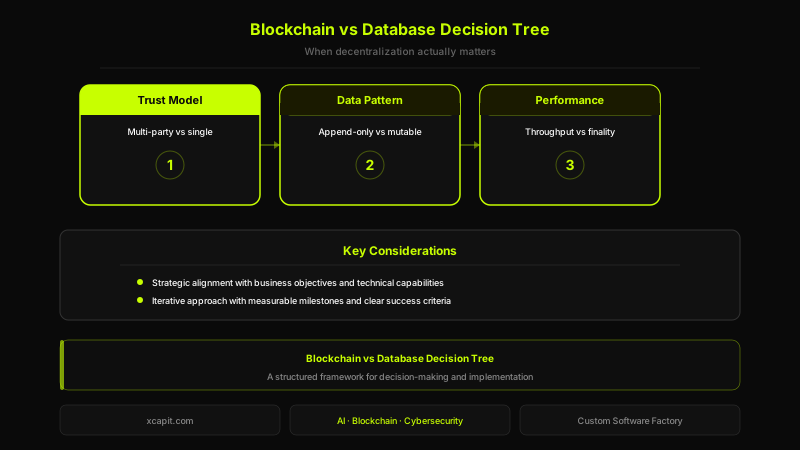
1. What Is the Trust Model?
Map every participant in your system and their trust relationships. If all participants trust a single authority (your company, a regulator, a well-established platform), a centralized database under that authority's control is sufficient. If participants need to verify data independently because no single authority is trusted by all parties, blockchain becomes relevant. The test is simple: if removing the central authority would break trust, you need blockchain. If the central authority is uncontested, you do not.
2. Who Owns the Data?
If one entity generates, stores, and is responsible for the data, use a database. If multiple entities co-create data and need shared ownership without any single party having deletion or modification privileges, blockchain makes sense. A useful mental model: data in a database has an owner; data on a blockchain has stakeholders.
3. How Critical Is Immutability?
Be specific about what 'immutable' means in your context. Do you need tamper-evidence (the ability to detect changes)? Database audit logs with cryptographic hashing may suffice. Do you need tamper-resistance (the inability for any single party to alter records)? That requires distributed consensus -- blockchain territory. The distinction matters because tamper-evidence is much cheaper to implement than tamper-resistance.
4. What Are the Performance Requirements?
Quantify your needs: transactions per second, acceptable latency, data volume, query complexity. If you need real-time analytics across millions of records, complex joins, or sub-second response times under load, a database is the right foundation. If your transaction volume is moderate and confirmation times of a few seconds are acceptable, blockchain can handle the workload. Most enterprise blockchain applications process hundreds to low thousands of transactions per second -- sufficient for settlement and audit use cases, but inadequate for high-frequency operational data.
5. What Is the Regulatory Context?
Some regulations explicitly require immutable records and third-party verifiability -- pharmaceutical track and trace, financial transaction reporting, carbon credit registries. In these contexts, blockchain provides compliance-ready infrastructure. Other regulations require data deletion -- GDPR's right to erasure being the most prominent example. If your application handles personal data subject to deletion requirements, keep personal data off-chain with only anonymized references on the blockchain.
Common Anti-Patterns We See
After years of consulting on these decisions, certain patterns of misapplication recur with frustrating regularity. Recognizing them can save months of development time and significant budget.
Blockchain for Everything
The most common anti-pattern is using blockchain because it sounds innovative rather than because the problem requires it. We have seen companies propose blockchain for internal inventory management (single party, no trust issue), employee time tracking (simple CRUD, frequent updates), and customer databases (GDPR deletion requirements). In each case, a database would be cheaper, faster, and simpler. The test is brutally simple: if you replace 'blockchain' with 'shared spreadsheet' in your description and the value proposition still holds, you probably do not need blockchain.
Database Because We Always Have
The inverse anti-pattern is defaulting to a centralized database when the problem genuinely involves multi-party trust. We have seen consortiums build centralized platforms where one member controls the database, creating exactly the power imbalance the project was supposed to solve. The symptoms are telling: participants maintain shadow records because they do not trust the central system, disputes are frequent because each party has different data, and the operator faces constant accusations of favoritism. When the trust problem is real, trying to solve it with a centralized database is like refereeing your own football match -- technically possible, but nobody trusts the outcome.
The Hybrid Architecture: Best of Both Worlds
In practice, the most successful enterprise systems we build are neither pure blockchain nor pure database. They are hybrid architectures that use each technology where it excels.
The pattern is straightforward: use traditional databases for operational data that needs high throughput, complex queries, and frequent updates. Use blockchain for settlement, certification, and audit -- the subset of data that needs to be tamper-evident, multi-party verified, or tokenized. Connect the two layers with event-driven integration that writes critical state changes from the database to the blockchain at appropriate intervals.
Consider a trade finance platform. The operational layer -- user interfaces, document management, workflow orchestration -- runs on conventional databases. Performance is high, development is fast, and the user experience is responsive. The settlement layer -- payment confirmations, document authenticity proofs, ownership transfers -- is recorded on blockchain. Each party can independently verify that settlements occurred as agreed and the audit trail is complete.
This architecture gives you database performance where you need speed and blockchain guarantees where you need trust -- without forcing either technology into a role it was not designed for.
Lessons from Xcapit's Experience
We have been on both sides of this decision many times. When we built a three-token energy platform for EPEC and the provincial government of Cordoba, blockchain was the right choice -- multiple stakeholders (the utility, the government, citizens, and energy generators) needed a shared, verifiable record of renewable energy generation, distribution, and certificate issuance. No single party could be the trusted authority for the entire chain.
When we built internal operational tools for clients in fintech and insurance, we used traditional databases -- the data belonged to a single organization, throughput requirements were high, and the trust model was straightforward. Using blockchain would have added months to the timeline and thousands to the budget without solving any problem the client actually had.
And when we built digital wallet infrastructure used by millions of users, we used a hybrid approach: conventional databases for account management, transaction history, and real-time balance updates, with blockchain for on-chain settlement, asset custody, and verifiable proofs of reserves. Users interacted with fast, responsive interfaces. The blockchain worked behind the scenes, providing guarantees that mattered at the institutional and regulatory level.
The common thread across all these projects was that technology choice followed from the problem analysis -- never the other way around. We started with the client's actual trust model, performance requirements, regulatory context, and budget constraints, and the right architecture emerged from that analysis.
Making the Right Call for Your Project
The honest answer to 'should I use blockchain or a database?' is almost always 'it depends' -- but it depends on specific, answerable questions, not on vague notions of innovation or tradition. Run through the five questions in the decision framework above. If your answers point clearly in one direction, trust that signal. If the answers are mixed, you are likely looking at a hybrid architecture.
The most expensive mistake is not choosing the wrong technology. It is choosing any technology before understanding the problem. A well-built database solution costs a fraction of a poorly conceived blockchain project. A well-architected blockchain system delivers value that no database can replicate. The technology is not the hard part -- the honest assessment of your actual requirements is.
If you are navigating this decision for a current or upcoming project, Xcapit can help. Our team has built production systems on both sides -- database architectures for fintech and enterprise clients, and blockchain solutions for government, energy, and financial services. We start every engagement with a Discovery phase that answers the technology question with data, not assumptions. Explore our blockchain development and custom software services, or reach out to discuss your specific requirements.

Santiago Villarruel
Product Manager
Industrial engineer with over 10 years of experience excelling in digital product and Web3 development. Combines technical expertise with visionary leadership to deliver impactful software solutions.
Building on blockchain?
Tokenization, smart contracts, DeFi — we've shipped it all.
You Might Also Like
The field's digital notary: what blockchain is (and why you don't need to understand the code to use it)
You don't need to know how a combine harvester's computer works to operate it. Blockchain is the same: a write-only record that guarantees provenance and cannot be forged.
API-First Design for Microservices: Best Practices and Patterns
How to design APIs that scale — contract-first development, versioning strategies, and patterns for building resilient microservice architectures.
Top 10 Blockchain Development Companies in Argentina 2026
An independent guide to the best blockchain development companies in Argentina for 2026 -- evaluating technical depth, notable clients, certifications, and international track record across the country's thriving crypto ecosystem.