
When we founded Xcapit, we faced a decision that every software company confronts early on: specialize or generalize. The safe path was clear -- build a traditional software factory, take whatever projects came through the door, and compete on price and availability. Instead, we chose to build our entire company around the intersection of artificial intelligence and blockchain. It was a bet that many people questioned at the time. Today, I'm more convinced than ever that it was the right one.
The Generalist Trap
The software development industry is crowded. There are thousands of companies worldwide that can build you a mobile app, a web platform, or an enterprise system. They compete on hourly rates, team size, and availability. When you compete on commodity inputs, margins compress, differentiation disappears, and clients treat you as interchangeable.
We saw this dynamic early and understood that long-term survival -- and the ability to do meaningful work -- required a different positioning. Not just 'we build software,' but 'we build software at the frontier of two technologies that are reshaping every industry.' That distinction matters because it changes the nature of every conversation with a potential client. We are not competing for generic development hours. We are offering a specific, hard-to-replicate capability.
But specialization for its own sake is just branding. The real question is whether the technologies you choose to focus on have a deep, structural relationship -- or whether you're just bundling unrelated services under a thematic umbrella. That's where the convergence thesis comes in.
The Convergence Thesis: Why AI Needs Blockchain and Blockchain Needs AI
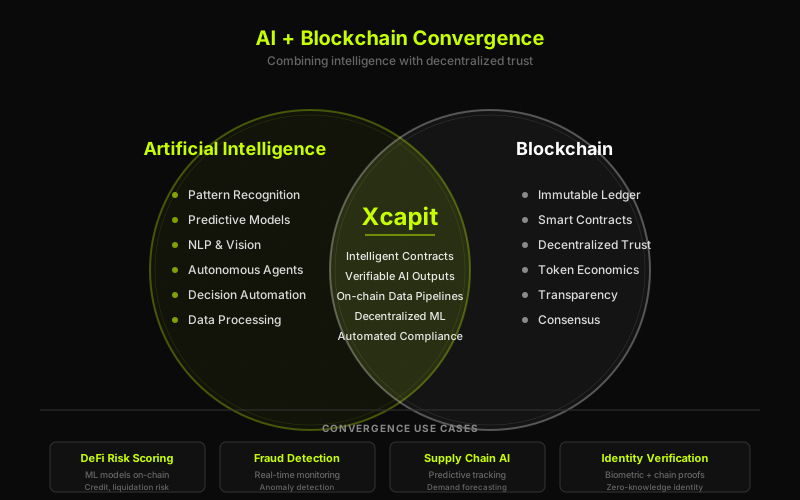
The case for combining AI and blockchain is not about marketing synergy. It's about fundamental complementarity. Each technology has strengths that address the other's core weaknesses.
What AI Lacks: Trust and Verifiability
AI systems -- particularly large language models and machine learning pipelines -- have a trust problem. Their outputs are probabilistic, not deterministic. They can hallucinate, they can be manipulated through adversarial inputs, and their decision-making processes are often opaque. When an AI system recommends a loan approval, flags a transaction as fraudulent, or generates a legal document, the question 'why should I trust this output?' is not rhetorical. It's the central challenge.
Blockchain provides a direct answer. By recording AI inputs, model versions, and outputs on an immutable ledger, you create an auditable trail that can be independently verified. Smart contracts can enforce constraints on AI behavior -- ensuring that an autonomous agent operates within defined parameters. Decentralized oracle networks can provide verified data feeds to AI models, reducing the risk of training or inference on corrupted data.
This isn't theoretical. In regulated industries -- financial services, healthcare, government -- the ability to prove what data an AI model used, what version of the model produced a given output, and whether the output met predefined criteria is increasingly a regulatory requirement. Blockchain makes this provable, not just claimable.
What Blockchain Lacks: Intelligence and Automation
Blockchain networks are powerful but rigid. Smart contracts execute exactly as coded -- which is both their strength and their limitation. They cannot interpret ambiguous conditions, adapt to changing circumstances, or process unstructured data. A smart contract can release funds when a specific condition is met, but it cannot determine whether a real-world event actually occurred without external input.
AI fills this gap. Machine learning models can process real-world data -- documents, images, sensor readings, market signals -- and translate it into the structured inputs that smart contracts require. Natural language processing can interpret contract terms and map them to on-chain logic. Predictive models can optimize DeFi strategies, detect anomalous transactions, and automate governance decisions with a sophistication that static rules cannot match.
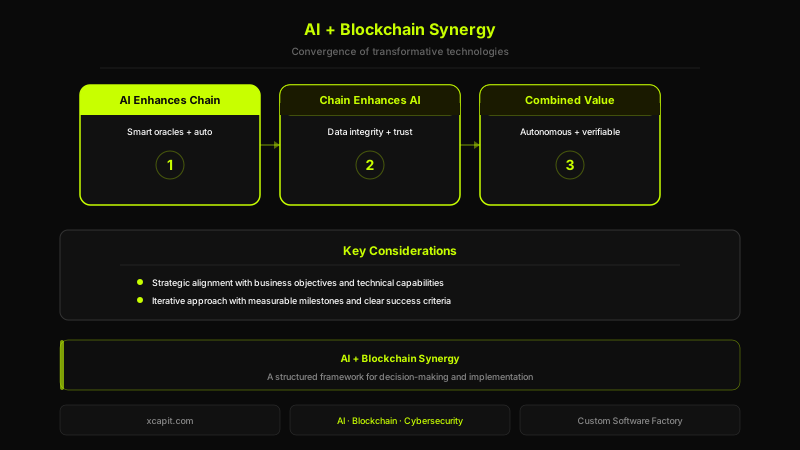
The combination creates something neither technology achieves alone: intelligent systems that are also trustworthy. AI provides the reasoning; blockchain provides the accountability. Together, they form the foundation for autonomous systems that organizations can actually deploy in production.
The Market Opportunity: An Underserved Intersection
When enterprises need AI capabilities, they go to an AI consultancy or an ML platform vendor. When they need blockchain, they go to a blockchain development shop. But when they need both -- which is increasingly the case for complex, high-value applications -- they face a coordination problem.
Two separate vendors means two separate architectures, two sets of assumptions about data models and security, two project timelines that need to be synchronized, and no one who owns the integration layer. The result is projects that take longer, cost more, and deliver less than they should. I have seen this pattern repeatedly in conversations with enterprise clients.
The companies that do combine AI and blockchain capabilities are rare. Most AI-focused firms view blockchain as a niche curiosity. Most blockchain firms view AI as outside their core competency. The few companies that genuinely operate at the intersection -- with engineers who understand both technology stacks and have built production systems that combine them -- represent a small fraction of the market. That scarcity is our opportunity.
Lessons from Building at the Intersection
Our conviction didn't come from reading market reports. It came from building real products and delivering real projects where the combination of AI and blockchain created value that neither could have produced alone.
The Xcapit Wallet: Self-Custody Meets Intelligence
Our own product -- the Xcapit wallet -- was one of our earliest proving grounds. We built a self-custodial crypto wallet that used AI to help users make better financial decisions: portfolio optimization, risk assessment, automated DeFi strategies. The blockchain layer provided security, transparency, and user sovereignty over their assets. The AI layer provided intelligence that made the product accessible to users who weren't crypto-native.
Building the wallet taught us something important: the integration challenges between AI and blockchain are not trivial, but they are solvable. And once solved, they create compounding advantages. Every improvement to our AI models made the blockchain-based product more useful, and every blockchain feature we added gave the AI more trusted data to work with.
UNICEF: Technology for Global Impact
Our work with UNICEF pushed the convergence thesis into entirely new territory. Building blockchain-based solutions for financial inclusion in developing markets required not just technical execution but a deep understanding of how these technologies interact in resource-constrained environments. We learned that the same principles -- AI for intelligence, blockchain for trust -- apply whether you're building fintech products for sophisticated investors or humanitarian tools for unbanked populations.
These weren't side projects or experiments. They were production deployments that reached millions of users and taught our team lessons you cannot learn from whitepapers. Every architect, every engineer, every product manager who worked on these projects came away with a dual fluency in AI and blockchain that is extraordinarily rare in the industry.
The Talent Advantage: Engineers Who Speak Both Languages
One of the most underappreciated benefits of our specialization is what it does to our talent pool. When you build a company around the intersection of AI and blockchain, you attract engineers who are genuinely excited about both technologies. And over time, you create something that is almost impossible to replicate quickly: a team with deep cross-domain expertise.
Our blockchain engineers understand machine learning pipelines. Our ML engineers understand smart contract architecture and on-chain data structures. Our security team thinks about both adversarial AI attacks and smart contract vulnerabilities. This cross-pollination doesn't happen by accident -- it's the result of years of working on projects that require both skill sets simultaneously.
For clients, this means faster ramp-up, fewer integration surprises, and architecture decisions that account for both the AI and blockchain dimensions from day one rather than bolting one onto the other as an afterthought. A generalist team with separate AI and blockchain specialists will always struggle with the seams between the two. Our team was built to work at the seam.
The Risks of Specialization -- and Why We Accept Them
I would be dishonest if I said specialization carries no risk. It does. When you bet your company on specific technologies, you are exposed to the possibility that those technologies fall out of favor, that the market shifts in unexpected directions, or that a regulatory change reshapes the landscape overnight.
We have thought carefully about these risks and concluded that the convergence of AI and blockchain is not a trend -- it is a structural shift. The need for intelligent, trustworthy, autonomous systems is growing across every industry. Financial services, supply chain, healthcare, energy, government -- they all need systems that can reason about complex data and provide verifiable, auditable outputs. That demand is not going away.
- AI adoption is accelerating across every sector, driven by advances in large language models, computer vision, and autonomous agents. This is not a cycle -- it is a permanent expansion of software capabilities.
- Blockchain is maturing beyond speculation into enterprise infrastructure for identity, supply chain provenance, financial settlement, and regulatory compliance. The technology is finding its natural use cases.
- Regulatory pressure for transparency, auditability, and data provenance is increasing globally. The combination of AI and blockchain directly addresses these requirements.
- The integration complexity between AI and blockchain creates a natural moat -- competitors cannot replicate years of cross-domain expertise through hiring alone.
The risk of being too narrow is mitigated by the breadth of application. We are not specialized in one use case -- we are specialized in a technology intersection that applies across dozens of industries and hundreds of use cases. That is a fundamentally different kind of specialization than, say, building only chatbots or only NFT marketplaces.
What This Means for Our Clients
For the organizations we work with, our specialization translates into concrete, measurable benefits.
Faster Time to Value
Because we have built AI-blockchain systems before -- repeatedly, across different industries -- we do not start from zero on each engagement. We have reference architectures, proven patterns, reusable components, and hard-won knowledge about what works and what doesn't. A project that might take a generalist firm six months of exploration and integration work can reach production in half that time with our team.
Integrated Architecture from Day One
When AI and blockchain components are designed together rather than integrated after the fact, the resulting system is more coherent, more secure, and more maintainable. Data flows are designed to serve both the ML pipeline and the on-chain verification layer. Security models account for both adversarial AI threats and smart contract vulnerabilities. Performance is optimized across the full stack rather than within isolated silos.
No Vendor Fragmentation
A single team that owns the full technology stack eliminates the coordination overhead, finger-pointing, and integration gaps that plague multi-vendor projects. When something doesn't work, there is one team accountable for fixing it. When requirements change, there is one team that understands the implications across both the AI and blockchain layers. This simplicity saves time, money, and frustration.
A Partner Who Understands the Full Picture
Perhaps most importantly, our clients get a technology partner who can advise them on the full spectrum of possibilities. We don't recommend AI where blockchain would be more appropriate, or vice versa. We recommend the right combination of technologies for each problem because we genuinely understand both. That advisory capability -- rooted in real implementation experience, not theoretical knowledge -- is something our clients tell us they cannot find elsewhere.
Looking Ahead: The Next Chapter
We are entering a period where the convergence of AI and blockchain will accelerate dramatically. Autonomous AI agents that manage on-chain assets. Decentralized AI training networks that reward data contributors fairly. Verifiable AI systems that meet the emerging regulatory requirements for transparency and accountability. Zero-knowledge proofs that enable AI models to demonstrate their outputs are correct without revealing proprietary data.
These are not distant possibilities. They are active development areas where our team is already building. And each new capability reinforces the thesis that drove our founding decision: AI and blockchain are not separate fields that occasionally overlap. They are converging into a single technological paradigm for building intelligent, trustworthy systems.
The companies that will lead this convergence are the ones investing in it now -- not as a side initiative, but as their core identity. That is what Xcapit has done from the beginning, and it is what we will continue to do.
If your organization is exploring how AI and blockchain can work together to solve complex business challenges, we would welcome the conversation. Whether you're building intelligent financial infrastructure, verifiable AI systems, or decentralized applications that need real-world intelligence, our team has the cross-domain expertise to move from strategy to production. Learn more about our AI development and blockchain development services, or contact us directly to discuss your project.

José Trajtenberg
CEO & Co-Founder
Lawyer and international business entrepreneur with over 15 years of experience. Distinguished speaker and strategic leader driving technology companies to global impact.
Ready to leverage AI & Machine Learning?
From predictive models to MLOps — we make AI work for you.
You Might Also Like
Our Vision 2025-2026: Where the Industry Is Heading
Xcapit's CEO reflects on what 2025 confirmed, what surprised us, and shares strategic predictions for 2026 -- from agentic AI to blockchain interoperability.
The end of the volume era: why tomorrow's agriculture sells trust, not just commodities
For decades, farming was measured in tonnes. Today the global market pays for verifiable evidence of origin, sustainability and process. How digitalization turns that evidence into margin.
Innovating faster doesn't mean building faster: it means validating first
AI makes it possible to build prototypes in hours, but it introduces a new risk: building too fast without having validated whether the solution answers a real need. Why speed today is measured by the ability to validate.