

Product-market fit is the most important milestone for any startup. Get it right, and growth becomes a matter of execution. Miss it, and no amount of funding, marketing, or token incentives will save you. In Web3, however, the concept of product-market fit is fundamentally warped -- and the distortion has killed more projects than bad code or bear markets ever have.
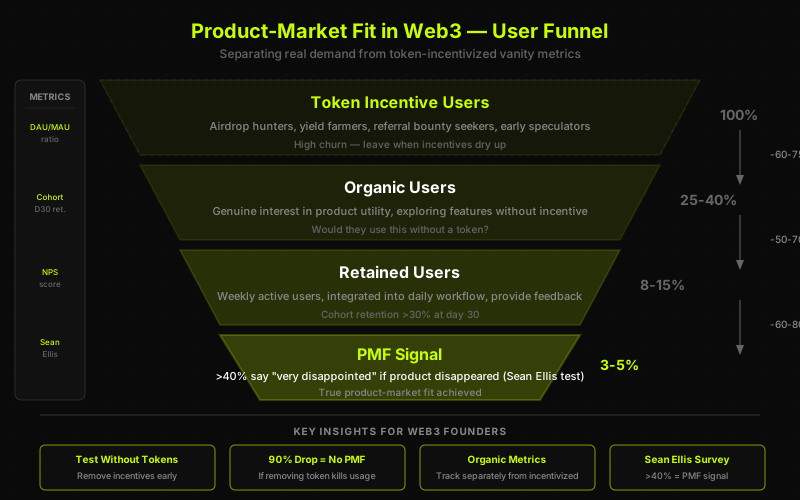
Over the past decade, I have worked on digital products across traditional tech and Web3. When we launched the Xcapit wallet -- a self-custody crypto wallet that grew to over 4 million users in more than 167 countries -- we learned that almost everything the startup world teaches about product-market fit needs to be recalibrated for decentralized applications. This article distills those lessons.
Why Product-Market Fit Is Harder in Web3
In traditional software, product-market fit has a relatively clean signal: people use your product, they pay for it (or they engage deeply enough to monetize through other means), and they tell others about it. The Sean Ellis test -- asking users how they would feel if they could no longer use the product -- works because usage is driven by genuine utility. If 40% or more of your users say they would be "very disappointed" without your product, you have likely found fit.
Web3 breaks this framework in several fundamental ways:
- Financial incentives contaminate usage signals. When users earn tokens for using your product, you cannot distinguish between genuine demand and mercenary behavior. A DeFi protocol offering 200% APY will attract millions in TVL, but that capital will vanish the moment a competitor offers 201%. The usage is real, but the loyalty is not.
- Speculation masquerades as engagement. In bull markets, users flock to any product associated with a token that might appreciate. They are not using your product because it solves a problem -- they are using it because they hope to profit from its token. This looks identical to product-market fit in your metrics, but it evaporates when prices drop.
- Airdrop farming creates phantom demand. Since the expectation of future airdrops became widespread, entire ecosystems of users interact with protocols solely to qualify for token distributions. These users inflate every metric you track -- daily active users, transaction volume, wallet counts -- while having zero intention of becoming long-term users.
- The market itself is unstable. In Web2, the market you are serving -- its size, its needs, its willingness to pay -- is relatively stable over short time horizons. In Web3, the entire market can shrink by 80% in a matter of months during a bear cycle. A product that appeared to have strong PMF in November 2021 might have looked like a ghost town by June 2022. Did the product lose fit, or did the market temporarily contract? The answer matters enormously for strategic decisions.
Traditional PMF Frameworks Fall Short
The standard PMF playbook assumes a direct relationship between user behavior and product value. In Web3, that relationship is mediated by token economics, market sentiment, and speculative dynamics that have nothing to do with your product's actual utility. Consider the metrics that traditional frameworks rely on. Daily active users? Inflated by airdrop farmers. Transaction volume? Amplified by speculative trading. Retention curves? Distorted by staking mechanisms that lock users in regardless of satisfaction. Every standard metric is contaminated by the financial layer that Web3 adds on top of the product layer.
This does not mean product-market fit is unmeasurable in Web3. It means you need different signals -- ones that can separate genuine utility from financially motivated behavior.
What We Learned Launching the Xcapit Wallet
When we started building the Xcapit wallet, the crypto wallet space was already crowded. MetaMask dominated on desktop, Trust Wallet on mobile, and dozens of alternatives competed for attention. But we saw something different when we looked beyond the crypto-native audience: millions of people in Latin America and emerging markets wanted to access decentralized finance but found existing wallets incomprehensible.
Our first version was too technical. We assumed users understood seed phrases, gas fees, and network selection. They did not. Early retention was abysmal -- not because users did not want the product, but because onboarding friction was so high that most people dropped off before experiencing the value. This is a critical distinction many Web3 teams miss: poor retention does not always mean poor product-market fit. Sometimes it means poor product-market delivery.
We iterated aggressively on onboarding -- simplified seed phrase backup, guided tutorials, fiat on-ramps for local currencies, educational content built into the app. Each change moved the needle. But the real breakthrough came when we stopped thinking about our users as "crypto users" and started thinking about them as people trying to save, invest, or send money across borders -- tasks they understood perfectly well in the traditional financial system.
The result was a product that reached over 4 million users across 167 countries. But the journey taught us that the metrics we initially tracked were misleading, and the signals we ignored were the ones that actually predicted long-term success.
Token Incentives Can Fake Product-Market Fit
This is perhaps the most important lesson we can share, and it applies to every Web3 project: token incentives are the single largest source of false PMF signals in the industry.
When you offer token rewards for usage, you create a circular logic trap. Users engage to earn tokens. You observe high engagement and conclude you have product-market fit. You raise funding or launch your token based on those metrics. The token launches, early users dump, engagement craters, and you realize the "product-market fit" you measured was actually "incentive-market fit." The market was fitting with the incentive, not with the product.
The DeFi summer of 2020 was the clearest example. Liquidity mining programs attracted billions in capital, but the vast majority of protocols saw 80-95% declines in usage once incentives were reduced. The projects that survived -- Uniswap, Aave, Compound -- had genuine utility that persisted after the subsidies ended. Most others did not.
The lesson is not that token incentives are inherently bad. They are a powerful bootstrapping tool when used correctly. The lesson is that you must never evaluate product-market fit while incentives are active. You can only see true PMF when the subsidies stop.
The Web3 PMF Signals That Actually Matter
After years of building and observing in this space, we have identified the signals that reliably indicate genuine product-market fit in Web3 -- and the vanity metrics that do not.
Organic Usage After Incentives End
The single most telling signal is what happens to your usage metrics when you turn off token incentives or when an airdrop concludes. If 70% of your users disappear within a week, you never had product-market fit -- you had incentive-market fit. If a meaningful cohort (even 20-30%) continues using the product at the same frequency without financial rewards, you are likely onto something real. This is the Web3 equivalent of the "would you be very disappointed" test.
Retention Without Rewards
Track cohort retention for users who have never received token incentives. These users chose your product purely on its merits. Their retention curve is your true PMF signal. In our experience, a 30-day retention rate above 25% for non-incentivized users is a strong signal in Web3, where the industry average for crypto wallets is closer to 10-15%.
Genuine Community Engagement
There is a stark difference between a community that discusses product features, reports bugs, and requests improvements -- and one that only discusses token price, listing rumors, and airdrop eligibility. The former indicates product-market fit. The latter indicates speculation. Monitor the ratio of product-focused conversations to price-focused conversations in your community channels. If more than 80% of discussion is about price, you have a speculation community, not a product community.
Bear Market Survival
Bear markets are the ultimate PMF test in Web3. When token prices collapse, speculative users leave, and only genuine users remain. If your product maintains meaningful usage through a bear market, you almost certainly have product-market fit. Some of the strongest Web3 companies -- Chainalysis, OpenZeppelin, Alchemy -- were built or solidified during bear markets because they serve real needs that persist regardless of market sentiment.
How to Measure PMF in Web3
Given the contamination of standard metrics, here is the measurement framework we recommend for Web3 products:
- DAU/MAU ratio (excluding incentivized users): A ratio above 0.2 for non-incentivized users indicates strong habitual usage. Separate your user base into incentivized and organic segments and track this ratio independently for each.
- Transaction frequency per wallet: Track how often individual wallets interact with your product. High aggregate volume can mask the reality that most wallets transact only once (airdrop farmers). Focus on the distribution -- what percentage of wallets transact more than 5 times per month?
- Wallet retention at 7, 30, and 90 days: Measure the percentage of new wallets that return and transact again at each interval. Plot cohort curves and look for a flattening pattern -- this indicates a stable base of users who have incorporated your product into their routine.
- Organic referral rate: Track what percentage of new users arrive without paid acquisition, token incentives, or airdrop expectations. Organic word-of-mouth growth is the strongest PMF signal in any industry, and it is even more meaningful in Web3 where so much growth is artificially subsidized.
- Usage during token price declines: Correlate your usage metrics with your token price (if applicable). If usage drops proportionally with price, your product is being treated as a financial instrument, not a utility. If usage remains stable while price declines, you have real product-market fit.
The Onboarding Challenge
The single biggest friction point in Web3 product-market fit is onboarding. Even if you have built a product that genuinely solves a real problem, you will struggle to demonstrate fit if 60-70% of potential users drop off during the wallet creation and setup process.
This is the fundamental tension in Web3: the features that make decentralized products compelling -- self-custody, permissionless access, user-owned data -- are the same features that make them difficult to use. A seed phrase is a brilliant cryptographic mechanism and a terrible user experience. Gas fees align incentives at the protocol level while creating unpredictable costs at the user level.
The teams that find product-market fit in Web3 are the ones that solve this tension. Account abstraction (ERC-4337), social recovery wallets, embedded wallets, and gasless transactions are architectural approaches to the problem. But the solution is not purely technical. It is also about progressive disclosure -- introducing complexity gradually as users develop familiarity, rather than front-loading every concept during onboarding.
Common Mistakes That Destroy PMF
In our experience building and advising Web3 projects, these are the mistakes we see most frequently:
- Launching a token before finding PMF: A token should amplify product-market fit, not substitute for it. If you launch a token before users genuinely need your product, you attract speculators instead of users and contaminate your ability to measure real demand.
- Confusing speculation with usage: A trading protocol might see enormous volume during a bull market, but speculative volume vanishes in downturns. Genuine usage -- lending for productive purposes, remittances, supply chain verification -- persists through market cycles. Know which type drives your metrics.
- Building exclusively for crypto-natives: The crypto-native audience is small and atypical of broader market needs. Products that achieve massive PMF in Web3 do so by serving people who do not identify as crypto users -- people who want to send money home, earn yield on savings, or access financial services unavailable through traditional banks.
- Optimizing for TVL instead of users: Total Value Locked is a misleading PMF indicator. TVL measures capital parked in your protocol, not how many people find it useful. A protocol with $1 billion TVL from 50 whale wallets has worse PMF than one with $10 million TVL from 50,000 active users.
- Ignoring the bear market test: If you only evaluate PMF during bull markets, you are measuring market sentiment, not product value. The most honest assessment comes when enthusiasm is lowest and only genuine utility keeps users engaged.
When to Pivot: Signals You Have Not Found PMF
You probably have not found PMF if your usage metrics correlate directly with token price movements, if reducing incentives causes immediate user decline, if community discussions are dominated by price speculation rather than product feedback, if your power users are primarily airdrop farmers, or if you cannot articulate -- in one sentence, without mentioning tokens -- why someone should use your product.
If multiple of these signals are present, it is time to reassess. This does not necessarily mean your vision is wrong -- it might mean you are serving the wrong user segment, the market is not ready, or your UX is preventing users from experiencing the value. The pivot might be in positioning, target audience, onboarding flow, or core product -- but the willingness to pivot is essential.
Building for Real Product-Market Fit
Finding product-market fit in Web3 is harder than in traditional tech, but the projects that achieve it build the most durable companies in the space. The key is intellectual honesty: separating genuine signals from noise, resisting the temptation to let token mechanics inflate your metrics, and subjecting your product to the harshest tests -- incentive removal, bear markets, organic growth measurement -- rather than seeking reassurance from vanity metrics.
At Xcapit, our experience building a wallet that reached millions of users taught us that the best Web3 products do not feel like "crypto products" at all. They feel like better solutions to real problems -- saving, investing, sending money, proving identity, tracking assets -- that happen to be powered by blockchain infrastructure. When users value what your product does for them without caring about the underlying technology, you have found product-market fit.
If you are building a Web3 product and struggling with product-market fit, we have been through this journey. At Xcapit, our product and engineering teams combine deep Web3 experience with rigorous product methodology. We help teams design measurement frameworks, optimize onboarding flows, and build decentralized applications that solve real problems for real users. Reach out to start a conversation.

Santiago Villarruel
Product Manager
Industrial engineer with over 10 years of experience excelling in digital product and Web3 development. Combines technical expertise with visionary leadership to deliver impactful software solutions.
You Might Also Like
Shielding credit risk: how Web3 technology simplifies bank and guarantee society processes in agriculture
Autonomous collateral locking, real-time value monitoring and guaranteed algorithmic execution: the three tools reshaping risk analysis in agricultural credit.
Innovating faster doesn't mean building faster: it means validating first
AI makes it possible to build prototypes in hours, but it introduces a new risk: building too fast without having validated whether the solution answers a real need. Why speed today is measured by the ability to validate.
What is a Product Builder and why will it be one of the most important roles in digital transformation?
When building gets faster and faster, the challenge becomes knowing what is worth building. What a Product Builder does, how they connect business and technology, and why AI amplifies their work without replacing their judgement.