
Every technology company faces the same inflection point: demand outpaces capacity, and you need to grow the team -- fast. The instinct is to hire as many engineers as possible, as quickly as possible. But anyone who has lived through a poorly managed scaling phase knows the consequences: declining code quality, knowledge silos, cultural drift, and the paradox where adding people actually slows the team down. At Xcapit, we've scaled from a small founding team to a multidisciplinary engineering organization working across AI, blockchain, cybersecurity, and custom software -- and we've done it without sacrificing the quality standards that define our work.
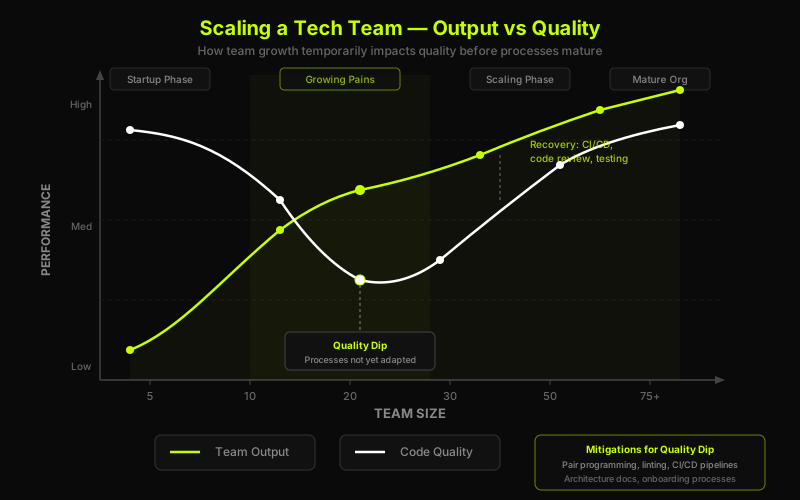
The Scaling Dilemma: Grow Fast or Grow Well
The tech industry often frames scaling as a binary choice: move fast and accept the mess, or move carefully and risk losing opportunities. We reject that framing. Growing fast and growing well are not mutually exclusive -- but achieving both requires deliberate systems, not just good intentions.
The real risk of uncontrolled growth is not just poor code. It's the erosion of the shared understanding that makes a team effective. When the ratio of new hires to experienced team members tips too far, institutional knowledge dilutes. The unwritten rules that guide decision-making -- how we handle trade-offs, when to push back on requirements, what 'done' actually means -- stop being transmitted organically. New engineers fill the gaps with their own assumptions, which may not align with the team's standards.
Our approach is to treat scaling as a system design problem. Just as we architect software with clear interfaces, error handling, and observability, we architect our team growth with structured hiring, systematic onboarding, and explicit cultural transmission. The goal is to add capacity without adding chaos.
Hiring: What We Look for Beyond Technical Skills
Technical skills are table stakes. Every candidate we interview can write code, and most can write decent code. What differentiates engineers who thrive in our environment -- and who make the team better rather than just bigger -- are three qualities that are harder to screen for but far more predictive of long-term success.
Curiosity
The technologies we work with -- large language models, blockchain protocols, zero-knowledge proofs, cybersecurity frameworks -- evolve constantly. An engineer who is only comfortable with what they already know will plateau quickly. We look for people who actively explore adjacent domains, who ask 'why' before 'how,' and who can demonstrate a pattern of self-directed learning. The best candidates light up when talking about something they recently learned, even if it's unrelated to the role.
Ownership
Ownership means treating a problem as yours until it's solved, not just until your pull request is merged. It means following up on a deployment to verify it works in production. It means flagging a risk you noticed in someone else's design because the project's success matters more than staying in your lane. We evaluate ownership by asking candidates to walk us through a project that went wrong. Engineers with an ownership mindset talk about what they did to fix it. Engineers without it talk about whose fault it was.
Communication
In a distributed, multilingual team working with clients across industries and continents, the ability to communicate clearly is a force multiplier. We need engineers who can explain a technical trade-off to a non-technical stakeholder, write documentation that future teammates can actually understand, and raise concerns early rather than letting them become crises. Poor communication is the root cause of most engineering failures, not poor code.
Our Interview Process
We've iterated on our interview process extensively. The current version has three stages, each designed to evaluate different dimensions of a candidate's potential.
Technical Assessment
We don't use algorithmic puzzles or timed coding challenges. Instead, we present candidates with a real-world problem similar to what they'd encounter in their first month -- a small system to design, a bug to diagnose, or an integration to plan. We evaluate not just whether they arrive at a working solution, but how they think: do they ask clarifying questions, consider edge cases, and reason about trade-offs? The assessment is conversational, not adversarial.
Architectural Thinking
Senior candidates participate in a system design discussion where we explore a hypothetical project -- perhaps an AI agent pipeline, a multi-chain blockchain integration, or a secure data processing platform. We evaluate their ability to decompose problems, justify design decisions, and anticipate operational concerns. This stage reveals whether a candidate can operate at the level of abstraction the role requires.
Culture Fit Conversation
The final stage is a genuine dialogue with team leads and peers about how the candidate works, what motivates them, and how they handle the messy realities of software development. We discuss their approach to disagreements, their experience with remote collaboration, and what team environment brings out their best work. Culture fit doesn't mean hiring people who are all the same -- it means hiring people who share our values of transparency, ownership, and continuous improvement while bringing diverse perspectives.
The Talent Market for AI and Blockchain Engineers
Finding engineers with deep expertise in AI, blockchain, or cybersecurity is genuinely difficult. Demand far exceeds supply, and the best candidates have multiple competing offers at any given time. We've learned three things about navigating this market.
First, interesting work attracts interesting people. Our project portfolio -- building AI agents for international organizations, developing blockchain solutions for financial inclusion, implementing security frameworks for energy companies -- is itself a recruiting tool. When candidates see the kind of work we do, the conversation shifts from 'what's the salary?' to 'when can I start?'
Second, Latin America is an underappreciated talent pool. Argentina has strong computer science programs and a culture of technical excellence that produces world-class engineers. Many of our team members could work anywhere; they choose Xcapit because of the work, the culture, and the autonomy we offer.
Third, we invest in growing talent internally. Not every role requires five years of blockchain experience. Some of our strongest contributors joined with solid engineering fundamentals and learned domain-specific skills through mentorship and project exposure. This widens our talent pool and creates loyalty that compensation alone cannot.
Onboarding: The 30/60/90 Day Framework
Onboarding is where most scaling efforts succeed or fail. A poorly onboarded engineer takes months to become productive, absorbs senior engineers' time with questions that documentation should answer, and may internalize bad habits before anyone notices. Our onboarding framework is structured around three phases with clear objectives and checkpoints.
Days 1-30: Absorb
The first month is about learning, not delivering. New engineers are paired with an onboarding buddy -- an experienced team member who serves as their primary point of contact for questions. They review our architecture documentation, coding standards, and development workflow. They set up their environment, complete small, well-scoped tasks (bug fixes, minor features, documentation improvements), and participate in code reviews as observers. By day 30, they should understand our codebase, our tools, and our way of working well enough to start contributing meaningfully.
Days 31-60: Contribute
In the second month, new engineers begin taking on real project work with close mentorship. They own small features end-to-end -- from understanding the requirement to deploying to production. Their pull requests receive thorough reviews with detailed feedback, not just approvals. Weekly check-ins with their buddy and team lead identify any gaps in knowledge or process understanding. The goal is to build confidence and establish a track record of reliable delivery.
Days 61-90: Own
By the third month, engineers should be operating with increasing autonomy. They're making design decisions, participating actively in code reviews for other team members, and starting to mentor newer hires. A formal 90-day review assesses their progress against expectations and identifies areas for continued development. At the end of this phase, the engineer should feel -- and be -- a full member of the team, not 'the new person.'
Mentorship and Pair Programming as Scaling Tools
Documentation and processes are necessary but insufficient. The fastest way to transfer knowledge -- especially tacit knowledge about 'how we do things here' -- is human-to-human interaction. We use two mechanisms extensively.
Mentorship pairs every junior and mid-level engineer with a senior mentor who meets with them regularly to discuss their growth, review their work, and help them navigate technical and professional challenges. The relationship is intentional and structured -- not 'ask me anything' but a deliberate program with goals and regular cadence. Mentors also benefit: explaining your reasoning to someone else forces you to examine and improve it.
Pair programming is our most effective knowledge transfer tool. When two engineers work on the same problem in real time, the junior engineer doesn't just learn what to do -- they learn how to think about the problem. They see how an experienced engineer reads error messages, navigates unfamiliar code, and recovers from mistakes. This is knowledge no documentation can capture, and we encourage it especially for complex tasks and cross-domain work.
Maintaining Engineering Culture at Scale
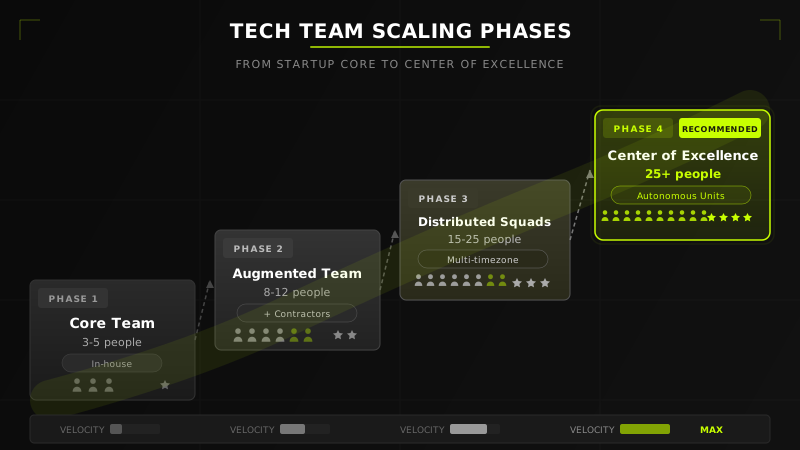
Culture is not a poster on the wall or a slide in the onboarding deck. It's the sum of thousands of small decisions made every day by every person on the team. As you scale, culture either strengthens through intentional reinforcement or erodes through neglect. There is no steady state.
We reinforce culture through several mechanisms: architecture review sessions where the team discusses design trade-offs and lessons learned, internal tech talks where engineers share topics they're passionate about, retrospectives with concrete action items, and a blameless incident culture where production issues become learning opportunities rather than finger-pointing exercises.
The most important cultural signal, though, is how leadership behaves. If leaders cut corners on code quality when deadlines are tight, the team learns that quality is negotiable. If leaders celebrate shipping features but ignore the engineers who prevent outages, the team learns that prevention doesn't matter. Culture flows from the top, and at Xcapit, our leadership team writes code, reviews pull requests, and holds themselves to the same standards as everyone else.
Remote-First Challenges and Solutions
Xcapit has been remote-first since before it was fashionable, and we've learned that remote work creates specific challenges for team scaling that require specific solutions.
The biggest challenge is visibility. In an office, you absorb information passively -- you overhear conversations and build relationships through casual interaction. Remote work eliminates this, so you must create it deliberately. We over-communicate in asynchronous channels, document decisions that might otherwise happen in hallway conversations, and invest in regular video calls that include time for non-work interaction.
Timezone management is another practical challenge. Our team spans multiple time zones across Latin America, and our clients span the Americas and Europe. We maintain a core overlap window where synchronous collaboration happens, and we design our workflows so that asynchronous handoffs are clean and well-documented. An engineer in Buenos Aires should be able to pick up where a colleague left off without needing to wait for them to come online.
Quality Gates: Non-Negotiable Standards
Quality gates are the engineering equivalent of guardrails on a mountain road. They don't slow you down -- they prevent you from going off a cliff. As the team grows and more engineers are pushing code, these gates become more important, not less.
Code Review Standards
Every pull request requires at least one senior review, and changes to critical systems require two. Reviewers evaluate correctness, readability, maintainability, test coverage, and alignment with architectural patterns. We treat code review as a collaborative process -- reviewers explain the reasoning behind their feedback, and authors are encouraged to push back when they disagree. The goal is shared understanding, not compliance.
CI/CD and Automated Testing
Our continuous integration pipeline runs unit tests, integration tests, linting, type checking, and security scanning on every pull request. Code that doesn't pass the pipeline doesn't get merged -- no exceptions, no 'we'll fix it later.' We invest significantly in test infrastructure because automated tests are the only quality mechanism that scales linearly with the team. Manual testing becomes a bottleneck; automated testing becomes a safety net.
Architectural Decision Records
When we make significant technical decisions -- choosing a framework, designing a data model, defining an API contract -- we document the decision, the alternatives we considered, and the reasoning behind our choice. These records serve multiple purposes: they prevent the same debates from recurring, they help new team members understand why things are the way they are, and they provide a historical record that informs future decisions.
When to Hire vs. When to Contract
Not every capacity need should be met with a permanent hire. Understanding when to bring someone onto the team permanently and when to engage external support is a strategic decision that affects quality, culture, cost, and flexibility.
We hire permanently for core competencies -- the skills and knowledge that define our competitive advantage and need to accumulate over time. Engineers who build deep expertise in our domains, who mentor others, and who shape our technical direction should be long-term team members. The investment in onboarding and cultural integration pays compounding returns.
We use contract or staff augmentation for peak capacity needs, specialized skills required for a specific project phase, or time-bounded initiatives where the scope is clear. The key is transparency: contractors should know they're contractors, the team should know how to collaborate with them effectively, and the engagement should be structured so that critical knowledge doesn't leave when the contract ends.
This is actually a perspective we bring to our own client relationships. When organizations partner with Xcapit, we offer flexible engagement models -- from dedicated teams embedded in your organization to project-based delivery to staff augmentation that supplements your existing capabilities. We design each engagement so that knowledge transfer is built into the process, not an afterthought.
The Compound Effect of Getting Scaling Right
When you scale thoughtfully -- hiring for the right qualities, onboarding systematically, maintaining culture deliberately, and enforcing quality standards consistently -- the benefits compound over time. Each new hire makes the team stronger, not just bigger. Knowledge flows freely. Quality improves as more experienced reviewers examine more code. Mentorship creates a self-reinforcing cycle where today's mentees become tomorrow's mentors.
The alternative -- scaling by volume alone -- creates a different kind of compound effect: technical debt accumulates, knowledge fragments, culture dilutes, and the best engineers leave because the environment no longer supports their best work. Rebuilding from that state is far more expensive than doing it right from the beginning.
Whether you're scaling your own engineering team or looking for a technology partner who has already solved these challenges, we'd welcome the conversation. Explore our engagement models at /services/custom-software to find the collaboration structure that fits your needs, or contact us to discuss how we can help you build and scale with confidence.

Antonella Perrone
COO
Previously at Deloitte, with a background in corporate finance and global business. Leader in leveraging blockchain for social good, featured speaker at UNGA78, SXSW 2024, and Republic.
You Might Also Like
What is a Product Builder and why will it be one of the most important roles in digital transformation?
When building gets faster and faster, the challenge becomes knowing what is worth building. What a Product Builder does, how they connect business and technology, and why AI amplifies their work without replacing their judgement.
Managing Distributed Software Teams Across Time Zones and Cultures
A COO's practical guide to leading distributed engineering teams — async-first communication, overlap hour strategy, documentation culture, sprint ceremonies, and measuring productivity without micromanaging.
Structuring Squads for AI, Blockchain & Dev Projects
How to organize cross-functional squads for projects combining AI, blockchain, and traditional development -- composition, communication, and scaling.