
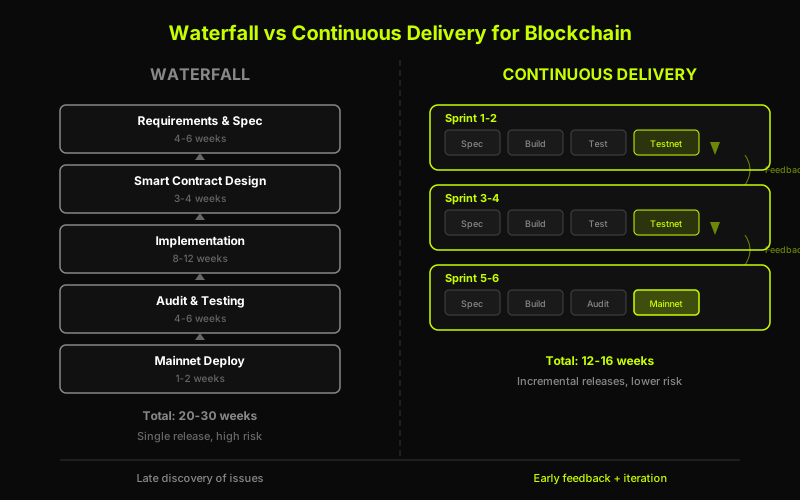
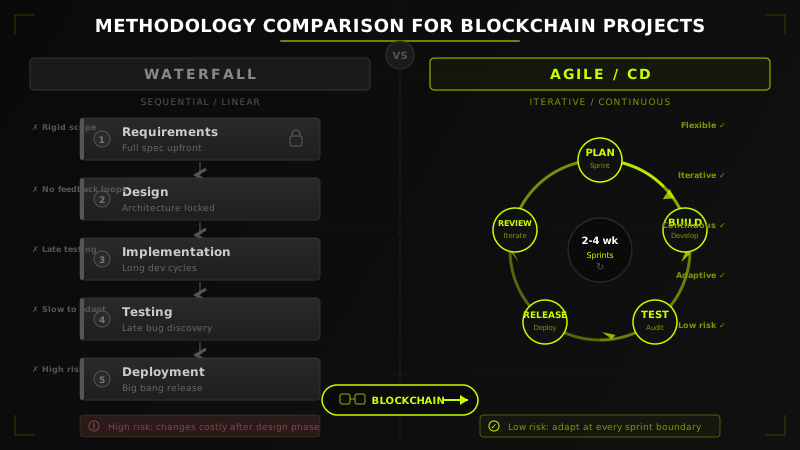
Blockchain development has an uncomfortable relationship with modern software delivery practices. While the rest of the industry has embraced continuous integration, continuous delivery, and rapid iteration, blockchain teams often find themselves trapped in waterfall patterns -- long development cycles, big-bang deployments, and the kind of late-stage surprises that agile methodologies were designed to prevent. This is not because blockchain engineers are behind the times. It is because the unique characteristics of blockchain -- immutability, financial stakes, audit requirements, and the irreversibility of production deployments -- create genuine pressure to 'get it right the first time.' The problem is that waterfall does not help you get it right. It just delays the moment you discover you got it wrong.
Why Blockchain Projects Fall Into Waterfall
To fix the problem, you first need to understand why it exists. Blockchain projects drift toward waterfall for reasons that feel entirely rational in the moment -- and that is what makes the pattern so persistent.
The Immutability Pressure
When you deploy a smart contract to mainnet, you cannot patch it the way you patch a server-side application. If there is a bug in your logic, you cannot SSH into the blockchain and fix it. This reality creates a psychological pressure to delay deployment until everything is perfect -- to write the complete specification, implement every feature, test exhaustively, audit thoroughly, and only then deploy. The intent is reasonable. The execution is counterproductive. Perfection through delay is an illusion. What actually happens is that teams accumulate risk in an ever-growing codebase that nobody has seen running in a production-like environment until the very end.
Audit Requirements
Security audits are expensive -- typically $50,000 to $300,000 for a comprehensive DeFi audit -- and teams naturally want to minimize the number of audit cycles. This creates an incentive to batch all changes into a single audit engagement: finish everything, then audit everything, then deploy everything. The result is that auditors review a large, complex codebase in a compressed timeframe, developers receive a flood of findings all at once, and the remediation phase becomes a scramble to fix issues under deadline pressure without introducing new ones.
High Financial Stakes
Smart contracts often manage significant financial value from day one. A bug is not a degraded user experience -- it is a potential loss of funds. This raises the perceived cost of any deployment error, which in turn raises the perceived value of extensive pre-deployment verification. Teams respond by adding more review stages, more sign-offs, and more testing phases, each one extending the timeline and reinforcing the waterfall structure. The irony is that longer timelines do not reduce risk. They increase the gap between development and feedback, making it harder to catch issues early when they are cheapest to fix.
The Real Cost of Waterfall in Blockchain
Waterfall does not just slow you down. It actively introduces the risks it claims to prevent. Having managed delivery for multiple blockchain projects -- from DeFi protocols to public-sector blockchain deployments -- I have seen the same failure patterns repeat across different teams, technologies, and domains.
Slow Feedback Loops
In a waterfall model, the first time smart contracts interact with a real blockchain environment is often weeks or months after they were written. Developers work against local test harnesses that imperfectly simulate on-chain behavior. Gas estimation discrepancies, transaction ordering dependencies, block timing issues, and cross-contract interaction patterns only surface when the code hits an actual network. By that point, the assumptions baked into the architecture may be wrong, and refactoring is expensive.
Integration Nightmares
When multiple developers work on different contract modules for weeks without integrating, the merge is painful. Storage layout conflicts in proxy patterns, event signature mismatches, and inconsistent access control assumptions across modules create a wave of integration bugs that surface all at once. Each bug is harder to diagnose because the full system has never run together before. I have seen integration phases consume more time than the original development -- a predictable outcome of the waterfall approach that teams somehow never predict.
Late-Stage Security Findings
When security review happens only at the end, critical architectural issues are discovered when it is most expensive to fix them. An auditor finding a reentrancy vulnerability in a helper function is a minor fix. An auditor finding that the entire access control model is flawed requires rearchitecting the system. In a continuous model, you catch architectural issues early because security analysis runs continuously against small, incremental changes. In a waterfall model, you discover them after the architecture is set and the deadline is approaching.
Adapting CI/CD for Blockchain: What Changes, What Stays
Continuous delivery for blockchain is not identical to continuous delivery for web applications, but it shares the same core principles: small changes, fast feedback, automated verification, and progressive deployment. The differences are in the specifics, not the philosophy.
What Stays the Same
- Version control discipline -- every change is committed, reviewed, and traceable
- Automated testing on every push -- unit tests, integration tests, property-based tests
- Code review requirements before merge -- at least one reviewer who did not author the code
- Build automation -- deterministic, reproducible compilation from source
- Environment parity -- development, staging, and production environments should behave consistently
What Changes
- The deployment target is a blockchain, not a server -- deployments are transactions, not file copies
- Rollback semantics are different -- you cannot undo a mainnet deployment, but you can migrate to a new contract
- Testing must include on-chain simulation -- local test harnesses are insufficient for gas behavior, transaction ordering, and cross-contract calls
- Security analysis is part of CI, not a separate phase -- static analysis, symbolic execution, and fuzz testing run on every pull request
- Deployment pipelines include network-specific stages -- local fork, testnet, staging environment, and mainnet are distinct deployment targets with different verification requirements
Our Framework: Testnet-First Development
After iterating through multiple approaches across several blockchain projects, we converged on a framework we call testnet-first development. The core idea is simple: smart contracts should be running on a testnet within the first sprint, and every subsequent change should be deployed and verified on-chain before it is considered complete. This is the blockchain equivalent of the 'deploy on day one' principle from DevOps -- except your deployment target is a test blockchain rather than a staging server.
The framework has four deployment stages, each with specific verification requirements that must pass before code advances to the next stage.
Stage 1: Local Development
Developers work against a local blockchain fork -- Hardhat Network or Anvil -- that simulates mainnet state. Unit tests and integration tests run here. The key discipline is that even at this stage, tests run against a forked chain, not a simplified mock. This catches gas issues, external dependency behaviors, and state-dependent logic early. Every pull request triggers a full test suite on the local fork, and static analysis tools -- Slither, Aderyn -- run automatically. A PR cannot be merged if any test fails or if the static analyzer raises a medium or higher finding.
Stage 2: Testnet Deployment
Once a feature branch is merged, the CI pipeline automatically deploys to a persistent testnet -- Sepolia for Ethereum projects, or the appropriate testnet for the target chain. This is not a one-time deployment. The pipeline redeploys after every merge to main, running a full suite of on-chain integration tests against the deployed contracts. Frontend and backend components are also deployed to a staging environment that points to the testnet contracts. The team interacts with the system as users would, testing flows end-to-end in a real blockchain environment.
Stage 3: Staging Environment
The staging environment is a mainnet fork with production data. We use tools like Tenderly or Anvil's forking mode to create a replica of the production chain state, deploy the new contracts against it, and run scenarios that exercise the contracts under realistic conditions -- real token balances, real oracle prices, real liquidity pools. This stage catches issues that testnets miss because testnet state is synthetic. Staging is also where we run extended fuzz testing campaigns and economic simulation models that would be too slow for the CI pipeline.
Stage 4: Mainnet Deployment
Mainnet deployment is the final stage and requires explicit human approval -- this is the one step we deliberately do not automate. A deployment checklist verifies that all previous stages passed, that the security gate is green, that the deployment transaction has been simulated on a fork, and that the multi-sig signers are available for any required governance actions. Post-deployment, automated monitoring verifies that the deployed contracts match the expected bytecode, that initial state is correct, and that the first transactions behave as expected.
Security Gates That Do Not Slow You Down
The most common objection to continuous delivery in blockchain is that security review cannot keep pace with frequent deployments. This is true if security review means a manual audit of every change. It is not true if you build security into the pipeline itself.
Our approach layers automated security analysis throughout the development workflow so that the manual audit -- which is still necessary for major releases -- is reviewing code that has already been through multiple rounds of automated verification.
- Static analysis on every pull request -- Slither and Aderyn catch common vulnerability patterns in seconds, not weeks
- Property-based fuzz testing in CI -- Foundry's fuzzer runs invariant tests against thousands of random inputs on every merge
- Symbolic execution on critical paths -- Halmos or Kontrol verify mathematical properties of financial logic
- Continuous dependency monitoring -- automated alerts when imported libraries or protocols publish security advisories
- Incremental audit model -- external auditors review changes incrementally rather than auditing the full codebase from scratch each time
The incremental audit model deserves emphasis. Instead of one large audit engagement at the end of the project, we engage auditors on a retainer basis. They review changes weekly or bi-weekly, providing continuous feedback rather than a single monolithic report. The per-change review is faster because the change set is smaller, the auditor maintains context across sessions, and findings are addressed immediately rather than accumulating. The total audit cost is comparable, but the risk profile is dramatically better.
Sprint Structure for Blockchain Projects
Our sprint structure is a two-week cycle that balances feature delivery with the security rigor blockchain requires. It is not dramatically different from a standard agile sprint, but the security integration points are explicit and non-negotiable.
- Days 1-2 -- Sprint planning and design review: Define scope, review architectural implications, identify security-sensitive changes
- Days 3-8 -- Development with continuous integration: Feature development with automated security gates on every PR, daily testnet deployments
- Days 9-10 -- Security focus: Extended fuzz testing campaigns, staging environment validation on mainnet fork, incremental auditor review of the sprint's changes
- Day 11 -- Deployment readiness: Deployment simulation on mainnet fork, multi-sig coordination, go/no-go decision
- Day 12 -- Mainnet deployment (if applicable): Staged rollout with monitoring, post-deployment verification
- Days 13-14 -- Retrospective and monitoring: Post-deployment observation, incident response if needed, sprint retrospective with security review outcomes
Not every sprint results in a mainnet deployment. Some sprints are purely testnet-focused, building toward a mainnet release in a subsequent sprint. The key is that every sprint produces deployed, verified artifacts -- even if only on testnet. The team never goes more than two weeks without seeing their code run on a real blockchain.
Deployment Strategies: Working With Immutability
The objection 'you cannot update smart contracts' is technically correct and practically misleading. While you cannot modify deployed bytecode, the blockchain ecosystem has developed mature patterns for managing change in production. The key is choosing the right pattern for your use case and designing it into the architecture from day one -- not bolting it on as an afterthought.
Proxy Patterns
The Transparent Proxy and UUPS patterns separate the contract's address and storage from its logic implementation. Users interact with a stable proxy address while the underlying implementation can be swapped through a governance-controlled upgrade mechanism. This gives you the ability to deploy fixes and improvements without migrating users or state. The trade-off is complexity -- proxy patterns introduce storage layout constraints, initialization patterns, and governance requirements that must be carefully managed. We use OpenZeppelin's battle-tested proxy implementations and enforce storage gap conventions to prevent layout collisions during upgrades.
Feature Flags On-Chain
Feature flags are not just for web applications. On-chain feature flags -- implemented as configuration parameters in a governance-controlled registry -- let you deploy new functionality in a disabled state, verify it on mainnet, and enable it through a separate governance action. This decouples deployment from activation, reducing deployment risk. If a newly enabled feature behaves unexpectedly, it can be disabled without a contract upgrade. We implement this as a central feature registry contract that other contracts query before executing feature-specific logic.
Circuit Breakers and Pause Mechanisms
Every production contract should include a pause mechanism -- the ability to halt specific functions or the entire contract in an emergency. This is your equivalent of a rollback. Combined with time-locked governance and multi-sig controls, pause mechanisms give you the ability to respond to incidents without requiring users to migrate to a new contract address. The discipline is ensuring that pause capabilities are tested regularly and that the team has rehearsed the incident response procedure.
Monitoring and Incident Response
Continuous delivery does not end at deployment. In blockchain, what you do after deployment is as important as what you do before -- arguably more so, because your ability to respond is constrained by the immutability of the system.
- Real-time transaction monitoring with alerts for unusual patterns -- large transfers, unexpected function calls, failed transactions
- Contract state monitoring that verifies invariants on every block -- token balances reconcile, collateral ratios remain healthy, access control state is unchanged
- Oracle feed monitoring that detects staleness, deviation, and manipulation attempts before they affect protocol behavior
- Governance action monitoring that tracks proposals, votes, and execution of time-locked operations
- Post-deployment bytecode verification that confirms the deployed code matches the audited source
We use a combination of Tenderly, OpenZeppelin Defender, and custom monitoring scripts that run against archive nodes. The monitoring stack is itself subject to the same deployment discipline as the smart contracts -- version controlled, tested, and deployed through CI/CD. If your monitoring breaks silently, you are flying blind at the worst possible time.
Results: Before and After Continuous Delivery
Numbers matter more than philosophy. Across the blockchain projects where we have transitioned teams from waterfall to our continuous delivery framework, we have observed consistent improvements in both velocity and reliability.
- Deployment frequency increased from quarterly or monthly releases to bi-weekly mainnet deployments and weekly testnet deployments
- Time from code complete to mainnet deployment decreased from 6-8 weeks to 5-10 days
- Critical bugs found post-mainnet deployment decreased by over 80% -- issues are caught in earlier stages where they are cheaper and safer to fix
- Audit cycle time decreased by 40% -- incremental reviews are faster than monolithic audits, and auditors spend less time re-familiarizing themselves with the codebase
- Developer confidence increased measurably -- engineers who see their code running on testnet daily are more willing to refactor, experiment, and improve than engineers who deploy once a quarter
The confidence metric is harder to quantify but may be the most important. Waterfall creates a fear of deployment. Every deployment is a high-stakes event with weeks of accumulated changes and uncertainty. Continuous delivery normalizes deployment. It becomes routine, low-risk, and reversible (through proxies and feature flags). Engineers who are not afraid to deploy are engineers who iterate faster, refactor more readily, and ultimately build better systems.
Getting Started: Practical First Steps
You do not need to transform your entire workflow overnight. The transition from waterfall to continuous delivery is itself best done incrementally. Based on our experience guiding teams through this transition, here are the highest-leverage first steps.
- Deploy to testnet in your first sprint -- even if the contracts are minimal, establish the deployment pipeline early
- Add static analysis to your CI pipeline -- Slither integration takes hours, not days, and catches real vulnerabilities immediately
- Fork mainnet for your test suite -- replace simplified mocks with forked chain tests to catch environment-specific issues early
- Adopt proxy patterns from day one -- retrofitting upgradeability is far harder than designing for it from the start
- Engage an auditor on retainer for incremental reviews -- the relationship model matters as much as the audit itself
At Xcapit, we have built and deployed blockchain systems for organizations ranging from UNICEF to fintech companies, and our continuous delivery framework is central to how we deliver reliably without sacrificing speed. Whether you are building a DeFi protocol, a tokenization platform, or an enterprise blockchain application, we can help you establish a delivery pipeline that treats security as a continuous practice rather than a final checkpoint. Explore our blockchain development services or contact us to discuss how we can accelerate your project with confidence.

Antonella Perrone
COO
Previously at Deloitte, with a background in corporate finance and global business. Leader in leveraging blockchain for social good, featured speaker at UNGA78, SXSW 2024, and Republic.
Building on blockchain?
Tokenization, smart contracts, DeFi — we've shipped it all.
You Might Also Like
Building DevSecOps Pipelines for Blockchain Projects
How to design and implement a DevSecOps pipeline purpose-built for blockchain development — covering smart contract static analysis, automated audit pipelines, secrets management, deployment automation, and post-deployment monitoring.
The field's digital notary: what blockchain is (and why you don't need to understand the code to use it)
You don't need to know how a combine harvester's computer works to operate it. Blockchain is the same: a write-only record that guarantees provenance and cannot be forged.
If you can't measure it, you can't monetize it: the Córdoba and EPEC lesson applied to environmental assets in agriculture
Measure, certify and monetize. The three pillars we validated tokenizing renewable energy with EPEC, and how they transfer to the field to standardize green credits.