
The choice of smart contract language is one of those decisions that looks trivial on paper and turns out to be load-bearing for the entire project. It determines your hiring pool, your security model, your deployment costs, and -- critically -- the kinds of bugs that will keep your team awake at three in the morning. After years of building production smart contracts across Ethereum, Stellar, and Cardano, I have watched teams make this decision based on ecosystem hype or whichever blockchain had the best conference swag that quarter. The results are predictable: months of rework, security vulnerabilities that could have been avoided by design, and budgets that balloon because the team is fighting the language instead of building the product.
This is not a theoretical comparison or a repackaged version of each blockchain's marketing materials. It is a practical guide based on shipping code in all three languages, hiring developers for each stack, debugging production incidents, and explaining trade-offs to clients who need to make this decision with real money on the line. The goal is to give you enough technical depth to make an informed choice -- or at least to ask the right questions before committing.
Why the Language Decision Matters More Than You Think
In traditional software development, language choice is important but rarely existential. If you pick Python over Go for a backend service, you can refactor later. The code is mutable, deployments are reversible, and the worst case is a performance bottleneck you can optimize. Smart contracts invert every one of these assumptions. Once deployed, the code is immutable -- or at best upgradeable through proxy patterns that introduce their own complexity and attack surface. The execution environment is adversarial: every function is callable by anyone, every transaction is public, and every bug is a potential exploit worth real money. In this context, the language's type system, its default safety guarantees, and the vulnerability classes it prevents by design are not academic concerns. They are the difference between a successful launch and a front-page exploit.
The language also determines your talent pipeline. Solidity developers are abundant but vary wildly in quality. Rust developers are fewer but tend to be more rigorous by self-selection. Haskell developers are rare and expensive but bring formal methods thinking that is genuinely valuable for high-assurance contracts. Each of these realities shapes your project timeline, your budget, and your ability to maintain the system after launch.
Solidity: The Incumbent
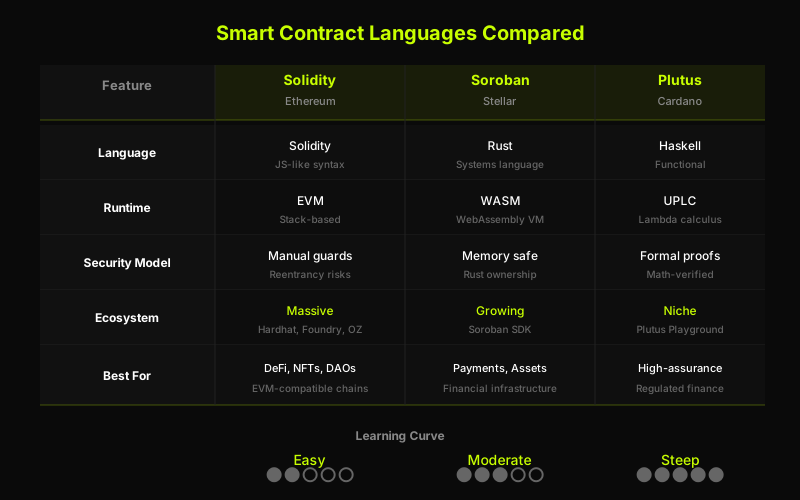
Solidity is the lingua franca of smart contract development. It powers Ethereum, Polygon, Arbitrum, Optimism, BNB Chain, Avalanche C-Chain, and dozens of other EVM-compatible networks. If you are building DeFi protocols, NFT marketplaces, DAOs, or any application that needs to tap into the largest user base and liquidity pool in blockchain, Solidity is the default choice -- and for good reason.
The ecosystem maturity is unmatched. OpenZeppelin provides audited, battle-tested contract libraries for tokens, access control, governance, and upgradability patterns. Hardhat and Foundry offer sophisticated development frameworks with built-in testing, debugging, gas profiling, and deployment automation. Etherscan gives you free contract verification and interaction tools. Slither, Mythril, and Echidna provide automated security analysis. The tooling ecosystem has had nearly a decade to mature, and it shows.
The developer pool is the largest in blockchain. EVM chains account for the majority of active smart contract developers worldwide. This means easier hiring, more Stack Overflow answers, more tutorials, and more open-source code to reference. For enterprise projects with tight timelines, this ecosystem density translates directly into faster development.
But Solidity's maturity comes with baggage. The language was designed in 2014 with influences from JavaScript, C++, and Python -- optimizing for accessibility over safety. Reentrancy attacks remain possible because external calls can transfer control flow to untrusted code before state updates complete. Integer overflow was unchecked by default until Solidity 0.8. The EVM's storage model creates subtle bugs around uninitialized variables, storage slot collisions in proxy patterns, and delegatecall context confusion. These are not theoretical risks -- they account for billions of dollars in real losses.
A disciplined team with strong testing practices and security audits can build safe Solidity contracts. But the language does not make safety the path of least resistance. Low-level calls bypass type checking, address types conflate contracts with externally owned accounts, and abi.encode serializes data without compile-time verification. Safety in Solidity is achievable but requires constant vigilance.
Soroban: Safety by Design
Soroban is Stellar's smart contract platform, launched in 2023 and built on Rust -- a language designed from the ground up for memory safety and correctness. Where Solidity inherited patterns from web development languages and then bolted on safety features, Soroban starts from a fundamentally different premise: the language should prevent as many vulnerability classes as possible at compile time, before code ever reaches a blockchain.
Rust's ownership model eliminates use-after-free, double-free, and data race bugs at compile time -- classes of vulnerability that simply cannot exist in valid Rust code. The algebraic type system lets you encode business invariants directly into types and have the compiler enforce them. Option and Result types force explicit handling of missing values and errors, eliminating unchecked error conditions that plague other languages. For smart contract development, where every unhandled edge case is a potential exploit, this compile-time rigor is transformative.
Soroban adds blockchain-specific safety features on top of Rust's foundation. Resource metering is built into the platform -- every contract invocation has explicit CPU and memory budgets that are determined before execution, not during it. This means no gas estimation surprises, no out-of-gas failures mid-transaction, and predictable costs that can be quoted to users before they confirm. The execution model is designed to prevent reentrancy by default: contracts communicate through direct invocations with clearly defined entry and exit points, not through the unconstrained callback patterns that make Solidity reentrancy possible.
For financial applications -- which is Stellar's core domain -- Soroban offers compelling advantages. Stellar's consensus mechanism provides 5-second finality with no probability of reorganization, which means settlement is deterministic. The network's built-in asset issuance model means you do not need to write an ERC-20-equivalent contract for basic token operations. Cross-border payments, asset tokenization, and regulated financial instruments benefit from Stellar's existing partnerships with financial institutions and its compliance-oriented architecture.
The trade-off is ecosystem maturity. Soroban's developer tooling, while improving rapidly, is years behind Ethereum's. The library ecosystem is smaller. The developer community is growing but still a fraction of the EVM world. Finding experienced Soroban developers requires finding experienced Rust developers who are also interested in blockchain -- a double filter that narrows the talent pool significantly. For projects that need to move fast and leverage existing infrastructure, this immaturity is a real constraint.
Plutus: Formal Rigor for High-Assurance Contracts
Plutus is Cardano's smart contract language, built on Haskell and leveraging functional programming principles that have been refined over three decades of academic research. If Solidity is the pragmatist and Soroban is the safety engineer, Plutus is the mathematician -- it approaches smart contract development as a formal verification problem where correctness should be provable, not just testable.
The foundation of Plutus's approach is Cardano's extended UTXO (eUTXO) model. Unlike Ethereum's account-based model, where contracts maintain mutable state that any transaction can modify, eUTXO treats every transaction as a function that consumes inputs and produces outputs. State changes are explicit, local, and deterministic. A transaction either succeeds or fails entirely -- there is no partial execution, no state corruption from failed transactions, and no reentrancy because there is no shared mutable state to reenter. You can prove properties about individual transactions without reasoning about the global state of every other contract on the chain.
Haskell's type system brings additional guarantees. Pure functions with no side effects make code behavior predictable and testable. Algebraic data types let you model your domain precisely, with the compiler ensuring you handle every possible case. Plutus's on-chain validator scripts are stateless pure functions that take a datum, a redeemer, and a script context, and return true or false. This simplicity -- while constraining -- makes formal verification practical rather than aspirational.
For regulated financial services, where auditors may require mathematical proofs of contract behavior, Plutus offers capabilities that neither Solidity nor Soroban can match today. Formal verification tools like Agda and property-based testing with QuickCheck integrate naturally with Haskell codebases. When a flaw could mean license revocation or criminal liability, the ability to formally prove contract correctness is worth the additional development complexity.
The honest caveat is the learning curve. Haskell is not a language most developers know or want to learn. Monads, type classes, lazy evaluation, and the eUTXO model create a steep onboarding path that can add months to project timelines. Cardano's developer ecosystem, while passionate, is smaller than Ethereum's by an order of magnitude. And the eUTXO model, while elegant for certain patterns, introduces concurrency challenges for applications that need to modify shared state -- DEXs being the canonical example.
Head-to-Head Comparison
Developer Experience and Tooling
Solidity wins on ecosystem breadth and developer accessibility. A junior developer can deploy a basic contract in a day using Remix IDE, and Hardhat and Foundry provide professional-grade workflows. Soroban benefits from Rust's excellent compiler messages and cargo ecosystem but requires Rust proficiency as a prerequisite. Plutus demands the deepest investment -- not just learning a language but learning a different paradigm. For enterprise projects, the language your team can be productive in within your timeline matters more than theoretical elegance.
Security Model
Plutus has the strongest security model by design -- the eUTXO model eliminates reentrancy and partial execution failures structurally, and Haskell's purity enables formal verification. Soroban inherits Rust's memory safety and adds blockchain-specific protections against reentrancy and resource exhaustion. Solidity requires the most defensive programming -- safety depends on developer discipline, library usage, and auditing rigor. All three can produce secure contracts, but the burden of safety falls differently: on the developer (Solidity), on the compiler (Soroban), or on the execution model (Plutus).
Performance and Cost
Stellar offers the lowest transaction costs, typically fractions of a cent, with 5-second finality. Cardano's fees are low and predictable, usually under $0.50 per transaction. Ethereum L1 is the most expensive, though L2 solutions like Arbitrum and Optimism reduce costs dramatically while maintaining EVM compatibility. For high-volume applications where transaction cost directly impacts unit economics, Soroban and Plutus offer significant advantages over Ethereum L1 -- though Ethereum L2s close much of that gap.
Ecosystem and Liquidity
Ethereum dominates in total value locked, active users, and composability. If your application needs to interact with existing DeFi protocols or access deep liquidity pools, the EVM ecosystem is unmatched. Stellar has strong partnerships in payments and financial infrastructure, with direct connections to traditional banking rails. Cardano has a growing DeFi ecosystem, strong adoption in Africa and emerging markets, and an active research community. The ecosystem you need depends entirely on where your users and partners already are.
When to Choose Each Language
After building with all three stacks, here is our practical guidance for technology selection based on project type and requirements.
- Choose Solidity for DeFi protocols, NFT platforms, DAOs, and any application that needs maximum composability with the existing blockchain ecosystem. The tooling maturity, developer availability, and network effects outweigh the security model disadvantages -- provided you invest in audits and follow established security patterns.
- Choose Soroban for payment systems, asset tokenization, cross-border settlement, and financial applications where Stellar's low costs, fast finality, and institutional partnerships provide direct business value. The Rust foundation makes it ideal for teams that prioritize safety without wanting to commit to functional programming.
- Choose Plutus for regulated financial instruments, high-assurance contracts where formal verification is a requirement, and applications where the cost of a bug exceeds the cost of longer development timelines. If your regulatory environment demands mathematical proof of contract behavior, Plutus is the strongest candidate.
- Choose multi-chain when your users span ecosystems. Many enterprise projects need to issue assets on Stellar for low-cost payments, provide DeFi composability on Ethereum for liquidity access, and maintain auditable records on Cardano for regulatory compliance. Cross-chain bridges and interoperability protocols are maturing rapidly, making multi-chain deployment a practical reality rather than a theoretical exercise.
The Multi-Chain Reality
The industry is moving toward a multi-chain world where the question is not which blockchain to choose but how to deploy across multiple chains effectively. A tokenized asset might be issued on Stellar for cost-efficient transfer, bridged to Ethereum for DeFi liquidity, and represented on Cardano for regulatory reporting with formal verification of compliance rules.
This reality means that teams increasingly need proficiency across multiple smart contract languages, or they need to structure their architecture so that chain-specific logic is isolated behind well-defined interfaces. We have seen projects succeed with a core team expert in one stack and specialized partners handling additional chains. What we have not seen succeed is a team that tries to learn all three stacks simultaneously on a production timeline.
Lessons from Our Production Experience
At Xcapit, we have shipped production smart contracts in all three ecosystems. Building a self-custodial wallet that integrated with Ethereum-based DeFi protocols gave us deep experience with Solidity's security challenges -- and convinced us that comprehensive testing and professional audits are non-negotiable in the EVM world. Working with Stellar for financial applications showed us how Soroban's resource model and Rust's type system can eliminate entire categories of bugs before deployment. Our experience with Cardano's eUTXO model reinforced that the right execution model can make formally verifiable contracts practical rather than aspirational.
The most important lesson across all three is that language choice should follow from project requirements, not precede them. Start with your security model, your performance needs, your regulatory context, your team's existing skills, and your ecosystem dependencies. The right smart contract language will emerge from that analysis. If you start with the language and work backward to justify it, you will spend the project fighting constraints that should not exist.
If you are evaluating smart contract platforms for an upcoming project, Xcapit's blockchain team can help you navigate this decision with data, not assumptions. We have production experience across Ethereum, Stellar, and Cardano, and we start every engagement with a technical discovery phase that matches technology choices to actual requirements. Explore our blockchain development services or reach out to discuss your project's specific needs.

Fernando Boiero
CTO & Co-Founder
Over 20 years in the tech industry. Founder and director of Blockchain Lab, university professor, and certified PMP. Expert and thought leader in cybersecurity, blockchain, and artificial intelligence.
Building on blockchain?
Tokenization, smart contracts, DeFi — we've shipped it all.
You Might Also Like
Account Abstraction: ERC-4337 and the Future of Crypto UX
Learn how ERC-4337 account abstraction eliminates seed phrases and gas fees. Explore the architecture, capabilities, implementations, and how to build with it.
Xcapit Labs & Naranja X: Credit with Smart Contracts
In November 2024, Xcapit Labs launched with Naranja X a guaranteed credit pilot using crypto-assets as collateral through smart contracts on Rootstock. A milestone in blockchain applied to financial services in Latin America.
How Xcapit Labs and Naranja X Validated a Secure, Auditable, Non-Custodial Guaranteed Credit Model: The Architecture Behind the Pilot
Technical deep dive into the guaranteed credit pilot architecture between Xcapit Labs and Naranja X: smart contracts, non-custodial wallet, KYC/AML compliance, interoperability, and scalability to new sectors.