
If you have spent any meaningful time building on Ethereum, you have internalized a mental model without realizing it. Accounts have balances. Contracts have state variables. Transactions mutate those variables. You think in terms of storage slots, msg.sender, and mappings that track who owns what. Then you try to build something on Cardano, and everything breaks. Not because Cardano is harder or worse, but because it operates on a fundamentally different paradigm: the extended UTXO model. Until you rewire your mental model, you will fight the architecture at every step.
This guide is for developers who know Ethereum and want to understand what actually changes when building on Cardano. Not the marketing narrative -- the real architectural differences, their practical consequences, and the honest tradeoffs. We have built production systems on both chains, and this is the guide we wish we had when we made the transition.
The Mental Model Shift: Accounts vs UTXOs
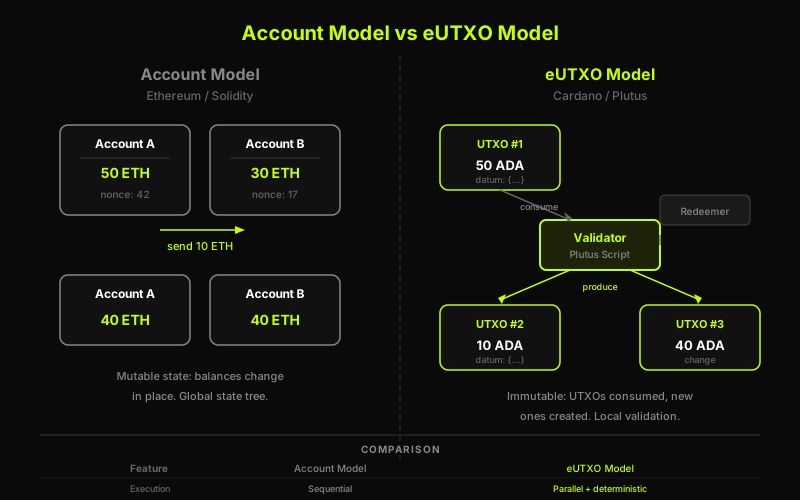
Ethereum uses an account-based model. Every address -- whether an externally owned account or a smart contract -- has a state that persists on-chain and gets mutated by transactions. When you send 10 ETH, Ethereum subtracts from your balance and adds to the recipient's. When a smart contract executes, it reads and writes to its storage slots. The blockchain is, conceptually, a global database of mutable rows.
Cardano uses unspent transaction outputs. There are no accounts with balances. Instead, there are discrete chunks of value sitting at addresses, each one the output of a previous transaction. When you want to spend value, you consume one or more UTXOs as inputs and produce new UTXOs as outputs. The old UTXOs cease to exist. The new ones are created. Nothing is mutated -- everything is consumed and recreated.
Think of it like physical cash. If you have a $50 bill and want to pay $30, you hand over the $50 (consumed) and receive $20 as change (a new output). This distinction matters when building dApps. On Ethereum, multiple users transact against a token swap contract's shared state sequentially. On Cardano, that shared state is a UTXO -- and a UTXO can only be consumed by one transaction per block. Two users targeting the same UTXO means one fails. This is not a bug. It is a fundamental property of the model.
Bitcoin's UTXO vs Cardano's Extended UTXO
Bitcoin invented the UTXO model, but its UTXOs are limited -- a locked box of satoshis with a simple script that checks a signature. No loops, no complex conditionals, no arbitrary data. Cardano's extended UTXO model adds three critical capabilities. First, UTXOs carry arbitrary data called datums -- structured state attached to each output. Second, spending conditions are defined by validator scripts that can execute arbitrary logic. Third, transactions include redeemers -- arguments the spender provides for the validator to evaluate.
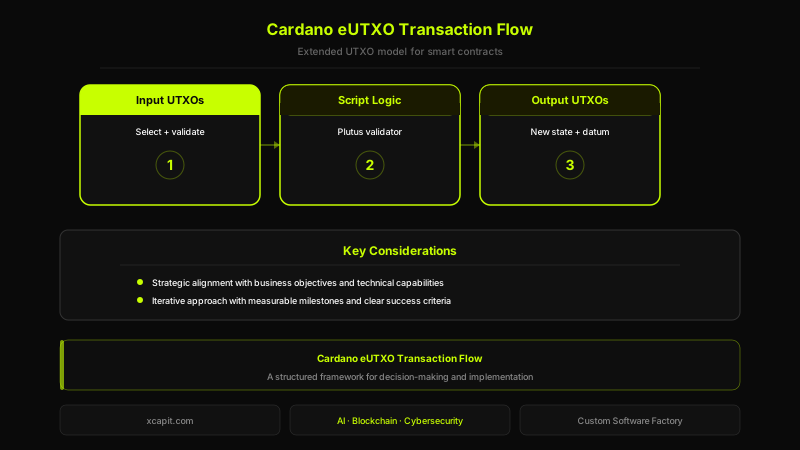
This combination gives Cardano the same expressiveness as Ethereum's smart contracts with a different execution model. Instead of calling a function that mutates persistent state, you consume a UTXO (carrying state in its datum), run a validator to check the consumption, and produce new UTXOs with updated datums. The state transition is explicit, immutable, and fully determined by the transaction.
Validators Instead of Stateful Contracts
On Ethereum, a smart contract lives at an address, holds state in storage, and exposes callable functions. The contract is an active entity that does things. On Cardano, the equivalent is a validator script -- but a validator does not do things, it checks things. A validator is a pure function receiving three inputs: the datum, the redeemer, and the script context (transaction metadata including all inputs, outputs, and signatures). It returns true or false.
This is a profound difference. Ethereum contracts are imperative -- they describe a sequence of actions to perform. Cardano validators are declarative -- they describe the conditions under which an action is permitted. The transaction itself specifies what happens (which UTXOs are consumed, which are created, what the new datums are). The validator only confirms that what happens is allowed.
Consider a simple escrow. On Ethereum, you write a contract with a release function that checks conditions and transfers funds. On Cardano, you write a validator that checks whether the transaction consuming the escrow UTXO produces the correct outputs -- funds to the recipient, datum updated appropriately. The transaction builder runs off-chain and constructs the entire transaction; the validator just verifies it. This separation of construction and validation is one of eUTXO's most powerful properties, because it means most computation happens off-chain, and the on-chain validator only needs to verify the result is correct.
Datums and Redeemers: State Without Storage
Datums are eUTXO's answer to contract state. Instead of persistent storage slots, state lives as data attached to UTXOs. When a UTXO is consumed and recreated, the new one carries an updated datum. A datum can be any structured data: a DEX order with token pair and exchange rate, a lending position with collateral and loan terms, or a governance proposal with vote counts. The datum is the application's state frozen into the UTXO.
Redeemers are arguments accompanying a spending attempt, telling the validator the spender's intent -- fill an order, cancel it, cast a vote. The pattern of datum as state, redeemer as action, and validator as rule enforcer replaces Ethereum's storage slots, function parameters, and imperative bodies. The entire state transition is visible in the transaction: old datums (inputs), the action (redeemers), and new datums (outputs). Nothing is hidden in opaque storage mutations.
The Concurrency Challenge
This is where most Ethereum developers hit a wall. If a DEX has a single liquidity pool UTXO, only one transaction per block can consume it. SundaeSwap's initial 2022 launch was marred by congestion from this exact problem -- Ethereum patterns ported without adaptation. The criticism was widespread but largely misdirected at Cardano itself rather than the application architecture.
The solutions are well-understood today and deployed in production.
- Batched transaction processing: Users submit orders as individual UTXOs. An off-chain batcher collects them, calculates optimal execution, and constructs a single transaction processing the entire batch. This is how Minswap, SundaeSwap v2, and WingRiders operate.
- UTXO splitting: The pool is distributed across multiple UTXOs, enabling parallel transactions against different fragments with periodic rebalancing.
- Order-book architecture: Each order is its own UTXO. Matching two orders consumes two independent UTXOs, so hundreds of matches can happen per block. Genius Yield uses this approach.
- Hydra state channels: Off-chain state channels where participants transact at sub-second speeds with eUTXO semantics, settling to the main chain periodically.
Concurrency on Cardano is an application design problem, not a protocol limitation. Transactions touching different UTXOs validate in parallel. The patterns for avoiding contention are mature.
Advantages of the eUTXO Model
- Deterministic fees: Validators are pure functions, so execution cost is known before submission. No failed transactions that consume gas. Users know exactly what they will pay.
- Parallel validation: Transactions consuming different UTXOs have no dependencies. Nodes validate them simultaneously. Ethereum must validate sequentially because each transaction can modify state the next depends on.
- Off-chain computation: Heavy computation happens during transaction construction. On-chain validators only verify correctness -- analogous to the prover-verifier relationship in zero-knowledge systems.
- Formal verifiability: Validators are pure functions with no side effects, making them significantly more amenable to mathematical proof than Ethereum's stateful contracts.
The Disadvantages: An Honest Assessment
- Steeper learning curve: The mental shift from imperative state mutation to UTXO consumption-and-creation is non-trivial and takes weeks to internalize.
- No porting Ethereum contracts: Every application requires ground-up redesign considering UTXO contention, datum structure, and off-chain transaction building.
- Smaller ecosystem: Fewer libraries, tutorials, and battle-tested reference implementations. Obscure issues may lack community answers.
- Transaction size limits: The 16KB maximum transaction size constrains complexity and requires careful design for applications with many inputs or outputs.
- Off-chain infrastructure burden: Transaction builders, batchers, and indexers must be built and maintained, adding operational complexity Ethereum does not require.
Tooling: Plutus, Aiken, and OpShin
Plutus, based on Haskell, remains the reference implementation with maximum type safety and formal verification support -- but its learning curve and compilation times are steep. Aiken has emerged as the most popular choice for new projects: a purpose-built functional language with Rust-like syntax, smaller compiled output, faster builds, and excellent developer experience. OpShin lets developers write validators in a Python subset, dramatically lowering the entry barrier for prototyping and Python-native teams.
The off-chain ecosystem has matured considerably. Lucid (TypeScript) and PyCardano (Python) handle transaction building. Blockfrost and Koios offer chain indexing APIs. Demeter.run provides cloud-hosted development environments. The experience is not yet at Ethereum's Hardhat/Foundry level, but it is production-ready and improving rapidly.
Practical Patterns for Production
The batcher pattern underpins most Cardano DeFi. Users submit orders as individual UTXOs locked at a validator address. Each order UTXO carries a datum describing the desired operation. An off-chain batcher collects orders, calculates optimal execution against the protocol's liquidity, and constructs a single transaction processing the entire batch atomically. Beyond solving concurrency, batching amortizes transaction costs across multiple users and creates a natural MEV-resistance mechanism -- the batcher processes orders fairly within each batch rather than sequencing them for extraction profit.
State machines on eUTXO are implemented as chains of UTXOs, where each UTXO represents a state and the datum encodes the current state data. A transition consumes the current state UTXO and produces a new one with an updated datum. The validator enforces the transition rules. Complex protocols use multi-validator architectures where separate scripts for deposits, borrows, and liquidations reference each other through transaction-level composition. Minting policies can enforce that tokens are only created when specific validator conditions are satisfied. This composability through transaction-level references replaces Ethereum's inter-contract calls.
When to Build on Cardano vs Ethereum
Cardano excels when deterministic fees matter, when the application leverages eUTXO's natural parallelism (order books, batch processing, per-user state), when formal verification is a priority, and when native multi-asset transactions are needed. Ethereum is stronger when you need the largest composable protocol ecosystem, inherently shared mutable state (AMM-style DEXs), speed to market with existing Solidity expertise, maximum liquidity, and EVM compatibility across L2s.
The honest answer for many projects is that both can work. The deciding factors are often team expertise and ecosystem fit rather than technical superiority. A well-designed application on either chain achieves comparable outcomes -- just differently.
Getting Started
- Start with Aiken: install the CLI, work through the official tutorial, and build a vesting contract as your first validator.
- Learn transaction building with Lucid or PyCardano -- this is where most application logic lives in eUTXO.
- Study production protocols: read the source code of Minswap or Liqwid Finance for real-world batching and concurrency patterns.
- Build end-to-end on Cardano's preview testnet: deploy a validator, construct transactions off-chain, and submit them.
- Join the Aiken Discord and Cardano developer communities -- the ecosystem is smaller but core developers are directly reachable.
At Xcapit, we have built production blockchain systems on both Cardano and Ethereum, and our team understands the architectural tradeoffs from hands-on implementation across both paradigms. Whether you are evaluating Cardano for a new project, adapting an existing Ethereum application, or building a multi-chain strategy, we can help you navigate the design decisions and deliver a system that leverages each chain's strengths. Learn more about our blockchain development services.

Fernando Boiero
CTO & Co-Founder
Over 20 years in the tech industry. Founder and director of Blockchain Lab, university professor, and certified PMP. Expert and thought leader in cybersecurity, blockchain, and artificial intelligence.
Building on blockchain?
Tokenization, smart contracts, DeFi — we've shipped it all.
You Might Also Like
Account Abstraction: ERC-4337 and the Future of Crypto UX
Learn how ERC-4337 account abstraction eliminates seed phrases and gas fees. Explore the architecture, capabilities, implementations, and how to build with it.
Xcapit Labs & Naranja X: Credit with Smart Contracts
In November 2024, Xcapit Labs launched with Naranja X a guaranteed credit pilot using crypto-assets as collateral through smart contracts on Rootstock. A milestone in blockchain applied to financial services in Latin America.
How Xcapit Labs and Naranja X Validated a Secure, Auditable, Non-Custodial Guaranteed Credit Model: The Architecture Behind the Pilot
Technical deep dive into the guaranteed credit pilot architecture between Xcapit Labs and Naranja X: smart contracts, non-custodial wallet, KYC/AML compliance, interoperability, and scalability to new sectors.