
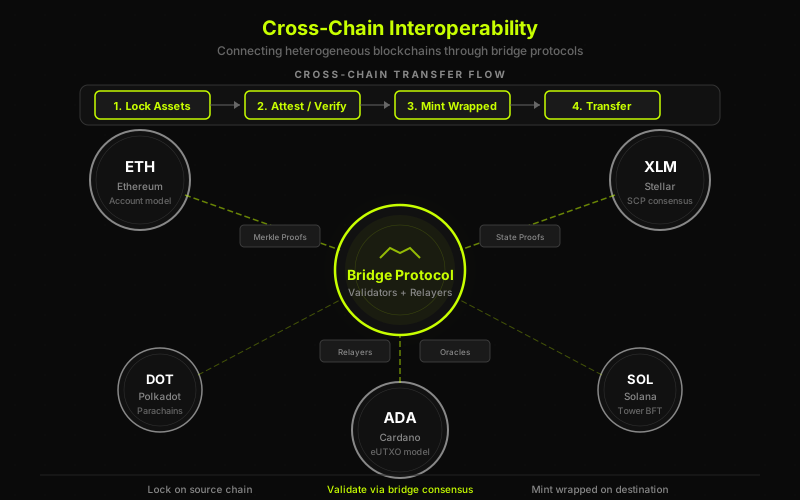
Blockchain was supposed to be a single, shared ledger of truth. Instead, we got hundreds of chains -- Ethereum, Solana, Cosmos, Avalanche, Arbitrum, Optimism, Base, and more arriving every quarter. Each optimizes for different trade-offs: throughput, finality, privacy, cost, decentralization. The result is a fragmented landscape where liquidity, users, and applications are siloed across incompatible networks. Cross-chain interoperability -- the ability to move assets, data, and execution between blockchains -- is the fundamental infrastructure challenge that determines whether the multi-chain ecosystem becomes genuinely composable or remains a collection of disconnected islands.
Having built production blockchain applications serving millions of users across multiple networks, I have seen the cross-chain problem from both sides -- as a builder who needs reliable interoperability and as a security practitioner who has analyzed what happens when bridges fail. This article covers how bridges work, why they keep getting exploited, the emerging standards that may solve the problem, and what enterprises should consider before connecting their systems across chains.
Why Cross-Chain Matters Now
The multi-chain reality is not a temporary phase -- it is the steady state. Ethereum dominates DeFi, but Layer 2 rollups now host more daily transactions than mainnet. Solana processes thousands of transactions per second for applications needing sub-second finality. Cosmos chains serve application-specific use cases with sovereign security. No single chain will win. The question is how they connect.
Liquidity fragmentation is the most immediate problem. A token on five chains has its liquidity split five ways, increasing slippage and reducing capital efficiency. Users face friction: they hold USDC on Arbitrum but need to pay gas on Optimism, requiring a bridge transaction that takes minutes, costs fees, and introduces risk. For enterprises evaluating blockchain for supply chain, payments, or asset tokenization, the cross-chain question is urgent -- their partners, customers, and assets may live on different networks. Over $15 billion in value flows through bridges at any given time, making them the single most attacked category in blockchain.
How Bridges Actually Work
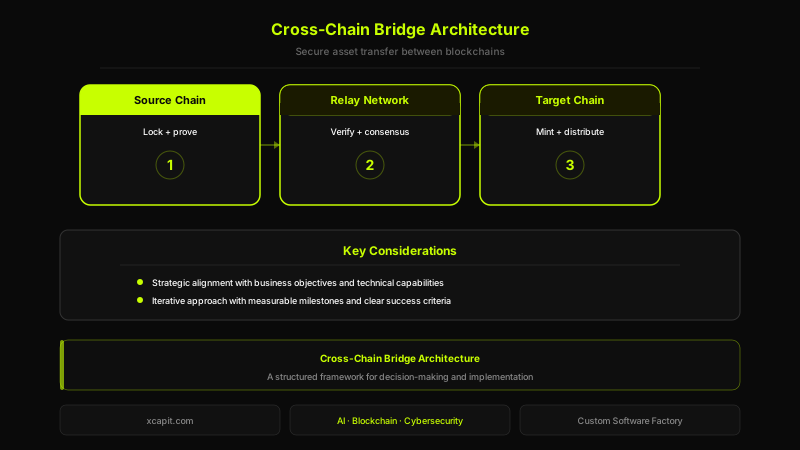
Cross-chain bridges solve a deceptively simple problem: how do you represent an asset on Chain B when the original exists on Chain A? Each chain maintains its own independent state with no shared memory between them. Bridges are middleware that creates the illusion of asset movement, and the security of the entire system depends on that middleware's integrity.
Lock-and-Mint
The most common architecture. A user locks tokens into a smart contract on the source chain. Validators observe this deposit, reach consensus, and trigger a minting transaction on the destination chain, creating a wrapped representation. To return, the user burns the wrapped token, and validators release the locked original. The security depends entirely on who the validators are, how many must agree, and what happens when they are compromised. Most billion-dollar exploits targeted this exact chokepoint.
Burn-and-Mint
A variation where the token is natively supported on multiple chains. The protocol burns the token on the source chain and mints an equivalent amount on the destination. This eliminates locked collateral pools but requires the token issuer to deploy contracts on every supported chain. Circle's CCTP for USDC uses this model -- you receive native USDC on the destination chain, not a wrapped derivative.
Liquidity Pools
These bridges maintain pools of native assets on each chain. A user deposits into the pool on Chain A, and a corresponding amount is released from the pool on Chain B. This offers faster transfers and native assets but requires deep liquidity on every supported chain. Protocols like Across and Stargate use this approach, incentivizing liquidity providers with fees and token rewards.
Atomic Swaps and Hash Time-Locked Contracts
Atomic swaps use hash time-locked contracts (HTLCs) for trustless peer-to-peer exchanges. The HTLC ensures either both sides execute or neither does -- no validators, no custodians, no collateral pools. However, both parties must be online, only bilateral exchanges are supported, and throughput is limited. HTLCs were the original cross-chain solution but have not scaled to meet modern DeFi demands.
The Security Graveyard: Billion-Dollar Lessons
Cross-chain bridges have suffered the largest losses in blockchain history. Understanding these exploits is essential because they reveal the structural weaknesses in bridge design, not just individual implementation bugs.
Ronin Bridge -- $625 Million (March 2022)
The Ronin bridge for Axie Infinity used nine validator nodes requiring five signatures. The Lazarus Group compromised four Sky Mavis validator keys through a fake job offer social engineering campaign and obtained a fifth through a legacy Axie DAO governance arrangement. With five of nine validators compromised, attackers drained 173,600 ETH and 25.5 million USDC. The breach went undetected for six days. The lesson: a multi-sig bridge is only as secure as its least-protected signer, and validator key management is an operational problem, not just a cryptographic one.
Wormhole -- $326 Million (February 2022)
Unlike Ronin, Wormhole was a smart contract vulnerability. The attacker bypassed signature verification in the Solana-side contract by providing a crafted system program address, forging guardian signatures to mint 120,000 wrapped ETH on Solana without any actual Ethereum deposit. The root cause was a missing validation check from an unaudited code update. Jump Crypto replaced the stolen funds from its own reserves to prevent a broader Solana DeFi crisis.
Nomad -- $190 Million (August 2022)
The Nomad exploit was uniquely chaotic. A routine upgrade set the trusted root of the message verification Merkle tree to zero, making any message with a zero-initialized proof automatically valid. Once the first attacker's technique was visible on-chain, hundreds of copycats replicated the transaction -- over 300 addresses participated in what became the first 'decentralized robbery.' The exploit proved that optimistic bridge designs can fail catastrophically if the fraud proof mechanism itself is compromised.
Bridge Security Models Compared
Every bridge makes a fundamental design choice about how cross-chain messages are verified. This choice determines the security model, the trust assumptions, and the failure modes of the entire system.
Externally Verified (Trusted Validators)
These bridges rely on a validator committee to attest that source chain events actually occurred. Wormhole uses 19 guardian nodes requiring a two-thirds supermajority. The advantage is speed and generalizability. The disadvantage is trusting a small group of entities -- if compromised through key theft, collusion, or social engineering, the bridge fails completely. This model has produced the largest losses.
Natively Verified (Light Clients)
These bridges run a light client of the source chain on the destination chain, verifying block headers and state proofs on-chain. The destination chain verifies the source chain's consensus directly, without trusting any intermediary. Cosmos IBC is the most successful implementation. The trade-off is cost and complexity -- verifying Ethereum's consensus on another chain is expensive, and each new chain requires a custom light client. Zero-knowledge proofs are emerging as a way to reduce verification costs while maintaining trust minimization.
Optimistically Verified (Fraud Proofs)
Optimistic bridges assume messages are valid and provide a challenge window for fraud proofs. If no proof is submitted (typically 30 minutes to a few hours), the message finalizes. The advantage is low verification cost. The disadvantage is latency and dependency on at least one honest watcher monitoring every message. If the fraud proof mechanism itself is compromised -- as happened with Nomad -- the entire security model collapses.
The Interoperability Trilemma
Arjun Bhuptani, founder of Connext, formalized the interoperability trilemma: bridge protocols can optimize for at most two of three properties -- trust minimization, generalizability, and extensibility. Trust minimization means the bridge does not add new trust assumptions beyond the underlying chains. Generalizability means the bridge can pass arbitrary data and messages, not just token transfers. Extensibility means the bridge can easily support new chains without significant engineering effort.
Light client bridges (Cosmos IBC) achieve trust minimization and generalizability but are not easily extensible -- each new chain requires a custom light client implementation. Externally verified bridges (Wormhole, LayerZero) achieve generalizability and extensibility but sacrifice trust minimization by introducing a validator committee. Atomic swaps achieve trust minimization and extensibility but lack generalizability -- they can swap assets but cannot pass arbitrary messages or trigger complex cross-chain logic.
Understanding this trilemma is essential for enterprise decision-making. There is no perfect bridge -- every solution makes trade-offs, and the right choice depends on which properties matter most for your specific use case. A payment application may prioritize trust minimization. A cross-chain DeFi protocol may prioritize generalizability. An enterprise connecting to multiple partner chains may prioritize extensibility.
Emerging Standards and Protocols
LayerZero
LayerZero separates the roles of oracle and relayer, letting applications choose their own providers. LayerZero V2 introduced Decentralized Verifier Networks (DVNs), requiring verification from multiple independent providers before a message is valid. This moves the trust model from 'trust one bridge operator' to 'trust the intersection of multiple independent verifiers' -- a meaningful improvement, though developers must configure security parameters correctly.
Chainlink CCIP
Chainlink CCIP leverages existing decentralized oracle infrastructure with a three-layer architecture: the committing DON that monitors source chains, the executing DON that submits transactions, and a separate Risk Management Network that independently monitors for anomalies and can halt processing. This defense-in-depth approach -- where monitoring is independent from execution -- addresses a key weakness in earlier designs where validators and monitors were the same entities.
Cosmos IBC
IBC remains the gold standard for trust-minimized interoperability. Sovereign Cosmos chains communicate via on-chain light clients that verify counterpart consensus cryptographically, without any external validator set. IBC has processed billions in transfers with zero core protocol exploits. The limitation is requiring compatible consensus mechanisms, making it less extensible to non-Cosmos chains -- though Polymer and Landslide are bringing IBC to Ethereum rollups and Avalanche subnets.
ERC-7683: Cross-Chain Intents
ERC-7683 represents a paradigm shift from bridge-centric to intent-centric interactions. Instead of specifying how to bridge, the user expresses an intent: 'I want 1,000 USDC on Optimism.' Solvers -- specialized agents with multi-chain liquidity -- compete to fulfill that intent at the best price. The user does not need to know which bridge or route was used. Protocols like Across and UniswapX are building on this model, and ERC-7683 aims to standardize the interface for solver and application interoperability.
Enterprise Considerations for Cross-Chain Solutions
For enterprises evaluating cross-chain infrastructure, the decision framework differs from retail DeFi. Enterprises care about reliability, compliance, auditability, and long-term vendor risk -- not just transaction speed and fees.
- Security model transparency: Can you audit the bridge's validator set, see their on-chain attestations, and verify the verification logic yourself? Avoid bridges that treat their security model as proprietary.
- Incident history and response: How has the bridge team responded to past incidents? A bridge with a well-handled incident is more trustworthy than one that has never been tested under adversarial conditions.
- Insurance and backstop mechanisms: Does the bridge have a security fund, insurance coverage, or a backer willing to make users whole after an exploit? Jump Crypto's $326M backstop of Wormhole is a data point, not a guarantee.
- Regulatory alignment: Does the bridge operator have a legal entity, comply with applicable regulations, and maintain the kind of documentation that enterprise compliance teams require?
- Chain coverage and roadmap: Does the bridge support the chains you need today and the chains you are likely to need in two years? Migrating bridge infrastructure is expensive and risky.
- Operational maturity: Does the bridge have monitoring, alerting, incident response procedures, rate limits, and circuit breakers? Production-grade infrastructure requires more than just correct code.
Our Approach to Cross-Chain Security
At Xcapit, we have developed a cross-chain security framework from our experience building and auditing blockchain applications across multiple networks. Bridge security spans cryptographic verification, validator operations, monitoring infrastructure, and incident response.
Pre-Integration Audit Checklist
- Verify the bridge's security model: validator set composition, key management practices, and consensus threshold
- Review the bridge's smart contract audit history and check for unresolved findings
- Analyze the bridge's incident history and the team's response timeline and transparency
- Assess the bridge's finality assumptions: does it wait for sufficient block confirmations on the source chain?
- Test failure modes: what happens if the bridge goes offline, if validators disagree, or if message delivery is delayed?
- Evaluate the bridge's upgrade mechanism: who can upgrade contracts, what time-locks exist, and is there a governance process?
Runtime Monitoring and Circuit Breakers
- Monitor bridge contract balances in real-time and alert on unusual outflows that exceed historical norms
- Track validator behavior for anomalies: missed attestations, unusual signing patterns, or sudden key rotations
- Implement application-level rate limits: cap the maximum value that can be bridged per hour, per day, and per transaction
- Deploy circuit breakers that automatically pause bridge interactions if predefined risk thresholds are exceeded
- Maintain independent verification: cross-check bridge events against source chain state using your own infrastructure
- Establish a multi-bridge strategy for high-value flows, routing through multiple independent bridges and comparing results
Cross-chain interoperability is one of the hardest problems in blockchain engineering. The technology is maturing rapidly -- light client bridges, intent-based architectures, and zero-knowledge verification are pushing toward a future where cross-chain transactions are as reliable as single-chain ones. But we are not there yet, and any organization integrating cross-chain infrastructure must approach it with the same rigor they would apply to any mission-critical system.
At Xcapit, our blockchain and cybersecurity teams bring deep expertise in cross-chain architecture, smart contract security, and production infrastructure for multi-chain environments. From evaluating bridge solutions and conducting security audits to building cross-chain applications with enterprise-grade monitoring and circuit breakers, we help organizations navigate cross-chain complexity with confidence. If you are building across chains and need a partner who understands both the technology and the risks, reach out to start the conversation.

Fernando Boiero
CTO & Co-Founder
Over 20 years in the tech industry. Founder and director of Blockchain Lab, university professor, and certified PMP. Expert and thought leader in cybersecurity, blockchain, and artificial intelligence.
Building on blockchain?
Tokenization, smart contracts, DeFi — we've shipped it all.
You Might Also Like
Digital transformation for utilities: modernizing energy without replacing the core
A practical guide for utilities and energy companies: how to integrate SCADA, IoT, AI, tokenization, and cybersecurity to modernize operations without replacing critical systems.
Building DevSecOps Pipelines for Blockchain Projects
How to design and implement a DevSecOps pipeline purpose-built for blockchain development — covering smart contract static analysis, automated audit pipelines, secrets management, deployment automation, and post-deployment monitoring.
Blockchain Security Audit Checklist for DeFi Projects
A comprehensive security audit checklist for DeFi smart contracts and protocols. Common vulnerabilities, testing methodologies, and best practices for blockchain security.