
After auditing dozens of smart contracts -- from DeFi protocols managing hundreds of millions in TVL to enterprise tokenization platforms -- one truth has become unavoidable: the projects that survive on mainnet are not the ones with the cleverest code. They are the ones that consistently apply proven security patterns. Ad-hoc fixes address symptoms. Patterns address the structural conditions that produce vulnerabilities in the first place.
The difference between a pattern-driven approach and a reactive one becomes obvious during audit. Codebases built on established patterns have fewer findings, lower severity, and faster remediation. Codebases built ad-hoc -- where each developer solved each problem in their own way -- produce cascading vulnerabilities where fixing one issue introduces another. This guide covers the security patterns we apply in every audit and expect to see in every production Solidity codebase.
Why Patterns Matter More Than Ad-Hoc Fixes
A pattern is a repeatable solution to a recurring problem. In Solidity, security patterns prevent entire vulnerability classes by design. The checks-effects-interactions pattern does not just fix one reentrancy bug -- it makes reentrancy structurally impossible in any function that follows it. That is the fundamental advantage: patterns scale across a codebase, across teams, and across time. Ad-hoc fixes address individual instances. A developer spots a reentrancy vector and adds a mutex lock to that specific function. The next function, written by a different developer next week, has no mutex. The vulnerability reappears.
In our audit practice, the first thing we assess is whether a codebase follows recognized patterns consistently. When it does, the audit focuses on edge cases and business logic -- the hard, protocol-specific problems. When it does not, the audit becomes a remediation exercise, and the finding count climbs into the dozens. Patterns reduce audit cost, reduce time-to-deployment, and dramatically reduce the probability of a post-deployment exploit.
Checks-Effects-Interactions: The Foundational Pattern
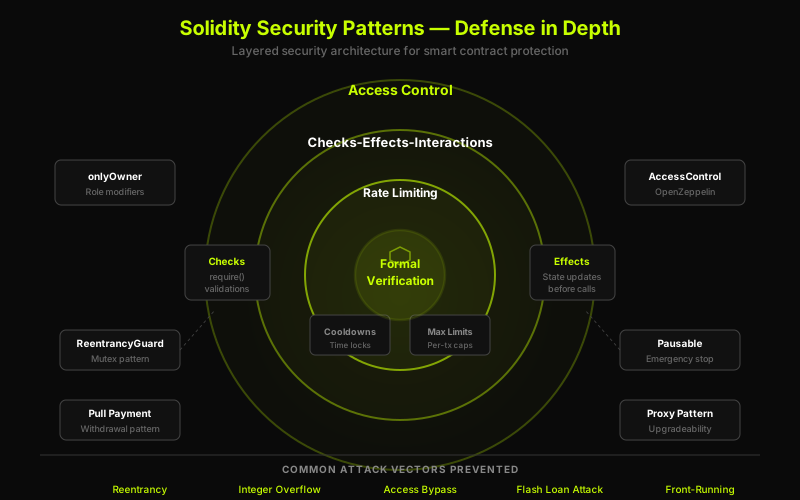
Checks-effects-interactions (CEI) is the single most important pattern in Solidity security. It dictates a strict ordering: first, validate all conditions (checks); second, update all state variables (effects); third, make external calls (interactions). This ordering ensures that by the time any external contract receives control, the calling contract's state is already consistent. The pattern directly prevents reentrancy -- the vulnerability class responsible for the DAO hack and hundreds of millions in losses since.
We enforce CEI not just at the single-function level but across cross-function and cross-contract interactions. Modern reentrancy attacks exploit shared state between functions -- function A updates variable X but not variable Y before making an external call, and the reentrant callback enters function B which reads the stale value of Y. Read-only reentrancy is another evolution: a view function returns stale state during a callback, and an external protocol that depends on that view function makes a decision based on incorrect data.
- Structure every state-changing function in strict check-effect-interact order and document any intentional deviations
- Apply reentrancy guards (nonReentrant modifier) to all functions that make external calls -- defense in depth even when CEI is followed
- Audit cross-function reentrancy by mapping all shared state variables and verifying they are updated before any external call
- Identify read-only reentrancy vectors by cataloging all view functions that external protocols consume
Access Control Patterns: Ownable, Roles, and Multi-Sig
Access control is the second most common source of critical audit findings. The simplest model is Ownable, where a single address has administrative privileges. OpenZeppelin's Ownable2Step improves on this by requiring the new owner to explicitly accept the transfer, preventing accidental transfers to wrong addresses. For production protocols, role-based access control (RBAC) using AccessControl is the standard -- it allows defining granular roles (MINTER_ROLE, PAUSER_ROLE, UPGRADER_ROLE) with separate admin roles for each permission, enforcing the principle of least privilege.
For high-value protocols, multi-signature governance adds a final layer. Critical operations require approval from multiple independent signers. We recommend Safe (formerly Gnosis Safe) with a minimum 3-of-5 configuration, combined with a TimelockController between the multi-sig and the protocol. The timelock gives users a window to exit before changes take effect -- both a security measure and a trust signal.
- Use Ownable2Step at minimum; prefer AccessControl with granular roles for protocols with multiple administrative functions
- Implement timelocks on all parameter changes with delays proportional to the change's potential impact
- Require multi-sig approval for upgrades, emergency functions, and any operation that moves protocol-owned funds
- Audit initializer functions on proxy contracts to ensure they cannot be called by unauthorized parties or re-invoked
Pull Over Push: Safer Withdrawal Patterns
Instead of a contract sending funds to recipients (push), let recipients withdraw their funds themselves (pull). This single design decision eliminates multiple vulnerability classes simultaneously. Push-based payments hand control to the recipient: a contract with a reverting receive function causes denial-of-service, a malicious fallback enables reentrancy, and iterating over large recipient lists can exceed the block gas limit, locking funds permanently.
With pull patterns, each user calls a withdraw function that sends only their funds. A malicious recipient can only harm their own withdrawal. The contract maintains a mapping of balances owed, updates it atomically, and lets users claim at their own pace. This aligns perfectly with CEI: check the balance, zero it out, then transfer.
- Default to pull-based withdrawals for any contract that distributes funds to multiple recipients
- If push payments are unavoidable, use gas-limited calls and handle failures gracefully without reverting the entire operation
- Combine pull patterns with CEI: check the user's balance, set it to zero, then transfer -- never the reverse
Rate Limiting and Circuit Breakers
Even with perfect code, protocols need mechanisms to limit damage when something unexpected happens. OpenZeppelin's Pausable contract provides the simplest circuit breaker, but we recommend granular pause controls rather than a single global pause. A DeFi lending protocol might want to pause new borrows during market turmoil while still allowing repayments and liquidations -- a global pause would prevent liquidations, potentially making the protocol insolvent.
Rate limiting adds time-based or volume-based constraints. A bridge contract might limit cross-chain transfers to a maximum dollar amount per hour. These limits do not prevent attacks, but they cap maximum damage and buy time for human intervention. We have seen protocols where a rate limit reduced a potential $50 million exploit to a $200,000 loss -- still painful, but survivable.
- Implement granular pause controls: separate pause states for different operations based on their risk profile
- Add rate limits on high-value operations: maximum amounts per time period, cooldown periods between critical actions
- Ensure emergency functions can be triggered quickly -- multi-sig thresholds for pause should be lower than for upgrades
- Test emergency procedures regularly: simulate incidents and verify that pause and recovery mechanisms work as expected
Safe Math and Overflow Protection Post-0.8
Since Solidity 0.8.0, arithmetic operations revert on overflow and underflow by default. However, the unchecked block explicitly disables these protections for gas optimization. We see unchecked blocks used aggressively in audit -- often without sufficient proof that overflow is truly impossible. A loop counter that will never exceed 2^256 is a safe candidate. A token amount calculation that depends on user input is not. Every unchecked block is an implicit assertion that overflow cannot occur, and every assertion needs proof.
Type casting is another subtle source. Casting a uint256 to uint128 silently truncates values above 2^128 -- not caught by Solidity's built-in checks. Division-before-multiplication precision loss is related: (a / b) * c can lose significant precision compared to (a * c) / b. In financial contracts, this precision loss can be exploited to extract value.
- Use Solidity 0.8+ and rely on built-in overflow protection as the default
- Audit every unchecked block with a formal argument for why overflow is impossible in that context
- Validate values before type-narrowing casts and prefer multiplication-before-division in financial calculations
- Use fixed-point math libraries (PRBMath, ABDKMath64x64) for complex financial formulas
Proxy Patterns Done Right
The three dominant proxy patterns each have distinct security profiles. The transparent proxy (EIP-1967) separates admin calls from user calls at the proxy level, preventing function selector clashing but adding gas overhead. UUPS (EIP-1822) moves upgrade logic into the implementation, which is more gas-efficient but introduces a critical risk: if an upgrade removes the upgrade function, the contract becomes permanently non-upgradeable. We have audited contracts where this would have bricked the proxy if deployed.
Beacon proxies allow multiple proxy instances to share a single implementation managed by a beacon contract -- ideal for factory patterns but creating a critical single point of failure. Across all patterns, storage layout compatibility between implementation versions is paramount. A single misaligned slot can corrupt the entire contract state.
- Choose transparent proxy for strongest admin/user separation; UUPS for gas efficiency with rigorous upgrade testing; beacon for factory patterns
- Disable initializers in the implementation constructor (_disableInitializers()) to prevent direct initialization attacks
- Verify storage layout compatibility between implementation versions before every upgrade
- Test upgrade paths in a fork environment before mainnet deployment: deploy, upgrade, and verify all state and functions
Oracle Security: Beyond Just Using Chainlink
Simply using Chainlink does not make a protocol oracle-secure. Stale data protection is the most commonly missed check -- Chainlink feeds update based on deviation thresholds and heartbeat intervals, meaning prices can be stale during low-volatility periods or network congestion. Every integration must check the updatedAt timestamp against a maximum staleness threshold. We have audited protocols where the contract would use a price that was hours old during a market crash.
Time-weighted average prices (TWAP) from Uniswap V3 provide manipulation resistance, but the window must be long enough -- typically 30 minutes or more. For high-value protocols, multi-oracle validation is essential: querying multiple independent sources and using a median or comparison-based aggregation prevents any single oracle failure from corrupting protocol decisions.
- Always check Chainlink updatedAt timestamps and revert if the price exceeds your staleness tolerance
- Use TWAP windows of at least 30 minutes for Uniswap V3 oracle integrations
- Implement multi-oracle validation with deviation checks for protocols managing significant TVL
- Handle Chainlink sequencer downtime for L2 deployments -- stale prices during outages have caused real exploits
Gas Optimization Without Sacrificing Security
The most effective gas optimizations are also security-neutral: using immutable and constant for values that never change, packing related storage variables into a single 256-bit slot, using calldata instead of memory for read-only parameters, and short-circuiting require statements by placing the cheapest checks first. These save gas without touching security-critical logic. Custom errors replace string-based require messages with gas-efficient, typed error definitions that also improve auditability.
- Use immutable and constant for deployment-time and compile-time values respectively
- Use custom errors instead of string-based reverts for gas savings and better auditability
- Emit events for every critical state change -- gas cost is minimal compared to monitoring value
- Never use unchecked blocks purely for gas savings on user-input-dependent arithmetic
Testing Patterns: Fuzzing, Formal Verification, and Invariants
Manual review cannot explore the full state space of a complex contract. Property-based fuzzing with Echidna and Medusa generates random transaction sequences and checks that defined invariants hold after each sequence. An invariant like 'the total supply must equal the sum of all balances' is checked across thousands of random scenarios, including edge cases no human would think to test. When a fuzzer breaks an invariant, it provides a concrete transaction sequence that reproduces the issue.
Formal verification with Certora takes this further by mathematically proving that properties hold for all possible inputs and states. Certora's Prover uses SMT solvers to exhaustively verify properties like 'no user can withdraw more than they deposited.' The cost is higher than fuzzing, but for high-TVL protocols, it provides the highest level of assurance. Foundry's invariant testing provides a practical middle ground that integrates naturally into standard development workflows.
- Write invariant tests in Foundry as the minimum baseline for every contract
- Use Echidna or Medusa for deep property-based fuzzing with multi-transaction sequences
- Apply Certora formal verification for mathematical properties in high-TVL protocols
- Run fuzz campaigns for extended periods (hours, not minutes) to explore deeper state-space paths
Our Audit Methodology: Systematic Pattern Application
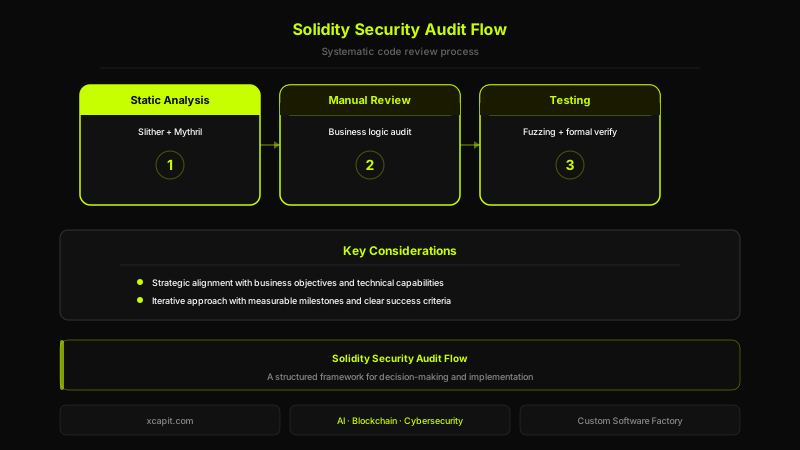
When we audit a smart contract at Xcapit, we do not start by reading code line by line. We start by mapping the contract's architecture against the patterns described in this guide. Is CEI followed consistently? Is access control granular and properly tiered? Are withdrawals pull-based? Are oracles integrated with staleness and deviation checks? This structural assessment identifies the highest-risk areas immediately.
The second phase is automated analysis: Slither for static analysis, Mythril for symbolic execution, and Echidna or Medusa for fuzz testing with custom invariants derived from the protocol's specification. These tools filter out entire vulnerability classes so that manual review can focus on business logic and economic attack modeling. In the third phase, two independent auditors review the codebase separately, cross-reference results, and validate each finding with a proof-of-concept. The final phase is remediation verification -- we review every fix, re-run automated tools, and verify invariant tests pass before signing off.
- Phase 1: Architecture review against established security patterns (CEI, access control, pull payments, proxy safety, oracle integration)
- Phase 2: Automated analysis with Slither, Mythril, and property-based fuzzing using protocol-specific invariants
- Phase 3: Independent manual review by two auditors with cross-referenced findings and proof-of-concept exploits
- Phase 4: Remediation verification with regression testing, re-run of automated tools, and invariant validation
At Xcapit, our cybersecurity team brings ISO 27001 certification, years of production blockchain experience, and a pattern-driven methodology to every smart contract audit. Whether you are preparing for your first audit or looking for a second opinion on a critical protocol, we can help you build security into the architecture -- not bolt it on after the fact. Explore our cybersecurity services or reach out to discuss your project.

Fernando Boiero
CTO & Co-Founder
Over 20 years in the tech industry. Founder and director of Blockchain Lab, university professor, and certified PMP. Expert and thought leader in cybersecurity, blockchain, and artificial intelligence.
Building on blockchain?
Tokenization, smart contracts, DeFi — we've shipped it all.
You Might Also Like
Digital transformation for utilities: modernizing energy without replacing the core
A practical guide for utilities and energy companies: how to integrate SCADA, IoT, AI, tokenization, and cybersecurity to modernize operations without replacing critical systems.
Building DevSecOps Pipelines for Blockchain Projects
How to design and implement a DevSecOps pipeline purpose-built for blockchain development — covering smart contract static analysis, automated audit pipelines, secrets management, deployment automation, and post-deployment monitoring.
Blockchain Security Audit Checklist for DeFi Projects
A comprehensive security audit checklist for DeFi smart contracts and protocols. Common vulnerabilities, testing methodologies, and best practices for blockchain security.