
Every AI project eventually hits the same fork in the road: should we use retrieval-augmented generation, fine-tune a model, or combine both? The answer is never as simple as a blog post headline suggests. It depends on your data, your latency requirements, your budget, your team's capabilities, and -- most importantly -- what your users actually need the system to do. After building dozens of AI-powered systems across fintech, energy, and government clients, I have learned that the RAG-versus-fine-tuning decision is less about which technique is 'better' and more about which failure modes you can tolerate.
This is not a theoretical comparison. I am going to walk through what each technique actually involves at an engineering level, where each one breaks down in production, and how we make the decision for real client projects at Xcapit. By the end, you will have a practical decision framework that goes beyond 'it depends.'
What RAG Actually Is
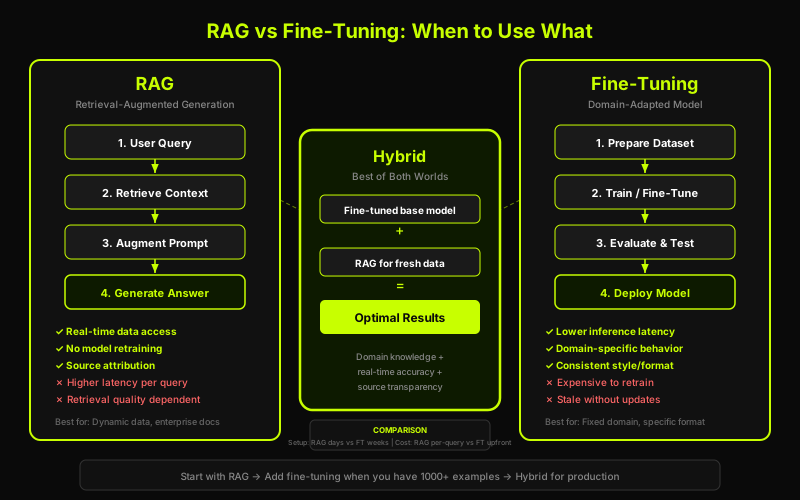
Retrieval-augmented generation sounds simple in concept: instead of relying solely on a model's trained knowledge, you retrieve relevant documents from an external knowledge base and inject them into the prompt as context. The model then generates a response grounded in that retrieved information. In practice, building a production-grade RAG system involves a surprisingly complex pipeline with several components that each introduce their own failure modes.
The Retrieval Pipeline
A RAG pipeline starts with document ingestion. Raw documents -- PDFs, web pages, database records, API responses -- are parsed, cleaned, and split into chunks. Chunking strategy is one of the most underrated decisions in RAG architecture. Chunk too small and you lose context. Chunk too large and you waste precious context window space on irrelevant information. We typically use semantic chunking that respects natural document boundaries (sections, paragraphs) with overlapping windows of 100-200 tokens to preserve cross-boundary context.
Each chunk is then converted into a vector embedding -- a high-dimensional numerical representation of its semantic meaning -- using an embedding model like OpenAI's text-embedding-3-large or open-source alternatives like BGE-M3. These embeddings are stored in a vector database (Pinecone, Qdrant, Weaviate, or pgvector for simpler deployments). At query time, the user's question is embedded using the same model and compared against the stored vectors using cosine similarity or approximate nearest neighbor search.
Reranking and Context Assembly
Vector similarity search alone is not enough for production quality. The initial retrieval step typically returns 20-50 candidate chunks, many of which are tangentially related or redundant. A reranking step -- using a cross-encoder model like Cohere Rerank or a fine-tuned BGE reranker -- scores each candidate against the original query with much higher accuracy than vector similarity alone. The top 3-8 reranked chunks are then assembled into the prompt context, often with metadata like source document title, date, and section heading to enable source attribution.
This two-stage retrieval (fast vector search followed by precise reranking) is what separates production RAG systems from tutorial-level implementations. Without reranking, retrieval quality hovers around 60-70% relevance. With it, you can consistently achieve 85-95% -- and that difference is the difference between a useful system and a frustrating one.
What Fine-Tuning Actually Is
Fine-tuning takes a pre-trained language model and continues training it on a curated dataset of examples that demonstrate the behavior you want. The model's weights are adjusted so it inherently 'knows' how to respond in your domain without needing external context injection. Think of RAG as giving the model a reference book to consult at runtime. Fine-tuning is more like sending the model to graduate school -- the knowledge becomes part of its internal reasoning.
Supervised Fine-Tuning and Parameter-Efficient Methods
The most common approach is supervised fine-tuning (SFT), where you provide input-output pairs that demonstrate desired behavior. For a customer support model, each example might be a customer message paired with an ideal agent response. For a classification model, each example is a document paired with its correct category and confidence score.
Full fine-tuning -- updating all model parameters -- is expensive and risks catastrophic forgetting, where the model loses general capabilities while learning domain-specific ones. Parameter-efficient methods like LoRA (Low-Rank Adaptation) and its quantized variant QLoRA have largely solved this problem. LoRA freezes the original model weights and trains small adapter matrices that modify the model's behavior. A 7-billion parameter model that requires 28 GB of GPU memory for full fine-tuning can be LoRA-tuned with 4-8 GB, and the adapter weights are typically just 10-100 MB. This makes fine-tuning accessible on a single consumer GPU and practical for iterative experimentation.
When to Fine-Tune vs. Prompt Engineer
Before jumping to fine-tuning, exhaust prompt engineering first. If you can achieve 90% of your desired behavior through careful system prompts, few-shot examples, and structured output formatting, fine-tuning adds complexity without proportional benefit. Fine-tuning makes sense when prompt engineering hits a ceiling -- when the behavior you need is too nuanced or too consistent to reliably achieve through prompting alone, when you need to reduce input token costs by eliminating long system prompts and few-shot examples, or when you need the model to reliably follow domain-specific conventions that it was not trained on.
RAG Strengths and Weaknesses
Where RAG Excels
- Up-to-date information -- RAG systems can incorporate new data in minutes by adding documents to the vector store. There is no retraining cycle. When a client's product catalog changes weekly, compliance regulations update quarterly, or support documentation evolves daily, RAG keeps the system current without touching the model.
- Source attribution and verifiability -- Because retrieved chunks carry metadata, the system can cite specific documents, sections, and dates for every claim it makes. For regulated industries -- fintech compliance, government contracts, healthcare -- this traceability is not optional; it is a legal requirement.
- Model independence -- RAG works with any LLM. If you need to switch from Claude to GPT to Llama for cost, capability, or compliance reasons, your entire retrieval pipeline, vector database, and document processing infrastructure remain unchanged. Only the generation step swaps out.
- No training infrastructure needed -- RAG requires no GPU clusters, no training pipelines, no hyperparameter tuning. The engineering investment goes into data processing, retrieval quality, and prompt design -- skills that are more widely available than ML training expertise.
Where RAG Struggles
- Retrieval quality bottleneck -- The system is only as good as its retrieval. If the right chunk is not retrieved, the model cannot generate a correct answer -- no matter how capable the LLM is. Semantic search misses lexical matches. Keyword search misses paraphrases. Hybrid search helps, but retrieval remains the weakest link in most RAG systems.
- Latency overhead -- Every query requires embedding generation, vector search, optional reranking, and context assembly before the LLM even starts generating. This adds 200-800 milliseconds to response time. For real-time applications or high-throughput processing, this overhead can be a dealbreaker.
- Chunking challenges -- Documents with complex structures -- tables, nested lists, cross-references, multi-page reasoning -- are notoriously difficult to chunk effectively. A legal contract where clause 4.2 references definitions in clause 1.1 cannot be meaningfully split into independent chunks without losing critical context.
- Context window pressure -- Even with large context windows (200K+ tokens), stuffing too many retrieved chunks degrades model performance. The model must reason over relevant and irrelevant retrieved content simultaneously, and research consistently shows that models pay more attention to the beginning and end of their context window -- the 'lost in the middle' problem.
Fine-Tuning Strengths and Weaknesses
Where Fine-Tuning Excels
- Domain-specific behavior and reasoning -- A fine-tuned model internalizes patterns that are difficult to elicit through prompting. A model fine-tuned on thousands of radiology reports does not just format output correctly -- it learns the reasoning patterns radiologists use. A model fine-tuned on legal analysis develops an understanding of jurisdictional nuance that no prompt can teach.
- Consistent style and format -- When you need every output to follow a precise structure -- specific JSON schemas, branded voice and tone, regulatory document formatting -- fine-tuning encodes this consistency into the model's weights. Prompt-based formatting is fragile; fine-tuning makes it reliable.
- Reduced inference costs -- Fine-tuned models can eliminate the need for lengthy system prompts and few-shot examples. If your system prompt is 2,000 tokens and you serve 10,000 requests per day, fine-tuning those instructions into the model saves 20 million input tokens daily. At scale, this represents meaningful cost savings.
- Offline and edge deployment -- Fine-tuned open-source models can run entirely on-premise or at the edge, with no API calls, no internet dependency, and no data leaving your infrastructure. For air-gapped environments, defense applications, or extreme latency requirements, this capability is irreplaceable.
Where Fine-Tuning Struggles
- Training data requirements -- Quality fine-tuning requires hundreds to thousands of carefully curated examples. These examples must be representative, diverse, and accurately labeled. Creating this dataset is often the most time-consuming and expensive part of the process -- and the quality of your training data puts a hard ceiling on your model's performance.
- Catastrophic forgetting -- Even with parameter-efficient methods, fine-tuning can cause the model to 'forget' general capabilities as it learns domain-specific ones. A model fine-tuned heavily on financial analysis might lose its ability to handle casual conversation or general knowledge questions. Balancing specialization with generality requires careful dataset design and evaluation.
- Model lock-in -- When you fine-tune a Llama 3 model, your training data, evaluation pipeline, and deployment infrastructure are all tied to that model architecture. Migrating to a different base model -- because a better one is released, pricing changes, or you need different capabilities -- means repeating the fine-tuning process from scratch.
- Stale knowledge -- A fine-tuned model's knowledge is frozen at training time. If your domain knowledge changes frequently, the model becomes progressively outdated. Retraining on new data is possible but introduces a continuous cost cycle and the risk of regression -- the new model might perform worse on previously correct tasks.
The Decision Framework
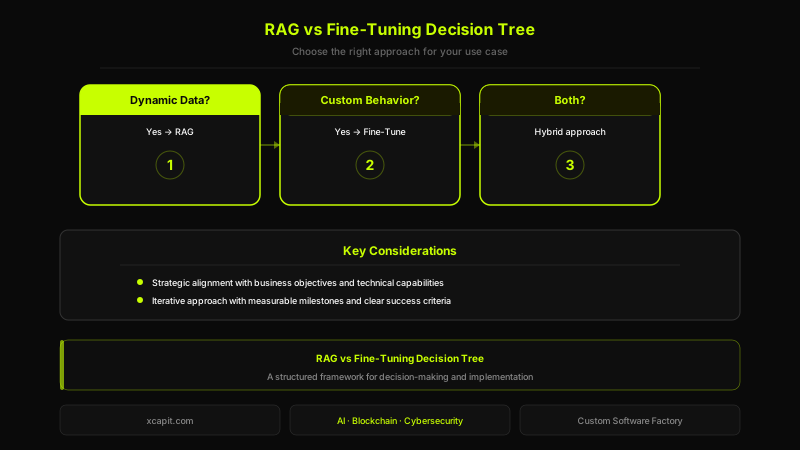
After working through this decision with dozens of client projects, we have distilled it into four key dimensions. Evaluating your project against these dimensions will point you toward RAG, fine-tuning, or a hybrid approach.
Data Freshness
How often does the knowledge your system relies on change? If it changes daily or weekly -- product catalogs, support documentation, regulatory updates -- RAG is the clear winner because new information can be indexed in minutes. If the domain knowledge is relatively stable -- medical procedures, legal precedent analysis, engineering standards -- fine-tuning becomes more viable because the model's internalized knowledge will not go stale quickly.
Response Format and Behavior
How strict are your output requirements? If you need consistent JSON schemas, specific document templates, or a particular analytical style across thousands of outputs, fine-tuning encodes this reliability into the model itself. RAG combined with prompt engineering can achieve formatting goals, but fine-tuning delivers more consistency at lower inference cost when the format requirements are non-trivial.
Cost and Infrastructure Constraints
RAG requires vector database infrastructure and adds latency, but avoids training costs. Fine-tuning requires GPU compute for training and a more specialized team, but reduces per-inference costs at scale. For teams without ML training expertise, RAG has a significantly lower barrier to entry. For high-volume production systems where every token counts, fine-tuning can deliver better unit economics.
Latency and Deployment Requirements
If you need sub-100-millisecond responses, or if the system must work offline or in air-gapped environments, fine-tuned models deployed locally are your only option. RAG inherently adds network latency for retrieval, and it requires connectivity to a vector database and an LLM API. For most enterprise web applications where 1-3 second response times are acceptable, this is not a concern. For real-time processing pipelines or edge deployments, it is a hard constraint.
The Hybrid Approach: Best of Both Worlds
In practice, the most effective enterprise AI systems combine both techniques. The hybrid approach uses fine-tuning for what it does best -- consistent behavior, formatting, and domain reasoning -- and RAG for what it does best -- dynamic knowledge retrieval and source grounding. This is not a theoretical ideal. It is the architecture we deploy most frequently for production client systems.
The pattern works like this: fine-tune a base model on examples that teach it your domain's reasoning patterns, output format, and communication style. Then use RAG to provide that fine-tuned model with current, specific knowledge at query time. The fine-tuned model knows how to reason about your domain. The RAG pipeline tells it what to reason about. Neither component is doing a job the other is better suited for.
A practical example: for a compliance checking system, we fine-tuned a model to understand regulatory reasoning patterns -- how to interpret 'shall' versus 'should' in legal language, how to identify conflicts between requirements, how to structure compliance findings. But the specific regulations being checked are provided via RAG, because regulatory texts are updated regularly and the system needs to cite specific sections and dates. The fine-tuned model 'thinks like a compliance analyst.' RAG gives it the current rule book to think about.
Real Examples From Our Client Projects
Theory is useful, but decisions are made in context. Here is how we approached the RAG-versus-fine-tuning decision in three recent client engagements.
Customer Support Automation: RAG
A fintech client needed an AI system to handle tier-1 support tickets -- account inquiries, transaction explanations, product questions. Their knowledge base included 2,000+ help articles, 500+ product FAQ entries, and internal policy documents that were updated weekly. We chose RAG for this project because data freshness was critical (policies changed frequently and the system needed to reflect updates within hours), source attribution was legally required (every response needed to cite the specific policy or article it was based on), and the client needed model flexibility to switch providers without rebuilding the system.
The RAG pipeline indexed all knowledge base content with semantic chunking and daily incremental updates. Reranking ensured that policy-relevant chunks ranked above generic FAQ content when both were relevant. Response quality improved from 72% accuracy with naive RAG to 91% after implementing hybrid search (vector + BM25), reranking, and a metadata filtering layer that prioritized recent documents.
Document Classification Pipeline: Fine-Tuning
An energy sector client processed thousands of regulatory filings, inspection reports, and compliance documents monthly. They needed a system that could classify each document into one of 47 categories, extract key entities (dates, facility IDs, violation types), and route it to the correct department -- all with sub-second latency and 95%+ accuracy.
We chose fine-tuning because the classification taxonomy was stable (categories had not changed in three years), the formatting and extraction patterns were highly specific and consistent, latency requirements ruled out a retrieval step, and the client had 15,000 manually labeled documents for training. We fine-tuned a Mistral 7B model using QLoRA on the labeled dataset. The resulting model achieved 96.3% classification accuracy and processed documents in 180 milliseconds -- 4x faster than the RAG-based prototype we benchmarked against.
Compliance Checking System: Hybrid
A government sector client needed a system to review contractor submissions against a complex regulatory framework spanning federal, state, and municipal requirements. The system needed to identify compliance gaps, cite specific regulatory sections, and generate structured findings reports following a precise template.
Neither RAG nor fine-tuning alone would have worked. RAG alone could retrieve relevant regulations but struggled with the multi-hop reasoning required -- comparing a contractor's claim against requirement A, which references exception B, which is modified by recent amendment C. Fine-tuning alone could not keep up with regulatory changes and could not provide the source citations required for legal defensibility. The hybrid approach fine-tuned a model on 3,000 annotated compliance reviews to teach it regulatory reasoning patterns and the client's findings report format. RAG provided the current regulatory text, indexed with hierarchical chunking that preserved cross-reference relationships. The result was a system that reasoned about regulations like a compliance expert while always grounding its analysis in the current, citable regulatory text.
Making the Right Choice for Your Project
The RAG-versus-fine-tuning decision is ultimately an engineering decision, not a philosophical one. Start by clearly defining your requirements across the four dimensions -- data freshness, output consistency, cost constraints, and latency needs. Prototype with RAG first because it is faster to build and iterate on. If you hit a ceiling that better prompting and retrieval optimization cannot break through, evaluate whether fine-tuning addresses the specific gap. And keep hybrid architectures in your toolkit for complex domains where neither approach alone is sufficient.
The most expensive mistake is not choosing the wrong technique. It is committing to an architecture without understanding its limitations, then discovering those limitations in production when changing course is 10x more expensive. Invest in prototyping and evaluation before committing to a production architecture, and design your system so the retrieval and generation components can evolve independently.
If you are facing this decision on a current project and want to talk through the trade-offs with someone who has made it dozens of times, reach out. At Xcapit, we help teams design AI architectures that match their actual requirements -- not the latest hype cycle. Learn more about our AI development services at /services/ai-development.

Fernando Boiero
CTO & Co-Founder
Over 20 years in the tech industry. Founder and director of Blockchain Lab, university professor, and certified PMP. Expert and thought leader in cybersecurity, blockchain, and artificial intelligence.
Ready to leverage AI & Machine Learning?
From predictive models to MLOps — we make AI work for you.
You Might Also Like
Innovating faster doesn't mean building faster: it means validating first
AI makes it possible to build prototypes in hours, but it introduces a new risk: building too fast without having validated whether the solution answers a real need. Why speed today is measured by the ability to validate.
What is a Product Builder and why will it be one of the most important roles in digital transformation?
When building gets faster and faster, the challenge becomes knowing what is worth building. What a Product Builder does, how they connect business and technology, and why AI amplifies their work without replacing their judgement.
If everyone has Artificial Intelligence, where will the competitive advantage be?
AI is no longer a barrier to entry: today it is within reach of companies of every size. Why the difference is no longer about using AI, but about how it is used and the quality of the architecture that integrates it.