
Every company that has taken an AI agent from prototype to production has experienced the same reckoning: the costs are nothing like what the proof of concept suggested. A demo running on a $20/month API key suddenly requires infrastructure, monitoring, fallback systems, and operational overhead that can exceed the original estimate by an order of magnitude. This is not a planning failure -- it is the predictable gap between 'it works on my laptop' and 'it works reliably for 10,000 users at 3 AM on a Sunday.'
Having overseen AI agent financials at Xcapit -- and having spent years in corporate finance at Deloitte before that -- I have learned that companies succeeding with AI agents are not the ones spending the most. They understand the full cost structure before committing, budget for the messy middle where costs spike before optimization kicks in, and build financial guardrails from day one. This is the cost briefing I wish someone had given me before our first production deployment.
Why AI Agent Costs Surprise Everyone
The prototype-to-production cost gap in AI agents is larger than in traditional software. A web application in development uses the same database and APIs as production -- just at lower scale. An AI agent prototype, by contrast, operates in a fundamentally different cost regime than its production counterpart.
In development, you test with a handful of queries, tolerate slow responses, skip monitoring, ignore edge cases, and use a single powerful model for everything. In production, you handle thousands of concurrent sessions, need sub-second routing decisions, log every interaction for compliance and debugging, handle every edge case gracefully, and implement model cascading with fallback chains. Each of these production requirements adds a cost layer that simply does not exist in the prototype.
The result is predictable: teams that budget based on prototype costs end up 5-15x under budget within the first quarter of production. This is not a sign that AI agents are too expensive. It is a sign that the industry has not yet developed mature cost estimation practices. This article aims to fix that.
Token and API Costs: The Visible Expense
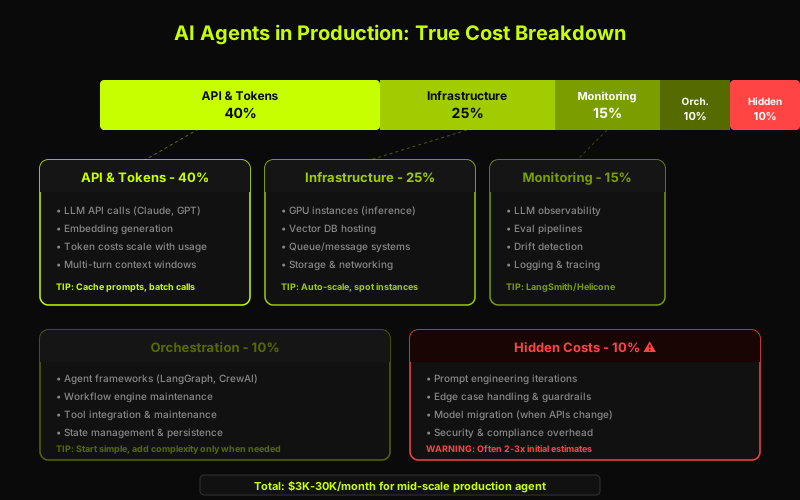
Token costs are the most visible line item in an AI agent budget, and they are often the one that executives fixate on. Depending on the use case, token and API spend typically represents 30-50% of total production costs. But the actual number depends on variables that are difficult to estimate from a prototype.
Estimating Token Volume
A single agent interaction is not a single API call. A customer support agent handling one ticket might make 3-8 LLM calls: classifying the query, retrieving context, reasoning about the response, checking against policies, and generating the output. Multiply the average tokens per interaction by expected daily volume, then add a 30-40% buffer for retries and unexpectedly complex queries.
As a rough benchmark: a document processing agent handling 500 documents per day might consume 15-30 million tokens monthly. A customer support agent handling 200 tickets per day might use 8-15 million tokens monthly. An internal research agent serving 50 knowledge workers might consume 5-10 million tokens monthly. At current pricing for frontier models, these volumes translate to $500-$5,000 per month in API costs alone -- before any optimization.
Optimization Levers
Three strategies consistently reduce token costs by 40-70%. First, prompt caching: if your agent uses a large system prompt or frequently retrieves the same context, caching at the API level can cut costs by 50-90% on cached portions. Most LLM providers now support this, and it should be enabled from day one.
Second, model selection by task complexity. Classification, extraction, and formatting tasks can be handled by smaller models at 10-20% of the cost -- reserve frontier models for tasks requiring complex judgment. Third, request batching: where latency is not critical, batching multiple requests reduces per-request overhead and often qualifies for lower pricing tiers.
Infrastructure Costs: The Foundation
Infrastructure typically represents 20-35% of total production costs and includes several components that are easy to overlook during planning.
Compute and Orchestration
The agent orchestration layer -- managing conversation state, routing requests, invoking tools, handling retries -- runs on traditional compute. For moderate workloads (1,000-5,000 sessions per day), expect $800-$2,500 per month for compute, load balancing, and auto-scaling. If you add self-hosted open-source models, GPU compute enters the picture at $3,000-$6,000 per month for a redundant pair of A100 instances -- only economical when token volume is high enough to offset the fixed cost.
Vector Databases and Embedding Storage
Most production agents use retrieval-augmented generation (RAG), requiring a vector database for document embeddings. Managed services (Pinecone, Weaviate Cloud, Qdrant Cloud) cost $70-$500 per month. The often-overlooked cost is embedding generation itself -- converting your knowledge base into vectors and keeping them current. For 50,000 documents with weekly re-indexing, embedding costs run $100-$400 monthly.
Caching Layers
Intelligent caching is both a cost and a cost-reduction strategy. A Redis or Memcached layer for caching frequent queries and tool results typically costs $50-$300 per month in managed services. But it can reduce total API costs by 20-40% by avoiding redundant LLM calls for repeated or similar queries. The ROI on caching infrastructure is almost always positive within the first month.
Orchestration Overhead: The Complexity Tax
Production agents require orchestration logic that does not exist in prototypes: retry mechanisms with exponential backoff, fallback chains (if Model A fails, try Model B, then degrade gracefully), timeout handling, rate limit management, and circuit breakers. Agent frameworks like LangChain or CrewAI reduce development time but introduce their own costs -- learning curves, dependency management, and framework limitations. Budget 15-25% of initial development effort for orchestration engineering, and 10-15% of ongoing engineering time for maintenance.
For multi-agent systems, orchestration costs multiply. Inter-agent communication, shared state management, and end-to-end tracing across agent boundaries add significant overhead. In our experience, multi-agent orchestration costs 2-3x more than single-agent orchestration because the interaction surface grows geometrically.
Monitoring and Observability: The Non-Negotiable
You cannot operate an AI agent you cannot observe. Unlike traditional software where monitoring means tracking uptime, latency, and error rates, AI agent monitoring requires capturing and analyzing the quality of every decision the agent makes. This is both more important and more expensive than traditional application monitoring.
What You Need to Monitor
- Interaction logging -- Every user query, agent reasoning step, tool invocation, and final response must be logged for debugging, compliance, and quality analysis. Storage costs for comprehensive interaction logs run $200-$800 per month at moderate volumes.
- Quality evaluation -- Automated checks on agent outputs (factual accuracy, policy compliance, tone) using LLM-as-judge patterns or rule-based validators. This adds 10-20% to your token costs because you are effectively running a second model to evaluate the first.
- Drift detection -- Monitoring for changes in agent behavior over time, which can occur when underlying models are updated, knowledge bases change, or user query patterns shift. Drift detection requires maintaining baseline metrics and running statistical comparisons, typically through specialized platforms.
- Cost attribution -- Tracking spend per user, per department, per use case, and per agent to understand where money is going and whether the ROI justifies it. Without cost attribution, optimization is guesswork.
Specialized observability platforms for AI agents (LangSmith, Helicone, Braintrust, Arize) cost $500-$3,000 per month depending on volume and features. Building custom observability adds 2-4 weeks of engineering time upfront and ongoing maintenance. Either way, plan for observability to represent 10-20% of your total production costs.
The Cost Curve: Why It Gets Worse Before It Gets Better
One of the most important financial realities of AI agent deployments is the cost curve. In months 1-3 of production, costs typically increase as you discover edge cases, expand monitoring, add fallback systems, and handle complexity the prototype never encountered. Many companies panic during this phase and either pull the plug prematurely or freeze optimization.
In months 3-6, optimization begins to take effect. Caching warms up, model cascading is tuned, prompts are refined, and the team develops an intuition for which cost levers matter most. By month 6-9, most well-managed deployments reach a steady state where costs are 40-60% lower than the month-3 peak. The key is budgeting for this curve and communicating it to stakeholders in advance. If leadership expects costs to decrease linearly from launch, they will lose confidence precisely when the team is doing the hardest optimization work.
Cost Optimization Strategies That Actually Work
Model Cascading
Model cascading is the single most effective cost optimization strategy. Route every query through a fast, cheap model first. If confidence is high and the task is straightforward, use its output. If confidence is low or the task requires complex reasoning, escalate to a frontier model. In practice, 60-80% of production queries can be handled by smaller models, reducing average per-query cost by 40-70%.
The implementation requires a confidence scoring mechanism and a routing layer, but the infrastructure cost of the routing layer is trivial compared to the token savings. We have seen clients reduce monthly API spend from $8,000 to $2,500 with model cascading alone, with no measurable impact on output quality.
Semantic Caching
Traditional caching matches exact queries. Semantic caching uses embedding similarity to identify queries close enough to return a cached response -- 'What is your refund policy?' and 'How do I get a refund?' are treated as equivalent. This is particularly effective for customer-facing agents where query patterns are repetitive, reducing LLM calls by 20-40%.
Prompt Engineering as Cost Control
Every unnecessary token in your system prompt is multiplied by every request. A 2,000-token system prompt serving 10,000 requests per day consumes 20 million tokens daily in input alone. Reducing that prompt to 1,200 tokens -- through compression, removing redundant instructions, and using structured formats -- saves 8 million tokens per day. At $3 per million input tokens, that is $24/day or $720/month from a single optimization. Prompt engineering is not just about quality -- it is a direct cost lever.
Hidden Costs That Break Budgets
Beyond the obvious infrastructure and API expenses, several cost categories consistently catch companies off guard.
- Data labeling for evaluation -- You cannot measure agent quality without ground-truth data. Creating and maintaining evaluation datasets requires human labelers who understand the domain. Budget $2,000-$8,000 per month for ongoing evaluation data, depending on how rapidly your use cases evolve.
- Prompt engineering time -- Production prompts are living documents that require continuous refinement as edge cases are discovered and model behaviors change. A senior engineer spending 20% of their time on prompt maintenance is a $3,000-$5,000 monthly cost that rarely appears in AI agent budgets.
- Incident response -- When an AI agent produces a bad output that reaches a customer or makes a consequential error, the response involves investigation, root cause analysis, prompt or guardrail updates, regression testing, and stakeholder communication. Budget for 1-3 incidents per month in the first year, each consuming 8-20 hours of engineering time.
- Model migration -- LLM providers deprecate model versions, change pricing, and alter behavior. Migrating from one model version to another requires testing, prompt adjustments, and evaluation against your quality benchmarks. Plan for 1-2 model migrations per year, each consuming 1-2 weeks of engineering effort.
- Compliance and legal review -- For agents that interact with customers or handle regulated data, legal review of agent behaviors, output disclaimers, and data handling practices adds $5,000-$15,000 annually in legal costs.
A Practical Budgeting Framework
Based on our experience deploying AI agents across fintech, energy, and enterprise clients, here is a framework for estimating monthly production costs. These ranges assume a mid-complexity agent handling 1,000-5,000 sessions per day.
Token/API costs: $1,500-$5,000/month (post-optimization). Compute infrastructure: $800-$3,000/month. Vector database and embeddings: $200-$800/month. Caching: $50-$300/month. Observability: $500-$2,000/month. Engineering maintenance: $3,000-$6,000/month. Evaluation data and labeling: $1,000-$4,000/month. Total estimated range: $7,050-$21,100 per month for a single production agent.
For the first three months, multiply the upper bound by 1.5x to account for the optimization curve. For multi-agent systems, multiply by the number of agents and add 30% for orchestration overhead. These are not small numbers, but they need to be compared against the value the agent delivers -- not against zero.
ROI: When the Costs Are Justified
The financial case for AI agents is strongest in three scenarios. First, replacing high-volume repetitive work: a customer support agent handling 3,000 tickets per month at $15,000-$20,000 in costs versus a human team costing $40,000-$60,000 delivers clear ROI within 2-3 months. Second, enabling previously impossible capabilities: a compliance monitoring agent reviewing every transaction in real time may cost $12,000 per month but prevent regulatory fines reaching millions. Third, accelerating revenue: a sales intelligence agent costing $8,000 per month that helps the team close 15-20% more deals needs to contribute just two additional closes at $50,000 average deal size to justify itself.
The ROI case is weakest when the agent handles low-volume, high-complexity tasks requiring heavy human oversight, or when the organization lacks data infrastructure for reliable agent performance. In these situations, total cost of ownership -- including the human review layer -- can exceed the cost of having skilled people do the work directly.
Building Financial Guardrails Into Your Agent System
Cost control cannot be an afterthought. Build financial guardrails directly into the agent architecture: per-session token budgets that trigger graceful degradation when exceeded, daily and monthly spend limits with automatic alerts at 70%, 85%, and 95% thresholds, cost attribution on every request to trace spend to specific users and use cases, and ROI justification requirements for any capability adding more than $500 per month.
At Xcapit, we build these financial guardrails into every agent system we deploy. Our clients receive real-time cost dashboards that show spend by agent, by model, and by use case -- enabling data-driven decisions about where to optimize and where the investment is paying off.
Running AI agents in production is not cheap, but the costs are predictable and manageable when you understand the full picture. The companies getting burned are not the ones spending too much -- they are the ones who did not budget for reality. If you are planning an AI agent deployment and want a realistic financial model before you commit, our team can help you estimate costs, design optimization strategies, and build systems with financial guardrails from the start. Learn more about our AI development services at /services/ai-development.

Antonella Perrone
COO
Previously at Deloitte, with a background in corporate finance and global business. Leader in leveraging blockchain for social good, featured speaker at UNGA78, SXSW 2024, and Republic.
Ready to leverage AI & Machine Learning?
From predictive models to MLOps — we make AI work for you.
You Might Also Like
MWC 2026: The Agentic Era Is No Longer a Promise — It's Strategy
Three lessons from Mobile World Congress 2026 redefining how enterprises adopt AI: from pilot to real value, from isolated agents to orchestrated enterprises, and why company size no longer matters.
From OpenClaw to Agentor: Building Secure AI Agents in Rust
How a security audit of an open-source AI agents framework revealed Python's limits and led us to build Agentor -- a Rust-based framework optimized for code generation.
Designing Autonomous Agents with LLMs: Lessons Learned
How we architect autonomous AI agents in production -- from perception-planning-execution loops to orchestration patterns, memory systems, and guardrails.