

Artificial intelligence is no longer a future technology — it's a present-day competitive advantage. But for many enterprise leaders, the gap between AI hype and practical implementation remains wide. This guide cuts through the noise and provides a framework for evaluating where AI can deliver real value in your organization.
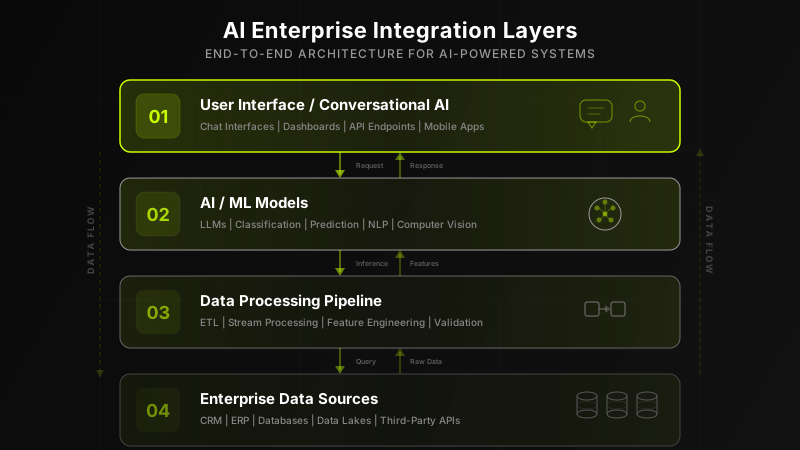
The State of Enterprise AI in 2026
The enterprise AI landscape has matured significantly. Large language models (LLMs) have become commoditized, making NLP capabilities accessible to organizations of all sizes. Computer vision has moved beyond proof-of-concept into production deployments. And MLOps practices have evolved to make AI systems more reliable and maintainable.
Yet adoption remains uneven. While tech-forward companies have integrated AI into core business processes, many organizations are still struggling with their first implementations. The difference isn't budget — it's approach.
Where AI Delivers the Most Value
Document Processing and Knowledge Extraction
One of the highest-ROI applications of AI is automating document processing. From invoice extraction and contract analysis to compliance document review, NLP models can process thousands of documents in minutes with accuracy that matches or exceeds human reviewers. Organizations processing more than 500 documents per month see payback periods under 6 months.
Predictive Analytics for Business Planning
Machine learning models excel at identifying patterns in historical data to predict future outcomes. Demand forecasting, inventory optimization, customer churn prediction, and credit risk scoring are all proven use cases with measurable ROI. The key is having clean, structured data and clear business metrics to optimize for.
Quality Control and Visual Inspection
Computer vision systems can detect defects, anomalies, and quality issues in manufacturing, agriculture, and logistics with consistency that human inspectors cannot match over long shifts. These systems integrate with existing production lines and provide real-time feedback.
Customer Service Automation
Modern AI-powered customer service goes far beyond scripted chatbots. LLM-based systems can understand context, access knowledge bases, and handle complex multi-turn conversations. When properly implemented, they resolve 60-80% of common inquiries while escalating complex cases to human agents with full context.
Build vs. Buy: Making the Right Decision
Not every AI capability needs to be built from scratch. The decision framework depends on three factors:
- Competitive differentiation: If AI is core to your value proposition, build custom solutions
- Data sensitivity: If your data can't leave your infrastructure, you need custom deployment
- Customization needs: Off-the-shelf solutions work for generic tasks; custom models excel for domain-specific problems
For most organizations, the optimal approach is a hybrid: use commercial APIs for commodity tasks (translation, speech-to-text, generic image classification) and build custom models for tasks specific to your domain and competitive advantage.
The Implementation Roadmap
Phase 1: Data Audit (2-4 weeks)
Before writing any AI code, audit your data. What data do you have? How clean is it? Where are the gaps? This phase determines what's actually possible and prevents the common pitfall of starting development before data is ready.
Phase 2: Proof of Concept (4-8 weeks)
Build a focused PoC that demonstrates value on a single use case with real data. The goal isn't perfection — it's proving the approach works and establishing baseline metrics. Use this to build organizational buy-in.
Phase 3: Production MVP (2-4 months)
Productionize the PoC with proper error handling, monitoring, data pipelines, and user interfaces. This is where MLOps practices become critical — you need automated retraining, model versioning, and performance monitoring.
Phase 4: Scale and Iterate (Ongoing)
With the first use case in production, expand to additional applications. Each iteration is faster because infrastructure, processes, and organizational knowledge compound.
Common Pitfalls to Avoid
- Solving for technology instead of business outcomes
- Starting with the hardest problem instead of the highest-ROI one
- Underestimating data preparation — it typically consumes 60-80% of project time
- Treating AI as a one-time project instead of an ongoing capability
- Not establishing clear success metrics before starting
Getting Started
The most important step is the first one: identify a specific business problem where AI can deliver measurable value, and validate that you have (or can acquire) the data needed to solve it. Everything else follows from there.
At Xcapit, we help organizations navigate the full AI journey — from data audit and strategy through production deployment and ongoing optimization. Our team combines deep ML expertise with practical experience building AI solutions for fintech, international development, and enterprise clients.

José Trajtenberg
CEO & Co-Founder
Lawyer and international business entrepreneur with over 15 years of experience. Distinguished speaker and strategic leader driving technology companies to global impact.
Ready to leverage AI & Machine Learning?
From predictive models to MLOps — we make AI work for you.
You Might Also Like
If everyone has Artificial Intelligence, where will the competitive advantage be?
AI is no longer a barrier to entry: today it is within reach of companies of every size. Why the difference is no longer about using AI, but about how it is used and the quality of the architecture that integrates it.
Will Artificial Intelligence replace developers? Why software engineering matters more than ever
AI automates code generation, testing and documentation, but it does not replace engineering. Why, as writing code becomes easier, the value of those who design architectures and understand the business goes up.
Innovating also means exploring: why companies need to build a culture of experimentation
When new AI tools appear practically every day, innovating no longer depends on adopting technology but on exploring, learning and experimenting continuously. How Xcapit Labs turns that exploration into business capability.