
The guaranteed credit pilot between Xcapit Labs and Naranja X proved that it is possible to build a financial system where trust does not depend on human intermediaries, but on programmed and immutable rules. This article is a technical deep dive into the architecture that made it possible.
The challenge: guarantee without trusted intermediaries
Traditional guaranteed credit systems rely on custodians, validators, and reconcilers — actors that add cost, time, and risk to the process. Each intermediary introduces a point of failure: verification delays, reconciliation errors, exposure to internal fraud. The challenge was to eliminate this chain of delegated trust and replace it with programmatic trust.
Architecture components
Smart contract (system core)
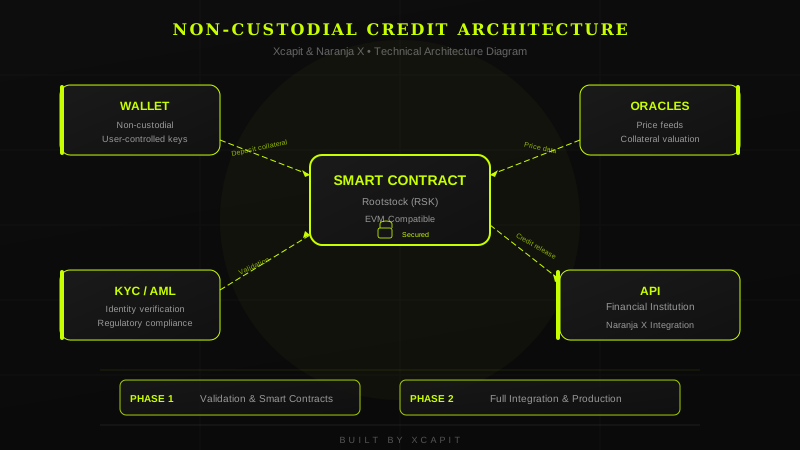
The smart contract is the heart of the architecture. Its function is simple but critical: lock USDC collateral and permit exclusively two operations — release to the user (if payments are met) or liquidation to the lender (if the contract is breached). There is no third option. The contract is immutable once deployed: neither Xcapit, nor Naranja X, nor any third party can modify its rules.
Non-custodial wallet
The user retains complete control of their assets through a non-custodial wallet. The private key never leaves the user's device. Interaction with the smart contract is performed through locally signed transactions. This means that even in a server compromise scenario, the user's funds remain secure — the only way to move collateral is through the contract's predefined rules.
API integration
The integration layer connects on-chain events with Naranja X's core systems in real time. When the smart contract confirms the collateral deposit, an API notifies the credit issuance system. The confirmation is verifiable: any party can query the blockchain to validate that the collateral is effectively locked.
Oracles
Oracles validate off-chain events that the smart contract needs to make decisions. Primarily, they feed real-time price quotes to assess the collateralization ratio and determine whether liquidation is triggered. The oracles used are independent and decentralized, avoiding single points of failure in data feeds.
Compliance integrated from the design
- KYC/AML: identity validation through specialized providers, automatic cross-checking against national and international control lists, immutable record of all verifications
- Interoperability: SEP-24 and SEP-6 standard support to facilitate integration with other financial systems and meet regulatory interoperability requirements
- ISO 27001: the entire operation under Xcapit's certified information security management system, with access controls, continuous monitoring, and incident management
Two validation phases
Phase 1: Functional validation
- End-to-end full flow testing: deposit, lock, credit issuance, payment, and release
- Minimum viable integration with Naranja X systems to validate cross-layer communication
- Usability testing with users unfamiliar with cryptocurrency to measure friction and drop-off points
Phase 2: Deep integration
- Automated approvals: the complete evaluation, issuance, and monitoring flow without manual intervention
- UX improvements: simplified interface for non-technical users, reduced steps and wait times
- Profile adjustments: calibration of collateralization parameters based on behavior observed during Phase 1
Scalability: beyond credit
The validated model does not depend on banking history, but on three pillars: digital identity, verifiable collateral, and programmable rules. This combination makes it adaptable to multiple sectors beyond financial credit.
- Insurance: parameterized policies with automatic execution based on verifiable data (weather, prices, events)
- Energy and carbon credits: tokenization of renewable energy certificates with traceability from generation to offset
- Agriculture: crop financing with collateral based on IoT oracle-verified production
- Education: educational credits guaranteed by on-chain verifiable academic outcomes
- Supply chain and logistics: inventory financing with collateral based on verifiable in-transit merchandise tracking
Conclusion
Trust can be programmed. Risk can be reduced through immutable rules. And financial inclusion does not have to compromise security — in fact, when the architecture is right, it includes it by design. The pilot with Naranja X proved that these are not theoretical claims: they are operational results from a system in production.

Fernando Boiero
CTO & Co-Founder
Over 20 years in the tech industry. Founder and director of Blockchain Lab, university professor, and certified PMP. Expert and thought leader in cybersecurity, blockchain, and artificial intelligence.
Building regulated financial products?
From digital wallets to tokenized collateral and secure platforms, we build fintech systems designed for production.
You Might Also Like
Xcapit Labs & Naranja X: Credit with Smart Contracts
In November 2024, Xcapit Labs launched with Naranja X a guaranteed credit pilot using crypto-assets as collateral through smart contracts on Rootstock. A milestone in blockchain applied to financial services in Latin America.
Shielding credit risk: how Web3 technology simplifies bank and guarantee society processes in agriculture
Autonomous collateral locking, real-time value monitoring and guaranteed algorithmic execution: the three tools reshaping risk analysis in agricultural credit.
Programmable guarantees: what we learned deploying smart contracts in the real financial system
From our work with Banco Industrial and a leading fintech to the mutual guarantee ecosystem: how smart contracts shield credit risk and cut guarantee issuance from weeks to minutes.