

Every company faces the same tension: employees need more benefits, but the budget is not infinite. Every additional dollar in compensation drags along social charges, employer contributions, and indirect costs that can double the financial impact. The question is: how do you improve employee benefits without increasing labor costs?
What is Bonum
Bonum is a digital benefits platform designed for mid-to-large companies. Its core is a closed-loop wallet: the company allocates points to its employees, employees use them at a network of affiliated merchants, and merchants invoice the company monthly. No cards, no payment processors, no financial intermediaries.
The three-actor ecosystem
- The company allocates points according to its defined rules: fixed monthly amount, by seniority, by department, by performance, or any custom criteria
- The employee receives points in the app and uses them at affiliated merchants by paying with QR or alias, with an experience similar to any digital wallet
- Affiliated merchants process purchases and invoice the company monthly, with no need for traditional payment method integration
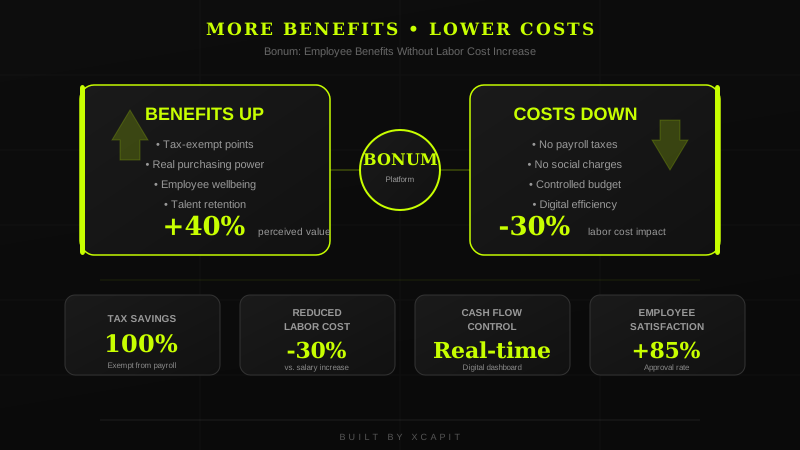
Benefit 1: Real tax savings
Benefits channeled through Bonum can be structured under favorable tax treatments. The platform enables optimization of income tax, VAT, and turnover tax treatment, transforming what would be a pure labor expense into a deductible item with automatic traceability. Each transaction generates an auditable record that simplifies tax reporting.
Benefit 2: Reduced total labor cost
This is the most significant structural advantage. Benefits channeled as non-wage points do not generate:
- Social charges
- Workers' compensation insurance
- Employer contributions
- Proportional vacation
- Annual bonus (13th salary)
- Severance
This means that every dollar allocated as a Bonum point has a significantly lower real cost than the same dollar allocated as compensation. The company can offer more perceived value to the employee with less budget impact.
Benefit 3: Financial savings and cash flow control
The end-of-month consolidation model changes the financial dynamic. Instead of immediate and scattered disbursements, the company concentrates payment into a single monthly invoice per merchant. This allows negotiating payment terms, planning cash flow with precision, and having complete visibility of the consumption cycle before paying.
Benefit 4: Greater employee satisfaction
Employees value tangible benefits. A Bonum point becomes real purchases at local merchants: supermarkets, pharmacies, restaurants, gas stations, clothing stores, services. The user experience is simple — app, QR, done — and the perceived value is high because it translates into everyday consumption, not abstract benefits that nobody uses.
Ready product: scalable SaaS
Bonum is a functional SaaS product that includes all the infrastructure needed to operate:
- Complete transactional infrastructure: QR payment processing, balance management, operation history
- Affiliated merchant management: onboarding, offboarding, transaction monitoring, automated monthly settlement
- Administration panel: bulk or individual point allocation, rule configuration, user management
- Automated reports: consumption by employee, by merchant, by period, exportable for accounting and audit
- Scalability: architecture designed to grow with the organization, with no artificial limits on users or transactions
Impact on local economies
There is a benefit that transcends the company-employee equation: the impact on local economies. When benefits are channeled toward affiliated local merchants, value circulates within the community. Neighborhood stores receive a predictable flow of customers, employees access nearby products and services, and the company strengthens its relationship with the environment where it operates. It is a model where everyone wins.

Fernando Boiero
CTO & Co-Founder
Over 20 years in the tech industry. Founder and director of Blockchain Lab, university professor, and certified PMP. Expert and thought leader in cybersecurity, blockchain, and artificial intelligence.
Building regulated financial products?
From digital wallets to tokenized collateral and secure platforms, we build fintech systems designed for production.
You Might Also Like
Shielding credit risk: how Web3 technology simplifies bank and guarantee society processes in agriculture
Autonomous collateral locking, real-time value monitoring and guaranteed algorithmic execution: the three tools reshaping risk analysis in agricultural credit.
From requirements to discovery: why companies need to rethink the way they build technology
The model of handing a requirements document to a technical team is starting to show its limits. Why the real challenge is no longer executing a list of features, but understanding precisely the problem you are trying to solve.
The new competitive advantage isn't building faster, it's discovering better what to build
AI accelerated development like never before and laid bare the real risk in every technology project: choosing the wrong thing to build. Why the competitive edge has shifted from execution speed to the quality of early decisions.