

Financial technology applications are the number one target for cyberattacks — and it is not hard to understand why. Fintech platforms process payments, store sensitive financial data, manage investment portfolios, and facilitate lending decisions. A single vulnerability can expose millions of dollars in funds, compromise thousands of customers' personal and financial data, and trigger regulatory consequences that threaten the company's survival.

Generic penetration testing methodologies are insufficient for fintech. Financial applications have unique attack surfaces: complex payment flows with race condition vulnerabilities, multi-party integrations with banks and payment processors, regulatory compliance requirements that dictate specific security controls, and business logic that is inherently more complex than a typical web application. This checklist covers the areas that matter most when testing financial applications, organized by domain.
Why Fintech Needs Specialized Pentesting
Standard web application penetration testing focuses on common vulnerability classes — SQL injection, cross-site scripting, broken authentication. These are necessary but far from sufficient for fintech. Financial applications face three categories of elevated risk:
First, regulatory requirements. Depending on the jurisdiction and the services offered, fintech companies may need to comply with PCI DSS (payment card data), SOC 2 (service organization controls), PSD2 (European payment services), GLBA (US financial privacy), and various national banking regulations. Each framework mandates specific security testing requirements, and failing to meet them can result in fines, loss of banking partnerships, or inability to operate.
Second, high-value targets. The direct financial incentive for attackers is orders of magnitude higher than for most applications. Attackers invest proportionally more effort in finding vulnerabilities, including sophisticated business logic attacks that automated scanners cannot detect.
Third, complex integrations. A typical fintech application connects to banking APIs, payment processors, credit bureaus, identity verification services, and often other fintech platforms. Each integration point introduces potential attack surface, and the interactions between these systems create emergent vulnerabilities that only appear when the full system is tested together.
Pre-Engagement Planning
A successful pentest begins well before the first scan. Inadequate planning leads to wasted time, missed vulnerabilities, and potentially dangerous unintended consequences — especially critical in financial environments where disrupting production systems can have immediate monetary impact.
Scope Definition
Defining scope for fintech pentesting requires precision. Financial applications typically include customer-facing web and mobile apps, internal admin dashboards, APIs (both public and partner-facing), payment processing infrastructure, and third-party integrations. Each component may have different risk profiles and testing constraints.
Document explicitly what is in scope and what is out of scope. Third-party payment processors and banking APIs often cannot be tested directly — you will need to define boundaries around these integrations and focus testing on how your application interacts with them. Include both authenticated and unauthenticated testing perspectives, and define which user roles should be tested (customer, admin, support agent, partner).
Compliance Requirements: PCI DSS and SOC 2
If your application handles payment card data, PCI DSS requires annual penetration testing that covers the cardholder data environment (CDE). PCI DSS v4.0 specifically mandates testing of network segmentation controls, testing from both inside and outside the network, and validation that all in-scope systems are included. The test must be conducted by a qualified assessor, and findings must be remediated and retested.
SOC 2 Type II audits evaluate security controls over a period of time and often require evidence of regular penetration testing as part of the risk assessment process. While SOC 2 does not prescribe specific testing methodologies, auditors expect to see comprehensive coverage, documented findings, and evidence of remediation. Aligning your pentest methodology with both frameworks from the start saves significant effort during audit season.
Rules of Engagement
Rules of engagement for fintech pentesting must be unusually detailed. Define testing windows to avoid peak transaction periods. Establish immediate escalation procedures for critical findings — if a tester discovers an actively exploitable vulnerability in a production payment flow, there must be a clear process to notify the right people immediately. Specify rate limits for automated testing to avoid triggering fraud detection systems or impacting production performance. And ensure legal authorization covers all testing activities, including social engineering if it is in scope.
Environment Setup
Ideally, penetration testing occurs in a staging environment that mirrors production as closely as possible. For fintech applications, this means realistic test data (anonymized production data is ideal), functioning integrations with payment processor sandbox environments, and representative transaction volumes. Testing in an environment that differs significantly from production will miss configuration-level vulnerabilities and integration-specific issues.
Authentication and Authorization Testing
Authentication and authorization are the front door of any fintech application. Failures here directly expose user accounts and funds. This area requires exhaustive testing:
- Multi-factor authentication (MFA): Verify that MFA is enforced for all sensitive operations (login, fund transfers, profile changes). Test for MFA bypass techniques including session fixation after MFA, response manipulation, and race conditions in MFA verification. Ensure backup codes are properly hashed and single-use.
- Session management: Test session token entropy, expiration policies, and concurrent session handling. Verify that sessions are invalidated on password change, MFA reset, and account deactivation. Check for session fixation vulnerabilities and ensure tokens are not exposed in URLs, logs, or error messages.
- API key handling: Evaluate how API keys are generated, stored, rotated, and revoked. Test for key leakage in client-side code, version control history, and error responses. Verify that API keys have appropriate scope limitations and cannot be used to escalate privileges.
- OAuth 2.0 flows: If the application implements OAuth, test for authorization code interception, CSRF in the authorization flow, token leakage through redirect URI manipulation, and scope escalation. Verify PKCE implementation for public clients and ensure refresh tokens are properly bound to the original client.
- Role-based access control (RBAC) and privilege escalation: Map all user roles and their intended permissions. Systematically test horizontal privilege escalation (accessing another user's data at the same role level) and vertical privilege escalation (accessing admin functions as a regular user). Test IDOR (Insecure Direct Object Reference) vulnerabilities across all resource endpoints — this is consistently one of the most common findings in fintech applications.
- Password policies and account lockout: Verify that password complexity requirements meet industry standards, brute-force protections are effective (without enabling denial-of-service via account lockout), and password reset flows do not leak user enumeration information.
API Security Testing
Modern fintech applications are API-first. The API surface is where the majority of business logic resides and where the most impactful vulnerabilities are found. Test thoroughly across these areas:
- Input validation: Test all API endpoints for injection attacks (SQL, NoSQL, LDAP, command injection). Pay special attention to financial data fields — amount, currency, account identifiers — which may have custom parsing logic that introduces vulnerabilities. Test for type confusion attacks where string inputs are accepted where integers are expected.
- Rate limiting and throttling: Verify that rate limits are enforced consistently across all endpoints, not just login. Financial APIs without proper rate limiting are vulnerable to balance enumeration, transaction brute-forcing, and resource exhaustion. Test whether rate limits can be bypassed through header manipulation (X-Forwarded-For), API versioning, or parameter variation.
- Injection attacks on financial logic: Beyond standard injection, test for template injection in notification systems (email, SMS), expression language injection in rule engines, and SSRF in webhook or callback URLs. These are common in fintech platforms that dynamically generate financial reports or process external data.
- Business logic vulnerabilities: These are the highest-impact findings unique to fintech and cannot be detected by automated scanners. Test for negative amount handling (can a user transfer a negative amount to increase their balance?), boundary conditions in fee calculations, logic flaws in promotional or referral credit systems, and time-of-check-to-time-of-use (TOCTOU) vulnerabilities in balance verifications.
- Excessive data exposure: Review all API responses for data that should not be returned to the requesting client. Common findings include full account numbers in list views, other users' PII in shared endpoints, internal system identifiers, and detailed error messages that reveal infrastructure details. GraphQL APIs are particularly prone to this issue if introspection is enabled in production.
- API versioning and deprecated endpoints: Old API versions often lack security controls that were added to newer versions. Test whether deprecated endpoints are still accessible and whether they can be used to bypass security measures implemented in current versions.
Payment Flow Testing
Payment flows are where security vulnerabilities translate directly into financial loss. These tests require understanding the specific payment architecture and testing edge cases that developers may not have considered:
- Race conditions: Test for concurrent request vulnerabilities in balance deductions, transfer operations, and withdrawal processing. Can a user initiate multiple simultaneous withdrawals that each pass the balance check before any deduction is applied? Race conditions in payment systems are notoriously difficult to detect in code review but straightforward to test with concurrent request tools.
- Amount manipulation: Test whether transaction amounts can be modified client-side (in request parameters, hidden form fields, or JWT claims) after server-side validation. Test negative amounts, zero amounts, extremely large amounts, and amounts with excessive decimal precision. Verify that the server-side amount matches what was presented to the user at every step.
- Currency conversion exploitation: If the application handles multiple currencies, test the conversion logic for rounding errors that can be exploited at scale (salami attacks). Verify that exchange rates cannot be manipulated by the client and that rates are locked at transaction initiation, not at settlement.
- Refund and chargeback logic: Test the refund flow for vulnerabilities. Can a user receive a refund for a transaction that was already reversed? Can refund amounts exceed the original transaction? Are partial refunds tracked correctly against the original amount? Can the refund endpoint be called directly, bypassing the intended refund request workflow?
- Idempotency: Verify that payment operations are truly idempotent — submitting the same transaction multiple times (due to network retries, user double-clicks, or intentional replay) should not result in duplicate charges or transfers. Test idempotency key generation, expiration, and scope.
- Transaction sequencing: Test whether transactions can be reordered or replayed to achieve unintended outcomes. Verify that transaction identifiers are unpredictable and cannot be used to enumerate or access other users' transactions.
Data Security Testing
Fintech applications handle some of the most sensitive data types: financial records, government IDs, bank account details, and transaction histories. Data security testing ensures this information is protected throughout its lifecycle:
- Encryption at rest and in transit: Verify TLS 1.2+ for all communications with proper certificate validation. Test for TLS downgrade attacks and weak cipher suites. Confirm that sensitive data in databases is encrypted at the field level (not just volume-level encryption), especially PII, account numbers, and authentication credentials.
- PII handling: Map all locations where personally identifiable information is stored, processed, and transmitted. Verify proper data masking in API responses (showing only last 4 digits of account numbers, for example). Test whether PII appears in unexpected locations — URL parameters, browser local storage, application logs, error messages, or analytics payloads.
- Logging practices: Review application logs for sensitive data leakage. Financial applications often inadvertently log full request bodies that contain account numbers, passwords, or tokens. Verify that structured logging redacts sensitive fields and that log access is restricted to authorized personnel. Check that audit logs for financial transactions are tamper-evident and retained per regulatory requirements.
- Backup security: Test the security of database backups and data exports. Are backups encrypted? Are they stored with the same access controls as production data? Can backup restoration bypass access controls? In many breaches, attackers target backups because they contain the same sensitive data with weaker protections.
- Data retention and deletion: Verify that the application enforces data retention policies — that data scheduled for deletion is actually deleted (not just soft-deleted or archived). Test the account deletion flow to ensure all user data is removed from all systems, including caches, search indices, analytics platforms, and third-party integrations. GDPR, CCPA, and other privacy regulations make this a compliance requirement, not just a best practice.
Infrastructure Testing
Application-level security is meaningless if the underlying infrastructure is compromised. Infrastructure testing evaluates the environment in which the fintech application operates:
- Cloud configuration: Review IAM policies for excessive permissions (principle of least privilege). Test for publicly accessible storage buckets, databases, or admin interfaces. Verify that security groups and network ACLs restrict access appropriately. Check for unused resources that may have weaker security configurations.
- Container security: If the application runs in containers, test for container escape vulnerabilities, privileged container configurations, and insecure base images with known CVEs. Verify that container orchestration (Kubernetes) RBAC is properly configured and that service accounts have minimal permissions.
- Secrets management: Verify that application secrets (database credentials, API keys, encryption keys) are stored in a dedicated secrets manager (HashiCorp Vault, AWS Secrets Manager) rather than in environment variables, configuration files, or source code. Test for secrets in container images, build artifacts, and CI/CD pipeline configurations.
- Network segmentation: Verify that the payment processing environment is isolated from other systems. PCI DSS requires segmentation of the cardholder data environment. Test whether lateral movement is possible from less-sensitive systems to payment infrastructure. Verify that monitoring detects and alerts on cross-segment traffic anomalies.
- WAF and DDoS protection bypass: Test whether the Web Application Firewall can be bypassed through encoding variations, request smuggling, or direct-to-origin requests that skip the CDN/WAF layer. Verify that DDoS protections cover all critical endpoints, not just the primary web interface.
Mobile Application Testing
Most fintech users interact primarily through mobile applications. Mobile testing introduces platform-specific attack vectors that web testing does not cover:
- Certificate pinning: Verify that the mobile app implements certificate pinning to prevent man-in-the-middle attacks on TLS connections. Test whether pinning can be bypassed using common tools (Frida, Objection). If pinning is bypassable, all API communications are exposed to interception on compromised networks.
- Local storage security: Examine what data the app stores locally — cached API responses, authentication tokens, user preferences, transaction history. Sensitive data should be stored in the platform's secure storage (iOS Keychain, Android Keystore), not in shared preferences, SQLite databases, or the file system. Test whether data persists after logout.
- Reverse engineering protections: Assess the difficulty of reverse engineering the mobile app. Can an attacker extract API keys, authentication logic, or business rules from the compiled binary? While complete protection against reverse engineering is impossible, obfuscation and tamper detection raise the cost of attack. Test for hardcoded credentials, debug endpoints, and hidden admin functionality.
- Clipboard and screenshot security: Verify that sensitive data (account numbers, passwords, OTPs) is not accessible through the system clipboard. Test whether the app prevents screenshots on sensitive screens — financial regulators increasingly expect this control. Check whether clipboard data is automatically cleared after a timeout.
- Deep link and intent handling: Test for vulnerabilities in the app's handling of deep links and inter-app communication. Can a malicious app trigger financial operations through crafted deep links? Are intent filters properly restricted? This is a common attack vector for account takeover on Android devices.
Reporting and Remediation
The value of a penetration test is determined not by the testing itself but by the quality of the report and the effectiveness of remediation. A good pentest report for fintech applications should include:
- Executive summary: A non-technical overview of the overall security posture, key risks, and priority recommendations — written for C-level executives and board members who need to understand risk without technical details.
- Methodology description: Clear documentation of what was tested, how it was tested, and what was out of scope. This is essential for compliance auditors who need to verify that testing meets regulatory requirements.
- Finding details with financial risk context: Each vulnerability should include a severity rating, technical description, proof of concept, and — critically for fintech — an assessment of the potential financial impact. A CVSS score of 7.5 means little to a CFO; 'this vulnerability could enable unauthorized fund transfers' communicates the actual risk.
- Remediation guidance with prioritization: Specific, actionable recommendations for each finding, prioritized by risk. Include both quick fixes and long-term architectural improvements. For fintech, prioritization should weight financial exposure and regulatory compliance impact alongside technical severity.
- Compliance mapping: Map findings to relevant compliance frameworks (PCI DSS requirements, SOC 2 criteria, OWASP categories). This saves significant time during audit preparation and helps the security team communicate findings in the language that compliance officers and auditors understand.
- Retest plan: A defined timeline and scope for retesting remediated findings. Critical and high-severity findings in financial applications should be retested within 30 days. The retest should verify not just that the specific vulnerability is fixed, but that the fix does not introduce new issues.
Building a Continuous Testing Program
A single annual penetration test is a compliance checkbox, not a security strategy. Fintech applications evolve rapidly — new features, new integrations, new attack vectors emerge continuously. Effective security requires a layered approach: automated security scanning in the CI/CD pipeline for every deployment, quarterly focused penetration tests on high-risk areas (payment flows, authentication, new features), and comprehensive annual assessments that cover the full scope.
Bug bounty programs complement formal penetration testing by providing continuous coverage from a diverse pool of security researchers. For fintech applications, bug bounties are particularly effective at discovering business logic vulnerabilities that automated tools miss. The investment is proportional to results — you pay only for valid findings.
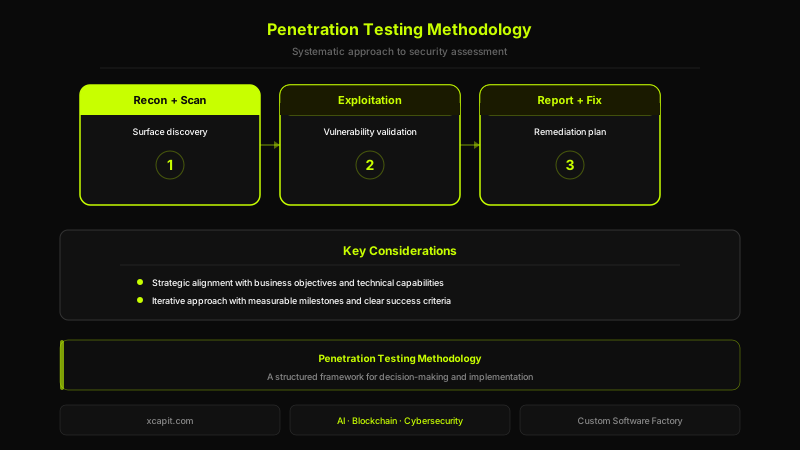
At Xcapit, our cybersecurity practice is built on real-world experience securing financial applications. We built XNinja, our automated penetration testing platform, which integrates 8 security tools with AI-powered analysis and supports 5 compliance frameworks including PCI DSS and SOC 2. As an ISO 27001 certified company, we apply the same rigorous security standards to our client engagements that we maintain for our own products. Whether you need a focused assessment of a specific application or a comprehensive security program, we bring the financial domain expertise that generic security firms lack.

Fernando Boiero
CTO & Co-Founder
Over 20 years in the tech industry. Founder and director of Blockchain Lab, university professor, and certified PMP. Expert and thought leader in cybersecurity, blockchain, and artificial intelligence.
Building regulated financial products?
From digital wallets to tokenized collateral and secure platforms, we build fintech systems designed for production.
You Might Also Like
Why Vulnerability Scanners Don't Replace a Pentest — and How AI Changes the Equation
Scanners like Nuclei and ZAP detect known CVEs but miss the vulnerabilities that actually get companies breached: IDOR, privilege escalation, race conditions, and business logic flaws. This article explains why, shows benchmark data (47 findings vs 0), and introduces a third option: AI-driven pentesting that reasons like a human attacker at scanner speed and cost.
Shielding credit risk: how Web3 technology simplifies bank and guarantee society processes in agriculture
Autonomous collateral locking, real-time value monitoring and guaranteed algorithmic execution: the three tools reshaping risk analysis in agricultural credit.
Programmable guarantees: what we learned deploying smart contracts in the real financial system
From our work with Banco Industrial and a leading fintech to the mutual guarantee ecosystem: how smart contracts shield credit risk and cut guarantee issuance from weeks to minutes.