
The energy sector's digital transformation is accelerating at an unprecedented pace. Driven by the urgency of climate targets, the growth of distributed energy resources, and aging infrastructure that can no longer meet modern demands, energy companies are turning to custom software to solve problems that off-the-shelf solutions were never designed to address.
From smart grid management and energy tokenization to IoT-enabled predictive maintenance and ESG reporting platforms, the opportunities for software-driven innovation in energy are vast. But the sector also presents unique challenges — real-time requirements measured in milliseconds, decades-old legacy systems that cannot be replaced overnight, strict regulatory compliance, and physical assets distributed across thousands of locations. This guide explores how custom software can meet these challenges head-on.
Why Energy Needs Custom Software
The energy industry operates under constraints that make generic software solutions inadequate for many core operations. Understanding these constraints is essential for designing effective solutions.
Legacy system integration is perhaps the most pervasive challenge. Many utilities run on SCADA systems, energy management platforms, and billing systems that were deployed decades ago. These systems were built for a centralized, one-directional energy model and cannot natively support the bidirectional flows, distributed generation, and real-time market dynamics of modern grids. Custom software bridges this gap by creating integration layers that extend legacy system capabilities without requiring full replacement.
Real-time operational requirements set energy apart from most industries. Grid management decisions must happen in milliseconds. Demand response signals must propagate in seconds. Market clearing prices update in minutes. These timing constraints demand purpose-built software architectures optimized for low latency and high reliability, not general-purpose business applications.
Regulatory compliance in energy is complex and jurisdiction-specific. From NERC CIP standards for critical infrastructure protection to state-level renewable portfolio standards and carbon reporting mandates, energy companies navigate a web of requirements that varies by geography, market segment, and asset type. Custom software can encode these requirements into operational workflows rather than relying on manual compliance processes.
Distributed asset management presents a scale challenge unique to utilities. A single distribution company may manage hundreds of substations, thousands of transformers, and millions of meters across a vast service territory. Software must handle this geographic distribution while maintaining centralized visibility and control.
Smart Grid Management
The transition from traditional grids to smart grids represents one of the most significant infrastructure modernizations in history. Custom software is the enabling layer that makes smart grid capabilities possible.
Real-Time Monitoring
Modern smart grid monitoring goes far beyond traditional SCADA displays. Custom monitoring platforms aggregate data from thousands of sensors, smart meters, weather stations, and market feeds into unified operational dashboards. These systems process millions of data points per second to provide operators with real-time visibility into grid health, power quality, fault detection, and capacity utilization.
Advanced monitoring platforms incorporate geospatial visualization, allowing operators to see grid conditions mapped to physical infrastructure. When a fault occurs, the system can immediately identify the affected area, estimate the number of impacted customers, and recommend switching actions — all within seconds of the event.
Demand Forecasting with AI
Accurate demand forecasting is critical for grid stability and economic dispatch. Machine learning models trained on historical load data, weather patterns, economic indicators, and calendar events can predict demand with significantly greater accuracy than traditional statistical methods. These models capture complex nonlinear relationships — such as the interaction between temperature, humidity, and time of day — that conventional forecasting approaches miss.
Short-term forecasting over minutes to hours supports real-time operations and automatic generation control. Medium-term forecasting over days to weeks informs unit commitment and maintenance scheduling. Long-term forecasting over months to years drives capacity planning and capital investment decisions. Custom AI solutions can be tailored to each utility's specific load characteristics, geography, and generation mix.
Load Balancing
As distributed energy resources like rooftop solar, battery storage, and electric vehicles proliferate, load balancing becomes exponentially more complex. Custom software enables intelligent load management through automated demand response programs that adjust consumption in response to grid conditions, virtual power plant aggregation that coordinates thousands of distributed resources as a single dispatchable asset, and dynamic tariff engines that use price signals to shape demand patterns.
These systems must operate autonomously under normal conditions while providing operators with override capabilities during abnormal situations. The software must balance multiple objectives simultaneously — grid reliability, cost minimization, renewable integration, and customer satisfaction.
Integration with Renewable Sources
Integrating variable renewable generation — solar and wind — into grid operations requires sophisticated forecasting and control systems. Custom software models the intermittency of renewable output, coordinates with storage assets to smooth variability, and manages ramp rates to maintain grid frequency within regulatory limits.
Advanced renewable integration platforms also manage curtailment decisions when generation exceeds demand, optimize the dispatch of hybrid renewable-plus-storage installations, and calculate the economic value of renewable energy certificates for trading and compliance purposes.
Energy Tokenization and Trading
Blockchain technology is creating new possibilities for how energy is produced, traded, and consumed. Energy tokenization transforms physical energy assets and attributes into digital tokens that can be tracked, traded, and verified with unprecedented transparency.
What Is Energy Tokenization
Energy tokenization represents a unit of energy production, consumption, or environmental attribute as a digital token on a blockchain. Each token carries verifiable metadata — the source of generation, the time of production, the carbon intensity, and relevant certifications. This creates an immutable, auditable record of energy provenance that supports regulatory compliance, voluntary sustainability commitments, and market trading.
Unlike traditional energy certificates that are tracked through centralized registries with limited transparency, tokenized energy attributes can be verified by any participant, traded fractionally, and settled in real time. This opens energy markets to smaller participants and enables new business models like community solar programs and corporate power purchase agreements with granular matching.
Peer-to-Peer Trading Platforms
Peer-to-peer energy trading platforms allow prosumers — consumers who also produce energy — to sell surplus generation directly to neighbors or local businesses. Custom software for P2P energy trading must handle real-time metering data integration, automated matching of supply and demand, smart contract-based settlement, and regulatory compliance with local energy market rules.
These platforms democratize energy markets by removing intermediaries and giving consumers agency over their energy choices. They also support grid efficiency by incentivizing local energy consumption, reducing transmission losses, and rewarding flexible demand.
Carbon Credit Management
As carbon markets mature and corporate net-zero commitments become binding, the demand for transparent, verifiable carbon credit management is growing rapidly. Custom software platforms can automate the lifecycle of carbon credits from generation through retirement — measuring emissions reductions from specific projects, issuing credits according to recognized standards, tracking ownership through trading, and ensuring credits are properly retired against offset claims.
Blockchain-based carbon credit platforms provide the transparency and double-counting prevention that traditional registries struggle to deliver. Every credit's history is publicly verifiable, making greenwashing significantly more difficult and giving buyers confidence in the integrity of their offsets.
Xcapit's EPEC Energy Project
Xcapit has direct experience in energy tokenization through our work with EPEC, the public energy company of Cordoba, Argentina. This project demonstrated how blockchain technology can be applied to energy distribution and management in a real-world utility context. The platform enabled transparent tracking of energy generation and distribution, creating an auditable record that supports both operational efficiency and regulatory compliance. For the full details, read our EPEC energy tokenization case study.
IoT and SCADA Integration
The convergence of operational technology (OT) and information technology (IT) is reshaping how energy companies manage their physical infrastructure. Custom software plays a critical role in bridging these traditionally separate domains.
Sensor Data Collection
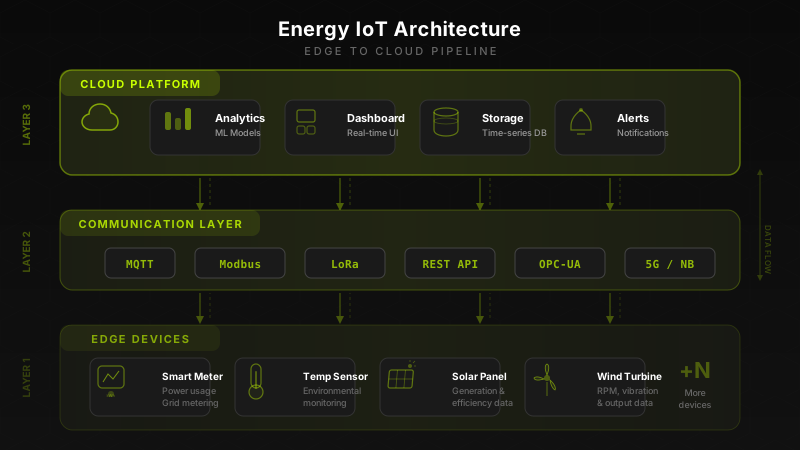
Modern energy infrastructure generates enormous volumes of sensor data — voltage measurements, current flows, temperature readings, vibration data, oil quality indicators, and environmental conditions. Custom data collection platforms must handle high-frequency sampling from thousands of sources, normalize data from diverse sensor types and protocols, and deliver it to analytics systems with minimal latency.
The challenge is not just volume but variety. Energy assets communicate through dozens of industrial protocols including Modbus, DNP3, IEC 61850, and OPC-UA. Custom integration software provides a unified data layer that abstracts protocol differences and presents a consistent interface to upstream applications.
Edge Computing
Not all data can or should be transmitted to centralized systems. Edge computing places processing capability at or near the physical assets, enabling real-time decisions without depending on network connectivity. For energy companies, edge computing supports local protection and control logic that must execute in milliseconds, data filtering and aggregation that reduces bandwidth requirements by orders of magnitude, local analytics for immediate anomaly detection and alerting, and autonomous operation during communication outages.
Custom edge computing solutions must be designed for the harsh environments where energy assets operate — extreme temperatures, limited power budgets, and unreliable connectivity. They must also be remotely manageable and securely updatable across potentially thousands of deployment points.
SCADA Modernization
Many utilities run SCADA systems that are 15 to 25 years old. Full replacement is prohibitively expensive and operationally risky. A more practical approach is SCADA modernization through custom software that wraps legacy systems with modern interfaces, adds new capabilities like advanced visualization and AI-driven analytics, and gradually migrates functionality to modern architectures.
Modern SCADA overlays can provide web-based interfaces accessible from any device, role-based access control that meets current cybersecurity standards, integration with enterprise systems like ERP and asset management, and APIs that enable third-party analytics and application development. This approach extends the life of proven control systems while delivering the user experience and connectivity that modern operations demand.
Predictive Maintenance
Predictive maintenance represents one of the highest-ROI applications of IoT and AI in the energy sector. By analyzing sensor data patterns, machine learning models can predict equipment failures days or weeks before they occur, enabling planned maintenance that is dramatically cheaper and less disruptive than emergency repairs.
Custom predictive maintenance platforms for energy assets typically monitor transformer oil dissolved gas analysis for incipient faults, vibration signatures on rotating equipment for bearing degradation, partial discharge patterns in switchgear and cables for insulation breakdown, and thermal imaging data for connection hot spots. These systems reduce unplanned outages, extend asset lifecycles, and optimize maintenance crew deployment — delivering measurable improvements in both reliability and cost efficiency.
Sustainability and ESG Platforms
Environmental, social, and governance reporting has moved from a nice-to-have to a regulatory and investor requirement for energy companies. Custom software platforms automate the data collection, calculation, and reporting processes that ESG compliance demands.
Carbon Footprint Tracking
Accurate carbon footprint measurement requires integrating data from multiple sources — generation fleet emissions, purchased power carbon intensity, fleet vehicle fuel consumption, facility energy use, and supply chain emissions. Custom platforms automate this data collection and apply recognized calculation methodologies such as the GHG Protocol to produce Scope 1, 2, and 3 emissions inventories.
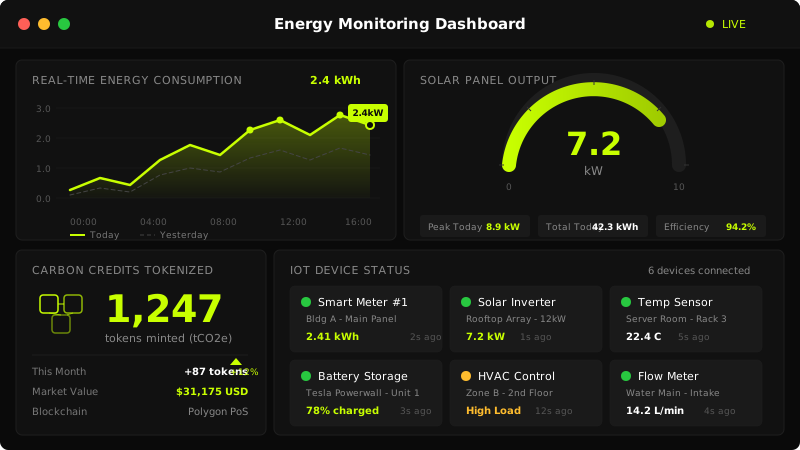
Advanced carbon tracking platforms go beyond annual reporting to provide real-time emissions dashboards that support operational decision-making. Operators can see the carbon intensity of their generation dispatch in real time and factor emissions costs into economic optimization alongside fuel costs and market prices.
ESG Reporting Automation
Energy companies must report to multiple frameworks — GRI, SASB, TCFD, CDP, and increasingly the ISSB standards. Each framework requires different metrics, different calculation methodologies, and different reporting formats. Custom ESG platforms map data elements to multiple frameworks simultaneously, automate calculations, and generate reports in the required formats.
Automation eliminates the spreadsheet-based processes that most companies still use for ESG reporting, reducing errors, improving auditability, and freeing sustainability teams to focus on strategy rather than data wrangling. As reporting requirements continue to expand, automated platforms scale without proportional increases in headcount.
Renewable Energy Certificate Management
Renewable Energy Certificates (RECs) are the primary mechanism for tracking and trading renewable energy attributes. Custom software platforms manage the full REC lifecycle — generation tracking from metered production data, registration with appropriate tracking systems, trading and transfer, and retirement against voluntary or compliance obligations.
For companies with large renewable portfolios or significant REC purchasing programs, custom platforms provide portfolio optimization, automated matching of generation to load for 24/7 clean energy claims, and integration with wholesale energy trading systems.
Technology Stack Considerations
Building software for the energy sector requires careful technology choices that reflect the industry's unique requirements.
- Time-series databases: Energy data is inherently time-series in nature. Databases like TimescaleDB, InfluxDB, or Apache IoTDB are purpose-built for the high-write, time-range-query workloads that energy applications generate. Relational databases struggle with the volume and query patterns of sensor data.
- Event-driven architectures: Energy systems are event-driven — faults occur, demand changes, prices update, and weather shifts. Apache Kafka or similar event streaming platforms provide the backbone for real-time data pipelines that connect sensors, analytics, and control systems with low latency and high reliability.
- Real-time processing frameworks: Apache Flink, Spark Streaming, or custom stream processing solutions enable real-time analytics on high-velocity data streams. These frameworks support windowed aggregations, pattern detection, and complex event processing that energy applications require.
- Edge computing platforms: Lightweight runtimes like Azure IoT Edge, AWS Greengrass, or custom containerized solutions enable processing at remote asset locations. These platforms must support offline operation, secure remote management, and efficient use of limited computing resources.
- Industrial protocol libraries: Integration with SCADA and field devices requires support for Modbus TCP/RTU, DNP3, IEC 61850, OPC-UA, and MQTT. Libraries and protocol adapters that handle the nuances of these industrial protocols are essential components of any energy software stack.
- Geospatial capabilities: Energy infrastructure is inherently geographic. PostGIS, Mapbox, or similar geospatial tools support network modeling, outage mapping, asset visualization, and service territory management.
Case Study: EPEC Energy Tokenization
Xcapit's work with EPEC, the public energy company of Cordoba province in Argentina, demonstrates how blockchain and custom software can transform energy operations. The project applied tokenization technology to energy distribution, creating a transparent and auditable system for tracking energy generation, distribution, and consumption.
The platform leveraged blockchain to ensure data integrity and provide all stakeholders — the utility, regulators, and consumers — with a shared, tamper-proof record of energy transactions. This level of transparency supports regulatory compliance, reduces disputes, and lays the foundation for more advanced applications like peer-to-peer trading and dynamic pricing.
The EPEC project is a concrete example of how custom software, combined with emerging technologies like blockchain, can address the specific challenges of the energy sector. For the full technical details and outcomes, read our EPEC energy tokenization case study.
Getting Started with Energy Software
Digital transformation in the energy sector does not require a big-bang approach. The most successful implementations start with a focused use case — a single operational pain point where custom software can deliver measurable value. Whether it is predictive maintenance for a critical asset class, a demand forecasting model for a specific service territory, or an ESG reporting platform to meet upcoming regulatory deadlines, starting small builds organizational confidence and technical capability.
The key is choosing a starting point that is operationally significant enough to demonstrate value but scoped tightly enough to deliver results within three to six months. Success with the first project creates momentum for broader digital transformation.
At Xcapit, we bring proven experience in energy sector software development, including our work on the EPEC energy tokenization project. Our team combines expertise in IoT integration, blockchain, AI, and cybersecurity — the core technologies driving energy industry transformation. We understand the unique challenges of building software for critical infrastructure: the reliability requirements, the legacy integration complexity, and the regulatory landscape. If you are exploring digital transformation for your energy or utility operations, we would welcome the opportunity to discuss how custom software can address your specific challenges. Learn more about our energy solutions or contact us to start the conversation.

Santiago Villarruel
Product Manager
Industrial engineer with over 10 years of experience excelling in digital product and Web3 development. Combines technical expertise with visionary leadership to deliver impactful software solutions.
Exploring energy transformation?
See how we connect demand forecasting, transformer digital twins, traceability, and smart-grid software into a practical utility roadmap.
You Might Also Like
Digital transformation for utilities: modernizing energy without replacing the core
A practical guide for utilities and energy companies: how to integrate SCADA, IoT, AI, tokenization, and cybersecurity to modernize operations without replacing critical systems.
How Blockchain and IoT Converge to Power Smart Grids
Explore how blockchain and IoT technologies are transforming energy distribution through smart grids — enabling real-time metering, peer-to-peer energy trading, and decentralized grid management.
If you can't measure it, you can't monetize it: the Córdoba and EPEC lesson applied to environmental assets in agriculture
Measure, certify and monetize. The three pillars we validated tokenizing renewable energy with EPEC, and how they transfer to the field to standardize green credits.