
When your clients include UNICEF, energy companies, and financial institutions, information security is not a nice-to-have — it's a prerequisite. Every line of code we write, every deployment we manage, and every piece of client data we handle carries real responsibility. That's why we decided to pursue ISO/IEC 27001 certification: not because someone asked us to, but because the work we do demands it.
Why We Pursued ISO 27001
We'd been following strong security practices for years — encrypted communications, access controls, code reviews, penetration testing. But practices without a framework are inconsistent. They depend on individual knowledge and good intentions, which don't scale.
ISO 27001 gave us what we needed: a systematic, internationally recognized framework for managing information security. It's not about checking boxes — it's about building a management system that identifies risks, implements controls, and continuously improves. For a company building custom software across AI, blockchain, and cybersecurity, that level of rigor is essential.
There was also a practical reality: more clients were requiring ISO 27001 certification as a condition for working together. Government agencies, international organizations, and regulated industries increasingly expect their technology partners to demonstrate independently verified security. We wanted to meet that expectation head-on.
What ISO 27001 Actually Is
ISO/IEC 27001 is the international standard for Information Security Management Systems (ISMS). In plain terms, it's a structured way to manage the confidentiality, integrity, and availability of information across an entire organization.
The standard requires you to:
- Identify all information assets and assess their risks
- Implement security controls proportional to those risks
- Define clear policies, roles, and responsibilities for information security
- Monitor, measure, and continuously improve your security posture
- Undergo regular internal and external audits to maintain certification
It covers everything from how you handle passwords and encrypt data to how you onboard employees, manage suppliers, and respond to security incidents. The framework includes 93 controls organized across four domains: organizational, people, physical, and technological.
What makes ISO 27001 powerful is that it's risk-based rather than prescriptive. It doesn't tell you exactly what firewall to use — it requires you to assess your specific risks and implement appropriate controls. This makes it applicable to organizations of any size or industry.
Our Certification Journey
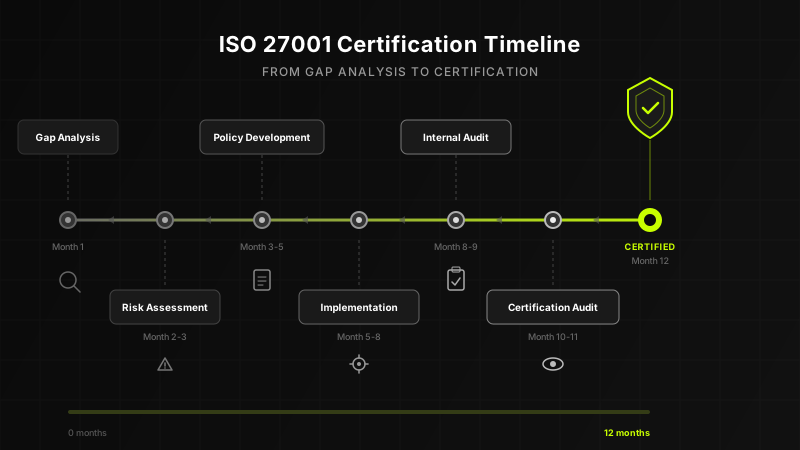
The path from decision to certification took approximately eight months. Here's what each phase looked like.
Gap Analysis and Initial Assessment
We started by mapping our existing security practices against the ISO 27001 requirements. The good news: many controls were already in place — we had secure development practices, access management, and incident response procedures. The gaps were mainly in formal documentation, risk assessment methodology, and some areas of physical security and supplier management.
Building the ISMS
This was the most intensive phase. We developed our Information Security Management System from the ground up: a comprehensive risk assessment covering all information assets, a risk treatment plan with specific controls for each identified risk, security policies covering 15+ areas from acceptable use to business continuity, and documented procedures for everything from access provisioning to incident response.
The key was making the ISMS practical, not bureaucratic. Every policy had to reflect how we actually work, not how a template says we should work. We adapted the framework to our reality as a distributed software development company.
Training the Team
ISO 27001 explicitly requires that everyone in the organization understands their security responsibilities. We ran training sessions covering information security fundamentals, our specific policies and procedures, secure development practices, phishing awareness and social engineering, and incident reporting procedures.
This was one of the most valuable parts of the process. Security knowledge that had been concentrated in a few people became shared across the entire team. Developers, designers, project managers — everyone understood their role in protecting information.
Internal Audits and Corrective Actions
Before the official certification audit, we conducted internal audits to test our ISMS against the standard's requirements. This uncovered several areas needing improvement: some documentation gaps, a few controls that existed in practice but weren't properly evidenced, and training records that needed to be formalized.
We addressed each finding with corrective actions and verified their effectiveness. This iterative process of audit-fix-verify is actually the core of ISO 27001 — the standard assumes you'll find issues and expects you to have a system for addressing them.
The Official IRAM Audit
IRAM (Instituto Argentino de Normalización y Certificación) conducted our certification audit in two stages. Stage 1 reviewed our documentation and ISMS design. Stage 2 was the full on-site audit — interviews with team members, review of evidence, and verification that our controls were operating effectively.
The audit was thorough and constructive. The auditors challenged our assumptions, tested our incident response procedures, and verified that security was embedded in our daily operations rather than existing only on paper. We passed with zero non-conformities.
IQNet International Recognition
Because IRAM is a member of IQNet, our certification is automatically recognized internationally across more than 30 countries. This means our ISO 27001 certification carries weight whether we're working with clients in Latin America, the United States, Europe, or anywhere else. It's a single certification with global reach.
Lessons Learned
Eight months of certification work taught us more than any textbook could. Here are our honest takeaways.
It's a Cultural Shift, Not Just Documentation
The biggest misconception about ISO 27001 is that it's a documentation exercise. It's not. The documentation is a means to an end. The real change is cultural: every person in the organization thinking about security as part of their daily work, not as someone else's job. If you approach it as "just paperwork to get the certificate," you'll fail — or worse, you'll pass but gain nothing.
Start with What You Already Do Well
Many organizations, especially in tech, already have good security practices. The gap analysis will reveal that you're further along than you think. Build your ISMS around your existing strengths and focus energy on the actual gaps. Don't reinvent processes that already work.
Executive Buy-In Is Essential
ISO 27001 requires top management commitment — and the standard means it. Leadership must define the security policy, allocate resources, review the ISMS performance, and visibly support the initiative. Without genuine executive buy-in, the certification effort stalls. In our case, security was already a founding principle, which made this natural.
The ROI Is Real
Beyond the certificate itself, the process delivered tangible benefits: clearer internal processes, better documentation, stronger supplier management, improved incident response, and a shared security language across the team. We also saw immediate commercial impact — the certification opened doors to opportunities that required ISO 27001 as a prerequisite.
What This Means for Our Clients
For the organizations that trust us with their software development, our ISO 27001 certification provides concrete assurances.
- Proven security controls protect client data throughout the development lifecycle — from requirements gathering to deployment and maintenance
- A structured incident response process means that if something goes wrong, we have a tested plan to contain, investigate, and resolve it quickly
- Regular internal and external audits ensure our security posture doesn't degrade over time — continuous compliance, not a one-time effort
- International recognition through IQNet means the certification meets the same standard whether you're in Buenos Aires, Lima, Miami, or Berlin
- Supplier management controls ensure that third-party tools and services we use also meet security requirements
In practical terms, this means our clients can point to an independent, internationally recognized certification when their own auditors, regulators, or stakeholders ask about the security practices of their technology partners.
How We Can Help You Get Certified
Going through ISO 27001 certification ourselves gave us something that most consultants lack: firsthand experience. We didn't just read the standard — we implemented it, lived it, and passed the audit. That practical knowledge is now available to our clients.
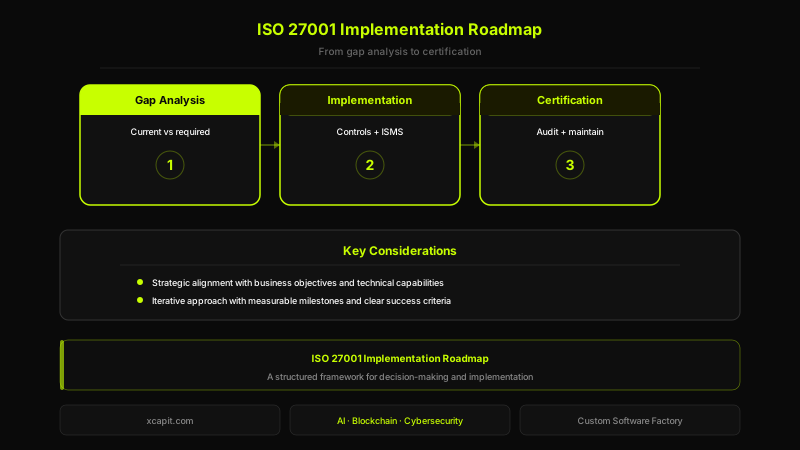
Our cybersecurity team offers ISO 27001 consulting services covering the full journey:
- Gap analysis to assess your current security posture against ISO 27001 requirements
- ISMS design and implementation tailored to your organization's size, industry, and risk profile
- Risk assessment methodology and risk treatment planning
- Policy and procedure development that's practical, not just compliant
- Team training and security awareness programs
- Internal audit support and corrective action guidance
- Audit preparation and accompaniment through the certification process
We also integrate cybersecurity into the software we build — secure development practices, vulnerability assessments, penetration testing, and security architecture design. Whether you need the certification, the security practices, or both, we can help.
Ready to start your ISO 27001 journey? Visit our cybersecurity services page to learn more, or check our ISO 27001 certification page for details about our own certification. Contact us to discuss how we can help your organization achieve and maintain ISO 27001 certification.

Fernando Boiero
CTO & Co-Founder
Over 20 years in the tech industry. Founder and director of Blockchain Lab, university professor, and certified PMP. Expert and thought leader in cybersecurity, blockchain, and artificial intelligence.
Need a security partner you can trust?
Pentesting, ISO 27001, SOC 2 — we secure your systems.
You Might Also Like
Programmable guarantees: what we learned deploying smart contracts in the real financial system
From our work with Banco Industrial and a leading fintech to the mutual guarantee ecosystem: how smart contracts shield credit risk and cut guarantee issuance from weeks to minutes.
Digital transformation for utilities: modernizing energy without replacing the core
A practical guide for utilities and energy companies: how to integrate SCADA, IoT, AI, tokenization, and cybersecurity to modernize operations without replacing critical systems.
Caracas, Fe y Alegría and blockchain: direct aid to 30 educators with no middlemen, no friction
Under the UNICEF Venture Fund, Xcapit and Fe y Alegría delivered $3,000 USDT to 30 teachers in Caracas via SMS wallet and FORUM supermarkets. 100% operational success rate, 5/5 satisfaction, and 94% spent on food. The story of a pilot that proved technology can become invisible — and leave only dignity behind.