

In fintech, compliance is not an afterthought — it is the architecture. Every design decision, from database schema to API endpoint, carries regulatory implications. Financial software that treats compliance as a last-mile checkbox inevitably faces costly rewrites, failed audits, and delayed launches. The companies that ship faster and scale more confidently are the ones that embed regulatory requirements into their development process from day one.
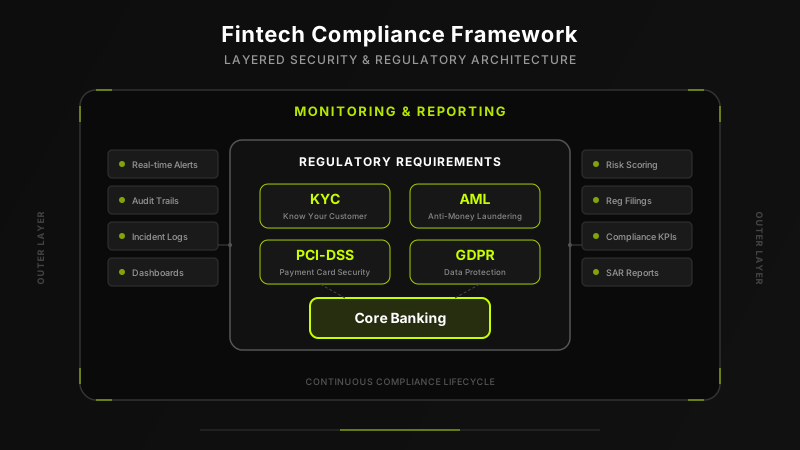
This guide provides a practical framework for building fintech software with compliance at its core. Whether you are developing a payment platform, a neobank, a lending application, or a wealth management tool, the principles here will help you navigate the regulatory landscape without sacrificing development velocity.
The Regulatory Landscape in 2025
The regulatory environment for financial technology has grown significantly more complex over the past few years, but it has also become more standardized. Understanding the key frameworks is essential before writing a single line of code.
PCI DSS 4.0 is now the enforced standard for any application that processes, stores, or transmits cardholder data. The updated requirements place greater emphasis on continuous monitoring, customized security approaches, and stronger authentication mechanisms. Organizations must demonstrate not just point-in-time compliance but ongoing security posture management.
SOC 2 Type II certification has become a de facto requirement for B2B fintech companies. Clients and partners increasingly require evidence that your systems meet the Trust Services Criteria for security, availability, processing integrity, confidentiality, and privacy. Planning for SOC 2 from the start means building the logging, access controls, and change management processes that auditors will scrutinize.
AML and KYC regulations continue to tighten globally. The sixth Anti-Money Laundering Directive in the EU, FinCEN requirements in the United States, and equivalent frameworks across Latin America and Asia-Pacific all demand robust identity verification, transaction monitoring, and suspicious activity reporting. Cross-border operations face the added challenge of reconciling different national requirements.
GDPR and its regional equivalents — Brazil's LGPD, Argentina's PDPA updates, and California's CCPA/CPRA — impose strict rules on how personal and financial data is collected, processed, stored, and deleted. Data residency requirements increasingly dictate infrastructure decisions.
Open banking directives, including PSD2 in Europe, Open Finance regulations in Brazil, and emerging frameworks in other markets, mandate secure API access to banking data with explicit consumer consent. These regulations create both opportunities and obligations for fintech developers.
Compliance-First Architecture
A compliance-first architecture does not mean a slower or more rigid system. It means making intentional design choices early that prevent expensive rework later. The following architectural pillars form the foundation of any compliant fintech system.
Data Classification
Before designing your data model, classify every data element your system will handle. At minimum, establish four tiers: public data that carries no sensitivity, internal data for operational use, confidential data including PII and financial records, and restricted data such as cardholder data, authentication credentials, and encryption keys.
Each classification tier should map to specific handling rules: storage encryption requirements, access control policies, retention periods, and deletion procedures. This classification becomes the backbone of your data governance and simplifies compliance audits because you can demonstrate exactly how each data type is protected.
Encryption Strategy
Fintech applications require encryption at multiple layers. Data at rest must use AES-256 or equivalent encryption, with key management through a dedicated service such as AWS KMS, Azure Key Vault, or HashiCorp Vault. Data in transit requires TLS 1.3 for all communications, with certificate pinning for mobile applications and mutual TLS for service-to-service communication.
Field-level encryption adds an additional layer for the most sensitive data elements — account numbers, social security numbers, and authentication tokens should be encrypted at the application layer before reaching the database. This approach means that even database administrators cannot access plaintext sensitive data without explicit key access.
Audit Trail Design
Every regulatory framework requires comprehensive audit trails, yet many teams treat logging as an afterthought. Design your audit system as a first-class architectural component. Every state change, access event, and administrative action should produce an immutable, timestamped record that captures who performed the action, what changed, when it occurred, and from where the request originated.
Use append-only data stores or write-once storage for audit logs. Implement cryptographic chaining or hash verification to detect tampering. Ensure logs are retained according to regulatory requirements — typically five to seven years for financial records — and that they can be queried efficiently during audits.
Identity and Access Management
Implement role-based access control (RBAC) with the principle of least privilege from the start. Every service, every API endpoint, and every database query should enforce access policies. Use centralized identity providers with multi-factor authentication for all internal access. Implement just-in-time access provisioning for elevated privileges, with automatic expiration and comprehensive logging.
For customer-facing authentication, support modern standards including FIDO2/WebAuthn for passwordless authentication, adaptive MFA that escalates requirements based on risk signals, and session management that meets PCI DSS requirements for timeout and re-authentication.
PCI DSS Requirements for Software
If your fintech application handles payment card data in any form, PCI DSS compliance is mandatory. PCI DSS 4.0 introduces several requirements that directly impact software architecture and development practices.
- Network segmentation: Isolate the cardholder data environment (CDE) from all other systems. Use network policies, service meshes, or dedicated VPCs to enforce boundaries. Every connection into the CDE must be explicitly justified and monitored.
- Tokenization over storage: Wherever possible, replace cardholder data with tokens. Use payment processors that provide tokenization services so that your application never handles raw card numbers. This dramatically reduces your PCI scope.
- Strong cryptography: All stored cardholder data must be encrypted with industry-accepted algorithms. Key rotation must be automated and documented. Split knowledge and dual control procedures are required for key management.
- Vulnerability management: Implement automated vulnerability scanning for all system components. Critical vulnerabilities must be patched within 30 days. Application code must undergo secure code review or static analysis before deployment.
- Access monitoring: Log and monitor all access to cardholder data. Implement automated alerting for suspicious patterns. Review logs daily — either manually or through automated anomaly detection.
- Secure development lifecycle: PCI DSS 4.0 requires a formal secure development lifecycle that includes security training for developers, threat modeling for new features, and security testing as part of the CI/CD pipeline.
- Customized approach: PCI DSS 4.0 allows organizations to meet objectives through customized controls rather than prescribed methods. This flexibility is valuable but requires thorough documentation of how your controls meet each requirement's intent.
AML/KYC Integration Patterns
Anti-money laundering and know-your-customer requirements are among the most operationally complex aspects of fintech compliance. The key is designing flexible integration patterns that can adapt as regulations evolve.
Identity Verification Flows
Modern KYC requires a multi-layered approach to identity verification. Design your onboarding flow to support document verification through OCR and liveness detection, database checks against government identity registries, biometric matching for ongoing authentication, and risk-based tiering that adjusts verification depth based on the customer's intended activity level.
Build your verification pipeline as an orchestration layer that can integrate with multiple identity providers. Regulations and provider capabilities change frequently, so your architecture should allow swapping or adding providers without modifying core business logic. Store verification results and evidence separately from customer data to support audit requirements.
Transaction Monitoring
Transaction monitoring systems must operate in real time or near-real time to detect suspicious patterns. Design your monitoring as an event-driven pipeline that evaluates every transaction against configurable rule sets. Rules should cover velocity checks, geographic anomalies, structuring patterns, unusual counterparty relationships, and deviations from established customer behavior profiles.
Machine learning models can significantly improve detection accuracy by identifying complex patterns that rule-based systems miss. However, regulators require explainability — you must be able to articulate why a transaction was flagged. Hybrid approaches that combine ML scoring with rule-based triggers provide both detection power and auditability.
Suspicious Activity Reporting
When your monitoring system identifies potentially suspicious activity, your software must support a structured investigation and reporting workflow. Design case management functionality that allows compliance officers to review flagged transactions, document their analysis, and file Suspicious Activity Reports (SARs) or equivalent filings with the appropriate regulatory body.
Critically, SAR filing must be confidential — the subject of the report must not be notified. Your system's access controls and notification logic must enforce this tipping-off prohibition at the technical level, not just through policy.
Sanctions Screening
Every customer, counterparty, and beneficiary must be screened against sanctions lists including OFAC's SDN list, EU consolidated sanctions, UN Security Council lists, and relevant national lists. Screening must occur at onboarding, at transaction time, and whenever lists are updated. Implement fuzzy matching algorithms that catch name variations, transliterations, and common evasion techniques. Maintain an audit trail of every screening event and its result.
Open Banking and API Security
Open banking creates tremendous opportunities for fintech applications but introduces specific security and compliance requirements around API design, authentication, and data handling.
API Gateway Design
Your API gateway is the enforcement point for open banking security policies. It should handle rate limiting, request validation, certificate management, and client authentication. Deploy the gateway in a high-availability configuration with comprehensive logging of all API calls. Implement circuit breakers and fallback mechanisms to maintain service reliability.
For regulated APIs, the gateway must also enforce consent verification — ensuring that every data request is backed by a valid, unexpired customer consent. This consent check must happen on every request, not just at initial authorization.
OAuth 2.0 and FAPI
Open banking APIs require implementation of the Financial-grade API (FAPI) security profile, which builds on OAuth 2.0 with additional protections. FAPI mandates the use of Proof Key for Code Exchange (PKCE), mutual TLS or private key JWT for client authentication, signed request objects to prevent parameter tampering, and sender-constrained access tokens.
Implement these requirements using a certified FAPI-compliant authorization server. Avoid building your own OAuth implementation — the attack surface is too large and the specifications too complex for custom implementations to be reliably secure.
Consent Management
Consent management is the cornerstone of open banking compliance. Your system must record exactly what data the customer consented to share, with whom, for what purpose, and for how long. Customers must be able to view their active consents, modify scope, and revoke consent at any time with immediate effect.
Design your consent data model to be granular — customers should be able to consent to account balance access without consenting to transaction history, for example. Store consent records immutably for audit purposes while respecting the customer's right to revoke ongoing data sharing.
Data Minimization
Open banking regulations and GDPR both require data minimization — collecting and retaining only the data necessary for the stated purpose. Design your APIs to return only the fields required by the consuming application. Implement data retention policies that automatically purge data when the consent period expires or the business purpose is fulfilled. This principle should be enforced at the technical level through API response filtering and automated data lifecycle management.
Testing for Compliance
Compliance testing goes beyond functional and security testing. It requires validating that your software meets specific regulatory requirements under realistic conditions.
- Penetration testing: Conduct annual penetration tests and after significant changes. Engage testers with fintech experience who understand financial attack vectors, not just generic web application testing.
- Static application security testing (SAST): Integrate static analysis into your CI/CD pipeline to catch vulnerabilities before they reach production. Configure rules specific to financial regulations, such as detecting hardcoded credentials or unencrypted sensitive data.
- Dynamic application security testing (DAST): Run automated scans against running environments to identify runtime vulnerabilities including injection flaws, authentication weaknesses, and configuration errors.
- Compliance validation: Build automated tests that verify regulatory requirements are met. Test that audit logs capture required events, that data retention policies are enforced, that access controls prevent unauthorized access, and that encryption is applied correctly.
- Disaster recovery testing: Regulators require demonstrated ability to recover from failures. Test your backup and recovery procedures quarterly, document recovery times, and validate that no data is lost during failover.
- Audit preparation: Maintain a living evidence library that maps each regulatory requirement to its implementation, test results, and supporting documentation. Automating evidence collection reduces the operational burden of audits from weeks to days.
Common Mistakes in Fintech Development
After years of building fintech software, we have observed several recurring mistakes that delay launches, increase costs, and create regulatory risk.
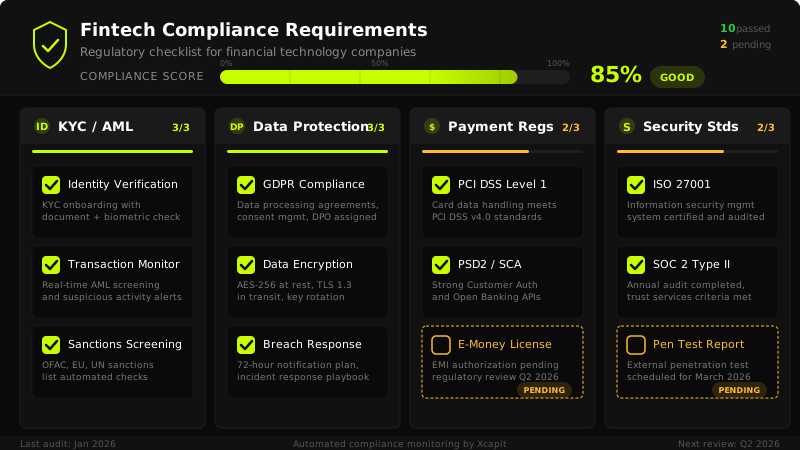
- Treating compliance as a checkbox: Teams that view compliance as a list of items to check off at the end of development invariably discover that their architecture cannot support requirements they did not design for. Retrofitting compliance is three to five times more expensive than building it in.
- Hard-coding regulatory rules: Regulations change. Hard-coding thresholds, rule parameters, and reporting formats directly into application logic makes updates slow and error-prone. Use externalized configuration and rules engines that compliance teams can update without code deployments.
- Ignoring data residency requirements: Many fintech companies discover too late that certain markets require customer data to remain within national borders. Design your infrastructure for data residency from the start, using regional deployments and data routing that respects jurisdictional requirements.
- No incident response plan: Regulators do not just care about preventing breaches — they care about how you respond to them. Financial regulators typically require breach notification within 24 to 72 hours. Without a tested incident response plan, organizations waste critical hours during incidents figuring out processes instead of executing them.
- Insufficient logging and monitoring: Many teams implement basic application logging but fail to capture the security and compliance events that regulators and auditors require. Define your logging requirements based on regulatory mandates before building your logging infrastructure.
- Overlooking third-party risk: Your compliance extends to your vendors and service providers. Evaluate the compliance posture of every third party that handles customer data or participates in transaction processing. Maintain documented due diligence records and contractual security requirements.
The Business Case for Compliance-First
Building with compliance in mind from the start is not just a regulatory necessity — it is a competitive advantage. Organizations that adopt a compliance-first approach consistently achieve faster audit cycles, often completing SOC 2 and PCI DSS audits in weeks rather than months because evidence is already organized and controls are already documented.
Client trust accelerates when you can demonstrate mature compliance practices from the first sales conversation. Enterprise clients and financial institution partners evaluate vendors heavily on their security and compliance posture. Being able to share audit reports, certifications, and documented security practices shortens sales cycles and opens doors to larger contracts.
Regulatory readiness becomes a market differentiator as fintech regulations continue to evolve. Companies with flexible, well-architected compliance frameworks can enter new markets faster because adapting to new regulatory requirements is a configuration change rather than an architectural overhaul. This agility translates directly to revenue opportunities.
Finally, compliance-first development reduces total cost of ownership. The initial investment in proper architecture, testing, and documentation pays for itself many times over by eliminating emergency remediation, audit findings, and the engineering hours spent retrofitting compliance into systems that were not designed for it.
Getting Started
The path to compliant fintech software begins with understanding your specific regulatory obligations based on your markets, products, and customer segments. From there, map those obligations to architectural requirements before starting development.
At Xcapit, we specialize in building fintech software where compliance is part of the foundation, not an add-on. Our team holds ISO 27001 certification and has deep experience with PCI DSS, AML/KYC, and open banking requirements across Latin American, European, and North American markets. We combine regulatory expertise with modern development practices to deliver software that is both compliant and fast to market. If you are building a financial product and need a development partner who understands the regulatory landscape, explore our fintech solutions at /services/custom-software or contact us to discuss your project.

Antonella Perrone
COO
Previously at Deloitte, with a background in corporate finance and global business. Leader in leveraging blockchain for social good, featured speaker at UNGA78, SXSW 2024, and Republic.
Building regulated financial products?
From digital wallets to tokenized collateral and secure platforms, we build fintech systems designed for production.
You Might Also Like
Shielding credit risk: how Web3 technology simplifies bank and guarantee society processes in agriculture
Autonomous collateral locking, real-time value monitoring and guaranteed algorithmic execution: the three tools reshaping risk analysis in agricultural credit.
Agenda 2030 as a value accelerator: the hidden market behind agricultural traceability
Corporate sustainability targets are not a bureaucratic burden: they are the biggest accelerator of new markets agribusiness has seen this century. How to capture that value.
Programmable guarantees: what we learned deploying smart contracts in the real financial system
From our work with Banco Industrial and a leading fintech to the mutual guarantee ecosystem: how smart contracts shield credit risk and cut guarantee issuance from weeks to minutes.